I feel like it's only going to get worse. California has a good number of problems: housing costs, traffic, wildfires, homelessness, ... and the high tax rate you pay for the privilege of enjoying them. But I haven't seen California take meaningful steps to solve any of these. We're still in the stage of "problems are getting worse", and any solutions will take a long time to materialize.
I grew up in California. It's still a great place to live if you're rich or if you bought property in a good location a long time ago, but if neither of those are true, you're going to have a huge uphill battle. Most people in my millennial friend groups, including me, have all talked about how we'd like to leave. We're mostly still here because our families are here and good jobs are easier to find. But each year, one by one I see people I know flee to other states.
Most of California's problems go back to lack of housing and opposition to building more. Everyone wants to live in Cali for nice weather and jobs. If you stop people from building more housing your property value just keeps rising.
Property costs are high because NIMBY blocking denser housing. Traffic is bad because housing density is too low for the population. Homelessness is bad because houses are too expensive.
Wildfires and earthquakes are the only problems not self inflicted
> Wildfires and earthquakes are the only problems not self inflicted
Massive wildfires (vs small distributed fires) are the result of the policy framework that (a) prohibits preventative controlled burns (b) requires immediate containment of any new fire. The old (more flammable) undergrowth never has a chance to burn off and free up the space for (less flammable) new generation.
Trees trap carbon. When they die, trees release carbon. Unless you bury dead trees underground (e.g. as paper, furniture, etc., in deep landfills), in terms net amount of carbon capture, there's no difference between a massive forest fire, periodic controlled burns, decay, etc.
They differ in time cycles. Even a sequoia will eventually die and release its carbon back into the atmosphere.
There's this myth that forests somehow reduce carbon in the atmosphere. Left to themselves, they store carbon, but they can't capture carbon. They're carbon-neutral. If you cut them down and release the carbon, you have a one-time emission. If you plant new ones, you have a one-time carbon capture.
The only real net change to CO2 comes from:
1) Extracting dinosaur-era carbon, and releasing it.
2) How we handle our waste. Ironically, composting releases all the plant carbon eventually, while burying it underground stores some carbon away from the atmosphere.
This. The most climate-friendly way to handle forests is to actually cut parts of them down regularly (in a sustainable pace, leaving enough unaffected areas for wildlife), and use the wood for building houses and other elements which stay intact long-term.
More buildings should be constructed from wood, less from concrete, which itself causes major co2 emissions.
This strikes me as a reasonable argument. I wonder why it doesn't work for agriculture, which is regularly criticized for e.g. the carbon in livestock feed?
I agree, I do think building more housing would help. However, my point is that I don't see that happening anytime soon. We've only seen light forms of the policy changes this would require, and many haven't even passed. There's a lot of opposition to these policy changes, and they have money on their side. And even when (if) they do change, it will take some time for them to have an effect.
My age group is at the age of looking to put roots down and have children. For many of us it makes more sense to leave than to wait 10-20 years and hope things get better.
I disagree. And I’m thinking of California in particular here. There is FAR too much reliance on personal transportation. It has little capacity to support “just increasing density”. There’s nothing natural about it. It will take a very serious planning effort to transform the state.
> Increasing density will naturally decrease reliance on personal motor-vehicles because more journeys become walkable.
Only if you don't need to go to work. Which is working wonderfully in pandemic era. I can pretty much walk anywhere I could need in terms of stores and services.
But jobs, unless you work in one of those stores or services, are of course far away, not in the middle of denser housing. Tech company campus won't be between housing rows.
My town has built tons of housing over the last two decades. Offices are still in the industrial campuses farther away and all that new housing means tons of new local traffic. Uncomfortable but true.
It used to be 2 minutes and one stoplight to get to the highway. Now it is 7 stoplights and up to 15 minutes to get to the highway (from the same house).
It would be wonderful if for every new housing block there was an adjacent office complex block, so most people can walk to work, but that's not how it goes. So in practice, yes, increased housing density just means tons new traffic to fight through.
Hopefully I can just remain work from home forever!
This is probably more true than any time in the last 30 years iff remote work takes hold. Previously, it wasn’t near as likely that all workers in a household could for a 40 year career live within an easy walk of their work.
Now it’s possible (maybe) for many more people (although they’ll need larger housing units).
Forcing low density housing causes sprawl. Look at European cities which generally have cores 5-10x denser than Cali. Most of them have no such traffic problems because you don't have the whole population travelling 30 miles on roads every day
Yes. But California isn’t Europe. There’s a million factors that led to California, or America as a whole, sprawl. Probably, primarily, land is plentiful and cheap. When it is no longer possible to get cheap land then density will naturally follow.
Take New York as an example. Limited land area. Lots of money. Drove up density and has a low reliance on cars and has an ok public transportation system.
Everywhere else it’s just cheap as hell to buy land and build. California is getting to the point now that some areas are expensive and density is increasing. But its also easy for people to just move somewhere else still
Dense housing is only dense housing, if people still need to commute half an hour or more to their workplaces dense housing is only creating traffic issues.
Transport infrastructure (roads, buses, railroads, trams), housing, everyday service infrastructure (supermarkets, medical services, restaurants, haircutters) and employment infrastructure needs to be planned holistically or you're just shifting between problems - in the case of only going for denser housing, you'll lower homelessness a bit but get traffic issues in return.
And on top of that, city planning needs to take entrenched interests into account. Often enough NIMBYist complaints are founded in real fears of exploding traffic or a loss in property value - but these can be counteracted and compensated, if one is willing to.
> Why can’t you have dense office, retail and housing space (can even be in the same building)?
I'd love that too, but it's not happening. FAANG isn't building their new HQ campus into the first floor of a new apartment complex. It'll be where it'll be and we'll have to fight through ever increasing traffic to get there.
Dense housing naturally causes businesses to move closer. I don't know of any cities where a dense urban core isn't also filled with businesses and very walkable. It will naturally happen if they allow dense housing
NIMBYism regarding more housing really only pertains to metropolitan/urban areas. How come the rest of the state can’t build housing consummate to the demand?
I live in a socal suburb and there is plenty of nimbyism. Any new developments take years or get stalled indefinitely as all the nimbys who already own their home show up to complain and block everything at every turn. Because they don't want the traffic to get worse, or they don't want the community to "lose its charm" or whatever else they can think of.
Even if people are saying this, what they actually do is quite different. People in CA moving out are generally moving into other metropolitan areas or smaller cities. They're not living some kind of Stardew Valley fantasy in the fields.
That was the major selling point of the CA high-speed rail when Governor Brown originally put it on the ballot - everyone would live in one of those ever-expanding residential suburbs and then take a quick train ride into a busy urban area.
Employment. Rural areas don't have much to offer in terms of jobs other than backbreaking farm labor, and Internet access is usually way too underbuilt to support full remote work.
NIMBY is everywhere in California. For being such a liberal state it's crazy how local governments are obsessed with stopping new and denser housing from being built
Everybody says that but I have never seen a study indicating increased housing availability reduces housing price. Where I live, growth rate 22% decade over decade for the last three decades, housing prices increase directly proportional to the increase of housing quantity. That is until an area is filled at which point housing values will either skyrocket or flatten based upon desirability.
Thats the issue with your approach. Supply and demand will cause housing in an area to be knocked down and replaced with denser housing. Townhouses, apartments, skyscrapers eventually.
In some places this natural replacement cycle is feircly resisted and local governments are bent to the will of incumbents.
HN leans heavily liberal but this is one place where conservative "small government" lack of regulations works better. In liberal areas local residents will co-opt the systems for making local regulations to protect their own investments. In conservative areas it's more difficult to NIMBY your way to halt development.
I agree with most of this, but "Local control" of housing of this sort is generally a conservative phenomenon. However, the bigger effect isn't typical left-right politics but instead the class-divide of homeowners versus renters.
Self-identified liberals are more receptive to nearby apartments than self-identified conservatives.
But the bigger effect is homeowners versus those in apartments. People in apartments are far more supportive of new apartments, and homeowners are less supportive, and this effect is bigger than the political divide.
You’ve hit the nail on the head here. The desirable parts of CA are located typically along the coast with geographies which don’t allow unlimited expansion (lots of hills/mountains and water). No matter how many houses we build, the desire to live here for the weather/amenities/economy will continue to outstrip supply. Plus, it’s not just housing which would need to expand, it’s transportation, water, etc. There are no easy answers but the solution is not simply “build more housing”.
IMO it's not true. If it wasn't for rampant NIMBY in Cali developers would gladly replace low density housing with skyscrapers.
There's less space but you can always build up. But none of the Cali cities allow this. That's why despite California's huge population you don't see any cities with skyscrapers and traffic is so bad.
Building upwards also solves the transportation issues.
Look at places like Tokyo and Singapore in comparison to Cali coasts. They're are all space constrained but these places managed to fit 20X the people in the same space and they still don't have Cali level traffic problems
You could be right about vertical construction lessening the transportation burden, but there’s still the water issue.
As an aside, I came across a Tokyo density map overlaid on a map of CA (Greater Tokyo Area, not just the city of Tokyo) and it would be like taking the entire population of CA and condensing it into the city of Los Angeles.
What water issue? People are not the problem when it comes to water, the problems are industry, agriculture, large lawns, and old construction.
Water usage in my small, coastal, mountain constrained town has decreased even as population has increased and number of connections to the water system have increased.
Check out page two of this PDF for the statewide picture; our use statewide urban water usage is going down, from a peak in 1995, even as our population increases:
I first became aware of this when lots of people were complaining about water use for a new apartment complex that included below-marker-rate units, as it seemed preposterous that <100 new apartments could have any significant impact, especially when the alternative is for the same people to live further out in bigger places that need more watering of lawns.
Turns out that our city's urban water use had decreased quite a bit, despite a slowly growing population, as shown on page 25 of this PDF:
There's a lot of really bad and environmentally counterproductive thought from the 1970s that needs to be fact checked. People don't require a fixed amount of resources, they require a fixed amount of services, and we have gotten better and better at providing those same services with far less resources.
This is the same as the hard energy versus soft energy debate from around the same time period. We don't care about total energy available to a person, we care about the services that the energy provides. So things like greater efficiency through insulating homes, switching to more efficient lights, etc, doesn't actually result in more energy usage.
The same surprising (to some) result applies for water, apparently! Swapping out all those old, bad water fixtures, and being better about lawn watering, makes a huge impact.
Someone else said it, but their comment is dead: California is bordered by a state with no sales tax to the north, and no income tax to the east. I would love to move to a more "rural" area if my company ever adopts remote work, but there is no financial advantage to rural CA over, say, rural any-other-state. If I'm going to move to the countryside, far away from my job, to remote work, I'm going to keep driving the moving van to at least cross a border, to avoid all that extra expense.
I've never lived there, but I bet the east and west sides of lake Tahoe have similar quality of life, similar amenities, similar schools, but living just a few km across a border could mean you keep thousands more per year of your compensation.
"But I haven't seen California take meaningful steps to solve any of these"
Yeah, the thing is there are political and regulatory efforts to deal with these, but most people don't hear/read about them, unless they are super wonky.
So the people who tend to get involved are the wealthy people who benefit financially from the outcome, and the occasional non profit. The latter is where you can actually make an impact for good.
Check out https://cayimby.org/ and take part in their campaigns/petitions, and tell your friends to do so.
They have a great track record in terms of housing bills, and an associated organization that is suing communities that are blocking affordable housing.
If you rely on nonprofits to solve homelessness, you are essentially allowing a nonprofit homelessness industry to exist and funding it with tax dollars.
I mean in a way that's fair. The way to solve homelessness is to provide housing, QED, not to have homelessness nonprofits.
It's impossible to solve homelessness with homelessness nonprofits, government programs for the homeless, as it's an outgrowth of factors like a high cost of living, generational poverty,the working poor lacking a living wage where they can save for emergencies, a lack of social welfare and health care programs, abusive homes, etc.
You have new people who were living paycheck to paycheck who are going to become homeless. Happens all the time.
You have queer and trans youths running away from abusive homes.
So lots of people being added regularly to the homeless population. And of course chronic homeless... because it becomes harder to get back on your feet the longer you are homeless.
The thing that really kills me, and I'm not exactly a marxist or anything, but there is absolutely enough money in America to solve homelessness, enough land to build on and enough money to build the homes. There is enough food to feed everyone (and 1 in 5 US families report not having enough food during covid 19).
We just don't distribute our resources well. The already wealthy got richer during covid 19, while many other Americans slipped deeper into debt/poverty, etc.
So yeah, we are left with our tax dollars funding these issues, because the system is set up to the benefit of some people, and to the detriment of others. And that's not just the way the world is, not some natural state of things, it's how our institutions and culture and laws and financial systems have been made in the US, and how they have been maintained and advanced by interested parties.
It doesn't have to be this way.
These are solvable problems, difficult but managible, which is why I encourage people to actually get involved, write letters, donate, organize and lobby, etc.
It's evident that the free market has failed to house people appropriately, and also evident that it would be cheaper and easier to solve homelessness with state-provided housing first solutions.
Not taking this action is "allowing a homelessness industry to exist".
To me it feels like that’s why it’s expensive. Either that or it just very coincidentally started getting extremely expensive at the same time housing segregation and home-loan discrimination were banned federally (1968 and 1974 respectively. People ask “WTF happened in 1971?” (https://wtfhappenedin1971.com) like they never took a high school “american history” class.
In my 20s, I was stunned to learn that my city's founding fathers got rich by developing land stolen from immigrant Japanese farmers. In my 30s, I learned about sunset laws, another large factor explaining segregation.
Growing up, it had been explained that racism was what other people did. Certainly not us.
There are several other general policy changes and trends that are far more relevant to housing.
With the passage of the Fair Housing Act, cities embarked upon thorough downzonings to prevent any new construction and "preserve neighborhood character" by not allowing more affordable forms of housing like townhomes and condos.
Prior to the downzonings, zoning capacity was very free, there's a great graph of LA's zoned capacity versus population over time, and it starts decreasing from many many multiples of population, and as population rises it falls to barely more than population. This sort of extremely tight constraint on housing, allowing it only in very certain areas, and in particular only if there is no small subset of homeowners that oppose it, is a huge change from the past.
You can also see similar evidence pretty much all over the Bay Area too. A six story apartment building in the Sunset may exist now, but could never be build now because of downzoning. You'll find lots of older duplexes in some parts of the Bay Area, similarly outlawed now.
This sort of planning trend wasn't limited to California by any means, and the Levittowns of suburban development embraced a development style of having nearly all land "built out," a state of regulation so that nobody with slightly less money could move in because apartments or duplexes were allowed.
We outlawed segregation so all those people who wanted it immediately realized they were wrong, racism disappeared, and we all lived Happily Ever After. Or that’s the way the Disney version goes anyway.
That wasn't covered in any of my public school classes. Offhand, none of the teachers for history ever covered past WW-II. None of the material in the books (I read ahead) covered anything during the 70s or beyond either... though the district I grew up in did have some really old books for the time (over a decade old, and no dedicated class for 'recent' history).
> But I haven't seen California take meaningful steps to solve any of these.
Based upon comments I have seen on HN California deliberately does not want to solve many of those problems. Expensive social polices cost more money which means higher taxes, which may or may not provide the intended result irrespective of increased price.
As a better more precise example of that phenomenon look at the city of Austin which has many policies, funding concerns, and results comparable to large California cities despite being the capital of a large deep red state. Compare the Austin experience, in numbers, to other major metros in the same state.
There is only one party, the Property party, with two wings: Democrat and Republican. - Gore Vidal
California doesn't care about anyone who isn't rich. (I'm politically ambivalent and non-participatory.) It's the neoliberals (the Clinton lowercase democrats who emulated Republican laissez-faire social darwinism) who let CA become an unequal society and helped along by Reagan Republicans. (The progressives are the group who later became the "true liberals" after the neoliberals stole and bent the uppercase Liberal moniker.)
PS: Heya ATX from I-35 and 5th. I moved to ATX from CIC/SJC/MTV in late 2020 because my mom couldn't financially live in Paradise anymore, or take the smoke and PSPS power outages. Unfortunately, all of the worst of Californians who made it terrible are moving here too. I prefer the original ATX hippie/bike mechanic/entrepreneur/tatted/skater/cool friendly people, not these kidult, a/anti-social, rude, fake, yuppie, ignorant, selfish ahole office jobber transplants who are clueless about what makes ATX culture or the plight of the tent city homeless under I-35. The yuppies I mentioned comprise most of my apt complex, and like stockbrokers, they take more meth and coke than the homeless do.. they bust out the hard drugs, and I leave. I tried being friendly with the neighbors, but they're not people I would be friends with or even want to be acquainted with... they're uncool like posers.
I agree. The worse part is that at Federal level all tech bro are considered rich end up paying ton of taxes along with CA taxes, without any possibility to deduct anything because, you know, as long as you work in tech, you are rich by definition. I work in tech, I earn very good money, but can't afford to buy a home.
I am planning to leave anyway, so at this point I don't really care much. But CA, along with its taxes, crazy regulations and nimby have made CA impossible to live for normal people. CA is for rich, period.
Exactly. I grew up in LA, and my parents bought a house for
50K in the 70s, but that same house today is ~700K. Just getting the down payment for a house that price would take a long time.
My grandparents bought their house on the SJC - Los Gatos border for $30k in 1968. It sold in 2019 for $1.4M.
That's what piggyback second mortgages are for. There are also subsidized loans for first-time buyers in the US called FHA loans that allow 3.5% to 10% down payments.
And yet, nobody bats an eye that this amazing returns of stocks, and continues to complain that housing prices are too high today, when it was "cheap" in the past. But was it really cheap in the past?
This is the biggest asshole response to real problems that I see Californians say all the time.
Maybe I just know too many assholes – but there has to be a better answer to “people are fleeing California for legitimate reasons” than “good riddance.”
Have you considered that it is not "good riddance", but an observation that as the population declines the housing problem is decreasing until it will go away?
Population growth is a real problem, we are living in an finite system called planet Earth. With 1/4 of the world population everyone would live better - less pollution, 4 times more resources per capita, etc. Imagine California with 10-15 million inhabitants, no homeless people, enough water for everybody.
The problem isn’t total population, its population density. Too much is bad and too little is bad. You could change the total all you want but if everyone decides to live in the same place then you’re stuck with the same problems.
I would say the reverse: low population rural areas are great, and high density cities are great, but suburban mid-density is the absolute worst of all worlds. It creates massive traffic, consumes unbelievable amounts of land with roads and environmentally destructive lawns, is super high-carbon per person with no way to add effective transit or amenities. It leaves people trapped in homes that they can't leave for any daily errand or commute without hopping in a car, which is terrible for people's health, and as we age it leaves us even more stranded because cars are not good for accessibility. Kids can't play outside on their own because of constant fear of cars, and as they grow the need constant taxiing around town to do any sort of activity or get to and from school. Schools themselves become enormous parking lots twice a day as kids are dropped off and picked up in what has to be the most ridiculous form of transit every conceived: massive SUVs weighing tons, spewing brake dust and exhaust into the lungs of the tiny princes and princesses being chauffeured one by one to their schools.
There is no redeeming the car-dependent suburban style of city planning. Commuter rail suburbs are better, rural life is better small towns are better, urban life is better. But our cars are killing us and we need to look beyond them for a sustainable and healthy future. We will not and do not need to eliminate these places, but we do need to allow transformation.
> Population growth is a real problem, we are living in an finite system called planet Earth. With 1/4 of the world population everyone would live better
First half is true, second half ignorant. Your life is better because somewhere out there are half a dozen poor people mining resources and building goods for you, for a tiny fraction of your income.
I am living in that country where poor people mine resources for others to live good, so I know what I am writing about. My family is from a mountain area where timber and cow farms were the only resources they lived on, now we can barely get enough wood for maintain the buildings because the demand is so big that we either limit the consumption or risk massive deforestation. Less people means less demand and more resources per capita.
Nobody is talking about happiness and nobody could agree with everybody on what that means. The word here was "better" and cheap labor in poor countries objectively makes our lives better, because we can afford more goods (both needed and unneeded) with our incomes and expectations regarding working conditions.
You say that but I absolutely love gentrifying (aka signing literally any lease at someone else’s price when I move literally any where) and there are still tons of people who took a bus escaping Mormonstan or Missouri to shack up with
Yep. Unless you have Prop 13 and can afford the cost-of-living and taxes, then GTFO. I was born there in the late 70's but left in 2020, mainly because most Californias were either out-of-touch (the 2% of the rich, sociopathic bastards who will hit-and-run anyone in their Bimmers) or angry-unfriendly ready to explode (90% of people). The middle-class in California is almost nothing but a slim segment of baby boomers and software developers. In addition, the SF Bay Area is, in a sense like Man Jose, full of dudes. Furthermore, the people who have migrated to the area pumped up real estate prices and displaced long-time residents. It's now (or was, pre-COVID) a place where people come to make tech money and leave, not put down roots; so most people come and go, and don't invest socially or in any community sense.
But the places like Oregon and Washington which are booming as a result of "California flight" have all of those same factors with marginally different weights associated to each individual problem.
In particular, Oregon has a higher tax rate than California does for high (~120K+) earners as a result of a lack of sales tax and correspondingly absurdly high income taxes. Oregon is booming. Blue state politics is not what is driving people out of California.
"Wealth tax"? The people who are leaving California are not high wealth.
The best wealth tax out there, a land tax, has been prohibited in the California constitution via proposition 13, and that tax would go a long way towards eliminating the rentierism that is pushing out people with lower incomes.
I'm a PhD student at Caltech. I'd love to stay in CA and become a prof at one of the world-renown universities in the state. The cost for a nice house is > $800K in all of the cities hosting these universities; on top of that, the state income tax on a prof's salary is 9-10%. CA is basically telling me (and millions of other millennials) that we are not wanted here.
I'm a lifelong Californian whose lived in Santa Cruz County for nearly nine out of the past 11 years, and as someone who wants to become a CS professor at a teaching university one day, I feel the exact same way. I love California and I don't want to leave the state. However, the housing prices signal to me that if I want to buy a house, I need to have a very high income and maintain it during the length of a 30-year mortgage. Professors are paid well compared to the average Californian, but professors' salaries are generally not enough to afford to purchase a place in the Bay Area or much of Southern California without involving mega-commutes from exurbia (and, thanks to the WFH boom, these exurbs have gone up in price dramatically). There's still some parts of the Central Valley that are affordable for professors and that are too far for Bay Area/Los Angeles mega-commuters, but the nature of academic hiring means that there's no guarantee a position at a place like UC Merced or Fresno State would open when it's time for me to apply for assistant professor jobs.
If I can't find a place in the next few years that is affordable on an $80,000/year salary in California, then I have to move. I'd like to move to a place where a 3-bedroom house in a safe neighborhood costs no more than $400,000, and where there is a diverse population. Ideally I'd like to live in a place that doesn't get too cold in the winter; I'd rather deal with very hot summers (I grew up in Sacramento where it regularly gets above 100 in the summer) than to deal with cold winters.
Cause of problem: Missing Middle Housing. Not everyone needs the concrete beehives or the single-family-home. But there's been very little built in-between in recent decades. https://en.wikipedia.org/wiki/Missing_middle_housing
I could live in very little space. Not into owning a lotta stuff, entertaining crowds. 15x25 is more than enough. Noone's building cottages these days. Let alone on nice streets with trees, away from traffic, walkable. A couple of US cities have opened that up. Neither is in CA. My family of 4 was once quite comfortable in one apt. in a quadplex. We did this to ourselves, and invested in a lot of infrastructure to be locked into.
Echoing others Atlanta is pretty much exactly what you are asking for. I dont think that will stay true for much longer with google and microsofts announced investments there however.
I wish you luck but even in CS there aren't many tenure track positions open. You might have to move to another state to pursue your career, regardless of housing costs.
I have some dear Santa Cruz friends with a toddler that just informed us that they are moving to Atlanta next month. Her mother and her entire family grew up near Santa Cruz, but all her siblings have migrated to Atlanta, because of housing, and her mother finally did too. Without family support, they've decided to leave now too.
They have good jobs, just not good enough to rent more than a two bedroom hovel.
This is the story with pretty much any friend that doesn't either come from a family with enough wealth to manage down payments for all the kids, or a crazy-high income from the right type of job.
If we keep in pricing out everyone except for those with family wealth or high incomes, we will lose most of the people that make California great and interesting.
Aren't you concerned that Californians will turn Atlanta into Little California by supporting the policies that caused the problems they are fleeing in the first place?
> I need to have a very high income and maintain it during the length of a 30-year mortgage
Not short-term helpful, but keep in mind that a mortgage only ever goes down due to both refinances and inflation. So the first few years are tough but it can only gets easier. So you don't need to maintain high income for 30 years.
Be prepared to offer 10% over listing price. Just bought a house in this market last week. Texas realtors are the real heroes of 2021. I can't imagine having to deliver bad news to 20+ people for every house that touches the market.
You don’t need to maintain a sky high salary during the length of a 30 year mortgage though. You can refinance every 3-5 years to reduce your monthly payment as you pay down the principal.
Your mortgage payment can go down quite significantly over 30 years while paying rent will go up quite significantly over 30 years.
You don’t need to refinance to reduce your payment. You would only refinance to get a better rate or to cash in some home equity. If you prepaid a lot of principle and simply want re-amatorize into a lower payment, you just need to recast your loan, which is pretty cheap (~$300 for my mortgage company).
Why is owning a house so important that people would move away from family to another state? Seems like there would be more important reasons.
Also, professorships are notoriously difficult to obtain and many professors move to far away rural and otherwise undesirable locations for that “privelege”. I’ve known several distinguished professor couples (not in CA) that live separately to pursue their careers … think twice before taking that route.
Not owning the house means that your landlord can kick you out at any moment because they can claim that they want to move in. Which means hunting for a new place, which is extremely difficult due to the massive shortage. There are also massive financial benefits of owning a house, for tax purposes, beyond avoiding the yearly increase in rent. This happens even in the cities in California with the highest amount of tenant protections.
Personally, I'd rather pay a property manager to take care of everything rather than have to do it all myself, or have to find landscapers and plumbers and all that other drudgery. But I bought purely for the security that we only provide to those who own their own place.
My point was addressing moving out of state to just buy a house.
However, owning has massive drawbacks like less flexibility to move, increased transaction costs, risk of decline in home value, mortgage costs, home maintenance costs, hoa assessments, etc
Also, taxes on housing increases every year as do maintenance costs, insurance, hoa fees … rents sometimes decrease by the way.
CA tax system is mainly set up for retirees - high tax rates for current income, low tax rates for long-term property ownership. Someone who no longer works for W-2 income, but lives off social security, pension or investment portfolio would flourish in CA.
It's interesting how AZ and FL get the reputation of being great places for retirement, even though their tax system highly encourages current income and penalizes home ownership through higher property taxes.
Actually these states maximize the taxes they can extract, some from active people and some from retirees. Taxes are no longer just a way to sustain the society, but a war game between the states and the citizens.
> on top of that, the state income tax on a prof's salary is 9-10%.
I think you are either too optimistic in what a professor can earn in California, or you are missing that taxes are marginal. I know a CS professor at UCLA who just makes around $120k, so single filer California taxes would pay just be around 6.5%. If you throw in a spouse with an additional $80k of income, you’ll hit 6%.
To pay an effective 10% rate in California, a single filer would have to make $700k/year and a married couple would need to make more than a million.
A school like UCLA deals with their faculty not making enough to buy a house in LA (or especially Westwood) by giving them access to special kinds of loans.
Thanks. Medical insurance paid by company? What is a normal amount people put in a retirement plan? Is that contribution tax deductible? If it is say like 20%, it seems easily 50% of your income are acounted for.
401ks are pretax, so you should max those out. Health premiums are fairly reasonable, I paid about $300/month when I was living in LA, that was just the employee side, the employee side was a lot more probably.
None of that is unique to California. Your overall tax burden in California will be about one percent higher than Texas, according to https://wallethub.com/edu/states-with-highest-lowest-tax-bur..., though Californians typically lay spot more taxes because they make more money.
I just wanted to reply to say thank you for that WalletHub link. Given the growing possibility my company will accept remote work, I'm more seriously looking into moving in order to minimize my CA induced tax burden, and I've always simply assumed that I was simply looking for places with no income tax. WalletHub's methodology that also includes property and sales taxes, AND presents them each as a share of income, makes a lot of sense, and has definitely changed my thought process significantly! Thank you!
In general, people put ~5% of their (pretax) money into 401ks because, on average, companies will match that ~5%, effectively doubling your retirement savings instantly.
A common thing to utilize after that is a ROTH IRA, which is paid with after tax money, but the money grows tax free. The max ROTH IRA contribution per year is $6k, $12k if you're married.
It is 9.3% on income after $58k until $300k (single filing), but the first $58k is taxed at a lower rate, so you never get anywhere near an effective 9% rate. That’s just the way marginal rates work, Republicans throw out the top tax rate to argue that California is high taxed, but it turns out the taxes are very progressive (the first $100k is taxed very lightly).
He should have tenure. The UC system doesn’t pay that great, and there is also a lot of competition for faculty positions. Your best bet is to make some money on the side , legally of course, advising some company, but even that has a lot of restrictions.
They're not low, certainly, but they aren't extravagant, and they are offset by low property taxes (California 1%, Texas 1.80%, New Hampshire 2.18%), even more so once you've been in a place some years, and are benefiting from Prop 13.
Sure, if housing prices increase at the same rate as the last 30 years there is a huge benefit, but regardless if you buy today you’ll have a massive property tax bill.
I know that CA (LA, SF, SD) housing has always been expensive but it seems like in the past 20 years or so it’s become cumbersomely so. Unless you rode up on the wave of raising house prices through those years (presumably, mostly boomers, or you’re already ultra-wealthy) buying a decent single family home is out of the question.
But with the boomer generation approaching EOL (sorry, a bit macabre) does anyone think prices will have to cool a bit as supply slowly starts to trickle up a bit? Or will that just attract other wealthy people from elsewhere into the market? The current price trend can’t possibly keep up at its current pace or no one will be able to buy…
That should help slow the rise, but since populations rise, I wouldn’t expect a big change. Only if nimbys were to kick off en masse and prop 13 were reformed.
populations don't always rise, and the boomers have implemented policy and stuck around long enough to kneecap the next generations and prevent younger people from starting families. america has dropped below replacement birth rate in the past few years, despite younger parents actually wanting to have more children
As long as living standards are lower elsewhere, you can just get replacements from other countries. You spend less this way as well and don't have to raise and educate people. You can also call people racists if they don't like it.
The birth rate is dropping the world over. As overpopulation with its resultant trauma and poverty decreases we will no longer have the immigrate-at-all-costs demographic to prop up the system.
i support open immigration but current policy just gives us the worst of both worlds. having children is financially impossible, moving here is legally impossible, so of course the only demographics doing it are either extremely rich or (mostly) extremely desperate. there's just a lot of suffering involved, which doesn't encourage positive outcomes in either set of folks. great world we've made
There will always be demand for CA real estate. Wealthy people from all over the world will happily pay top dollar for the homes of EOL’d boomers. Don’t expect prices to drop any time soon, at least in the desirable ares.
One thing to keep in mind about CA, once you buy that $800k house, your real estate taxes are more or less locked at that price and won’t rise as the value increases.
i.e. the original sin that gave us this problem in the first place.
It makes absolutely no sense to have the older, wealthier, luckier, "I got here early, therefore I'm set for life" generation pay $300/year, while the couple in their thirties who moved in two years ago, have a new baby, and can barely afford the mortgage and daycare despite both parents working in tech have to pay nearly $15,000/year.
I know the original argument for prop 13 was about how awful it was for poor little old ladies to lose their houses, but that is by far not the common case, and this level of inequality, stealing from the young to give to the old, is completely insane.
That was only one of the original arguments for Proposition 13. The main reason it passed was that local governments had been jacking up property taxes and spending it on things that most homeowners didn't particularly want, such as higher wages for unionized government employees. Eventually people got fed up with the waste. Prop 13 was a blunt instrument but at least it finally forced local governments to exercise some fiscal restraint.
Prop 13 actually passed because property owners were pissed their nominal taxes were going up due to inflation in the 70s.
Renters voted for it because they were told that their rents wouldn't go up if property taxes were capped, but of course that's not how market rate rents work. So pissed off renters voted in rent control on SF, Oakland, and elsewhere.
If the taxes get locked in, then you get the "2 neighbors with near identical houses paying totally different amounts in taxes" problem.
If the taxes are not locked in, then you get the retired lifelong home-owner (or renter) on a fixed income, unable to afford the increasing taxes (or rents).
Propositions are legislation; specifically, they are one of:
(1) initiatives which are exercises of legislative power reserved by the people to adopt a law initiated by citizen petition,
(2) referenda which are exercises of legislative power reserved by the people to approve or reject measures passed by the legislature, either with the assent of or over the veto of the governor.
(3) legislation referred to the people by the legislature (often because it would impact a previously passed initiative statute in a manner which the legislature has not been delegated the power to do without popular assent.)
Prop 13 of 1978 (proposition numbers get reused, so “Prop 13” alone is technically, though only rarely practically, ambiguous—though confusion from that ambiguity has been suggested to have helped the defeat of Prop 13/2020, which was on the ballot with two measures that would have modified Prop 13/1978, Prop 15/2020 [which failed] and Prop 19/2020 [which passed]), specifically is an initiative constitutional amendment.
A good solution would be to lower property taxes for everyone to something manageable, and increase taxes elsewhere, especially around loopholes for the wealthy.
That is easy, eliminate property taxes. That property was bought with money that was already taxed. If you provide services, ask them to pay for the actual services provided, not for a generic tax. Common services like police can be split to the number of residents.
This "the money was already taxed" line is so much BS. There's not some law handed from God that says "Thy shall only levy taxes on a single dollar once in its entire existence". There isn't even one that says "Thou shalt not levy a tax on this meagre dollar more than once as long as it is held by this particular individual".
Taxes are a matter of choice - a (democratic, even vaguely) society makes a choice to spend a certain amount of money, and as a reflection of that, they levy taxes on a variety of things to raise something roughly equal to that amount of money. These taxes will affect different people differently, and they will affect different kinds of income and different kinds of wealth differently. Some taxes are based on what a person is paid for their labor. Some taxes are based on a person's ownership of something valuable. Some taxes are based on what a person spends. What matters is who pays what and why, not whether "the money was already taxed".
But you're right that we have a choice in whether or not we levy a tax on the ownership of land/buildings. Personally, I'm more a Georgeist in such things, and I think that taxing the ownership of land is an excellent idea, much better than taxing income or spending. But I don't feel that Georgism itself answers the question of how to determine how much tax a person would/should pay for owning a particular piece of land.
Would you go to Mars to ask the people moving there to pay tax on the land they will own? Where is the boundary of what you think you can "democratically" force your taxation views on? I consider zero taxation as living people alone to live their lives, not as forcing them to do something that I think it's good for society.
The people on Mars will likely decide to levy their own taxes to cover the costs of the things that they decide to collectively fund. Just like Americans did after the declaration of independence from England.
I suspect you don't believe that there can be society-wide collective goals, and I just don't have any time for that nonsense. I spent too much of the 90s on Usenet arguing with people who thought that, and it just isn't worth my time anymore.
The reason you are being downvoted is that you are proposing an extremely regressive tax. For example, splitting police costs among the residents evenly means that everyone, regardless of income, has the same tax burden.
The reason property taxes are based on value is that it acts to tax wealthier people at a higher rate than poorer people. Plus, just because the money that purchased the land was taxed means nothing to the local community. Sure, the federal & state governments have already taxed that income, but that means nothing to the local community, who has to pay for schools and EMS every year. And these services act to make the property more valuable, so why shouldn't the residents of the community pay for them?
I don't mind people having different opinions, I am a bit sad to see some are not honest.
1. There are places in the civilized world without property taxes.
2. I am not proposing a regressive tax system, I am proposing a tax system based on actual consumption and frugal mindset. People are always equal until they are not - one man one vote is good, but one man one dollar tax is bad, 'cause some men cannot afford to pay for the services they get, but they have equal right to vote. That is hypocrisy. In some circumstances I am fine with people living on state care or UBI, but they should completely give up their right to vote as they are incapable of having a solid life for themselves, so they are incapable of deciding for community.
3. When you pay per service, you are a lot more careful with what you ask for and what you get for than when you pay a sum for a bucket of "something". A colleague that lived somewhere in a small town in Ohio told me they did not have a police force in their community by choice: the cost-benefit ratio was not good. A different colleague told me she was paying about half of her salary (low level manager in a big company) as property tax for the small farm her family had for generations, somewhere in West Virginia. In my part of the world most of the tax money are wasted on things that are not necessarily the biggest priority for the community, but the politicians are rarely competent and most people don't mind the waste, while others like me do. This is why I am looking at a zero tax and pay per service to eliminate waste.
In a progressive tax system, the burden of taxes is related to the marginal utility of money. That is, an extra $1000 for a person who earns $15k a year has enormous utility, whereas an extra $1000 for a person who earns $150k a year is of much less utility (and this trends to zero utility as base-line income rises).
Consequently, when you collect $1000 in taxes from a person who earns $15k, you have a dramatic impact on their life. When you collect $1000 in taxes from a person who earns $500k a year, it has very littl eimpact on their life.
This notion of "progressivity" in taxes has been at the heart of most taxation in most western nations, including the USA, for centuries.
Your suggestion does not follow this, and is thus called "regressive" - people are taxed without attention to the marginal utility of money.
No, I am not doing the philosophy of taxation, I am suggesting eliminating taxation as a concept; you pay per service consumed. Even buying a sandwich is regressive, but I haven't seen proposals to make the price of sandwiches progressive.
That's fairly exagerated. It means the recent buyer paid 1.5M for the same house the older buyer paid well under 30K (since their tax has been increasing 2% every year since then).
It might be true somewhere, but finding a house worth well under 30K in 1978 (start of prop 13) and 1.5M today, isn't that common.
My neighborhood is 25 years old and the largest real spread between property taxes is ~2x, very far away from the 50x of your example.
You can absolutely afford it on two tech salaries. I was exactly the person your describing 15+ years ago, but my wife wasn’t working so we only had one tech salary. Fast forward all that time, and the housing market you complain about will likely be a huge wealth generator for you, where as this cheap houses in the middle of no where won’t be.
> Fast forward all that time, and the housing market you complain about will likely be a huge wealth generator for you
But this perpetuates the problem, and makes it much worse for the next generation! You do realize that this can't continue indefinitely, right? I mean, maybe this doesn't bother you, which I suppose is fine. Does it bother you?
Look, you're technically right. I also own a house in California, and am far better off because of it. But it still bothers the hell out of me.
I'd much rather fix the problem in the general case than adopt this "I've got mine, therefore everything is fine" sense of entitlement.
Do you really want to be 90 years old in your $50 million NorCal farmhouse paying your grandfathered in $15,000/year property taxes when everyone else paying $500,000/year decide that enough is enough and torch the place?
A retirement strategy that depends on screwing over a younger generation and hoping that they don't manage to get revenge before you die is a risky bet.
> I'd much rather fix the problem in the general case than adopt this "I've got mine, therefore everything is fine" sense of entitlement.
The root of the problem is California is a very desirable place to live, and adding sufficient supply would decrease what makes California so desirable (per the local voting populaces).
The solution is non existent, as you’re not going to be able to come up with more Californias, but people are accepting some pieces of it by moving to various other cities in the West.
I don’t know if not buying a house makes any difference because you are still taking up apartments that non tech people are priced out of. To quote Skyrim NPCs “Should’ve never come here.”
I’m guessing this is sarcasm, and yes, it’s not a sure thing, but it’s pretty close. Also, you have to live somewhere so the investment is offset by the rent you’d otherwise be paying.
If you look at SF market history, you see mostly rapid growth with short term declines from peaks which are quickly erased.
Is there risk? Sure, but its hard to find a 5-10 year period where you lose even if you hit the bottom of one of the drops, which are usually only a year or two from the peak.
Right, so if you pick the absolute worst moment to buy, you still make a profit in 10 years. Sounds like a good bet to me, especially considering you have to live somewhere and pay rent or a mortgage.
No, you’d break even after 10 years, actually less than even due to inflation. Then add on top maintenance, property taxes, opportunity cost of your down payment (market was up 107% over that period).
Again, not saying you can make good money but there is no reason why the opposite can’t happen.
No one is saying it’s a sure thing, but the fact that you have to pick the absolute worst time, and it still is a positive return over ten years, really proves it’s a good bet.
> your real estate taxes are more or less locked at that price and won’t rise as the value increases.
That’s...not true.
For the ad valorem part of real estate taxes (classic “property tax”), the assessment will rise with value increases to a level capped by a cumulative annual increase of the lower of 2% or the actual level of inflation from the date of purchase or qualifying improvement eligible for full-market valuation. The tax rate for those taxes can also change in principal, but the other part of Prop 13 limits the ad valorem rate to 1%, so most jurisdictions are maxed out.
But California has another form of real estate taxes not subject to the limits on classic property taxes, parcel taxes (Mello-Roos fees) which are assessed at a flat dollar amount against all properties in a taxation district.
Less (excluding potential new or increased Mello-Roos fees), no matter how the real estate market goes, if, as has often been the case recently, general inflation is <2%/year since the cap on assessments is the lower of 2% or the actual rate of inflation.
To be fair the gerontocracy is pretty much saying that to all millennials in the US.
They invested all those years ago and we damn well best recognize their sacrifice with eternal servitude, and be thankful our buying power is deflated to prop up theirs!
No offense, but housing policy should focus on helping people at the bottom, which will eventually trickle up to the people at the top (where you are)
Price control is an illusion and demand will outstrip supply for a long time
But state-sponsored, ugly, tall affordable apartment blocks will save from misery those who need it the most (i.e. the homeless) and offer a surplus supply to perhaps not lower current prices for "nice houses" but at least contain them
Bottom line, you're best off leaving CA because no matter what there won't be a solution for YOU in your lifetime. The sooner you do it the better (speaking from a similar experience)
We definitely need to produce healthy incentives and non-market rate housing, and IMHO housing is a human right (as the UN declared and the US signed on to last century).
However, this is not the primary problem in California. The primary problem is that the wealthy are doing all they can to make sure that housing prices rise as much as possible. And because of the 5x leverage that a mortgage with a 20% down payment earns, any small shortage of housing greatly amplifies prices even further, accelerating asset price inflation for the landed class, giving them even greater gains.
So we have two structural problems 1) the one you mention where wages are not enough to produce or maintain housing, and 2) those with the resources to build housing for themselves are not allowed to use those resources for more housing, instead transferring all wealth to the landed class instead of productive uses.
If we don't solve 2), we will never have enough resources done 1) because the landlords will still take all the money of the working class.
I'm going to disagree the wealthy care very much. This is a giant political can which we are basically kicking down the road.
The problem is middle class America has their entire net worth in the property, and it must appreciate. If that goes down, the entire middle class evaporates.
China has the same problem except 100x worse. Canada and Australia too, to a lesser degree. What happens when the music stops?
edit: mispellings, possibly due to poorly aged scotch
I'm not sure what you mean by "the wealthy care very much." But perhaps it has something to do with the definition of "wealthy." I would say that anybody who owns a house free-and-clear in California, or another high-cost location such as Beijing of Vancouver, as "wealthy."
But I also separate out this sort of wealth from, say, stocks or highly liquid wealth in a bank account. Land, and even structures themselves in a supply constrained location, act as a far more insidious form of capital than dollars or stocks. They are used to extract rents from people, just as monopolies are used to extract wealth, or capitalists with a monopsony on labor can extract the excess value of labor, far more than capital interest would normally demand.
There's a solution to this, capture the excess value that real estate commands and redistribute it, either through taxation, or modified forms of limited ownership. This has two effects, the primary one being that it eliminates the motive to use housing as an appreciating asset. People can still use their homes as a store of value, meaning that they can put work into their homes to improve them to their liking, and not have it all taken away. But they do not take the value that comes merely from excluding people from access to the area, the increase in land values. (Though in places where there is not change in land use allowed, the homes themselves start to behave as land does, commanding excess rents merely due to the inability to let more people have access to an area.) The secondary effect is that these socially created land rents get distributed to all of society, who generate the value, rather than the person who is speculating.
There are two end games to the bubble in land prices that we are currently seeing. A slow deflation, or a sudden pop. However, since so much of our wealth is predicated on housing values, and since so many of our banks are dependent on high valuations, there will always be a strong enough political coalition in the US to stop a pop. We need to build a coalition that prevents the growth of the bubble, committing it to steady deflation.
In reality, the solution to the housing crisis isn’t either/or. The same construction productivity improvements and building reforms are necessary to allow for productive investment for housing at all income levels.
The state can invest billions of dollars into affordable housing, and simultaneously allow private developers to invest billions of their own dollars to meet demand from people at the top. Impeding the latter does nothing to help the former.
If people's rent went to producing more housing and paying for the labor and materials of that housing, and we simultaneously invested in the trades to make sure there was consistent and good pay and that there was enough labor, there would be more than enough money.
If we try to take money from income taxes, it won't work.
We need to stop transferring wealth to unproductive rentiers (landlords), and instead transfer it to labor which will produce what we need.
The reason this doesn't happen is that the rentiers control the zoning boards.
It will be very difficult when total tax rate reaches 100%. It is already over 60-70% in some places, so people's lives are managed more by the government than by themselves, but when you reach 100% and the disposable income gets to be 0 it is hard to extract more tax.
Also: if you are willing to pay more taxes don't even consider forcing others to do the same, that is rude.
I am not interested as I don’t think voluntary contributions can change anything. This argument goes both ways: why not lowering taxes since people can just donate instead? The next thing you know you don’t have hospitals, roads, police, firemen, army, education, healthcare, oops
> state-sponsored, ugly, tall affordable apartment blocks will save from misery those who need it the most
You might want to read the history of Chicago's ugly, tall, public housing projects. Cabrini-Green, Robert Taylor Homes, Stateway Gardens, Henry Horner Homes, etc. That they've all been torn down will give you a clue how it ended. In short, they were horrible shitholes.
Look at Davis CA or 20 minutes away from half the UCs really. North of San Diego is cheap is peaceful. Most places do not have the endless urban sprawl of the bay or LA.
Paradise on Earth and home to the world’s brightest-future industry; California could easily grow to 100M residents if it simply allowed housing to be built to accommodate all the people who want to live here. And it would be a net win for the climate, because most of them would be coming from much less eco-friendly places.
I agree so strongly with this sentiment. There is always such a defeatist attitude on these threads that assumes California is somehow full and unchangeable. Outside of the three metro areas, it's basically empty! Separately, in the metro areas, there's a lot of room for infill density.
Three years back, I made the rational choice to leave because I could barely see a way to home ownership - not to mention having a family and sending children to a good school.
California can solve all of it's problems if it wanted to. I think the problem is the number of people in California who have barely left the state and view the rest of the country as this underdeveloped backwater.
It won't take much water to support more people, and adding more people might even reduce water demand. Getting rid of old fixtures with née construction drastically reduces water demand. Replacing single family lawns with multi family and shared lawns typically allows far more people to live on the same amount of land and at the same time use less water. Even as my town's population has grown, water use has dropped:
The bigger problem is water supply reliability, and that's going to need some serious attention whether or not new people come.
The water rights system in this state are absurd, and we use water in terrible ways because of it. We need to reign in the farmers, who have been abusing aquifers and living without thought for the next generation. And we probably need to start taxing water rights, based on the water rights value.
I don't think this takes into account the ongoing decreases in CA's current water sources. Some of those sources are shared by multiple, growing, states.
> The bigger problem is water supply reliability, and that's going to need some serious attention whether or not new people come.
This seems to undermine any arguments about not requiring much water to support more people.
If our water sources are decreasing, and building new infill housing for more people decreases water use, then more people's helps the water problem by changing our very infrastructure.
But more people will help our water situation in other ways too. Those new people also bring the resources with them to address a changing climate that has more water variability. Because of Prop 13, a static population will starve local governments of funds to deal with their water issues. We require new people to reset tax assessments and bring in funds.
A third way that more people help the water situation is that it wrests more control of water from economically exploitive water usages such as industry and towards more socially supportive uses. The current coalition of residents does not have sufficient political power to reform our awful water rights system. It will take an expanded electorate of residents to overpower the i democratic influence of the industrial uses of water that would be far better suited to other areas of the country.
Also can we talk about lawns for a second? Your pastoral evolutionary roots called: you haven’t owned any livestock for a minute. Your lawn won’t help you eat anymore.
And farm where? The aquifer used by most of the midwest is over half drained and can't be replenished. South of there is dessert. North is cold. East is populous and mountainous.
If we made no change other than to stop growing the almonds that we export overseas, that alone would free up enough water to accommodate about 20 new San Franciscos:
I mentioned almonds because California grows so many of them that the total water use of all the state's production outweighs the total for beef, but your point is valid that beef (in terms of water-per-pound-eaten) use even more water. This is another area we could free up the supply for residential use: Let other parts of the country develop stronger cattle industries. Or just let the price of meat go up.
California has a rich delta, the San Joaquin River Delta, which is a natural rice growing region.
People who are ignorant of geography, and think water is much more fungible than it is, would prefer that some small amount more of this water be expelled into the San Francisco Bay, as the great majority of it is already.
Contrast with alfalfa, which is grown mostly from aquifer water in the Central Valley, constitutes 50% of the entire agricultural water use for the state, and is used as cattle feed. That we can do without.
Also people who are aware of the invention of aqueducts would prefer that agricultural use of water be priced the same as residential use, if water is to be the main argument in opposition to allowing the state's population to grow.
Water is absolutely no practical barrier to population growth in California.
It's a fake issue, made up to disguise a classic NIMBYist fear of changing "the character" of California.
Which, I've been to Yosemite recently, so I get that. But the ship sailed long ago.
California does have unsustainable agricultural practices. Alfalfa growing for feedlot cattle is the big one, eliminate that and Cali can in fact expand on her comparative advantage in growing fruits, nuts, and specialty crops like asparagus and artichoke.
But this is completely unrelated to residential use of water, which is a) a rounding error next to agriculture and b) provisioned through a largely orthogonal system of reservoirs and, yes, aqueducts, which agriculture simply isn't competing with. Expanding that system and stewarding the available water better wouldn't take away from agriculture, which is fed by rivers and aquifers.
Again, the big offender is alfalfa. Rice, irrigated from canals off the Delta, is an irrelevant distraction to agricultural sustainability, let alone residential growth.
California's system of water rights is ancient and corrupt, and isn't serving the state well. But "pricing ag water like residential water" is a nonsensical way of solving that problem, it's just not the same water. Actually auctioning available water, and setting hard limits on aquifer withdrawal, is both necessary and quite sufficient.
Thanks, this was an interesting perspective. Alfalfa does seem to come up as a waste of water occasionally, but almonds seem get most of the hate.
How would limits on aquifer withdrawal be enforced? In general reforming water rights seems politically infeasible due to entrenched interests that benefit from the status quo.
Disagree that the statistics I cited have water availability as a prerequisite to improvement. California can simultaneously have water problems and graduate more seniors. They are not mutually exclusive.
Agree in the need to ramp up water availability. Though certainly simple solutions like reducing the number of water intensive crops would provide enough water for decades of population growth without new sources. The key is to allow people to imagine a slightly different California and not panic that there just aren't as many almond growers as there used to be.
> Paradise on Earth and home to the nation’s fastest-growing industry; California could easily grow to 100M residents if it simply allowed housing to be built to accommodate all the people who want to live here. And it would be a net win for the climate, because most of them would be coming here from much less eco-friendly places.
Are you in agreement with changing zoning laws to accommodate many more high rises e.g in norcal and around the bay? (I'm presuming your location from your bio. Correct me if I'm wrong)
(I live near DC. DC itself has a height restriction that dates back to the building of https://en.wikipedia.org/wiki/The_Cairo, and I quite wish DC's height restrictions would change at the very least in its residential areas, but people are NIMBYing the heck out of that too)
I’m in favor of higher density and I’d have no problem tying it to practical mass transit - thus encouraging developers to work to expand mass transit so they can redevelop land to higher density.
Unfortunately countless coastal communities will happily watch their children flee so that they can keep their "beach bungalow vibe" or whatever other delusion they have. Meanwhile we will keep building huge roads and parking lots to accomodate their lifestyle.
My father doesn't live in California, but he's one of those baby boomers that drives me crazy with this kind of crap.
There are no jobs or industry anywhere near where we grew up but people like him make sure that stays a reality and then he has the nerve to complain about how I live so far away. He's the ultimate NIMBY. He and others like him all truly believe that as soon as their house was completed no further changes can ever allow to happen or else it will ruin the landscape. It's not just hypocritical it's outright selfish.
Yes, but aren't we all to at least some degree? "Self-focused" is perhaps an easier adjective to digest?
The reality is that the boomers dominated politics (local and national) up until now. That starts to change inside this decade. So we are going to see dramatic shifts by 2030 and we will see if that is for the better or the worse.
I'm ok with taller buildings if we ever finally allow more CLT construction in this state. Our building code is antiquated and silly, and the construction industry itself is probably the least innovative or capable industry in the entire US, which is probably to be expected with the way we've treated it to such awful boom and bust cycles.
"With this approval, California will adopt the entire series of the ICC approved change proposals for the design of tall wood buildings in California. California will become the fifth state to move forward with early adoption of the 2021 International Building Code"
Most of California, even the densest regions like the city of San Francisco, are covered in a sea of single-family houses. This is primarily because in the 1970's, all other kinds of housing were banned. See, for instance, the map at:
If we allowed four-story apartment buildings again like we used to, the state's population could easily double in size without even having to raise a single height limit anywhere.
(However, I should mention that I, for one, think six-story apartments are where it's at.)
in LA, the limit in the early 1900s was 13 stories/150’ [0], so many of the older tall-ish buildings in downtown and along the wilshire corridor are a uniform height. it’s quite pleasing actually.
i’d support a bill allowing all mixed-use buildings to be 13 stories/150’ by default, and taller along transit corridors. and all residential to be 4+1 by right, and bigger within 1/2 mile of a transit corridor. CA politicians don’t even let such bills get to vote oftentimes, but vote them down when they do. i’d be down to put them on the ballot as a voter proposition instead.
Politics is the art of the possible, and a bill that made those changes is highly unlikely to pass.
San Francisco's state senator Scott Weiner has been leading in he charge. A few good bills have gotten through, but opposition from LA has been a serious hurdle to upzoning.
weiner has gotten a lot of credit at the state level, but no obvious political success. that's why a ballot measure may be the way to go.
and LA isn't the principal opposition, that's broad among the state's landlords and homeowners. let's not let (geographical) divide-and-conquer obscure the goal here.
High rises don't necessarily help much with adding additional population, the real key is consistently higher density being allowed. Barcelona is an absolutely beautiful city with amazing transit and amenities, all without any high rises at all.
Really the key is to ban single unit detached homes, get rid of setbacks, get rid of parking minimums, establish parking maximums, even.
Basically, the entire planning profession has gotten every single thing wrong. Take any limit they have established, and reverse it, IMHO. All that feeder street nonsense has destroyed an entire century's worth of planning.
We don't even need to ban single-family houses; we just need to repeal the laws that ban everything else. People who want to pay extra for SFHs will continue to be able to do so, but crucially, people who want to put something else on their land would be able to as well. Those folks would build enough housing to accommodate at least a doubling of the state population.
Is this really the future you want to live in? I would like there to be a sane tradeoff between density and proximity to the city center.
I stayed in an Airbnb in a central neighborhood in Barcelona (l'Eixample IIRC) and I found it to be pretty cramped quarters. I'm not sure how much difference there is between one apartment building and the next, but I have more space living in San Francisco right now and I still would like to have more. I personally would not like to live in SF if I had to live in housing that small.
I want a garage, I want another room in my apartment, and I want a driveway where I can wash my car. I also want to live in a thriving city with lots of interesting people to meet and things to do. I recognize that these are contradictory desires. I think the latter desire is more healthy for society, but I think there is definitely a reason I feel the former desire. It's because that's how I grew up.
I think that Americans, culturally, value space more than perhaps some other cultures do. I think that trying to fight against that is a losing fight. You will not get any policy passed if you lead with "banning single unit detached homes". That is far and away the most popular housing option in the United States and absolutely what the average American thinks of when they think about "buying" (vs renting). I walk by people living in their modern, rectangular condos big glass windows that let me see everything in their house at once and I cringe - who on earth wants to live in tiny terrarium that costs $4000 a month? Like it or not, most people feel this way about condos. Also like it or not, a lot of people basically think that these are the only two options, because that's all that they've seen.
I think we need to just allow the missing middle. There are people who like high-rise condos, and there are people who like single family homes, and there are probably a lot more people who, when presented with the financial advantages of the middle options, would choose something in between.
I don't get it, so you think I don't want to live in a place like Barcelona? Seriously? Of course I do!!
I can understand people having different preferences. What I can not understand is refusing to believe that people don't love living in a place like Barcelona.
> who on earth wants to live in tiny terrarium that costs $4000 a month
Why not ask the people that live there rather than pretending they don't exist or that their desires don't deserve to be allowed? Seriously, this is a strange way to think of other humans, seeing that they are right in front of you but trying desperately to pretend that they are fundamentally fooled, or nonexistent, or don't deserve to exist, or something. People pay waaaaay more than $4000/month for a detached home, and far less than that, but only they exist as people with valid desires, somehow?
I don't think it's clear at all that Americans "culturally value" space more. We have done lots of top-down planning to prevent density, disallowing it in nearly all places. But it's hugely in demand, and far more people want it than we allow to live in it. This despite nearly a century of media, law, and political movements on both the left and right vilifying cities as places of disease, crime, and inherent poverty.
If people didn't want to live in these types of places, why is it necessary to ban them? We should definitely legalize missing middle, but also legalize far more dense walkable urban areas, at least enough of them so that they are cheap to live in rather than the most expensive form of housing.
I think your desired living situation should be allowed, but it shouldn't be subsidized by prohibiting more urban ones. There would still be houses with garages and driveways for carwashing in San Francisco, but there would also be car-free four-story, four-unit apartment buildings in every neighborhood.
Well, yeah. That’s kind of what I mean. There are many kinds of housing options besides single-family home that meet my criteria. My point is that we shouldn’t just ban the single-family home, and arguing that we should seriously jeopardizes the cause of increasing density because it’s a really unpopular proposal.
What you want is fundamentally incompatible with city living. The best way to scale up the kind of housing you describe is in the suburbs with high speed rail links to the city center.
Not really. I live in a relatively spacious duplex that shares a terrace in with another house that has a garage facing the street. I live a 20 minute bike ride from downtown. How can it be fundamentally incompatible if the house I share the terrace with pretty much ticks all of my boxes? Hell, where I live does too for the most part.
I don’t want to live in the suburbs. I also don’t want to live in a high rise. I think there is a case for something in between.
I grew up in a high population density area with 3 generation sharing the same apartment because that was the way to go. It is far from being a bright future one would want.
Constant conflicts in the family because the grandparents want to watch TV, parents need to rest after work, and the child wants to study.
Constantly hearing your neighbors when they want to have a party, or do some renovation.
Trashed up common spaces because some guys just don't give a damn and will throw trash, or literally pee on the staircase, and you are forced to share some area with them.
I grew up with the biggest dream of escaping that hell and it was one of the main reasons I immigrated to the West, where having your own private house was still affordable for most people.
Now, through unwise fiscal policies and excessive centralization, the entire generation is completely priced out of it. But instead of seeking to change these policies, push for decentralization, and be able to afford freedom and independence, they seek to blame those who was born in a luckier time and want to force everybody to live in a concrete box. I don't think it's the right way.
The overcrowding you describe is endemic in California. Likely, nearly all you food is produced by people living in overcrowded housing, worse than you describe. What you describe is common for the people who serve you food in restaurants, and restock the shelves, and do pretty much all the stuff that makes society run these days in California.
And we got to that point without concrete boxes at all. Avoiding density isn't helping.
Let's imagine density, but with enough living space so that each person gets their own room. Let's imagine that we build so that we don't have to hear our neighbors' partying. Let's imagine that a full time wage lets somebody rent their own 1 bedroom apartment.
The only thing stopping us is an electorate that has your beliefs. We don't get crowding from building more housing, the idea is preposterous on its face. It doesn't pass a basic sniff test. We get overcrowding because we didn't build enough.
> Let's imagine that we build so that we don't have to hear our neighbors' partying.
I’ve heard (and been kept awake by) my neighbors in every single place I’ve lived that’s not a detached home. Even the fancy condo with super thick walls/floors/ceilings only made it rarer. If nothing else, this is why I want a single family home and hate the idea that this is the desirable future. Invest in remote work and let people have space.
You're welcome to your experience but my fancy London flat was dead quiet from neighbours. One time I met a lady at the lifts and she apologized for her kids making so much noise (they were adjacent to my flat) and to be honest, I hadn't heard a damn thing and I was just lying in bed in the room adjoining their flat the whole morning.
Of course, personally I don't think we should "invest in remote work" or "build flats". I think we should simply allow the market to flow to optima by deregulating.
Many people like single family homes in the suburbs. And clearly many people like a flat in the city. So let them have both by allowing them to sell their land to people who can build arbitrary density.
I've got to tell you that a lot of American construction is pretty shoddy in comparison. I don't know if it's a materials problem or just that America is so rich that $4k/mo flats aren't actually luxury.
Time has shown that the market optima reached by deregulation aren’t optimal for everyone. It’s why we have a minimum wage, for example. There’s a place for letting the market decide, but it’s no panacea.
It’s disingenuous to act like there are no externalities involved and what’s what regulation is needed for. Especially when government investment is needed for the essentials like utilities and transit.
I think we can allow for those things to follow people rather than prescribing it ahead of time.
The Command Economy style of "First build transit, then enable large buildings" just leads to nothing going anywhere and a lot of people complaining about prices while rent seekers eat all surplus.
Single family homes in cities will still exist. They're a luxury now -- SFH in desirable parts of SF start around $1300/sq ft -- and will likely remain so.
As has everyone. The parents comment is the residential version of champagne socialism.
Somebody advocating for something they've never experienced but demand that it be the future despite most people who have experienced it saying it can be soul destroying.
Grow your smaller cities and stop pumping everything in mega cities.
Parents comment reminds me of the people drooling at the mouth for Tokyo style housing despite being told the truth by westerners who have lived/live there.
> Grow your smaller cities and stop pumping everything in mega cities.
This is precisely what has resulted in lots of our overcrowding. We allow greenfield sprawl pretty much all over in the smaller cities, but modestly sized apartment buildings are banned nearly everywhere in the "mega cities." Yet, still, people still want to live in the mega cities.
You seem to be unable to comprehend that some people, even a huge number of people, want to live differently than you, in a bustling city, without cars, but surrounded by lots of people and experiences and culture. That's fine, you don't need to understand it! But what's not fine is saying that other people aren't allowed to want what they want, or to build what they want.
The shitty part is that a lot of people do try to allow people who want dense urbanization to urbanize and we go somewhere that isn’t dense. You get what you want and we get what we want.
And then more and more people move out where we are because of how nice it is and complain that we don’t want to urbanize the place we moved to escape density. I’m sick of people moving to where I live and blaming me because where they moved isn’t what they wanted so it needs to change to accommodate them. Instead of blaming their job for forcing them to live somewhere they don’t like.
Like if you went to a French restaurant and demanded the owners turn into a pizzeria because yeah there’s a pizzeria a few blocks over you could have gone to in the tenderloin but there aren’t enough pizzerias in general and you want this nice restaurant to be a pizzeria too.
The Right Answer of whether to focus on encouraging companies to spread out versus encouraging people to squeeze together probably depends on how many people want urbanization for job markets versus how many want it for lifestyle.
Do you have any links on what Tokyo style housing is actually like? I’ve heard that you can relatively easily afford single family housing there if you’re willing to put up with a long commute to work.
Density has a limit. It's easy to postpone the problem by replacing 2-storey houses with 20-storey high rises, but it won't work for long. Once enough people move in and demand catches up with the supply, you're back to square one, but with much less private space for everyone.
Decentralization, on the other hand, is limited by the supply of land, that is fairly plentiful in the U.S. And it incentivizes taking care of your property, saving and paying off your mortgage (other than just giving money to the landlord). It would also create local jobs for owner-operated businesses related to construction and infrastructure maintenance, instead of corporate drones maintaining corporate-owned apartment towers.
I consider myself pretty flexible, and don't have many never-evers, but I will never, ever, ever again live in a home with any kind of shared wall or shared space. No apartments. No condos. No townhomes. No single family homes close enough that I can reach over and touch the neighbor's wall. Never. Ever. I would quit my job and move if that's what it came to. It's the one thing non-negotiable.
I don't want to see my neighbors. I don't want to hear them. I don't want to smell their cooking. I don't want to have to deal with their problems that they drag home every day. I don't want to have to deal with their friends who bang on the wrong door at 2AM. I don't want to have the police always around because of whatever they are deciding to do that night. I don't want to have to park next to them so they dent every car I buy. I don't want to have to hear them complaining about whatever annoying thing I'm doing, because I'm probably an annoying neighbor just like them.
Politically, I'm totally fine if that's your thing. Go wild and build concrete honeycombs (as someone else here put it) all over the city, and live in them if that's what you like. We need the housing. But it's just not for me.
I'm usually a huge cheerleader for most things California, but I think this comment is missing some important considerations. Namely, people don't just need housing, they also need food, energy, water, transportation, waste management, employment, education, health care, and space for recreation. Every new home that goes up requires a lot of infrastructure to support a healthy population.
And people don't want to be evenly distributed throughout the state. There's still plenty of space in Fresno! But, many of the people who live there wish they lived somewhere else. Lots of people all want to live in the same places; doing some math based off 2010 census numbers, the San Francisco Bay Area currently has an average population density of about 912 people per square mile [1]. That may be getting asymptotically close to the carrying capacity for those areas for people who want to live suburban lifestyles.
California might be able to carry 80 million people, twice its current population, but that will require solving California's population distribution problem -- making some undesirable places a lot more desirable.
Density makes it easier to build the infrastructure to support population growth.
Distribution makes it more expensive to build that infrastructure. Thus inreasing distribution hinders rather than helps the ability of California to support a larger population.
That seems to directly contradict the points you were making.
Okay. Let's try this: raldi et al are talking about whether the state can support a 150% population increase, but I'm talking about whether 150% more people will want to live there.
Let's walk through some of the numbers and issues in detail, together.
As of 2019, San Francisco county has a population density of about 18,000 people per square mile. Let's say that San Francisco county is the ideal scenario for the Raldi Model. And clearly, lots of people do want to live there now, so it can't be all bad.
Let's take that model and cut the population density in half and extend it across the greater Bay Area. Magic wand, presto-chango, the population density of Alameda, Contra Costa, Marin, Napa, San Mateo, Santa Clara, Solano, and Sonoma counties is now 9,000 people per square mile, uniformly.
That gets us 70 million people in just the greater Bay Area. Awesome! We did it. 30 million people get to share the rest of the state, everything is grand.
What was the cost?
Well, if the greater Bay Area were a country, it would now be the world's 3rd highest population density (give or take) [1]. In terms of scale, it would blow away any other competitors in the list, dwarfing most high-density countries' total populations by a significant factor, except Bangladesh.
There was a thread yesterday on California's water woes [2]. What impact would the Raldi Model have on the state's water demand? San Francisco County uses about 41 gallons of water per person per day [3], which is less than half the state average. Fantastic! We only need to find about 3 billion gallons of water per day to serve this area, or 5.6 million acre-feet per year. This amounts to only about 5% more water than the state is currently consuming, so we only need to build one new reservoir that's a little bigger than the Shasta Reservoir, the state's current largest, and, somehow, fill it. Or, build 175 more Carlsbad desalination plants at $1 billion each, your choice.
Okay, water's solved! Next, energy. We only need an additional 448 TWh to serve this area at current San Francisco County per-capita usage levels [4]. Well ... 449, since we tore down the Altamont Pass Wind Farm and replaced it with high density housing. California currently consumes around 260 TWh statewide [5], so... uhh... we'll build 10 more nuclear power plants somewhere [6], somehow -- handwaving away all the costs and political challenges, and also their locations, since Diablo Canyon sits on 900 now very valuable acres of real estate. And the rest, let's just say rooftop solar covers the gap, haha.
Recreational space! Well, look, I have some bad news here. A lot of parks are gone now. Mount Diablo, the entire East Bay Regional Park system, the wildlife refuges in the north bay, Point Reyes, Muir Woods, they're all gone. Fortunately, people have all the same walkable concrete that San Francisco has. But, if you want to get away from one of the world's densest population centers for the weekend, don't go to Yosemite: due to consistently high traffic and the impacts it causes, Yosemite is using a reservation system for day passes now [7], and they'll want no part of 70 million more people visiting from the Bay Area.
Waste management: here, the Raldi Model gets a big point in its favor, since San Francisco overall does a magical job of reducing waste and landfill usage through multiple programs [8], although I'm skeptical we're getting a complete picture [9]. Even so, San Francisco County takes advantage of nearby open spaces for things like composting, and those open spaces are gone, so more waste needs to be transported farther afield and handled there. But, compared to the last few logistical issues we've handwaved away, this one's a peach.
Let's fast forward a bit and assume that everything else is taken care of too. There are enough teachers. All the paving that needs to be paved has been paved. Everyone is still, somehow, able to get all of the locally-grown organic food products that San Francisco County currently demands, we just have to stretch the definition of "locally grown" a bit. Lawrence Livermore National Laboratory was found to be taking up valuable real estate, so it was relocated to let's say San Diego, they'd love to have it there. All the trillions of dollars needed to make all this happen just sort of flew in and everybody looked at the plan and went, "yep, looks good to me."
Now, honest question: do you, personally, want to live here?
Lots of people would, no doubt. Lots of people live there now. But it's unclear how many people actually enjoy living there, and that kind of population density brings some serious human problems along with it [10].
I am extremely skeptical that, even if all the logistical problems could feasibly be solved, we'd find 70 million people in this country that would choose to live in that region once all the dust settled.
Well, you have successfully demonstrated that an strawman plan that nobody would ever dream of implementing wouldn't work. That isn't hard and I am not sure why you put so much effort into it.
San Francisco is a horrible example because it notoriously does really bad at density. Then you halve that density to make it even worse, which will of course force massive problematic sprawl. This alone makes the rest of your long comment pointless as you spend the whole time talking about the problems caused by running out of space due to your low density.
In fact, all of the challenges you've listed are easier to solve with high density cities.
Higher density cities have less water use per capita, so they make it easier to supply any given population level with water. However, I don't think California can support 100mil without large desalination projects.
Higher density cities use less power per capita, plus lower transmission distances reduce upkeep per capita.
With waste management, again you get higher efficiences with higher densities.
Higher density cities mean that you have more room for green space and recreation areas and they can be situated close to the people who use them.
Sure, those who find nature and wilderness attractive will find denser cities less attractive... but those people already find them unattractive.
> Well, if the greater Bay Area were a country, it would now be the world's 3rd highest population density (give or take) [1]
This is a useless point to make. Of course its density is high compared to countries, because most countries don't consist of just one sprawling city with no land around it.
> I am extremely skeptical that, even if all the logistical problems could feasibly be solved, we'd find 70 million people in this country that would choose to live in that region once all the dust settled.
Well they'll have to, because there are a limited number of areas in the US making jobs. And the US population is growing not shrinking, so even if jobs fan out to other, less-crowded population centers, we're just kicking the can down the road. Let's not forget about all the pollution that vehicles cause, which is a direct side effect of suburban sprawl. According to US gov't data [1], transportation is almost 30% of our emissions.
Did San Francisco stop making jobs in 2000? Because its population growth has been flatlined or declining since then [1]. The numbers don't support the argument that jobs alone are enough of an incentive for people to move to San Francisco.
Guess which California cities are currently the fastest-growing. Ready? Bakersfield and Sacramento [2]. The numbers suggest that the role of jobs tends to be overestimated when it comes to the places that people choose to live.
No disagreement from me that denser population centers have net lower carbon emissions when compared to the same population over a larger area.
> Did San Francisco stop making jobs in 2000? Because its population growth has been flatlined or declining since then [1]. The numbers don't support the argument that jobs alone are enough of an incentive for people to move to San Francisco.
No, it has nothing to do with job growth. San Francisco and Daly City have tried to block as much new housing as possible, so everyone simply spills out into the rest of the Bay Area. Neighboring Daly City [1] gained 3k people out of 103k, so ~3% increase but looking southward, South San Francisco [2] went from 60.6k to 68.1k people, a 12.4% increase. Further down in the Peninsula, Redwood City [3] went from 75.4 to 76.4k people, an increase of 13.3%. San Mateo [4] went from 92.5k to 104.4k people, a 12.9% increase. A bit more South, Mountain View [5] went from 70.7k to a peak of 83.2k, growth of 17.68%. Palo Alto [6] went from 58.6k to 67k people, a 14.3% increase. And finally, San Jose [7] went from 894.9k people to 1M people, an increase of 11.74%. Most cities in the Bay Area have seen tremendous growth in the last 20 years, it's just that San Francisco and Daly City continue to block new housing being built.
Moreover I really don't think jobs will get much more decentralized in the future. Post-COVID, some businesses probably will distribute themselves more, but not enough to have an effect. I only see urbanization increasing in the long term in the US. Clinging to our SFH only model of development is just short-sighted thinking based on our population growth alone, let alone environmental targets that we will need to hit to avert climate change disasters.
If the Tokyo we know didn’t exist because long ago they enacted single-family-houses-only zoning, I’m sure we’d see a comment like this explaining why it would be impossible to scale its metropolitan-area population to 14M people, or find 14M people who would want to live there.
I put about an hour of effort into gathering the numbers and citations for my comment. Flippant low-effort replies like yours really discourage putting any effort into commenting on HN.
I suppose I should have instead just said, "if raldi were right, the whole world would be Tokyo by now, wouldn't it?" and left it at that.
I appreciate your enumeration of some of the things that have to happen to make a city grow, but I don’t understand how you bring it to conclude that any of these would be insurmountable or unprecedented.
Every major metropolitan area in the history of the world went through a process like this. Sometimes within a single generation.
If demand tapers off at some point, growth will stop too. That doesn’t seem like an argument against letting it happen.
As for “if raldi were right, then why isn’t the whole world Tokyo?”, the answer is that there are precious few places that people really want to live in (barring a state-created housing shortage making it unaffordable). Tokyo is one; California is another.
I'll add, I don't think we should be developing new housing on any of our wild lands. Not our beaches, not our mountain passes, not our forests or wetlands or grasslands, and certainly not Muir Woods.
What I'm calling for is to allow the owners of existing single-family houses in urban and suburban job- and transit-centric neighborhoods to voluntarily tear them down and, if they choose, replace them with multifamily housing of, say, four stories.
You’re basically saying people should live in the desert or farmland, where there are not many good jobs, because you don’t want to be inconvenienced. But worse than that is the head in the sand attitude that if only people held the same opinion as you, the problem would fix itself. No amount of opinion will fix the mismatch between jobs and housing in California’s large urban areas
The primary reason we have a fire season at all is that we don't let people build housing in California's existing cities and towns, and so instead they sprawl out into fire-prone areas requiring long-distance power lines.
Fire is a part of the lifecycle of many of the plants native to California. If power lines didn't spark fires, something else would (lightning if nothing else).
That said, power lines do have a tendency to spark fires in remote areas on the windiest days, which is not ideal. But eliminating power lines still wouldn't eliminate brush fires.
But once you start letting people build houses in fire country, they pressure the local and state government to suppress those natural fires, and thus, instead of frequent manageable ones, we get less-frequent infernos.
Actually I think the real reason is that PG&E has ≈100 year old power lines with components that are well past their service life and regularly arc/fail causing fires. But there doesn't appear to be any accountability for their lack of maintenance.
Did you read the link? It’s specifically when the power lines run through fire-prone land, and also when the trees/brush interact with houses. The plants spread flames rapidly, and the buildings act as torches, keeping the fire going long after nature would’ve burned up.
That's a bit of a stretch. You would to rethink how American society works for that to happen. Everything from water use and automotive dependency would have be reconsidered. And since this is earthquake country construction is relatively expensive. It doesn't take much math to realize that building enough housing for a 60M population increase would cost around $10T.
So while this is an theoretical exercise but in reality it is very very hard to see happening under any short-term circumstances.
Why would one need to rethink how society works? This is how all cities grew until single-family-houses-only zoning swept the United States in the 1970s. And if Tokyo can build skyscrapers, I don’t see why earthquakes would keep California from replacing 40’ SFHs with 40’ multifamily buildings.
Japan has a much better mass transit system and a culture that does not embrace the automobile like the US has. Plus, Japan has far more access to fresh water that California does. And Tokyo doesn't have that many skyscrapers. In fact, for a city of its size it has surprisingly few.
Even if we could magically upgrade every SFH to a multi-family building we'll have very unlivable cities with infrastructure falling well short of comfortably supporting the resulting population. So a realistic and worthwhile path to 100M would be a long and very expensive process.
I agree that we'd have to move away from the idea of every household owning a car, but there are plenty of American cities to look to as an example. Not only did New York somehow find a way to do it, but San Francisco itself was great at it until it decided in the 1970's to make illegal the kind of growth it had been doing continuously since its inception.
How is it paradise? Really just wondering as I totally can't see that from afar. I see expensive housing, a lot of poor and homeless, drug issues totally out of control,... Even the tech thing is argueable. Sure most unlucrative unicorns are there, but there are cool and serious startups all around the world.
Never gets too hot, never gets too cold, doesn't rain at all for half the year, you can grow just about anything in your garden, there's natural beauty all around and you get get out there quickly and easily to enjoy it — beaches, snowy mountains, hiking, rolling hills...
There are places in Spain just like that. Only that they are not overpopulated already. That's not exclusive to California, rather available several times on that line around the globe.
I agree that there are places like this in Europe, but generally in Europe, they allow four-to-six-story multifamily housing in their cities. What part of Spain looks like this?
That looks like a human mass production farm. I don't think any place in Europe looks like this. We have mixed areas to decrease traffic and inequality, these kind of housing farms are pretty much non existent
Exactly. You know that the places people want to live should have decent housing density. Here, existing homeowners addicted to free street parking and ever-rising property values have learned to exercise power to prevent it.
Right? Libertarian property development has no problems that have been repeatedly demonstrated throughout history! Why didn’t the people who study and work in housing policy just realize that? And you can throw some savior complex in on top — nothing but California housing to save the world from China’s emissions. And sure those less eco-friendly places would cease reproducing to replace their lost members?
Utopia is a philosophical concept, like paradise, like perfect.
California is paradise, still, except for the exclusion which leads to high prices, and the car-dependent city design which leads to traffic and misery.
There's one trick to solve both these at once, while simultaneously helping the environment: more mixed-use walkable housing close to job centers.
Amazing people, amazing environment, amazing opportunity to contribute to the world. I am fortunate enough to be able to live close to work, and I usually bike otherwise, so traffic is only a problem if there's an emergency. So I'm lucky, I guess, it really is my paradise. I'm not upset by homeless people when I see them, I am upset by the choices of some selfish wealthy people.
Homelessness and traffic are policy choices that we've made because the last generation, the one in power that refuses to see the errors of their philosophy and refuses to budge an inch, consciously made the decision that after a population boom, they wanted to keep people out. Which results in the long commutes, which causes even more traffic.
Still sounds horrible, not sure what I should say. Traffic rarely is a issue where I live, most people prefer public transport anyway, because it works. We do have homeless, but WAY less and they are getting help. They are not upsetting me (?) I am just glad none of my neighbors has to suffer, this is something I deem important. I know all people here are able life an amazing life. People are amazing too (we are one of the most happy countries after all), it's cleaner than nearly everywhere else and food quality is higher than prolly anywhere. Yet I don't consider it paradise
It's not for everyone, but I stand by my assertion that 100,000,000 feel otherwise and would choose to live here if we allowed the housing supply to meet demand.
You're acting like when you prevent people from coming here, they vanish into thin air, rather than go live somewhere else that's worse for the planet.
For instance, city families use far less water per capita than rural and suburban families, and they produce fewer "capitas".
Similarly, when you take people from elsewhere in the country and move them to places like San Francisco, their consumption of fuel and electricity go down, as does their production of garbage.
The majority of water problems come not from a few entities consuming massive amounts of water. Why we allow growing almond trees in an arid climate is beyond me.
After that, you have smaller but water intensive businesses.
Being suburban doesn’t mean you waste water. I live in the suburbs and our water use is minimal. I use water saving shower heads, I turn off the water during most of the shower. In fact, the water never runs for more than two minutes. I wash my car extremely rarely. I don’t water a lawn. I only water a couple of small potted plants. I have water saving toilets.
There are always going to be outliers (people in cities who use a lot of water, and people outside who don't), but on average you will always find that city families tend to use less water than non-city families.
In other words, public policies that divert people away from cities tend to increase water consumption (and harm the environment by just about any other metric you can name.)
I personally moved from a city to an RV and stay in rural areas. We (wife and myself) use about 60 gallons of water _per week_ right now. We're planning on getting a well on our property soon and even after that we're probably going to use at most 20-40 gallons a day (with a fairly large garden). I don't exactly understand what city people these days (it's been 7 years for me) do but they tend to wash clothes and shower... a LOT.
We should be building Fabs in California, Cars in California, getting the smartest people in the world here, in solid numbers. Perhaps we’re in a global competition and we’ll not be the largest economy soon, perhaps we’re too busy with pronouns to notice.
People pattern-matched that the house prices always went up, assumed it was an axiom, and that drove us into a recession. Gavin Newsom will observe that California always grows and people have been talking of leaving the state for years, they never do - axiom. Basically, physics (cause-effect) stops mattering if you pattern match history.
Biggest threat to California is being taken over by the employee-bureaucracy class - that never has built anything. It is in their nature to pattern match so de effects of actions and treat them as axioms, and they miss the big picture, and they’re consistent as hell in it. And they vote very left.
It seems like Silicon Valley, as it's increasingly moved towards being dominated by a few giants, has increasingly been dominated by the employee bureaucracy class that you describe.
Instead of companies filled with risk takers working for crazy founders, now it's just the path followers playing it safe, checking off the boxes to go get the guaranteed money and not that much work at the FAANGS.
When we have >90% renewable energy, or maybe lots of peaking solar that goes unused, and desal plants driven by that renewable energy, I will happily support incentivizing chip fabrication.
The funny thing is that Silicon Valley was literally built on top of orchards, and in the process created several Superfund sites that have made the soil unsuitable for orchards. And then paved it all over with the awful suburban sprawl of 1970s planning that has created little opportunity for more environmentally friendly non-car-based development, despite being one of the best places in the world to not be in a car and instead be out walking or biking.
I can't come to any conclusions, I'm just struck by the irony of it all.
Why does California have to be ideal to build a fab? A fab in California seems like one of the most worthwhile public works projects I’ve heard of in awhile.
More worthwhile than an expanded subway system in LA? Or a light rail in San Diego? Or an offshore wind farm? Or desalination plants? Or energy storage for the electric grid?
California is just at saturation level. There's just too many people for the small strip of coastal land that is inhabitable. All I could think while living there for 5 years was how damn cool it must have been in the 60's/70's with literally half as many people. The traffic, the crowds everywhere at all times, it's all just too much at this point. It's still an amazing paradise playground if you're a millionaire. But any normal person just trying to establish themselves can only tread water, nothing more.
> All I could think while living there for 5 years was how damn cool it must have been in the 60's/70's with literally half as many people.
There are places that are, today, what California was in the 60's/70's. It's springtime, get out there and look for them. I found one and I love it here.
Just don't waste your time asking the urbanist hipsters for directions... back in the 1970s they would've been trying to convince you anything outside of NYC was "provincial" -- including San Francisco.
I try and imagine the state before the Sacramento, Feather, American, and San Joaquin rivers were dammed, and before 95% of the salmon runs were destroyed.
With judicious planning, we could probably restore much of the original (aboriginal) ecosystems by 2200 or so, but I don’t see how we could do that with more than a few million people.
Indeed. Compare the Bay Area to say NYC and it’s not dense at all. SF is a few sq miles of high density surrounded by single family homes. Then expand that across the entire Bay Area.
Hotel California is now the place you never check in. You're a visitor, like it or not.
The established interests in California are hostile to the people who would live in it. Life is dirty, crowded, and economically inhospitable, and the future promises more of the same.
It's been a couple of decades since I lived in California and my parents moved out to Nevada five years ago so my current knowledge of the state is pretty much from media and online sources. Despite that, I have to wonder if the state has simply become too unwieldly and if it's time to give the idea of splitting it into multiple states some serious consideration. While I didn't like the "Six Californias" plan, some of the earlier plans to split the state into two states or perhaps three states seem more reasonable. There'd probably be some opposition from other states since adding more senators to the Senate dilutes every other state's relative power plus it's likely any way you split California is going to result in all of the new senators being Democrats. Nevertheless, it seems worth exploring, seriously this time. The "smaller" states would still be huge states but hopefully more manageable.
The bureaucracy in California definitely feels excessive. Taxes are too high and don't seem to be helping solve the numerous social problems that California is facing. But politically is seems that one of the biggest issues hindering development is how different municipal governments can block and sabotage regional projects at the expense of the rest of the state (e.g. billionaires in Atherton preventing high speed rail "because it would be too noisy"). Is diving the state into even more political units the solution?
3 states would work best. 1 NorCal which would be heavily blue. SoCal which would lean blueish-purple which Orange County and SD. Then you can carve out a Central Valley state which would be red.
In effect we'd be adding 2 new senators for central/southern California, and it would be 1 red and 1 blue.
Born in CA, lived in CA my whole life (-1 year) until end of 2020 (last 30-1 in San Jose, working in tech the whole time). Now reside in semi-rural AZ (working remotely for the same tech co as before I left CA). I might visit CA eventually, but aside from those few family and friends still there, I've not found myself missing it at all.
I can only comment on the Bay area which has plenty of land and lots of entrenched vested interests. Take a town like Atherton which is full of billionaires like Marc Andreesen who talk about how they want builders etc... But they are allergic when it is in their tony neighborhood of the zillionaires.
Let's be fair. Andreesen is just one person out of 7000 living in Atherton, and he's made his own position clear. Other than that, there's no evidence that he is or isn't a NIMBY, so let's not jump to fast conclusions without more data.
Vote with your feet. At least send your property taxes to a town that allows for at least some multi-unit housing (Palo alto isn’t great but it’s better and right next door).
I'm not sure how much I believe that. It seems likely that this census was incredibly compromised compared to past censuses, and the 0.4% decline is well within what I'd consider a plausible margin of error.
In absolute numbers, California has a population of ~39.51M, so 182k isn't significant enough.
Personally, I left for a multitude of reasons, but whoever takes these statistics and concludes that "California is dying" is delusional in my opinion, at least for the foreseable future.
Population decline is a really serious ailment. It makes for an eternally shrinking economy and a death-spiral, as the value and prosperity of the place decays YoY.
Less people means less demand, means less businesses, less jobs, less tax revenue, etc.
It is reversible, by changing expectations of the future, to prevent people from leaving and to attract new people, but a few years of shrinking population would make the spiral very hard to revert.
The process was highly politicized and one party and the one in power while the census was administered stood to gain from sowing doubt, fear and confusion. I think the actual results gathering was handled normally but the idea of course was to depress census response rates.
Motive isn’t evidence. I haven’t seen any serious criticism of data collection methods. Just doubting results based on “stood to gain” is silly unless there’s actual evidence.
In what world would there be a conspiracy to reduce california population by 200k?
But again, motive alone is empty. There is "plenty of reason" for me to do all kinds of terrible things that I consider abhorrent and would never act on.
There were lots of news stories of how it was changing wrt to people here illegally. The supreme court even stopped some of the challenge of it, right? The article doesn't break that part down at least from what I could search in it.
If you don’t believe this, then maybe believe the truck rental companies that were charging up to 10x for outgoing vehicles than incoming ones. There are more people moving out than moving in.
I hit the WSJ paywall so I don't know what they say about it, but according to the AP article on this topic the state's population estimates don't use census data
>The state's population estimate comes from a number of sources, including birth and death counts, the number of new driver's licenses and address changes, school enrollments and federal tax returns.
You don't even need to go there--many different populations are unlikely to return their forms. And the Post Office was having issues due to DeJoy and dorks.
The Census normally tries very hard to find people. They do this by sending out legions of people in person to people who may not have returned their Census forms.
The "in person" part of the census was heavily compromised this year due to Covid even before you start to add in the Republican fuckery.
People who live on the coasts really don’t understand how much of the Millennial existential angst is due to inability to buy a house and live a typical life. My wife went to the University of Iowa, and her friends who stayed in state all bought houses years ago. (We’re in our mid-30s.) Meanwhile few of our friends from law school (many of whom are by now moving up the ranks in their profession, are still trying to get settled.
We short-circuited the process, accepting a long commute and moving out to the suburbs of a satellite city near DC (Annapolis). Bought a house for less than 1/3 of what my colleagues are spending. Could make my mortgage payment if my wife quits her job, I change jobs, etc. We live around couples with young kids, just like us, with normal middle class jobs. It’s amazing.
But thanks to the Fed printing money property values in the area are shooting up. The house next door, which is a bit smaller than hours, recently sold for double what we paid in 2016. I’m worried it’s going to destroy the neighborhood so only upper middle class people can live here. This must stop.
This can only happen if the upper middle class people move away from somewhere else. There has to be some limit to how far away they'll commute to get access to suburban houses, right?
I'm probably wrong about everything. But to me: remote work explains why houses in, like, Idaho might get more expensive. But if you're going to live in Chicagoland or in DC metro, there are big advantages to living close to the center, even if you don't have to commute; all the good restaurants are there, all the shows are there, public transportation is better, and so on.
> all the good restaurants are there, all the shows are there, public transportation is better, and so on.
I know this is heresy and contrary to all I purport to stand for, but I've gotten pretty acclimated to suburban big box eating, lol. We've been to Glory Days Grill more than once.
You're right, but there's also a difference between a daily work commute and a "let's do fun city stuff on weekends" commute that would influence your choice of house in a big metro area.
Anecdotally: my house in Oak Park has barely appreciated at all since 2005, but my brother in Bolingbrook --- an hour outside of Chicago --- is making a mint on his house.
What's the property tax situation like where you live, versus the inner-ring counties?
Property tax in our county is the same as Montgomery County, the inner ring county. I think one of the factors in play in DC is the inner ring counties are topped out in terms of what a dual GS scale couple can leverage themselves into. That might be driving different dynamics than a city where a large fraction of jobs don’t have this tightly constrained salary scale.
Although, parallel to your observation with your brother: my parents’ house in the traditional “rich” Northern VA neighborhood barely appreciated from 2000 to 2018, but prices for houses in areas that were more affordable to begin with have exploded.
Most people I know that grew up in Southern California want to live long-term in California.
Most people I know that grew up in a different state and tried living in Southern California, end up hating it and leaving.
If you’re used to Southern California you’re probably more likely to put up with it’s many problems because it’s home, there’s great food, plenty of things to do, and of course the amazing weather. If you’re an outsider, I can see why living in California seems absurd if you’re not used to the heavy traffic and high prices.
Yes they should. Because the alternative is subsidizing the same bad behavior across the the entire nation and bankrupting our grandchildren before they’re even born.
How does letting those pensions go bankrupt help anything? If the funds go bankrupt, it isn't the executives who used financial shenanigans to bleed the funds dry that face consequences. It is the employees who had no role in the management of the pension funds that end up punished.
If you want to actually stop that bad behavior, we need to massively overhaul how we address whitecollar crime in this country so that bad actors face real consequences.
The root cause is people are bad at projecting the future. Defined benefit pensions are projecting economic conditions decades into the future, and they’re simply not true (at least not until the government juiced the numbers to offset the anemic growth due to outsourcing and automation). But then that’s just inflating away one’s debts, and the recipient is still screwed.
The second problem with defined benefit pensions is agency risk. Anytime you have a big pot of money, it invites corruption, and in the case of DB pensions it’s very easy for people in power today to tilt the scales towards themselves at the expense of those decades behind them. And so they do, by voting themselves lavish benefits, voting for politicians to enhance benefits, voting to hire the actuary that understated the costs, etc (that stuff is more so in taxpayer funded DB pension land).
For multi employer defined benefit pensions, the simple matter is US economic growth in their businesses didn’t pan out. A lot of businesses contributing to the funds consolidated, got automated away, outsourced to cheaper countries, etc, and so a lot of the assumptions in there don’t hold true and so they come up short.
But keep in mind, every time the government bails someone out, you pay little by little by your USD being worth less and less.
It depends on which type of pension fund and is generally more complicated than a single reason.
One big general cause of failure was that companies were allowed to stop paying into the funds without paying enough into the fund to cover their employees who would receive.
However, the particulars don't actually matter here. No matter the reason, it will have been the responsibility of the employer, fund manager or government regulators. The average Joe, who will lose his retirement if the pension is allowed to go bankrupt, didn't have enough control of the fund to be held responsible. As such, punishing him will do nothing to de-incentivize this from happening again.
> As such, punishing him will do nothing to de-incentivize this from happening again.
It can, if word spreads that defined benefit pensions aren’t worth the paper they’re printed on. My friends and I place zero value on DB pensions, as should anyone else unless they’re promised by the federal government (who can print dollars so they can never be unfunded).
If I am evaluating two jobs offers and one gives me a DB pension (not from government) and one gives me a 401k, I’m going to value the DB pension at zero and go with the 401k.
I would encourage you to look for cities in the United States with declining populations or even states and ask yourself if you still feel the same way.
Nobody complains about housing prices in Detroit. (Yes I'm aware there is a specific section of Detroit that is very trendy but I'm talking about the city as a whole)
Personally, I disagree, the people of California are probably one of the best parts of it, IMHO. If it's just the climate or the views, there are many other great places in the West coast that are cheaper and have the same natural amenities. But the people are irreplaceable, which is what make California so much more desirable than those other places that you aren't living.
However if there was a system for limiting access, then I think it should be a time based thing, where you get like 30 years but then have to leave. It's the only fair way to deal with an in-demand resources and would quickly get rid of the people that don't really care for it much but are still here just because it's what they know.
Yikes. I wouldn't want to move to this state to begin with if it had a law like that. Also, who would that apply to? Farmers? Families? If someone has lived here for 40 years and is retired, would they have to leave?
It's an absolutely horrible, awful, no good system.
We can act all shocked and horrified that somebody has to leave their home and their roots, but that's what we have already with the current system.
It's just that it's people with less wealth that are being forced out, rather than the policy being applied to everyone equally. Doesn't matter if they lived here for 60 years, retired, then had a medical expense that cost them all their savings and their home. It happens to people that lives here their entire lives, retired into social security, then were priced out.
If we are going to entertain some idea of "demand side management" it had better be applied fairly to everyone, because our entire system is built upon freedom of movement. If one state is going to opt out of that system, it needs to be applied fairly to its population rather than unfairly.
And if we are going to maintain a system where people can be arbitrarily forced out of all their social connections, then we should just make that clear from the start. That would really lessen the demand.
I think that people should have a right to stay where they are. But with that right comes a responsibility to either let more people live nearby.
Yes the people were California’s greatest asset. Unfortunately many of them have been displaced by hordes of tech bros (and sis) who swooped in for those almighty dollars.
Not that I am knocking the hustle, but in my experience they don’t really like living here, do not understand or respect the locals, and their contributions to the overall cultural atmosphere are subtraction by addition.
I knew we were in trouble when I started running into people who moved into tech from finance after the 2008 crash. Now these people are spreading to Austin, like a cancer. The sad part is people blame California for it, when most of these people are not actually from here.
I don’t think you’re wrong, I’m personally part of the problem. I just think you’re barking at the wrong tree. Focus on the incentives and what make people move here and leave so quickly. If prices and safety were better people would want to stay and improve what’s around them.
I get what you are saying about incentives. You can’t really lay the blame for mass movements of people at the feet of individuals.
I think that the biggest contributing factor was (1) Google’s successful execution of an ad based revenue model for the internet and (2) the launch of smart phones, and (3) MBA-ization of the valley - a shift in culture and mindset from R&D to operations.
We all saw something similar in the 90s. It self corrected during the recession. While the recession wasn’t great, the early part of the recovery circa 2004 was amazing. I hate to root for anyone to lose their jobs. I would rather companies relocate people.
The next boom will most likely come in crypto / blockchain after the price of Bitcoin crashes and the hucksters and hype die out. Biotech after that.
I wish that we had a tenth of the contempt for the landlords and homeowners that causes this as we do for the tech bros who are the symptom of the artificial scarcity.
The tech bros were not the ones displacing people, it was entirely the fault of landlords who raised rents, and the homeowners who are selling for record profits. It is this landed class that has turned what should have been a boon for everyone into a zero sum game. Tech bros don't profit from the displacement, they pay for it too, it's the landlords and homeowners that profit. Tech bros didn't put in place the current system where there's no more construction, either, that was put in place by the landlords and homeowners so they could profit from the massive increase in land prices.
Tech bros brought fantastic wealth from around the world to California, and with our gloriously high income taxes, and our taxation of capital gains as income, and we should have been able to redistribute that wealth to bring tremendous prosperity to all, eliminating homelessness, maybe even eliminating good chunks of poverty.
The people who set and control this system are not the tech bros. Go ahead and hate them for good reasons, being greedy, or being ignorant, for having ugly personalities or interests, but don't blame them for displacements. The displacement it 100% on the Californians that profited from it and the class-unconscious culture warriors that did not profit, but unwittingly and stupidly supported the capitalist exploitation of labor and the displacement of those with lower incomes or who encountered hardship.
I often remark that SF and the valley are a flawed democratic institution: it has a very high immigrant population that would vote against the majority of things that get voted. Immigrants are generally tough on crime, Yimby, anti-tax, etc.
After trying to get a bit more involved with local politics, I've come to the conclusion that we have the politicians we deserve, unfortunately.
The only solution I can think of is very time consuming: start talking to lots of people, start thorough education of people about the consequences of our current course and the alternatives build coalitions, and build organic change.
When it comes to national level change, Californians are typically very progressive. But when it's local change, they are the most conservative and reactionary crew I have ever encountered. Which only locks in our current course of increasing wealth inequality, increasingly unaffordable housing, and increasing homelessness right next to excessive wealth.
The crazy thing to me is just how ugly urban areas of California are. All around the bay it is just strip mall after strip mall and post-war cheap single family homes. Other than property values, for the vast majority of the San Francisco Bay area - zoning restrictions solve absolutely nothing. Allowing mixed use zoning around the bay would make the Bay area a much nicer.
Likewise in Los Angeles, pretty much everything other than the beach cities and the hollywood hills are a complete eyesore and look like any random suburb on the west coast. Nothing of value would be lost if most parts of LA were demolished to build high rises.
Same is happening in TN, but for home buyers. If you’re a first time buyer looking in the < 300K range, forget it. You’ll get outbid 50K over asking with a cash offer. Resign yourself to renting if you can even find something.
I have no idea what my kids are gonna do. They will never be able to afford a decent house at the current rate of growth.
There are several comments on this page from people who say they are in California and think this news is a good thing, and also seem to perversely think that it's not a terrible terrible sign for any native Californian who isn't already tremendously wealthy.
This is probably my biggest complaint about California: there is this incredibly wrong strain of thought that keeping people out will somehow make everyone's lives here better. It does not, unless you are benefiting directly from how housing austerity drives up prices of housing and everything else.
People leaving may decrease housing prices but it also increases the cost of public services per capita. It also can lead abandoned areas as in Detroit.
On the other hand modest growth accompanied by significant increases in the housing supply would also cause the COL to stagnate, but they increase the tax base and decrease the per capita cost of public services, especially if the resulting developments are dense and mixed use.
What we don't want is CA to become a place that's inaccessible to middle class, working families, and the population to skew towards people who are too old to want to move. An exodus of working families just as infrastructure and pension liabilities come due is a recipe for economic disaster.
On Nextdoor you can see the settled Californians complaining about the traffic, crowding, and wanting to stop development. The housing crisis doesn’t register for them at all since they got theirs.
i was born and raised in california. i left a year ago for the midwest.
the situation in california is depressing. and im not talking about human poop or homeless people. im talking about jobs, culture and general lifestyle. california is filled with lots of very ugly urban wasteland. its filled with lots and lots of very disadvantaged people, hordes upon hordes of people who might not be homeless but are involved in crime and smoke meth and shoot up heroin. there is broken glass on every other sidewalk. its basically legal for people to steal things as long as its less than a thousand dollars, in that the penalty is so small that it might as well be legal. im just rattling off my lifes truth, my memories.
but worst of all is the grey dread everywhere. people in california do not think for themselves. they are so career oriented and so entangled in the bureaucratic system of formal societal infrastructure that basic common sense is dying a brutal death and you can feel this when you are amidst it. i always felt anxious because its a society resting completely on its laurels. there is nothing propelling it forward besides the momentum created by the previous generation of single minded, abrasive intellectual mavericks who raged against convention and dogma. now california is the embodiment of convention and dogma. its largest companies have transitioned over the past ten years from pioneers to custodians of entrenched power and market dominance.
i could feel this when i was a small boy growing up in the san francisco bay area. my peers seemed super petty and intellectually average. easily pulled into dogmatic, fuzzy ideas. most of them anyway. when i imagine the country now being the result of my generation growing up and using their dollars and tweets as their votes, it all lines up.
If you look at a California population graph over the last one hundred years, you see a huge growth in population, being at about parity with Texas in 1940. And now, that really long population boom has leveled off and started to even decline a bit, not a drastic drop. It sounds like maybe California has just reached it’s carrying capacity for the time being, why should we be worried about that?
But the curve for California seems really steady, I don’t think we will see any big surprises in the next ten years barring some kind of Katrina-scale natural disaster.
What's worrying is not the population drop by itself, but the widespread belief that it's caused by ridiculous housing prices that we're not effectively addressing.
If it’s just housing prices, then people leaving will reduce demand until an equilibrium is reached. Of course, that really isn’t happening because the big popular cities are still gaining people.
I also don’t see how NYC scale density will improve things that much, it’s not like NYC is much more affordable than the Bay Area or LA.
It's mostly from lack of building housing in the places that have jobs, which is what turned it into an investment vehicle rather than a savings vehicle.
And when there's lack of housing, the two choices are high prices and homelessness, or wait lists and homelessness. Neither are good, but the solution is really just more housing.
I thought that it was a good idea to sell my house and rent for a few years when it tripled in value.... we'll see in 1.5 years if that was a good choice.
Probably if you just sold like in the past few months, if it was a year ago or longer, probably not. And yes, I agree that will probably be seen as save in 1.5 years.
I'm for building reasonably priced housing, and apartments.
In CA, Governor Neusome signed some sort of mandate, that put hard limits (build more you NIMBY's) on new housing.
It was done for the right reasons. A lot of his wealthy supporters could care less about rent, but he doesn't seem to be able to be bought--yet.
It's tied to state funds? I would like to know more, but too lazy to do research.
Our little towns, in Marin County, are scrambling for a solution to enable more housing. I shouldn't have used "scrambling". I don't think they really care. They own their homes, but they need funds.
Ok---that said, I don't know how they can think about building anything because of the water shortage?
Not having enough water is huge. They could offer incentives for digging wells I guess?
I am glad Neusome made putting in a mother in-law units much easier. We need more low/middle income housing. We need less mansions though. Neusome is a rich boy, but has progressive values. I went to school with him, and he knows what a struggle life can be sometimes. Yes--even for a rich boy, I felt sorry for him a bit at certain points in his life. He was actually voted most Fashionable in the year book.
Fun fact for those that know nothing about Marin County. Most of you have probally heard of Bolinas before? The town without a sign. A town the locals want kept a secret?
The history of building in Bolinas is kinda interesting. Years ago a bunch of hippies, and other brilliant creative people, saw what a beautiful area Bolinas is, but they knew it could be ruined by overbuilding. They knew it was a far commute, but people would suffer with the long drive to SF because it was such a idyllic location.
The hippies got themselfs on the town council. (I use hippies in the best sence. The world needs more hippies.)
They passed a law that the size of their town would be mandated by water hookups.
There is a hard set number of water hookups, and they went quick. A few years ago a small plot of land with a water hookup became available. Just a tiny piece of land, but it had a legal water spigot. It went for a huge amount money.
Mu point is without more water, I don't know how these housing mandates will work?
A desalination plant might work?
Would I mind seeing a desalination plant instead of San Quentin--yes. San Quentin is a prison right near the bay. It's old, and just a prison to be honest. A lot of those guys could be in a minimum security prison, in better living conditions, but that's another story.
I would like to see some Stimulus money being spent on a desalination plant.
I know nothing about the technology though. I just know water is something very important.
I do feel the wealthy, and those living in mansions, should pay more for water than the rest of us.
(Yes-- I'm all over the place today. I guess I'm nervous over reopening? I need to take a walk.)
@hellbannedguy interesting that you went to school with Newsom/Getty. I live in California, am a registered Democrat and signed the recall. He doesn't seem to comprehend, or has some discordian delight in the full horror of the drug epidemic and attendant homeless crisis and appears to actively encourage US homeless to move to coastal California, some of the most expensive and desirable real estate on earth, where he will 'provide permanent homes' for them.
The cities are overrun, sanitation and safety is badly compromised, yet half the US homeless are in California with more coming. This is a primary reason along with cost of living why people are leaving.
This video about Bonin, supervisor for world famous Venice Beach in LA encapsulates the mayhem and dystopian lack of logic exhibited by the current bureaucracy.
https://vimeo.com/532718306
Thank you sir for very interesting stories, and a good point about water potentially being a limiting factor - clearly a solvable problem but not at all ignorable or trivial either. Please don't mind the downvoters and continue adding your unique and interesting perspectives!
INHO, this is a terrible thing. The drop in population provides no benefit at all to those struggling to get along.
Austerity measures never help those who are struggling. It's always a reallocation of resources from those with less to those with more. And California has embraced austerity in housing and land for almost half a century now.
Under housing austerity, as the wealthier buy more and more of an ungrowing housing stock, those with more will have fewer people per house, driving a population decrease even as demand has not decreased at all, and has likely increased.
I do agree that California is currently a raw deal for anybody not in a high-paying career. Without drastic change, life will eventually get too hard for the very wealthy as they can no longer find anybody to do things such as repairing their house. We are still a decade or more from that, but this news is a very bad sign of what's to come.
It’s time to break up California. One size does not fit all. California is too big. Its government cannot tackle the problems it faces effectively. Break it up into 3, 4, 5 states.
This is presumably based on estimates from the ACS, which have severely undercounted population in many states. In August the official census estimates may say the opposite.
This biggest problem is lack of housing. The people leaving are those with lower incomes and less education, whereas new arrivals have high education levels and high incomes.
This is evidenced in the booming housing prices, which seemingly never stop accelerating despite being many multiples more of median income than other places.
This is a planned process, Californians have consciously chosen to become exclusionary. Does great things for the housing values, which is easily leveraged into purchasing more real estate or pretty much anything else.
>Well...when fire's everywhere, I'd get out of dodge too...
most people in the U.S. just live where they were born[0].
everyone likes to frequently attribute some reason as to why California shouldn't be lived in, but the reality is that the average size of the family is dwindling[1] within the United States, and this pattern of growth has been expected for many decades. California is one of the first states to expose this trend due to high land values helping to facilitate out-of-the-ordinary social mobility out of the state, another well-predicted happening[2].
It's not fires, it's not earthquakes, it's not tsunamis, it's not social unrest -- It's natural population movement that coincides with social distribution of wealth, power, and opportunity. Whether or not one wants to associate these attributes to poor governance, well that's opinion. I tend to think this type of redistribution is inevitable and not necessarily a negative for quality-of-life across the board.
After leaving SF for 6 months I came back here to see if the housing market is better. I’m here for a month in an Airbnb. I just visited a place that was 4600$/month, 2 tiny bedrooms and all the windows gave on the landlord’s patio. Not like a nice patio, some small space surrounded by buildings, and not like I could see them, I could literally open my window and walk in their patio.
I just visited another place today at 5k/month with good location but not rent controlled (so they can pretty much double your rent at will) and the laundry isn’t even in unit. I still have to pay for a parking space.
At least it’s not a “tandem” parking, which I’ve been offered a lot these weeks. If you don’t know what a tandem parking is: you have to coordinate with another person because one car always block the other. It’s usually 250$, or more.
So right now I’m thinking, why do I want to spend so much to have the privilege to live in this city. It’s filled with homeless, it’s cold all year long, there’s a month of pollution every year due to the wild fires, and there isn’t that many things to do compared to a real city like new york. They don’t even have pedestrian streets or terrasses/patios/beer gardens (parklets are ridiculous).
So now I’m really considering moving to san diego, or nyc, or somewhere else…
Cali is beautiful, but unfortunately I can’t see myself living there in the future. I wish I could since it’s the state I grew up in, but unless I win the lottery or the equivalent, I don’t see that happening anytime soon.
Building more housing won’t help either; it’ll just get bought by Chinese investors.
I can’t help but believe that California will again be the bellwether for the USA.
In my time in the USA I have seen California signal major trends, from the neocon movement of Nixon/Reagan, tax protest, the rise of megachurches, growth of civil rights for some repressed groups (e.g. LGBTQ+), and so on. And this predates me — it’s a long term trend.
Birth rates are dropping and there is a demographic bulge with the boomers. Instead of laughing at California as the WSJ likes to do, people should consider if it’s what the future holds where they are. Some of the trends discussed (huge separation between mean and median income, overt ecological shifts) are already widespread, and increasing, in the rest of the country.
My tip for you is to stop using the word preposterous. You present a correct argument here but in my other thread you used the same garbage and offensive language were utterly wrong. You completely embarrassed yourself and had to run away from the conversation.
My advice to you is to be more humble. You're so hellbent on finding people incorrectly pointing out that California is in an economic downturn that you "thought" that this was what I was doing and you ended up humiliating yourself. Then you weaseled your way out by saying it's not productive.
Its a direct result of of the pandemic; particularly its effect on international migration. Prior, California was growing, small net internal outmigration offset by net internation immigration.
California was not not keeping pace with deaths minus deaths plus immigration nationwide, there was nowhere near enough construction. When you add in that California was seeing amazing economic growth during this period, and could have houses people and provided them good jobs, all with better environmental impact than elsewhere in the country, Californian has not only done itself a massive disservice to its own people by pushing them out, it's done a massive disservice to the environment and the rest of the country.
The problems California faces have been decades in the making.
But I am specifically commenting on “the state income tax on a prof's salary is 9-10%. CA is basically telling me (and millions of other millennials) that we are not wanted here.”, which the OP was lamenting. I see that as a direct result of how Californians vote and how they fund their state government.
It's funny how people in this thread are complaining about housing costs, homelessness, high tax rates, etc... and no one actually wants to blame it on the liberal policies that have caused all these problems. People are leaving California to states likes Texas and Florida, in part due to better costs of living and lower taxes. Unfortunately, said people will try to turn those states into another California by pushing for the same policies that ended up making California unlivable.
1. Texas has 29m people in 261k sq.m and cal has 39m people in 163 sq.m => land is obviously cheaper
2. CA is worlds 5th largest economy because of silicon valley, great schools, agriculture and hollywood.
3. Liberal policies are the reason for the economy. If CA can infect Texas, I see that as a progress.
4. It is natural people will move for better cost of living; one cannot see the end (is there an end?) when in middle of a self correcting process;
So I assume it’s “people that can move” which means this 200k likely represents a whole lot more in tax base. Miami has really been exploding with ex-SV talent from my anecdotal social feeds. Might as well as you’ll save tens/hundreds of thousands each year in taxes and not have to live with the dysfunctional political system in much of CA.
I’m not from there or live there (FL or CA) but from the outside looking in, CA is in crisis whether it knows it or not. It’s sick right now but I hope it can get better. FL seems happy.
Not especially. Rents have tripled and available homes have dropped to ~0, due to a sudden influx of move-ins buying every sq inch of property.
Meanwhile wages remain well below national average. Auto, housing and health insurance are each among the highest in the nation. Our homeless population has long been enormous and is getting ready to skyrocket. Excepting kids, socials services for the vulnerable are largely non-existent. We've spent more time in drought than out of it over the last 30 years. The 13th month of summer is the worst btw. Coastal beaches are routinely closed due to high bacteria counts.
Happily full of voters that collect tons of government aid via Medicare, Social Security, and National Flood Insurance Program, and yet happy to decry government help for anyone else.
Let me know when FL has parental leave or any half decent employment laws that help those at the bottom.
I am not sure why net payer/net beneficiary is relevant, but your link states the opposite of your claim.
>The majority of states receive more in federal services than what they pay in federal taxes, but 11 states, including California and New Jersey, spend more than they receive.
>We described the difference as the balance of payments. For example, California's balance of payments is -$13.7 billion. This means California residents get less in return than they pay for.
>In California, each resident is sending in $348 more than they get back.
>Florida: Total balance of payments: $62.4 billion Per capita balance of payments: $2,977
Its also from Sep 2017, after which there were considerable changes to the tax code so it is probably outdated.
Here is a crazy idea: let's build big and ugly apartment blocks with tax money. The emphasis should be placed on the "ugly" bit. They should be a place where someone with taste would never want to live. They should still include all the basics (heating, plumbing etc)
This will make it really hard for these places to become investment vehicles. The State could even just straight up sell them, no priority list needed. The final price would necessarily be low, and the people buying would do so because they need to, not because they need a place to park their money
There could be a competition to "design the ugliest, fully functional tower". There are plenty of concepts readily available (brutalism, etc).
Now that I think of it, I've already seen this. This is Gypsyism 101: Trash your neighborhood, cherish your home. At last we can all see that they were on to something
*Please don't take offense at my Gypsy comment; I merely wish I was Gypsy myself, that's all


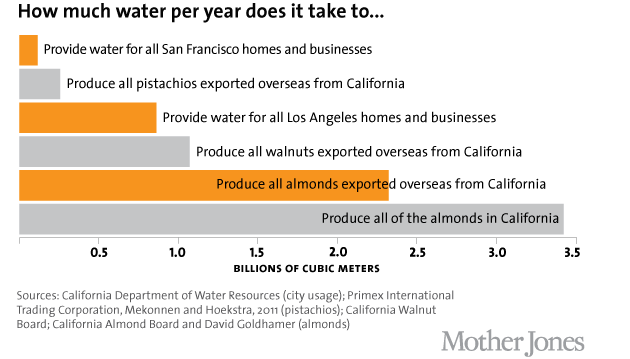


I grew up in California. It's still a great place to live if you're rich or if you bought property in a good location a long time ago, but if neither of those are true, you're going to have a huge uphill battle. Most people in my millennial friend groups, including me, have all talked about how we'd like to leave. We're mostly still here because our families are here and good jobs are easier to find. But each year, one by one I see people I know flee to other states.