Also can we talk about lawns for a second? Your pastoral evolutionary roots called: you haven’t owned any livestock for a minute. Your lawn won’t help you eat anymore.
And farm where? The aquifer used by most of the midwest is over half drained and can't be replenished. South of there is dessert. North is cold. East is populous and mountainous.
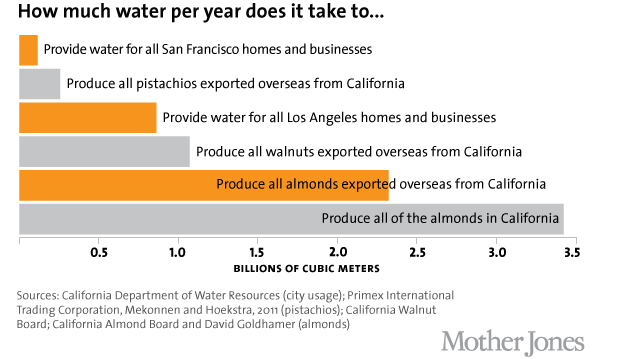
If we made no change other than to stop growing the almonds that we export overseas, that alone would free up enough water to accommodate about 20 new San Franciscos:
I mentioned almonds because California grows so many of them that the total water use of all the state's production outweighs the total for beef, but your point is valid that beef (in terms of water-per-pound-eaten) use even more water. This is another area we could free up the supply for residential use: Let other parts of the country develop stronger cattle industries. Or just let the price of meat go up.
California has a rich delta, the San Joaquin River Delta, which is a natural rice growing region.
People who are ignorant of geography, and think water is much more fungible than it is, would prefer that some small amount more of this water be expelled into the San Francisco Bay, as the great majority of it is already.
Contrast with alfalfa, which is grown mostly from aquifer water in the Central Valley, constitutes 50% of the entire agricultural water use for the state, and is used as cattle feed. That we can do without.
Also people who are aware of the invention of aqueducts would prefer that agricultural use of water be priced the same as residential use, if water is to be the main argument in opposition to allowing the state's population to grow.
Water is absolutely no practical barrier to population growth in California.
It's a fake issue, made up to disguise a classic NIMBYist fear of changing "the character" of California.
Which, I've been to Yosemite recently, so I get that. But the ship sailed long ago.
California does have unsustainable agricultural practices. Alfalfa growing for feedlot cattle is the big one, eliminate that and Cali can in fact expand on her comparative advantage in growing fruits, nuts, and specialty crops like asparagus and artichoke.
But this is completely unrelated to residential use of water, which is a) a rounding error next to agriculture and b) provisioned through a largely orthogonal system of reservoirs and, yes, aqueducts, which agriculture simply isn't competing with. Expanding that system and stewarding the available water better wouldn't take away from agriculture, which is fed by rivers and aquifers.
Again, the big offender is alfalfa. Rice, irrigated from canals off the Delta, is an irrelevant distraction to agricultural sustainability, let alone residential growth.
California's system of water rights is ancient and corrupt, and isn't serving the state well. But "pricing ag water like residential water" is a nonsensical way of solving that problem, it's just not the same water. Actually auctioning available water, and setting hard limits on aquifer withdrawal, is both necessary and quite sufficient.
Thanks, this was an interesting perspective. Alfalfa does seem to come up as a waste of water occasionally, but almonds seem get most of the hate.
How would limits on aquifer withdrawal be enforced? In general reforming water rights seems politically infeasible due to entrenched interests that benefit from the status quo.