Plenty of people drive EVs in the arctic far north of Norway (Troms & Finnmark). Not quite as cold as Canada, maybe, but close.
Of course EVs will have less range in cold conditions, but they also have some advantages in the cold: pre-heating from an app so the car is warm when you set out, for example. They may be more reliable than petrol and diesel vehicles in extreme cold conditions, and no need for engine block heaters, etc.
> far north of Norway (Troms & Finnmark). Not quite as cold as Canada, maybe, but close.
Not even close! The Gulf Stream keeps them nice and toasty. Tromsø or Hammerfest, for example, sees wintertime overnight lows similar to e.g. Worcester, Massachusetts (28 degrees of latitude further south). A far cry from places like North Dakota where the daytime highs in December and January are colder than the overnight lows in Tromsø, let alone places in inland Canada.
The interior of Finnmark in northern Norway can get very cold indeed. Temperatures approaching -40 degrees are not unheard of there. The coast is much warmer most of the time as you say.
Wow. That would be "nearly every modern gas vehicle in north America".
Seriously. Running a cold petrol engine under low load in freezing conditions only for heating i just simply a bad idea. Never understood how this is even remotely OK in the US. This is illegal in most of Europe. And for good reason.
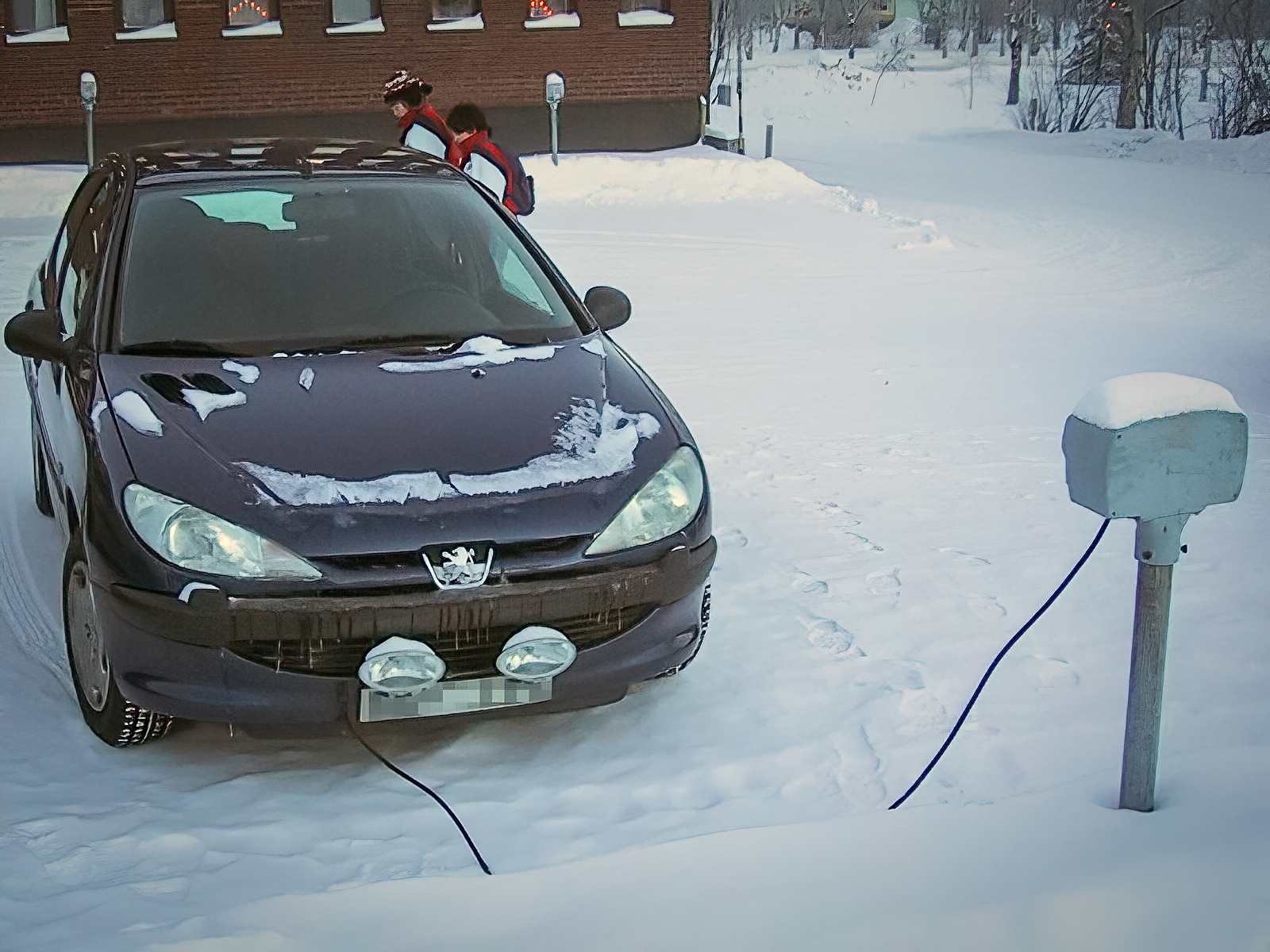
If it is around Celcius -40 then you would never turn off the vehicle. And a bit over that - there is always the Russian option of having a large candle below the oil tray (bad english, but you get it... under the engine) for pre heating. The more mainstream option is plugged in electric heating of coolant water.
I remember from my days in the Swedish army that there was a pre heating scheme for the drivers where specific spots on trucks APC's and such should be heated by gas light.
Usually it is sufficient to start the engine, clean the windows from ice, and then get going. A short engine running time without load for letting oils and fluids melt is only sane. Actually heating the cabin is nothing but wasteful.
>Wow. That would be "nearly every modern gas vehicle in north America".
>Seriously. Running a cold petrol engine under low load in freezing conditions only for heating i just simply a bad idea. Never understood how this is even remotely OK in the US. This is illegal in most of Europe. And for good reason.
My German BMW 7 series definitely had remote start (and an auxiliary heater too). Maybach GLS has an auxiliary heater.
These are hardly uncommon features in vastly cheaper cars either. Various Webasto systems have been around for ages, often installed by OEMs.
In Canada, electric block heaters for the engine are fairly common as well: https://en.m.wikipedia.org/wiki/Block_heater . Similar concept to fire under the engine, but a bit more modern
It's to do with safety, not economics. Remote start on a combustion vehicle presents a carbon monoxide poisoning risk. This is perhaps more significant in Europe where more people park indoors and in confined spaces.
Pretty much any EV in Europe has a remote cabin heating feature. If it were about energy and economics, wouldn't that be banned also?
If you are parked indoors you don't need remote start. Our garage stays about 32F degrees even when it is -10F out. The entire point of remote start is for the case when you are parked outside, such as at work.
Sure, but is the car actually smart enough to detect when it's indoors and block remote start? Many countries ban or restrict remote start features due to the risk of carbon monoxide poisoning.
In any case, not all indoor parking is climate-controlled. It's nice to be able to remotely warm (or cool, in summer) the cabin to a pleasant temperature before you arrive! 32F is still pretty chilly.
> "Surely pretty much any equivalent gas car remote cabin heating too, it's a very common feature."
Remote cabin heating in a gas car requires a "remote start" feature, which is illegal in many European countries - particularly Germany. This is not a common feature in Europe, except in EVs.
No it doesn't. It just requires an auxiliary heater, which has been a common feature in cars sold in Europe for at least 20 years. It's a feature you can find in cars sold during the 80s, like the W214.
> This is not a common feature in Europe, except in EVs.
It's a common feature in fancy cars and has been so for ages. Most EVs definitely fall into the fancy car category.
Fair point, but what, maybe 5% or so of gas cars are fancy enough to have a fuel-burning auxiliary heater in Europe? (not just Scandinavia)
Where as most EVs have a "remote HVAC control" feature - even the pretty basic ones. And EVs, of course, will cool the cabin in summer time as well, something that an auxiliary heater can't do.
Across all of Europe? No way. No cars sold in Southern Europe have this, and afaik it's rare (at best) in the UK. In Scandinavia? Maybe.
But aren't most premium new ICE cars in Europe now (mild) hybrids anyway? Why not use the big 48V battery to power an electric aux heater? Surely way cheaper, simpler, and less dangerous?
Running the engine is a very inefficient way to heat the oil (sometimes requiring a plug-in _electric_ engine block heater if it's so cold the bearings and rings would be insufficiently lubricated to start), and doesn't work at all to warm up a gelled tank of diesel. It's ridiculously inefficient to try to cool the cabin.
EV heating and cooling is far superior to warming up a gas vehicle.
Not directly, but the warm water in the block will mean that at least some heat is immediately available once you start the car. The main benefit of block heaters is not in heating the cab, but heating the engine itself so that it's actually possible to start it.
That aside, never understood the value of "pre heating" the car interior. If it's that cold, you're wearing a coat and gloves (or should be). Start the car, drive off, and you'll have heat within a few minutes.
The value is not having to wear all that gear while driving, and just comfort generally.
Living in the bay area it's nice that the Teslas have this capability to warm the interior from 55 to 70 before I get in the car. It means I can leave the house in a t shirt in the morning.
If you're driving around in subzero weather without a coat, gloves, and preferably a few blankets in the car, you're asking for more trouble than I am.
It’s kinda a pain to drive with a big puffy jacket, especially once the cabin gets warm.
I’m often in this position: car is in underground car park that sits above zero (Celsius) when it’s far colder outside, so I hand-carry my jacket and keep the vent off until the engine heats up.
You don't need to wear the gloves, you want to have them in the car in case you end up in an accident and your car is rendered unable to keep you warm.
Essential safety equipment while driving in the cold.
Almost all ICE cars I've seen sold in Nordic countries during the past 30 years have an outlet on the passenger side to power these. I think these have been a thing since the 70s though.
Fuel-type block heaters heat the cabin as well (they turn on ventilation once the coolant has warmed enough). Electric heaters are meant to be used with a cabin heater that uses the same external power source.
And another difference is that I can preheat my EV while it’s inside the garage. While I’d never warm my gas engine car inside the garage, not even with the garage door open.
My gas powered Mercedes heats up just fine without starting the engine.
This has been a common feature for like ... idk, 20 years? I think even the 80s W214 had this option, although that used a separate burner system instead of batteries.
If its cold enough in Europe they install dedicated heaters rather than idling the engine - they install a small heating device and pump plumbed into the cooling loop and to the petrol or diesel supply.
When it runs it heats the coolant and circulates it through the engine block.
Newer ones can also talk to the ECU to open the heater core valve and fans to pre heat the interior too. They also can use either SMS messages or an app to turn on remotely if you don't want to use fixed timers.
Replying to the comment below about garages. One can simply open the garage door, also remotely. Step 1, open garage door remotely, step 2, start car remotely.
But those aren't real differentiators. You've been able to remote start ICE cars for years, so it's warm when you get in. With a block heater, even diesels will start well below zero. Even without one, my 20 year-old ICE car starts up in -20F. And if you've got a place to charge your EV, then you've got a place to plug in your block heater.
I was under the impression that cars died in the cold due to the battery dying. Are evs more reliable because they are likely to be plugged in over night?
It depends on how cold you are talking about. Lead acid batteries run into issues, but portable jump starter is a cheap and easy solution for that. However, if your talking -40C both oil and fuel both run into problems with ultra low temperatures so people need to use heating blankets.
The nice thing about EV’s is you can have them warmup while plugged in an unheated parking space. The bad thing is cars are poorly insulated so at ultra low temperatures they need to use a lot of energy to keep warm.
Or a standard feature if you're living on the Canadian prairies.
In the mid 70's my uncle left Edmonton to do his doctorate in the Bay Area, and had his classmates at Berkeley convinced that his big Dodge Charger was electric because of the block heater cord on the front of it :-)
An EV battery is entirely different than a lead acid accessory battery in a combustion car.
It has a whole system dedicated to maintaining its temperature within ideal ranges.
They don't die in cold weather. I've never heard of one doing so.
The only issue with cold weather is reduced range. So just make sure you buy one with a battery big enough to handle your commute even with reduced range in cold. Which is pretty much all of them these days, honestly.
Those don't have "a whole system dedicated to maintaining its temperature within ideal ranges" although now you've got me wondering whether a laptop that expends some energy to keep its battery warm would actually last longer in extreme cold than an otherwise-identical laptop that doesn't... of course one would need to also consider whether the keep-warm energy is drawn while plugged in (which would obviously let it last longer) or not (which I'm not sure about).
EVs are mechanically far simpler. Mechanical parts always have issues dealing with large temp ranges (it becomes a very hard engineering problem), and the simpler the better. It’s not just oil (not needed to the extent it is in ICE cars), but everything.
For EV’s, the chemistry will have issues at low temps (fixed with battery warmers), and it has to use propulsion energy to heat the cabin, both of which will cause some loss of range.
As long as the battery doesn’t run down too low though, it’s a decent choice if other things are engineered correctly.
Li-ion batteries perform better at low temperatures than Lead-acid. The traction battery is also a lot bigger so it retains heat for much longer. And in some models, the car's battery management software can kick in some heating to prevent it from getting excessively cold if necessary.


Of course EVs will have less range in cold conditions, but they also have some advantages in the cold: pre-heating from an app so the car is warm when you set out, for example. They may be more reliable than petrol and diesel vehicles in extreme cold conditions, and no need for engine block heaters, etc.