> Cultural norms can also encourage poverty cycles.
I often wonder about these.
Growing up I watched friends whose families had what you might describe as a cultural distrust of institutions, including schools, or even anyone who seemed to “think they’re better than us” (translation anyone who did well in school or a career).
They constantly made self defeating choices and seemed destined to have the same problems/ poverty as their parents.
Their distrust of institutions like schools could maybe be justified… but they were capable people who made choices that reduced their opportunities.
As an adult I watch my local schools reach out to provide services, help of all kinds and struggle to find more than a handful of takers or folks who want to try…
By no means does that mean there are no other barriers, but even trying to address those barriers/ help, you can encounter some surprising resistance/ challenges.
I'm one of those people living in poverty that distrusts school institutions. My main philosophical gripe is that it doesn't seem to really matter what your major is. "Oh, you got a bachelors in Biology? Well, I guess that's fine. Come work at my tech company in a way that is completely unrelated to Biology." In this particular situation, it seems like the only purpose of college is to create arbitrary classist hurdles for poor people to jump through.
Now, obviously, that's not the case with all education, but my next gripe with it is the seemingly insurmountable debt that said education brings. Literally, all of my friends that have gone to college are no where near paying their debt off and I'm in my late 30s.
Finally, that in of itself, ya know, maybe that's like the licks you gotta take when you're trying to rise up in the world, but the fact that educational debt in America can never be voided through bankruptcy seems like a conscious systemic decision to create debt slaves.
And, while my parents, have been relatively ambivalent about education, almost everyone else in my family has gone out of their way to emphasize the importance of education. I just can't get over the previously mentioned hurdles.
> Now, obviously, that's not the case with all education, but my next gripe with it is the seemingly insurmountable debt that said education brings. Literally, all of my friends that have gone to college are no where near paying their debt off and I'm in my late 30s.
I grew up lower middle class - not poor - took on a healthy amount of debt to get a CS degree from a crappy college in West Virginia.
Most of my classmates are doing quite well, and I'm working at Google - with a fellow classmate, literally in the 1% now (both of us, out of a class of only 8).
I know plenty of rich kids who went to Stanford and studied philosophy or underwater basket weaving, and they're killing it.
But that doesn't mean poor people have no opportunity. Sure, it's not equal. But it's far from hopeless.
I think there's a lot of people who look at the world and see how unfair it is and think: why even try?
The world is not fair, never has been, never will be even close to it. You just have to accept where you started from and try your best. And we can try to push for a fairer world, but don't hold your breath. If anything, inequality is skyrocketing and the world is becoming less fair.
I am also bothered by the rise in income inequality. Specifically, in many highly developed nations, the likelihood one can jump up income deciles has greatly decreased generation-over-generation.
As someone who grew up lower middle class and leapt many, many income deciles, what ideas do you have to decrease income inequality? For example, you say that you are in the top 1% now. Do you favour increasing your own personal tax burden to help offset income equality?
I'm of the belief that income is less relevant - wealth is what really matters.
My marginal tax rate is ~48%. I think that's already high enough.
The idea that there is no wealth tax - and that the Fed arguably gives people a negative wealth tax - that seems a little off to me.
The median home owner has about 3:1 leverage on their house - with a home value that's 4x their income. The Fed has been pumping up house prices by a couple percent per year for 13 years.
.02x4x3=.24
The average home owner with a mortgage is getting an ~24% negative income tax. The median tax payer has a ~22% federal tax rate. Effectively, this is a -2% income / wealth tax.
This seems incredibly broken. We've created a society of haves and have nots. People willing to speculate on government handouts on their mortgage are wealthy. People not willing or unable have almost 0 wealth.
I'm in the 1%. Do I deserve to be? I don't know. But by definition, someone does. I make ~4x the median laborer after taxes and transfers. This doesn't seem broken. In my state, I make ~9x minimum wage after taxes and transfers. This also doesn't seem broken. Maybe others think differently?
Before taxes and transfers, the numbers seem much more extreme. That seems irrelevant to me.
The top 1% in wealth have ~100x the wealth of the median person in my state. That seems broken.
I have noticed a pattern: People like to complain about their "marginal tax rate", but rarely share their "effective tax rate". What is your effective tax rate? Unless you are a multi-multi-millionaire or billionaire, only a tiny fraction of your income will be taxed at the maximum marginal tax rate.
My view: If you really believe in reducing income inequality, there is no shortcut. You need to pay. How else can we fix this issue? Beg private corporations to give huge pay rises to medium- and low-skill people? (Don't wait for it!) We need a tax code that forces the 10%/5%/1%/0.1%/0.01%/etc. to pay geometrically increasing effective tax rates. I have never seen an alternative solution that will actually work. Yes, it is painful, but what kind of society and world do we want to create?
They are contributing to decreasing income inequality by describing how they increased their income.
Why should it follow that people who break from a culture of poverty should be forced to support those who do not? It smacks of the “black tax” described in the article - a response that undermines the good that could otherwise follow from greater employment and productivity.
> Most of my classmates are doing quite well, and I'm working at Google - with a fellow classmate, literally in the 1% now (both of us, out of a class of only 8).
What happened to those who didn’t study CS? How are they doing?
We far too frequently look into our bubbles as if they reflected the world around us. They don’t.
> My main philosophical gripe is that it doesn't seem to really matter what your major is.
Can't you just hack this by going to school for pretty much anything you're interested in and being able to work in an unrelated field?
> my next gripe with it is the seemingly insurmountable debt that said education brings
You've established that education is a good investment. So why not find an affordable college? It's not as important which college you go to or what major you select from your first paragraph. So find a cheap city or state school. Most of the debt comes from people going to private schools. I don't know where you live but NYC for instance is one of the most expensive cities in the world, but they even have a great city university (CUNY) which costs NY State residents around $7k a year, which is definitely reasonable.
> You've established that education is a good investment.
My friend often comes to me and says, "Hey, man, how come you don't invest your money in <x>?" Because I'm living in poverty. People who live in poverty don't have money to invest.
> So why not find an affordable college?
So I did a quick calculation. Affordable, meaning junior college and public state college, would come out to roughly $23k for a bachelor. Maybe round it to $30k. When I was paying off my car, which only come out to about a little over $10k. Two years of having to work JUST to pay that off felt really, really uncomfortable. A college infused starting salary would probably only pay about 1 and 1/2 times more than what I was making then and the idea of having to do that for even longer without being able to absolve myself of it through bankruptcy is not something I want to do.
> Can't you just hack this by going to school for pretty much anything you're interested in and being able to work in an unrelated field?
That particular situation doesn't apply to every job. It seems like its mainly tech jobs I see that in and I'm not 100% certain I'd want to work to be forced into a tech job.
So I'm trying to think of the best way to explain this because I feel like I'm going in different directions but it seems like there's two paths:
1) go to college, accrue debt to get a job then work at your job for 5-10 years to pay that debt off
Barring someone making sure I have the proper technical bonafides, I'm philosophically opposed to getting a piece of paper for a job that I could do just as easily without a college education as I could with one. I also feel really uncomfortable with debt in general, especially debt that I cannot choose to have absolved through bankruptcy.
2) live at the lowest possible means necessary and eke out a living as best you can
As it stands now, my current expenses are no more than $500 a month (including rent). My biggest challenge, currently, to maintaining that type of lifestyle is getting remote work that I can do on an ad-hoc basis that will allow me to stay under the income necessary for government subsidies.
these are the rules of the game. you didn't create them, you have little to none influence on them. you can disagree with them on principle, you can exploit them to your benefit. you can do both.
> People who live in poverty don't have money to invest.
You wrote below this line that your current expenses are $500/month. The poverty line is currently $12,880. Even if you are making one half of that (which is hard to believe: $6,440/year works out to $3.10/hour), you would still have $440/year to invest. You wrote elsewhere that you are in your late thirties; $36.67/month invested in the S&P 500 over the last 15 years (which has returned 8.4% over that time) would be worth $13,195.76 today. That is not a lot for folks above the poverty line, but by your own math that works out to over two years' living expenses. Over the course of forty years at the same long-term rate one could expect to have enough saved up for twenty-four years' expenses.
Or you could invest it in something with a greater than 8.4% return … such as a college education.
> I also feel really uncomfortable with debt in general, especially debt that I cannot choose to have absolved through bankruptcy.
Debt can be a problem, but it can also be a solution. Borrowing at X% and investing at Y% is a great idea when Y > X (of course, if Y or X is not constant, then there is a risk that Y < X at some point!). When Y >> X, as in the case of going to college for a marketable degree, it is an easy decision.
You get out of a college education what you put into it. I wouldn't recommend it just for a job, and the debt is an unfortunate modern heavy consideration to keep in mind. However, consider that it can be a force multiplier for your income for life, and give you the time/motivation to study things you may not otherwise come across, which can open you up to new opportunities and expand your network.
Also, people who come to college later in life tend to do better than average, because they want to be there, and have more maturity and discipline to do the work necessary.
I'm not saying college is the right choice for you, you do have important considerations that you're clearly weighing against each other. But, I am saying it may have more in the "pro" column than you credit it for, and there are also some non-loan subsidies that open up for students as well.
"Because I'm living in poverty. People who live in poverty don't have money to invest."
You have your time and energy to invest, and you can get an educational loan.
" then work at your job for 5-10 years to pay that debt off"
I don't think all of your money goes into paying off the debt during that time.
"I'm philosophically opposed to getting a piece of paper for a job that I could do just as easily without a college education as I could with one"
Well if you don't need it and don't want it, obviously don't get that degree.
" I also feel really uncomfortable with debt in general, especially debt that I cannot choose to have absolved through bankruptcy."
Since you have established you can earn as much without a degree, and it takes 5 years to pay off the costs, you could also work for 5 years and save money for the degree.
"Well if you don't need it and don't want it, obviously don't get that degree."
The concern is that, according to parent, and I believe parent, is that the system requires a useless piece of paper. The degree is more an economic hurdle than a proof of capacity. That merit is a social construct.
Money is a social construct. In fact almost everything other than food, shelter and tools are either social constructs or only have value in a social context. Jobs are social constructs too.
But the parent also claimed he can make the same money without the degree. Both things can not be true at the same time ("you need the useless paper", "you can make the same money without it").
Apart from that, while the usefulness of some degrees can be questioned, there is a general concept called "signalling" which has actual value. That is you demonstrate certain qualities in a way that are difficult to fake (usually by doing something costly, like getting a degree, or carrying around a huge tail if you are a parrot).
I think their point (which i agree with) is why do you need a college degree just to get a basic entry level job with a career path. You're delaying entering the workforce for 4+ years ($100k+ at minimum wage, minus some if you work during college) with ~30k debt (with your example tuition/costs not sure if it include room & board) so they should get a similar output from that education.
This probably wasn't the situation prior to the USA population tripling over the last 70-80 years while tech/automation has acted as a limiting force to job growth. It's easy to say the cost of college has skyrocketed because of cheap non-discharable debt but it's pusdo-requirement has also caused demand to skyrocket too.
> why do you need a college degree just to get a basic entry level job with a career path.
The two options here are that either all the businesses using college degrees as a signal are wrong and they could be saving a lot of money by hiring non college educated applicants for slightly less pay and building them up.
OR college education is a useful signal and so businesses are willing to pay a higher price for it.
If the prior were true, then I would assume a business would have developed already to take advantage of the arbitrage opportunity. It is not a novel or less known idea.
A degree can be a valuable signal to employers and also be a terrible waste of time and resources. It can be both at once.
It would be better if we found ways to let young people get into white collar and middle class professions without spending $100K and four years of their lives. This used to be possible. I'm quite sure it could be done again, but collectively we're not going to go there. Yet, anyway.
> A degree can be a valuable signal to employers and also be a terrible waste of time and resources. It can be both at once.
Sure, but it answers the question of why a degree is “needed”, and that is given the supply and demand curves for labor, the suppliers of labor need it to compete with each other.
> It would be better if we found ways to let young people get into white collar and middle class professions without spending $100K and four years of their lives.
Really simple, remove all taxpayer funded (including guaranteed) education loans, and any special bankruptcy protection they might have.
"In this particular situation, it seems like the only purpose of college is to create arbitrary classist hurdles for poor people to jump through."
There are certainly a lot of useless majors. But that doesn't imply all of them are useless.
"the fact that educational debt in America can never be voided through bankruptcy seems like a conscious systemic decision to create debt slaves."
I'm not in the US, but isn't the rationale for that construct to make people more credit worthy? Ultimately you have to convince somebody to give a random person a lot of money on the odd chance that they'll finish their education and earn the money back. I suppose if you don't like "educational debt", you could also try to convince somebody to give you another type of loan.
> There are certainly a lot of useless majors. But that doesn't imply all of them are useless.
It's not so much a critique of the majors but rather the professional requirements of the job listing. For jobs that don't have an innate technical (technical in the loosest sense of the term) requirement, they only want a certain class of person working there and college degrees are just how they do that.
> I'm not in the US, but isn't the rationale for that construct to make people more credit worthy? Ultimately you have to convince somebody to give a random person a lot of money on the odd chance that they'll finish their education and earn the money back. I suppose if you don't like "educational debt", you could also try to convince somebody to give you another type of loan.
One rationale that I heard that seems reasonable at face value is since you can't give back your education, that's the justification for not being able to declare bankruptcy.
I mean, I could put it on credit cards or take a personal loan, but that just increases the financial burden (via the interest rate), and if I'm not going to do that for the explicit purpose of purposely declaring bankruptcy, it seems unnecessary.
> One rationale that I heard that seems reasonable at face value is since you can't give back your education, that's the justification for not being able to declare bankruptcy.
It goes a little further than that. It doesn't really matter that you can't give back the education. It's that the loan is entirely unsecured - there's no collateral, but also the people who get student loans typically don't have any assets. So it would cost nothing to take out student loans, study, and then declare bankruptcy.
So I'll just leave an answer here. Credit cards, when they are issued to college-aged kids with little to no income or assets, are typically issued with very small credit lines (i.e. we're talking much smaller amounts than students loans) and/or require a co-signer, like a parent with an established credit history.
> reasonable at face value is since you can't give back your education, that's the justification for not being able to declare bankruptcy
At face value, yes, but in the real world if you're not earning enough after 10 years to pay it down, it was a bad investment. Allowing bankruptcy after the passing of a few year's time is a way of notifying lenders, who should be the more sophisticated party to the transaction, that if the career investment fails to pan out, they take a loss.
That would work, except that politics become involved, so it doesn't.
Realistically, employers are simply seeking to reduce the number of applicants down to manageable levels. When you have 1,000 people lined up at the door for a job, you cannot meaningfully evaluate them all and need to find a mechanism to quickly eliminate most of them.
You also need a method is deemed legally acceptable. Throwing out all the resumes of women, for example, could land you in some legal hot water. Degrees are one of the few filters that is deemed legally acceptable. It's there to keep the lawyers happy and little else.
>It's not so much a critique of the majors but rather the professional requirements of the job listing. For jobs that don't have an innate technical (technical in the loosest sense of the term) requirement, they only want a certain class of person working there and college degrees are just how they do that.
I'd go further and suggest that many of these jobs only really exist to save face for the underperforming children of the upper-middle classes.
> My main philosophical gripe is that it doesn't seem to really matter what your major is. "Oh, you got a bachelors in Biology? Well, I guess that's fine. Come work at my tech company in a way that is completely unrelated to Biology." In this particular situation, it seems like the only purpose of college is to create arbitrary classist hurdles for poor people to jump through.
In the U.S., this is due to the fact that employers practically may not use proficiency exams; since they are prevented from testing for actual proficiency, they must use a proxy, and a college degree is a decent proxy for 'reasonably educated enough, exposed to enough general knowledge, knows how to function in a group.'
I don't think that class really enters into it.
> the fact that educational debt in America can never be voided through bankruptcy seems like a conscious systemic decision to create debt slaves.
More that without the inability to discharge it in bankruptcy interest rates for student loans would need to be sky-high: the smart move for anyone graduating at 22 would be to immediately declare bankruptcy when all he would have is debt and no assets.
> In the U.S., this is due to the fact that employers practically may not use proficiency exams
What do you mean here?
I'm a life-long US resident and I've never heard such a thing. I've also taken exams when applying to jobs. There is also the civil service exam which is a prerequisite for many government jobs. Jobs like the police and military have exams, both written and physical. I can't square my experience and your statement.
More likely, employers do not want to pay for additional exams as part of the hiring process and use college-degrees as a proxy. But there's nothing preventing them from using exams if they wanted.
From the US and I've also taken exams when applying for all kinds of jobs. I applied to work in a convenience store and had to take a test on simple math and alphabetizing things. I applied to IBM and took a strange test full of math word problems (the IPATO test; I was amazed they still did that in ~2013). There are certain employers in the tech industry that are well known for their standardized exams, like Epic Healthcare. And that says nothing of the many, many low-wage jobs that require you to take a bogus personality test to prove you're an extrovert before they'll let you stock shelves.
Griggs v. Duke Power held that if a test has a disparate impact on ethnic minorities, then the burden of proof is on employers to demonstrate that the test is reasonably related to the job. The practical effect is that private employers are highly unlikely to use these tests, since doing so opens themselves up to liability, particularly since due to socioeconomic factors any fair test will have a disparate impact. For example, the tests in the particular case were a general IQ test and a mechanical aptitude test.
> I can't square my experience and your statement.
Every particular instance you gave was of a public employer, but I was careful to note that employers practically may not use proficiency exams. It's not directly illegal, and some employers might use them because either they do not realise how much liability they are exposed to, or because they have been very careful to justify them.
> Griggs v. Duke Power held that if a test has a disparate impact on ethnic minorities, then the burden of proof is on employers to demonstrate that the test is reasonably related to the job.
It actually held that for any employer-imposed hiring requirement (not merely a test), and later cases have made it clear that applies pretty much to any element of the hiring, advancement, retention, or disciplinary process.
> The practical effect is that private employers are highly unlikely to use these tests
No, its not. The practical effect is that employers doing cargo cult HR (which is quite common) are highly unlikely to use the specific tests that have been at issue in superficially well-known cases like Griggs (e.g., specifically due to Griggs, IQ tests) even when they could easily meet the test laid out Griggs but simultaneously using many employer-imposed job requirements for which they could not meet the test.
OTOH, employers that have decent legal advice regularly use tests of even the specific types that have been problematic in other cases, but make sure that there is a job rationale supported by evidence for both tests and other requirements in case they are challenged, because that’s the thing that actually matters.
Proficiency exams are exceedingly common (heck, when I did clerical temporary work for a while, it was pretty much the entirety of the hiring and placement process.)
Not the op, but I'm still having a hard time buying this argument that assessment tests "practically" may not be used when Walmart, Home Depot, IBM, and Epic use them, and countless companies required me to fill out their questionable Unicru personality assessments in the 2010s when applying for a summer job. And those are just the big names that folks here might have heard of and that I knew from memory. Clearly this particular decision hasn't been a big barrier to implementing various kinds of pre-employment tests in the US.
Thank you for pointing out what the consequences would be of allowing student loans to be discharged by bankruptcy. It's obvious this would happen a lot if allowed - I would have done it and would tell my kids to do the same. It turns out being held accountable for the debts you incur is usually a good thing.
> Now, obviously, that's not the case with all education, but my next gripe with it is the seemingly insurmountable debt that said education brings. Literally, all of my friends that have gone to college are no where near paying their debt off and I'm in my late 30s.
A solid 31% of college graduates have no loans, and current graduates with loans average something like $30k in debt. With this in mind, it's perhaps worth pausing to consider why the sample that is your social circle suffers from decades of crushing debt. Perhaps your sample is not representative?
Or, more insidiously, perhaps debt levels tend to reflect class and class aspirations? Someone who attends a community college likely has little to no debts. Someone attending a local tier two or three public university probably has some modest debt, often below their yearly income after graduation. Someone who goes through a private post-grad program likely has six figures worth.
> Finally, that in of itself, ya know, maybe that's like the licks you gotta take when you're trying to rise up in the world, but the fact that educational debt in America can never be voided through bankruptcy seems like a conscious systemic decision to create debt slaves.
What do you imagine the outcome might be if student loans were voidable through bankruptcy? How do you think fresh graduates with loans and no assets would handle things?
> the fact that educational debt in America can never be voided through bankruptcy seems like a conscious systemic decision to create debt slaves
The inability to be voided through bankruptcy, as I understand it, was setup so that educational loans would not wind up with insane interest rates. Given that they are unsecured (there's nothing for the lender to repossess if the borrower fails to pay), there is much greater risk to the lender. Being unable to discharge the load in bankruptcy is one way to mitigate this. Raising interest rates on everyone taking such loans (so the people that do pay subsidize the people that don't) is another. Presumably, it was decided that the former was a better option than the later.
> The inability to be voided through bankruptcy, as I understand it, was setup so that educational loans would not wind up with insane interest rates. Given that they are unsecured (there's nothing for the lender to repossess if the borrower fails to pay), there is much greater risk to the lender.
Most loans issued before 2010 are guaranteed by the US government. So while they are technically unsecured, the government will cover the lender if the borrower doesn't pay.
Since 2010, student loans are actually owned by the government, that is, students are borrowing money directly from the US federal government.
So, in most cases, if a student loan were discharged in bankruptcy, it would be the federal government that would eat the cost of the loan.
> Since 2010, student loans are actually owned by the government
Federal student loans are owned by the government. Private student loans, of which there are many and more every day, are owned by private (generally for-profit) companies. They're also not covered by the student loan relief efforts of recent times (CARES), if I understand correctly.
I'm seeing a lot of anecdotal evidence you're using to justify your biases. This isn't an attack on you; I think you would have a tremendous amount to gain from a science education. Please consider it for the future of you and your family.
Going beyond anecdotes, the data is clear that there is no economic benefit. Wages are stagnant and job quality is in decline alongside the rise of post-secondary attainment.
While there is no doubt an entertainment benefit to be gained, that is not likely the best choice for someone without the means to take on nearly a million dollars of opportunity cost.
I went to college mostly as a means to get some distance from my horrible family, and I advise anyone coming from a rough family to go to college just so you don't need to do with your family as much. You don't need to go to a good one, even with a GED. You can always go down to community college a few cities over.
That can more than be enough.
>Now, obviously, that's not the case with all education, but my next gripe with it is the seemingly insurmountable debt that said education brings. Literally, all of my friends that have gone to college are no where near paying their debt off and I'm in my late 30s.
I will say this generation is all about complaining and less about hard work. It's about going on Twitter to complain about how hard it is to find a job, instead of going on LinkedIn to actually find one.
I can make a single phone call and pay off all my student loan debt today, I just feel no need to since some politician is going to eventually forgive it some of it.
I also use having a degree as a filter for who I associate with. In my current city, except for a single person I've never gone out with anyone not either pursuing, or currently holding at least a four year degree.
If you tell me your 24 or something and you've never gone to college and you've never worked, I know you can bring harm to me. I'm from a very bad background full of these freaks who don't want to do anything except cause chaos.
Hold high standards for both yourself, and anyone else you surround yourself with. For example, on the Tinder TOS thread, I saw a minor debate over if it's okay to exclude people who don't have jobs from your dating pool.
I wasn't going to argue with anyone directly, but if you tell me your unemployed and you're still spending all day on match or Tinder, I don't want to be around you. Where I'm from, if someone doesn't have a job particularly they aren't even trying to find one, bad things tend to happen.
>I went to college mostly as a means to get some distance from my horrible family, and I advise anyone coming from a rough family to go to college just so you don't need to do with your family as much. You don't need to go to a good one, even with a GED. You can always go down to community college a few cities over.
That can more than be enough.
What major did you choose?
How did you manage to find an apartment and the means to pay for independently one at 18?
Back in a distant time, even in LA you could find an apartment for 600$.
Add in loans and it wasn't really hard. This is why I'm actually a defender of student loans, used correctly their the best thing ever.
At 18 you can do dozens of life destroying stupid things. You can have a kid you can't afford, drive drunk , etc. Taking out a loan for school isn't going to hurt even if it doesn't work out
Loans don't help with credit checks, background checks, and the now-common reluctance to renting apartments out to undergrads. I don't know how little paperwork and difficulty existed during the hallowed '90s, but I doubt those circumstances could be replicated for an 18 year old wanting to escape his family today without going homeless.
Let's not forget that government-backed loans will require information regarding parental income and assets unless you file as "Independent", a status with its own restrictions on well may apply.
> My main philosophical gripe is that it doesn't seem to really matter what your major is
That's because (starting in high school) teachers are "assigned" a subject. If they change subjects, they essentially have to restart their career, there is a great personal cost (mostly going back to part-time teaching) for doing that. Plus for a whole bunch of things, from sick days to yard supervision there's a "pecking order". Changing subjects means you go to the back of the pecking order.
So if a biology teacher gets hired to emergency fill a math teacher's position, if they're smart they will never give up that math position.
That was sort of my experience. I grew up in poverty and stayed in poverty until I was almost 25 years old because I didn't know any better. My parents didn't distrust institutions. Instead, they mocked things they couldn't afford, so I grew up thinking college was a "stupid waste of time and money" and unimportant.
For me, the things that broke me out of my family's cycle of poverty were a public library, a love of reading, and a determination to learn a valuable skill that people would be willing to pay me for.
I read everything from medical journals to books on auto mechanics to baking. I was willing to do anything to make more than the $5.85 an hour I was, at the time, raising my family on. Eventually, I picked up a copy of "Sam's Teach Yourself C Programming," which was weird, since I didn't know what C was and didn't own a computer. But, for some reason, the book clicked. I kept reading and studying programming books from the library and eventually got my first programming job with Intel. In my case, the public library was the key to breaking the poverty cycle, not just for me, but for my children as well.
I eventually got a college degree in my early 40s and graduated with a 4.0 GPA. I don't think I could have done that in my 20s though, due to the way I was raised. I had to get there via another route; the public library.
Because of the benefit they've been to my life, I love public libraries and recommend them to anybody wanting to improve their current situation. I'm sure there are other resources available too. That's just the one that worked for me.
That's a harsh truth that's easily ignored, especially by people who didn't grow up in diverse communities. During my education the "behavioral bell curve" for each culture was clearly not centered in the same place. One population had a lot less free time at home than the rest of us, and their grades and eventual careers reflected that. Another population made up a majority of the disruptive pupils who didn't seem to care all that much about their performance. A third was far less driven than the first but much better behaved than the second. The trajectories of these populations largely reflected the manner in which they were raised.
To be clear, there was nothing inherently superior or inferior about any of these kids. All the populations had outliers in both directions. That's also not to say the academically maladapted nature of some cultures are exclusively or even primarily the fault of those cultures. I do, however, believe the continued determination to not address these disadvantages represents a failure on the part of educators just as surely as a refusal to address visually-impaired students would be a failure.
Have you seen people manage to breakout from the poverty cycle? I have lived long enough to actually see a handful of people doing just that, and I often wondered what made them different.
One trait I often observed is risk-taking. The ones that broke free from their upbringing always seemed to have high tolerance for risks. So maybe it's simply statistics -- if you have a group of people taking a lot of risks, some of them are bound to end up doing well (with a comparable subset end up doing worse).
Risking is one option, but there is another one: the breaking might take more than one generation an that is something which is often overlooked by the modern discourse. Every next generation might end up a bit better off and on the timespan of 50 years the poverty cycle will be broken.
I remember reading something about this, apparently it’s takes about five generations to escape poverty and about three generations to dissipate family wealth.
I don’t know how to check the robustness of these figures, sounds a bit headliny, maybe sounds approximately sensible at first glance.
I'm only in my 20s, but know three people quite well, all from diverse backgrounds, who have escaped the poverty trap. The traits I would note is that they were reasonably intelligent, actually made changes in their lives in order to achieve financial success (ie played the game to win), and were somewhat "interesting" socially.
The last one may be selection bias, but I'm not so sure. I remember listening to an interview with Grant Petty (Co-Founder/CEO of Blackmagic Design, grew up in public housing in Shepparton, would be worth $100m+ overnight if they IPO'd) saying that he was basically too Autistic to pick up on social cues from others informing him that he was white trash and had no future.
No pain, no gain, but don't do things that may kill you, maim you or land you in prison for several years or make you homeless.
I am a moderate risk taker as well, but I had my share of failures and my instinct would never allow me to gamble everything at once. I always try to have some reserve/slack just in case.
I can confirm this - I moved twice within Europe, once after a year of working (software dev), and then after 5 more years.
First time I went financially to 0 at the time first salary came, not a nice feeling. I don't have anybody rich in family, rather poor university educated parents (the beauty of communism and some time afterwards - when you are highly skilled engineer, hardworking and manage 200+ people you may get half the salary of some common agriculture worker or trench digger; or when being head of economic departments of 3 high schools combined you deserve even less). I had to adapt 'fuck it' mentality to make this step, otherwise the risks were too high. With kids for example this wouldn't be possible, parents generally move to very risk-averse mindset.
Second move didn't ruin me completely since I've saved up a little, but I had running mortgage which was eating my savings constantly. Plus I've moved to Switzerland and started looking for work - even when living on tuna cans and pasta in flatshare my expenses skyrocketed. Going through this for 2.5 months with very real option of failing and coming back and trying to not lose the mortgage takes some nerves. Again, 'fuck it' mentality helped, this time hardened with 6 months of backpacking in India and Nepal.
In both cases, I've had plenty of folks who were dissuading me from the moves (its hard to find job, more competition, foreign country and language etc. - all true at that time). None I know made similar move to mine. Many of those were talking about it, trying to find some super convenient way through it, asking me after move if I can find some work for them. When I explained to them its not an easy feat and they probably have to move beforehand they ignored the advice. Needless to say all remained where they live.
When comparing my first 100% software dev salary ever and the first after second move, my net income jumped 20x. I was extremely lucky when picking up my university studies to go for software development - it was not popular, we were unattractive geeks to girls, the salaries at least at home sucked and not too much work.
What I want to say with all this - its possible to move out of poverty, but one needs luck (at least with timing of actions), some tungsten balls help, and the less responsibility one has the easier the choices and hardships are. Generally its worth taking risks, but one has to know when to push hard and when rather accept losses and retreat.
I sometimes think, one way to break this cycle is to send the all the kids to boarding school or military school. It could put them in an environment free from their background circumstances. It is of course a harsh thing to do, but I think maybe it could work.
> I sometimes think, one way to break this cycle is to send the all the kids to boarding school or military school.
This is a pretty standard solution by people working from abstractions that aren't checked against the realities of people.
It’s also a stunningly bad idea that tends not to survive past very initial steps toward implementation (on a general societal level; it has often been implemented in a more limited way targeted at disfavored minorities where it is a component of genocide by destroying the people as a people) in real societies, even when there is a powerful governing group devoted religiously to an ideology which embraces it.
> send the all the kids to boarding school or military school. It could put them in an environment free from their background circumstances.
It is a common meme in some circles that sending (problematic) kids to boarding or military school will "set them straight". To me, it's basically just hope that a bit more violence will work.
Also, after 6 years spent in an environment where you are told what to do every minutes, where rules are clear and mostly non-negotiable, bed and meal times always the same... what happens when you are put back in the regular world ? I exaggerate things to make a point, it's not black and white but still.
Can confirm.
My oldest daughter roomed in College with a girl who came from a structured boarding school. She was a mess.
I also recall a similar experience when I was in College.
That is a good point. But all these had racist reasons at their core.
Can this be better implemented today?
With extensive supervision and scrutiny.
For example, teenagers routinely join the army, and spend time learning and training at what is essentially a boarding school. It seems to work quite well.
I'm not sure replacing racism with classism (oh, you are poor, you need to go away to school) is much better.
Extensive supervision and scrutiny? I mean, are we not doing some of this with public schools now? And if not, why not?
And seriously, we (in the US) allow lots of options for troubled kids without supervision ("work the bad out of you), we've allowed conversion therapy for LGBT+ children, have little oversight on for-profit schools and we allow folks to force their religion on their children, even if the 16- or 17-year-old doesn't believe.
I highly doubt there would be oversight.
I'd also like to point out that the Canadian schools were really, really recent, and I don't think much has changed since.
In a some cases they had racism at their core - but that's a step removed.
They thought that the parents were (for whatever reason) incapable of raising their children appropriately and that the best way to properly raise the children was away from their homes, their cultures and their problems. They may even have thought their goals were noble and justified - as most folks tend to.
I cannot see a meaningful difference between taking kids away from their parents for racial reasons, for class reasons or really any other reason.
The issue isn't necessarily why they saw them as inferior, it's that they saw them as inferior.
> For example, teenagers routinely join the army, and spend time learning and training at what is essentially a boarding school.
This choice is made by the family and the individual. This is not the same thing. A meaningful harm vector is the removal of autonomy.
Once people leave a structured environment (home, boarding school etc) and live 'on their own' even if it's just a dorm room, then tend to act as one who has been leaning against a post, and you take the post away suddenly. It can talk a while for them to stand up straight again - keep their room clean, do their laundry on time, manage their money, wash and dress suitable for the situation.
I could always tell in college, which people had not lived on their own before. They were a mess.
One of the students from my high school, who was orphaned at 11, enrolled himself to the military university. At that school, he got free education, free uniform and free boarding. Every graduates must commit themselves to serve the military for a number of years. He possibly figured out that it's a good way to be independent, to get a quality education and to earn a decent living.
That school in my country has not been trivial to get accepted. He aimed for good grades at high school and participated in sports teams.
> Microsoft introduced the School of the Future that had incredible results.
Your article cites no actual results.
In reality, the problems it seems to have had is that the basic idea just doesn't work: the first years were plain rocky. [0] When it dealt with some of the early problems, it got good results, to the extent it did (and certainly some measures were quite good), largely by costing more, even though the fundamental concept was to prove a scalable, efficient model by requiring no additional funding (so it had to try to close the gap by aggressive outside fundraising to meet the additional costs.) [1] When the baseline funding for public schools dropped, the extra cost of SoF’s original model became even less sustainable. [2]
The school still exists, but I can't find anything after 2014 even treating it as a particularly interesting thing.
I'm thinking of this and i can't see it working. All previous attempts were usually executed on racist grounds, and i don't think we can do the same on non-racist grounds because poverty itself is a result of either intrinsic differences between races, or racism itself, so racial layout of kids in those boarding schools will be similar to the racial layout in prisons... It's hard to expect anything but radicalisation happening there.
GP did say "all the kids", so maybe they actually meant all the kids, as in rich, poor, in-between. So that it wouldn't be based on family income or school sector or what-have-you.
Of course, this could be construed as "discrimination" against the better off, since they have to go through what seems like a tough time "just because of the poor people".
There is a long history of marxist groups trying to destroy the family by forcibly removing children and making them live in various communal camps. For example this was done in forced collectivization projects in the USSR and China, and also by the Khmer Rouge in Cambodia.
I really recommend watching the film "The Killing Fields", in order to see this in action.
Both the USSR and China ended up abandoning these efforts and now acknowledge them as terrible failures. The Khmer Rouge had to be forced out via military invasion.
Always the justification is the fact that smarter parents tend to have smarter kids, patient parents tend to have patient kids, etc. E.g. most things in life are at least half heritable, and so you will see both competency and dysfunction cluster in families. This offended the levelers greatly and so they decided that families need to be broken up and the kids randomized in order to achieve a Great Leveling.
The result has always been catastrophic, not to mention a gross human rights violation.
Hardly just the Marxists - the Nazis gave it a go, the Danes gave it a go and so did the Canadians [1]. This idea spans the political spectrum, and it tends to go, er, predictably.
Meh… the Canadian example is more complex than the article infers. The idea is that all children should be educated in the public system. (we still do it today - education is mandatory). For First Nations in remote communities, those children would be required to attend residential schools since no local school existed.
If anything the mentality has more similarities to race relations today - “the White Man’s burden” of helping these cultures “bring themselves up”. Back then they took kids from parents and gave them a European education, and told them their current culture should be forgotten.
Today we just get rid of failing grades, calculus in high school, and standardized testing and implement racial quotas. In the end it’s the same - assuming we know best for other groups even if in the end it harms them.
Indeed, I didn't mean to equate them in any way other than "children were removed from their parents and educated according to prevailing practices." I suspect each example is quite unique.
Oh well this is a terrible idea beyond imagination. Even just simply "solving" poverty by the means of good old segregation, delimiting poor places with barbed wire, sounds better to me.
It's not, because America is highly segregated by self-increasing difference in school quality (because more expensive homes in the area yield more property taxes to the municipality which are used to fund school), and better schools make richer people move to the place, driving up both home prices, and school qualities too by improving racial and social mix of students, and it goes on and on in a self-propelling virtuous cycle. As a result most places are strictly segregated and no, children from all backgrounds don't go to the same school because they don't live (poor can't afford) in the same school district.
I was fortunate to not experience this myself, but my best friend struggled with his peers in school bullying him for "acting white" when he actually tried to do well. Fortunately for him, his dad was a firm believer in education, so he moved up out of poverty when most of his childhood friends ended up in gangs or worse.
Isn't it the trick in every social class? Society is built in a way that tries to prevent members of each social class from moving up, and that goes from lowest to highest classes alike.
Poor people are taught to distrust everything and everyone, and to think strictly short-term because nothing you can't hold in your hands here and now can be trusted to be real, this prevents them from moving to the middle class.
Middle class people are taught to get a most expensive degree (sinking them forever in debt) and get a stable job with benefits, and buy a house, which all prevents them from making good money by getting an inexpensive degree in area they like, and/or contracting and making top $, and investing into the stock market.
Upper class people are taught to be gentlemen and do the respectable things expected from one: follow their parents' role in the company, or do civil or military service, or do other bullshit, which prevents them from becoming the like of Elon Musk and moving even further up.
Poor are not alone: beliefs and cultural norms of all classes alike are built to prevent people from succeeding just because doing otherwise would result in too much of a dog-eat-dog society. Trick is to learn to ignore norms of your class and follow your own way.
IMO it has not much to do with how every social class are taught but rather the Mathew effect.
Put aside those exceptionally smart or dumb ones, most people are more to less with the same capabilities and the class they were born to almost define who they will become. The reason is simple: upper class have maybe 10 times the resource a middle class have and in turn a middle class may have 10 times the resource a poor people have. So the upper class can easily have enough resource to develop themselves, and provision for the risks and still have lots to invest. For middle class, they have enough to develop themselves, a little bit surplus to insure themselves and/or to invest. For the poor people, what they have is barely enough to make ends meet, little or none for personal development or invest.
So if everything goes well, the upper classes can get decent investment returns even if they do nothing actively. For the middle classes, it's not too bad, they can still get a piece of the cake, though not much. For poor people, they might be able to save a couple of bucks but nothing much.
If things go side ways, the cut of the cake for the upper class at worst is slightly smaller as they are impacted but as there are already provisions for that so they don't really lose much. Sometimes their portfolios actually grows a lot because central banks print lots of money and the inflation skyrockets. For the middle class it really depends on how lucky they are. Lucky ones' asset grows, average ones are not impacted or lose little bit. If they made wrong decisions, they might become poor people. For the poor people, the best case would be their savings eaten by inflations. If other bad things happen, they might become homeless.
Just take a look at statistics around the world, almost exactly the same story.
I don't get this attitude. Sounds pretty great, these institutions you talk about! What happens to children these institutions care for 100%? Oh wait ...
You're assuming blanket good intentions on part of institutions and schools. Does it really need to be said this is exceptional, rather than the norm? Here is a study that quantitatively compares really bad home situations to many forms of institutional care.
Here is a study that correlates the "help" given by institutions like schools with betterment or worsening of symptoms. And again, we see: beyond giving information to children ALL institutional help is worse than no help at all. So I wonder how you justify these good intentions? More institutional involvement makes lives of children worse, not better. (And yes, I get it, some problems evolve in dramatic fashion, and tend to worsen, such as anorexia. However, again, no institutional help has better outcomes. It's just no help results in a slowly worsening situation, institutional help results in a fast, dramatic worsening of the situation).
Therefore, I question why you criticize children and parents for refusing help. For the large majority of help provided this is the best choice for the child. Do people overreact? Yes, absolutely. Especially CPS is famous for "one wrong move, one second of trusting the wrong social worker, locked up for years" situations. It's almost funny, but these institutions are a recurring theme IN HORROR MOVIES.
I realize it's only one aspect of the problem you're identifying, but institutions, especially schools, really aren't good for children. Otherwise we'd see a lot of effort preventing this situation (and therefore a lot of tolerance for suboptimal home situations). Yet we see the reverse: defunding institutional care, defunding actual help, taking away information (talking with any social worker as a child can result in getting locked up for up to 27 years in New York, yes, really), fund 1000 new efforts for getting more kids into institutional care, because the kids never want to, not even when they are deep in abusive situations, and force everyone and everything to "report" kids for institutional care. I recently found an article that hairdressers are to watch for signs of child abuse.
Obviously that article never once mentioned just how bad the institutional alternative to "child abuse" situations is.
The arguments are that it's about "justice" (the many suggestions for punishing families, by "helping" the children (because criminal law makes touching the parents very hard) for example, for not vaccinating. Or for "disturbances". Or ...). Systematically we see the effects of this: youth crime is dropping like a stone. Crimes against children are dropping like a stone. And ever more kids are forced into institutional care.
Schools are a big part of that.
> As an adult I watch my local schools reach out to provide services, help of all kinds and struggle to find more than a handful of takers or folks who want to try…
As illustrated above, most social help programs at school are meant to trap kids and force them into institutional care. And if 1 school program has this intention, nobody will trust other efforts.
Besides, I don't get this attitude. In low primary school, perhaps this is true. But starting at something like 2nd-3rd grade the teachers, in my experience, are not sufficiently competent to effectively help children learn. And there's too many kids in a class to do it even if you do have the odd teacher that really does make a difference.
At home, kids can be taught by parents, and by a great many people on the internet. Pedagogical studies have always shown that parental teaching produces far better results (to the tune that some studies claim 1h of teaching by parents is roughly equivalent to ~14h of school, or 1h daily work by a parent makes kids advance far faster than in school). And, essentially all parents aren't incompetent and really care about their children.
And yes, there are bad and abusive parents. You know what is MUCH more common? Bad and abusive teachers (look up how many gym teachers are convicted for sexual assault yearly ...). Bad and abusive classmates is more common still (one UN study claimed 70% of kids have been victims of violence from classmates, done under teacher supervision. And whilst I'm not claiming teachers often cause or supervise violence, they are still failing to care for these children). And yet ... never is anything done about those teachers or schools.
Poor people are used to being victims so it's hard to trust other people. When you look at it deeper, if these are poor minorities in a white mans world, no matter what there will never be trust. Hard to trust the same people who are oppressing you.
Many policy maker are born well off, so it's hard to relate. When the social workers are driving in BMW's and talking to you like you're retarded...
It's ongoing. I have done a bit of outreach work in the past and it's totally wacky on so many levels.
If we're in the reality of accepting that culture, patterns of behavior, and what thoughts are inculcated in people actually impact the outcomes they'll net in life, then I hope we can start legitimately talking about the harm that comes from attitudes like the one you've laid out. The idea that, say, a black person need not even try, because they'll just be attempting in vain in what is ultimately a white man's world...it's horseshit, and it does far more harm than good.
The reality is that almost every elite institution is geared for precisely the opposite of what you're describing. For better or for worse, being a black person applying to college or a job at Google will actually be advantaged on the basis of their race. And if we acknowledge that the first step towards seeing a black person in poverty becoming a black software engineer is knowing that this is even an option for them, and that they have more than a realistic chance of achieving that goal, then maybe we'd be more cautious with the sort of oppression rhetoric we deploy.
In China where I emigrated, white people arent poorer than their yellow counterparts in average because immigration is done differently (no slavery, no low income, leave if you cant make it etc).
The problem is more complex than color, it's just the immigration origin of the population that drive the current state. A better sentence maybe would be "to be a descendant of slaves in a world of descendants of masters", and even then would probably be unfair to people who actually wanted to end slavery and are now guilty of succeeding.
>In China where I emigrated, white people arent poorer than their yellow counterparts in average because immigration is done differently (no slavery, no low income, leave if you cant make it etc).
Not saying you're wrong about white people, but I've heard some very different stories about Filipino/Indonesian maids in HK, as well as Black and Domestic Migrant labourers holding a rural hukou on the Mainland.
As usual in the American racial discourse, this argument entirely ignores the huge gaping hole in its side that is the Asian community.
Casual racism against Asians is pretty strong, not just in the US, in Europe, too. (My own country has a significant Vietnamese community and casual racism against them was absolutely shocking in the 1990s. It has since become less pronounced, but is still there.)
And yet they thrive in your so-called "white mans world" and within two generations, sometimes only one generation, after arriving from formerly colonized and impoverished countries, they become MPs, ministers, professors and investors.
It isn’t surprising that groups like descendants of chattel slavery who have had the same legal rights as white people for about half a century are systematically worse off than groups like middle class immigrants from East Asia.
That is just a small part of the entire picture. Plenty of Asians arrived as low wage manual workers or refugees (boat people) from then-strongly underdeveloped countries. Sometimes as orphans or incomplete families with all male relatives killed.
Or you can look at Jewish people, terrorized, oppressed and killed by their neighbours for centuries. Expressions like "pogrom" and "ghetto" come from a long, bloody history of violent antisemitism.
There are clear differences between these groups that reflect their circumstances though. Indian Americans tend to be well educated offspring of the Indian elite, and they're also the richest Asian-American subgroup. Hmong, Laotians and Vietnamese mostly descend from penniless refugees, and surprise surprise, they're at the bottom of the income table. Working your way from nothing to owning a nail salon or a donut shop is an achievement, but in financial terms it pales compared to the income of the IIT grad Brahmin who did their master's at Stanford and went on to work at Microsoft.
Yes, undeniably so, but the same applies to non-Asian groups.
Nigerian Americans have the highest # of PhDs per 1000 people. Albanian Americans (white) are among the poorest Americans, while Russians are among the richest ones.
As usual, there is a lot more diversity within the big racially defined groups than among them.
And I would not discount the "nail salon" achievements at all. In my experience, it is the parents who build up these small shops, but their kids set their sights much higher than just inheriting those.
> Yes, undeniably so, but the same applies to non-Asian groups.
You’re the one who wanted to focus on Asians:
> > As usual in the American racial discourse, this argument entirely ignores the huge gaping hole in its side that is the Asian community.
But now that you aren’t managing to prove your point you (perhaps) want to broaden the topic again. Or?
> Nigerian Americans have the highest # of PhDs per 1000 people. Albanian Americans (white) are among the poorest Americans, while Russians are among the richest ones.
Ok? Racism is huge topic and can manifest itself in a lot of different ways. One type of racism would be to be mean to an African-looking person, and ~~an African~~ a Nigerian could be confused with an African-American. But that’s not really the kind of racism that is relevant here.
Again, not sure what point you’re trying to make with this specific paragraph.
> As usual, there is a lot more diversity within the big racially defined groups than among them.
What people like you (or people who make the same points as you do) fail to realize is that disparity of outcomes among non-whites does not disprove racism, or prove that group X just need to study/work harder.
One could theorize that the descendants of chattel slavery will have (for example) less family wealth than whites who are descendants of property owners and indentured servants. For example. And that’s a result of racist policies like slavery and lack of equal legal rights (of course blacks have less wealth to this day since blacks gaining equal legal rights did not even the playing field with regards to wealth…).
Take your point about Nigerians for example. An African-American descendant of slaves and a Nigerian expat PhD-holder who works and lives in America will have about zero common background. Zero! The common experience they will have while living in America is to be treated like blacks. But their family background and upbringing will be as different as that of another Nigerian and a white American. So does that mean that racism isn’t really a thing? Not really. The African-American will still have been held back by racism.
"One could theorize that the descendants of chattel slavery will have (for example) less family wealth than whites who are descendants of property owners and indentured servants. "
People have even less family wealth in less stable places, plagued by war, genocide, forced expropriation, violent regime changes, state bankruptcies etc. For example, both Germany and Poland were big heaps of rubble in 1945. Nothing to inherit there but destroyed, burnt-out cities.
The 20th century in general was pretty awful outside North America. If bad history was such a universal determinant of future failure or success, the world would be one giant hopeless poverty-stricken hellhole.
> People have even less family wealth in less stable places
But we’re comparing whites and blacks in America, so the old “but people are starving in Africa” doesn’t apply here.
So why is there a disparity of family wealth between whites and blacks in America? Any alternative theories? Because “but the bombing of Dresden…!!!” does not explain it.
It sort-of does, because America is a country based on immigration and many contemporary Americans, not just white ones, have relatively recent background in poorer, less stable, more violent countries. A lot of people who are now living comfortably are kids or grandkids of parents who came with nothing in their pockets.
As for your question, I do not have any theory. A viable theory would have to explain the variation of the black-white gap across the US.
Looking for data, I found a graph mapping the differences of average black and white income (not wealth) across U.S. states:
If racism was the only root explanation, Pennsylvania would be more racist than Georgia and Wisconsin more racist than South Carolina. That does not seem plausible to me.
What's wrong about it? I can only praise a person who has generational wealth and doesn't need to work, yet chose the socially beneficial occupation of a social worker (which is neither well-paid nor, let's be honest, well-respected, but necessary job), to do their part?
It's all trust. This is what makes this hard, and you can see here no one has experience in this field so everyone has a dumb ass comment.
A lot of people regardless of status will still try to have pride. I used to help homeless people and they would often have a lot of trust issues and often prefer to be homeless rather than help.
While a social worker may dress up and drive a nice car because they have money, the poor people they are helping don't have trust in them for many reasons. One is that they have nothing, and then they see someone that wants to help and that person is getting richer while they are getting poorer.
Same reason people get miffed at donating to the United way only to find out the CEO was making something like 750k a year and asking me to donate 10% of my pay automatically deducted to them. Lol
That’s where I can see the efficiency of free education.
I live in France and I come from about the median class. I didn’t struggle in my education.
But while I was a student, I saw quite a lot of people, who came from poor family being able to catch the opportunity to leave this poverty. Of course they still struggled more than me to pay their day to day expenses while I had the chance to be backed by my parents. Some of them have a better situation than me.
Of course, the fact that I was surrounded by tech students probably is an important variable. But I saw it happening outside of this circle too.
Don’t get me wrong, it’s far from enough, and there is still a lot of people abandoning studies because of money issues in France and we should fix that.
But managing to get through your studies to your first job with zero, or some manageable debt, is the way to leave poverty.
This is a harder problem than just "Free Education".
I grew up in the UK (in "deprived" areas, to a single parent with no income other than jobseekers allowance and some childcare from the state) and I can formerly attest that my "free education" was atrocious.
I am not sure if there was a negative feedback loop involved: School funding was determined by efficacy. How do you measure efficacy of a school? Well, test results... which people from this kind of background will not have good ones.
Another issue that perhaps is not thought much about is that 'Homework' for impoverished people is very difficult, in my case I didn't have a place to actually sit and work (no dining table, we ate on our laps). But Homework is a necessary part of education.
Add to the fact that socio-economic factors do filter into the school; things like gangs and in-groups.
Worried about gangs and gang colours: uniform
Uniforms cost money. Money people don't have.
By the time you get to the age where you're allowed to work (or go to university)- you take what you can get to get out of poverty; which is not going to be further education.
In my experience school is a temporary prison for children so that their parents can go to work, I definitely didn't learn the things I know from school. I learned them from my mum and school regurgitated them at me ad infinitum in a boring classroom in a small building surrounded by prison bars.
I do not miss free school. I strongly resent that it was ever forced on me.
I'm also from the UK, and I was lucky enough that my parents used a cunning trick to get me into a good school[0], I'd like to add that even when the school is good, the expectations people have for you can make a huge difference.
I am terrible at the French language. I could never get the verb conjugations into my head, and trying to do that is one of only three memories I have of the entire learning experience from Year 7 to the start of the exams. Somehow I managed to end up in the top class for everything, including French. I found it really stressful and asked to be moved down to the middle group, and the teachers agreed — but as soon as I did, I found nobody, students certainly and it felt like also the teacher, was even trying in the middle group. While it stopped me being stressed, I ended up with a GCSE grade D in French, my joint-worst with R.E. (guess who wondered into the New Age section of Waterstones and decided Wicca was a lot more interesting than the Bible, while still a student in a Catholic school with mandatory Mass attendance and R.E. lessons).
For university I went to Aberystwyth[1]; I never even considered applying to Oxford or Cambridge, because Oxbridge is the best-of-the-best. When I graduated and got a job which happened to be in Cambridge, all my new friends assumed I was a fellow Cam grad, and I rapidly developed a regret I hadn't even tried to get in[2]. I might still have failed if I had tried, but I didn’t even try.
I enjoyed learning German at school for the one year I was allowed to (hence moving to Berlin a few years ago), and like your general resentment, I resented having French GCSE forced on me when I sucked so much at it. And the R.E. lessons, too.
[0] A Catholic baptism because the best local school was Catholic.
[1] Owing to a misunderstanding, a friend said they had a lot of fun there when they were a student, but it turned out they were talking about the town and visiting friends as their university was a completely different one.
[2] Thanks to a convoluted series of events, I can technically say I studied in Cambridge university as part of my degree; but this is because my industrial year job sent me on a training course in the William Gates building. This is also how I was in New Hall despite my beard and it being a women-only hall.
I don’t agree with the uniforms point. If uniforms are replaced with a student's own clothes they will be bullied relentlessly for not sporting the latest fashion.
This happens today because shoes and bags aren’t part of the uniform. Other than the colour requirements. That was a source of bullying for myself and others.
> This happens today because shoes and bags aren’t part of the uniform
I see that too here in Ireland. Uniforms (and meals) should be included with education. Everyone should have at least all the materials they need.
This was one of the ideas behind the OLPC laptop - it was supposed to be a standard tool and end up cheaper than printing and shipping physical books. Didn’t work out, but beget netbooks, chromebooks and other low end laptops, which are kind of great for kids.
A) It didn't solve the issue, people looked at other signifiers such as jewellery or shoes instead (or if the uniform required "a white polo" then they'd have a name brand polo instead).
B) It forced the parent to buy (in some cases) expensive Uniform(s) (because you can't have just 1 and kids grow quickly too).
For the second point I was fortunate enough to have really good grades when tested, so I was allowed to go to a more prestigious school that required a tie and blazer.
The total cost for everything was more than my Mum received in cash for an entire year. If it wasn't for my granddad stepping in I wouldn't have been able to go to the school on those grounds alone.
(EDIT: just so I'm clear, Mum got about 48~ gbp per week but rent was paid directly by the Government)
What's funny is how niche it got. At my school with uniforms which dictated the type of shoe you had to wear, the "cool" kids would steal these tags off the laces of the shoes in the stores in town. The coolest kids had the most tags hanging off their shoelaces O_O
People will always find something to use as a status symbol amongst each other and the rich will lord it over the poor. If you give them uniforms they will use something else purses, phones (or lack there of), what brand of cosmetics are used, the price of the car they ride in to school vs the bus, their bicyles price, people will find something.
we are nothing but smarter chimps. our basic psychology is tribalistic one with a strong dominance hierarchy. we are constantly looking for anything to put out selves above others and are constantly looking for social signals of dominance.
> How do you measure efficacy of a school? Well, test results... which people from this kind of background will not have good ones.
If you are going to test a school, your tests must be differential. If you don't test at the beginning and end of the course, you'll only measure noise.
To help foster growth, kids need a person that encourages them when they fail, keeps them from trouble and bad influences, disciplines them when they make bad decisions, helps with their mental health, and encourages them to learn and grow in whatever interest the kid enjoys.
Not all children have access to this kind of role model. And even if they do, it's not a guarantee, just a more favorable probability.
School is so strained that it can't be this system by itself. Good teachers help, but they're transitory, and typically not available after hours. And very few care in the same way a parent, grandparent, relative, or adoptive family would as they're not as deeply invested.
Other children can be horrible influences that can make a child depressed, angry, lose faith in themselves, and take up bad habits. Kids need to be shielded and told that the pain they experience is temporary, that life holds promise, and that the problems they face can be overcome.
Why did this get downvoted? Do people deny the influence that good role models make for children or just extremely resent the fact that we don't have a good universal solution for that problem?
> School funding was determined by efficacy. How do you measure efficacy of a school? Well, test results... which people from this kind of background will not have good ones.
That's exactly backwards from how it should be funded but is the sad result of trying to implement "market based" solutions to sociological and historical problems.
Over the long term? The frequency and size of the checks their alumni write them. It's good signal that the alumnus likes the school well enough wish to do so and was prepared to be successful enough to be able to.
> The frequency and size of the checks their alumni write them
This only measures economic success, which is only a single dimension of educational success. It also fosters inequality, as schools with better outcomes from other factors (such as rich parents) will receive more resources as the ones that fail for factors the school system can’t control (such as, surprise, poverty).
Economic success is a decent proxy for social success, and has the advantage of being quantifiable. Being successful also correlates with health and happiness. If the purpose of school is to prepare students to have good lives then it’s a good metric. Not to mention donating to the school is charitable, which is another nice trait for people to have.
Evidently you believe that the purpose of school is enforcing equality? How exactly does that work in a way that doesn’t result in at best failure and at worst an Harrison Bergeron hellscape?
> Economic success is a decent proxy for social success
By that logic, Jeff Bezos would be an amazing human being. I believe we can agree he isn't.
> Not to mention donating to the school is charitable, which is another nice trait for people to have.
Donating to the school in your catchment area will increase the sale value of your property, and improve the school for your kids and your neighbors. That's not charitable. What would be nice is donating the same amount to the least privileged schools in your city/county/state. A donation that benefits your own kids? Seriously?
> Evidently you believe that the purpose of school is enforcing equality?
Evidently you confuse equality of opportunities (which I do support) with equality of outcomes (which I don't). Overall, the more unequal a society gets, the less democratic it becomes.
> By that logic, Jeff Bezos would be an amazing human being. I believe we can agree he isn't.
You know what a proxy is. Please don't straw-man it's against the guidelines and not very interesting besides. One can always pick out individual exceptions. "My grandfather smoked two packs a day his whole life and never got lung cancer," doesn't refute that smoking is correlated with lung cancer.
> That's not charitable
Your highest obligations of charity are to yourself, your spouse, and your children. Once those obligations are met I agree that it's good to donate to your wider community. It's uncharitable to neglect your family for the dopamine hit of virtue signaling.
> least privileged schools in your city/county/state
It's observably true that poor school quality in the USA isn't due to a lack of funding. California's school system is proof.
> Evidently you confuse equality of opportunities (which I do support) with equality of outcomes (which I don't). Overall, the more unequal a society gets, the less democratic it becomes.
I don't confuse them, I consider them both equally impossible. Equality of opportunity is impossible because in large part one's opportunities are the result of the decisions one's parents made, beginning with choosing to procreate together. It's a heresy against the tabula rasa dogma to say so, and yet it moves.
As for a society being more or less democratic, that's a grave oversimplification. First, there are no extant democracies. We have constitutional monarchies, federal republics, and so on. Second, the extent to which democratic decision making is beneficial is very much a consequence of scale and locality. It makes sense for the citizens of a county to popularly elect the Sheriff that will police them. Paradoxically, a larger pool of electors is actually less democratic. If the citizens of the entire country voted on who was to be sheriff for the county, then the citizens of that county effectively have no vote at all over their own affairs.
> Your highest obligations of charity are to yourself, your spouse, and your children.
That’s not charity. That’s self interest, specially if I can save on taxes while I increase the value of my property.
> It's observably true that poor school quality in the USA isn't due to a lack of funding. California's school system is proof.
There’s a multitude of reasons for school failure that are unrelated to funding - violence, poverty, discrimination, etc. Supporting those in need is always more important than supporting those who don’t need support.
> Equality of opportunity is impossible because in large part one's opportunities are the result of the decisions one's parents made,
And we should work towards not allowing that to reduce the opportunities for those who lack that privilege.
> beginning with choosing to procreate together.
I don’t see how genetics are involved here. It’s been proven many times it has little relation with academic success. Growing up in a favourable environment to learning is a much more powerful predictor.
> As for a society being more or less democratic, that's a grave oversimplification.
When you have people who can fund successful electoral campaigns you get people who effectively can vote multiple times, by convincing more people to vote for their candidates. You also get people who can influence the elected officials because they know that, if they don’t favour the people who got them elected, they’ll make someone else be elected.
One important role of public universal schooling is to form an informed electorate that can operate a democracy. If the last few years didn’t teach us we have been failing at that, I can’t imagine what will.
> Second, the extent to which democratic decision making is beneficial is very much a consequence of scale and locality.
I’m not sure why you brought this up. There are local authorities at various levels, but that has no impact on the argument I was making. All levels can be influenced with the right amount of money.
> That’s not charity. That’s self interest, specially if I can save on taxes while I increase the value of my property.
You are evidently using a definition of charity that’s somehow related to the tax code. From context it should be clear that by charity I meant our obligation to love our fellow humans. And a person who neglects his own family to provide for another is doing evil not good. Get your own house in order first.
> Supporting those in need is always more important than supporting those who don’t need support.
This is a surprising claim. If you also find this exchange interesting please elaborate. I’d agree that it’s true in some cases, but universally? Ought parents always give away all their resources except what is required for their family’s basic subsistence?
> I don’t see how genetics are involved here. It’s been proven many times it has little relation with academic success. Growing up in a favourable environment to learning is a much more powerful predictor.
The tabula rasa position has been thoroughly discredited. That said, growing up in a favorable environment for learning is also very much dependent on one’s parents’ mating strategy. Please construe that broadly: where they choose to settle, etc.
> One important role of public universal schooling is to form an informed electorate that can operate a democracy. If the last few years didn’t teach us we have been failing at that, I can’t imagine what will.
On this we agree. I believe I articulated my position on why that might be. What’s yours?
> And a person who neglects his own family to provide for another is doing evil not good.
I never suggested that. I suggested it’d be more charitable to use the money set aside for charity in a way that benefits others. You don’t benefit your family and say it was charity.
> I believe I articulated my position on why that might be.
If you agree with that, then you agree it’s our job to maximise the number of functional well informed members of our society in order to have solid democracies. If we condemn a large part of the population to sub-par education, we get the flawed democracies we’ve seen flourishing in the past couple years.
> You don’t benefit your family and say it was charity.
Why not? What’s wrong with your family also benefitting when you give to your community?
Donating to your alma mater in no way exclusively benefits your family. It also provides scholarships for example. All of the most well endowed schools are very much looking for otherwise disadvantaged persons.
I agree, but housing is the real kicker in Europe.
Lower wages and higher taxes on working people (income and sales tax are way higher than property, inheritance and capital gains taxes (if they even exist!)) make it almost impossible to save up a reasonable deposit. Meanwhile house prices have gone to the moon. 30% rise in Stockholm in the last year alone for example, a 100+% rise in most of southern England since 2008, etc.
So you're stuck renting, and paying more for less, with no hope of building up savings for retirement (the state pension won't exist for us!).
There is a sample bias: you only see the poor people that made it to university, not the ones that didn’t (also went to uni in France). You also don’t see a lot of lower/middle class folks in prestigious schools in France.
> Of course they still struggled more than me to pay their day to day expenses while I had the chance to be backed by my parents.
As others mention, this is why free education should provide everything that the children need to be able to take advantage of said free education.
I know many folk who went through the UK's free education whilst their parents struggled to even ensure they had breakfast, or lunch money. What does that do to a child's ability to concentrate and perform well in class?
The same goes for school uniforms - I remember a few who I went to school with couldn't afford the schools own brand of uniform and would just wear the closest matching unbranded clothes their parents could find - and would often get made fun of for it.
IMO - free education should include a healthy breakfast and lunch to ensure everyone is given the best chance to succeed. (The definition of healthy in the UK is another issue - our school meals growing up included some of the cheapest food available like chips, pies, sausage rolls).
I'm a fan of how Finland have tackled this issue by making private schools effectively illegal - so that all schools have the same level of funding. A nice side effect, or I guess perhaps the intended effect is that if wealthy parents are having to put their children to the same schools as working class kids - then they're going to do their best to ensure these schools are up to standard. Everyone benefits.
Relevant: A study in India found that a one-time boost of capital could help families avoid poverty even decades later[0].
The truth is, you probably don't understand poverty. It's both much simpler and much more complicated than your personal anecdata might lead you to believe. By far the best series I've heard on this is On The Media's 5-part series breaking down the biggest poverty myths and what the current science has to say[1]
Poverty in poor countries and poverty in rich countries are two totally different issues though. In poor countries poor people don't learn to read, get physical trauma from being near starvation so often etc. That is relatively easy to fix, we have already fixed all of those in every developed country, that we are able to fix them in other countries by injecting money isn't big news. We already try to do that in every poor country, and it succeeded in most places where there wasn't corrupt regimes to take the money.
Fixing the kind of poverty you find in Sweden is much much harder though, we don't know how to fix that. They do better than poor people in many other countries, sure, but they still do way worse than people with wealthier backgrounds in just about every measurable way.
how might one fix all of the US workers “stuck” making $20k-$50k/yr? that’s the biggest form of “poverty” I have interaction with. they aren’t starving, but their quality of life stinks. especially mental health because you feel like a failure for not being able to figure out how to make “easy money” like tech, influencers, etc.
>Fixing the kind of poverty you find in Sweden is much much harder though, we don't know how to fix that.
It's not a question of how, it's a question of whether you care.
For example, I have recently read an article about whether inflation or unemployment is worse and it is quite obvious that unemployment is worse. However, a reader comment pointed out that inflation impacts everyone and therefore people will vote for less inflation even if it is at the expense of people who are on the margin who get a job because of inflation.
It's the same with housing. People vote for exclusive zoning policies that screw anyone who is born too late.
In other words, we already know how these problems can be solved but we consider having poverty an acceptable trade off for getting other things we want.
When I started to pile some cash, so many opportunities opened up to save more money. Like I've got a chance to buy a good car for a good price, but I need money right now. Or I can buy plenty of food at once with a good discount, but I need to have enough money and enough refrigerator space to store it. Poor people who don't have a house, must spend tremendous money to rent it. I'm spending like $20/month to pay for house that I own. Poor people who don't have a car must spend tremendous money for taxi while I can spend laughable money for gasoline and have cheap transportation (while still keeping the option to use cheaper bus if I want).
Basically when you don't have enough money, you always struggle, you always have to pay more money for basic needs. And when you have some buffer, you often can negotiate and get better deals.
Another example is stress-free life. When I have enough money to cover my expenses for 5 years, I don't really care about being fired, for example. I know that I'll have enough time to find a work. But if one does not have that option, he'll bend before his manager, because he fears to lose work.
Also credits are a bad thing in my book. Mortgage is an exception, but only for cheapest apartments ever, so you can pay it as fast as possible.
> I'm spending like $20/month to pay for house that I own.
Even assuming you own the house outright (which is not true for most people that have bought a house less than 30 years ago), that number seems ridiculously low. In every place I've lived, the land taxes alone are an order of magnitude higher than that. And then maintenance for the house is on top of that (something that people renting don't pay directly).
I know renting has its disadvantages, but owning a house certainly isn't cheap either, even ignoring the price of the actual house.
Not necessarily. The market will ultimately dictate what a landlord can charge for rent .. if that includes their cost of repairs + taxes, good for them. It's by no means a guarantee, and landlords can go through periods of being cash-flow negative on a property.
The person was commenting on renting vs owning, so I assumed they were talking about the house they lived in (vs renting it out to someone else). When comparing the costs of renting to owning, the "extra" costs of owning a house (taxes, maintenance, insurance, etc) add up to a considerable sum, generally.
Of course, but my own experience was that I could forgo a car for a bike. I could still buy bread at the end of day for a 75% discount. I could rent a room with 2 other people for 1/4 of what a 1 bedroom would be. I could go to 2nd hand stores for clothes.
Yes, trying to replicate a middle class life as a poor person is expensive. But you can also just live like a poor person and get by.
It's true that culture can make you poor, by the means of setting your mindset.
I've seen people in the towns of South America (i.e. not the main cities) whose family traditions set them on a path of "wait to be given" instead of "go and get it" mentality. Of course, this never materializes, and the person lives their life impoverished.
Money is such a taboo in these families, that you end up thinking it's dirty until it's engraved in your subconscious. You don't even think about these exact words anymore.
If money is not within your first 3 priorities at life and you happen to have victim mindset, be ready to starve.
Also, if you're a teenage girl, depending on your culture, your family seems to be peer pressuring you to be a mother, because that's the only source of life meaning they know. Breaking such a mold will take a toll on your family acceptance, for which you'll need to grow a thick skin.
About all countries https://www.bbc.com/news/health-53409521 there is some exceptions like Nigeria(dropping slowly) but generally fertility rate is dropping all over world.
I wish fertility drops much harder in Nigeria. We have a very high poverty rate over here (40%) [1], but projections say we'll surpass China in population by 2100 [2]. I dread to think of what'll it'll be like that projection comes to pass.
Once you get rid of all the irrational babies (e.g. through unplanned unprotected sex), the rational babies never get born as people notice how "unprofitable" it is to have children.
I've not seen societies going down for this, but it's easy to see a well-positioned families have one child and financially poor families have 5 or more children.
Eastern Europe is firmly on this path under the twin depopulation factors of abysmal fertility and powerful brain drain towards the West. Come visit a middle-sized town anywhere in the Three Seas region and you’ll see industry, infrastructure, housing built for a much larger, more successful civilization.
I personally think the euro is a failure. It only works if every nation cooperates and the nation at the heart of the euro zone (Germany) doesn't play along with the rest.
For example, a simple way to make the euro area boom again is to let wages in Germany rise. This will never happen as German politicians think that exporting goods to eastern europe while never importing anything back is sound economics and politics.
Some economists point at Say's Law (people sell something because they want to buy something else) which postulates that this behavior should be impossible or at least highly irrational and resolves itself over the long term. Yet for some strange reason Germans have instinctively discovered that money is superior over goods and services and this hasn't changed at all since the euro was introduced.
In my opinion, neoliberalism is not really the source of the problem but rather a misguided attempt at serving near endless demand for efficiency and competitiveness. One could argue that the owners of the means of production are themselves just puppets of a higher force.
Think about lending a sack of potatoes with interest. If the borrower really needs potatoes today he might accept that offer, but what if he doesn't? Threatened with the prospect of having your potatoes go bad, it is you that is in trouble and therefore must lower the amount of interest that you charge. Even 0% interest may be profitable to you as getting fresh potatoes back next year would be still better than having yours spoil. There is an opportunity cost to doing nothing (spoilage is a effectively a negative interest rate), therefore the negotiations happen in a way that both parties end up happy.
Now repeat the exercise with money. As the lender you can always walk away from the deal and collect 0% interest on your cash but as money is necessary for economic specialization (through employment at a company) there will always be a borrower who will take your money. As the lender has the upper hand in these negotiations, he can get away with charging way more interest than he really ought to and we can forget the idea of 0% interest altogether.
The end result? People twist their brain into somehow paying that excessive interest. There is your endless demand for efficiency and competitiveness. Of course, thanks to our central banks interest rates do fall, but the potato analogy still isn't true. Once money spoils (negative interest rates), the problem is most likely gone.
It’s generally true that as people become richer and better educated, fertility goes down. In the US, I think it’s also true that women have fewer children than they would like (common reason being that it is expensive in absolute terms and opportunity cost) so another question is whether the state should do things to allow people to do the things that both they and the state want.
There is a qualitative difference between human and animal societies.
"One morning, working alone in the attic, I came across some boxes of skeletons that had been dug up from a monastery. I was soon to be reminded of a lecture given by the anthropologist Margaret Mead, who spent much of her life studying primitive culture. She asked the question, What is the earliest sign of civilization?” A clay pot? Iron? Tool? Agriculture? No, she claimed. To her, evidence of the earliest true civilization was a healed femur, a leg bone, which she held up before us in the lecture hall. She explained that such healings were never found in the remains of competitive savage societies, There, clues of violence abounded: temples pierced by arrows, skulls crushed by clubs. But the healed femur showed that someone must have cared for the injured person – hunted on his behalf, brought him food, and served him at personal sacrifice. Savage societies could not afford such pity. I found similar evidence of healing in the bones from the churchyard."
The fact that something is a social construct does not mean that it is not important and has not rules by which the members of said society have to live by. Money and democracy are social constructs too.
So what's the life meaning they should chase? Money? Human greed seems to center around money and causes tons of issues in society, maybe those families have the right sort of idea thinking of it as dirty
Money can be a dirty thing if we assign wrong values to it. This is the same with relationships, religion, fame, and even family. Thinking that money is inherently dirty isn't any more right than thinking money will solve all problems.
However, money as a tool should be well-balanced into your priorities as a human participating into this society. Not the 1st thing, but perhaps the 2nd or 3rd at the very least.
Money is the most liquid value exchange tool we have. It's not to be hoarded I agree, but to be effectively used towards one's benefits which in turn, by the forces of altruism also serves the society as a whole. Would you use barter, then?
It absolutely is, though.
I'm not saying it's easy to go from rags to riches, but the only barriers stopping someone working their way up from the bottom 10% to middle class[1] are in their head[2].
I've spent most of my adult life living in lower socio-economic areas. Far too many people shoot themselves in the foot and blame the system for me to buy the whole "the poor are trapped" argument.
[1] At least in Australia, or other countries with similar opportunities.
[2] Sometimes what's "in their head" can be severe mental illness or substance abuse issues. I'm not denying this is trivial to overcome, but I have seen it.
"It is a sad and little-known reality that poverty tends to persist between generations".
Is it? To me it's intuitively obvious and I can't think of any real person who would disagree?
I can't even conceive of a different way this could work. Reducing the correlation to zero would require basically removing money's functional utility.
Being able to work to increase your own wealth isn't really controversial. In fact most Americans over-estimate the amount of economic mobility that we have, which is probably what the article is referring to. And rich families tend to have their wealth eroded in just 2-3 generations. https://www.nasdaq.com/articles/generational-wealth%3A-why-d...
> In fact most Americans over-estimate the amount of economic mobility that we have
Your link seems to say otherwise. If economic mobility were low then most rich families would not see their wealth meaningfully eroded for generations. This was the case in feudal Europe and many ancient empires like Rome. The fact that most families lose wealth in 3 generations due to mismanagement implies someone else is gaining that lost wealth - ergo economic mobility should be high.
Personally I feel the economic mobility afforded by high paying jobs and widespread capital in the US is unmatched. I started making more money than my parents by my junior year in college and genuinely feel like I have a non-zero chance at hitting 25 million USD net worth during my life. I have friends who have gotten millions of dollars in startup funding and have 10+ paid employees. You can't say the same if you live in Europe.
How does the fact that 70% of wealthy families lose their wealth within 3 generations gel with wealth being lost to other rich people? That doesn't logically make sense. If that was the case then there would slowly be ever fewer rich people who become ever richer. But if you look at the richest people in the world that isn't the case.
In another discussion, someone tried to make the argument that Buffet was a real-life rags to riches story. Like, my guy, his father worked as a stock broker, and he used to hang out at his dad's office when he was a kid, and his dad eventually became a Congressman. I don't know why people think that's "rags to riches".
I might be misinterpreting the facts but Gates got the deal to sell DOS to IBM because his Mom knew someone or was on the board. Bezos went from a successful career in finance to start Amazon. Zuckerberg started Facebook at -Harvard- and partly, the success of Facebook was predicated on Harvard's social prestige.
I just don't understand where people come up with these weird bootstrap narratives from.
The ways one can use to multiply millions by a thousand aren't open to people that only owns thousands. And you really don't want to multiply your possessions by a thousand if they are negative.
I don't think that's true at all really, there are like 500,000 millionaires in my town alone.
A billion is actually just a lot of money, there's a much more finite amount of room at the top.
All you need to do to make a million quid in the UK is get a 75th percentile job and save half of it. After a few decades you are now a millionaire. I mean, everyone can't do it, but it's not some unfathomable task.
In the US I imagine it's even easier. Your median income is lower but the top end is insane.
>> All you need to do to make a million quid in the UK is get a 75th percentile job and save half of it. After a few decades you are now a millionaire. I mean, everyone can't do it, but it's not some unfathomable task.
I agree that it is possible, but it is sadly an impossible task for most. That's my point above: for those who have wealth it is easy to grow it. It takes money to make money.
My other point was that those who have a billion started with millions.
Until dynasties with extremely large Southh Dakota in-perputuity Trusts make it almost impossible for wealth to erode in 2-3 generations or even longer. There's a good reason why trusts were restricted to ~100 years but now the world has lost that legal fight. In 100, 150 years, just how much power will the trust holders of these perpetual trusts have over the rest of society?
Impossible is a bit of a joke there considering the instability this country has has had on those timescales. 3 generations ago South Dakota being a state was a novelty.
Let's use the less emotionally charged example of the gym rat.
An individual who sets out with the goal and drive to become substantially physically stronger can be successful with high probability.
But not everyone will do that. Most will give up or just not even bother in the first place. Lots of people don't even care, despite it being almost strictly superior.
It would be logically incorrect to use that fact in order to argue that muscle mass is likely to be unchangeable. It is changeable, it's just not the path of least resistance.
edit: or, to put it succinctly - prevalence is not probability
It's true, the nordic countries do well on Social Mobility [1] (measure of intergenerational economic mobility). However, I think we can all agree that they're fairly homogenous ethnically & culturally (e.g. as measured by Fearon's measure [2]), and that these factors play a huge role in social mobility in places like the United States.
In fact, if you jointly score social mobility & ethnic diversity, the United States looks to come out very close to the top (if not the top). It's probably not a "one size fits all" solution, though social safety nets are obviously a critical part of the equation.
I think it's not the tax rate; most despotic regimes grab as much or even more from their subjects.
It's the legal framework, the laws being actually enforced (low corruption), and just the culture of the lay people who learned to trust each other after centuries of that. Formally Sweden is a kingdom while Nigeria is a democratic republic, but it does not change much.
It's a lot more than the US median salary though (31 kUSD). And 309 kSEK is roughly the arithmetic mean income in Sweden so most people are paying less than that marginal tax rate.
Yes agree, but would disagree that most of the tax revenue comes from most of the people. Ie the top earners (1% or 10% or whatever) pay a significant portion of the tax take, well beyond their percentage of the population. I’m not making any judgment on if that’s right or wrong morally, just making the point that 35% isn’t the top tax rate for many but not most people.
It's obvious but acknowledging it too loudly can be seen as denying people's agency, both in the abstract(It can be interpreted as devaluing the experiences of people who escaped generational poverty) and in particular(A poor person hearing you say it may interpret it as you saying that their efforts to escape poverty are for naught). I don't agree with these interpretations, but there certainly are people that will deploy them, for one reason or another.
Most people, particularly in the west, believe that merit can be acquired, "just do it", "self made man", free will etc.
Liberal economics are surrounded with those kinds of ideals that always explain that the poor deserve their status, that they only have themselves to blame.
Is money really the issue? In many places, everybody gets a free education, and even university is free. So everybody could simply become a doctor or a lawyer and expect an income above the poverty line - at least if money was the only issue.
Having money buys your kid diagnosis and treatment for their learning disability, and later on private tutoring at university. Even if they're reasonably bright the spoilt brat with middling intelligence will have significant advantages.
That would assume the free education people get is equivalent across income levels, which is a hard thing to do in the best of circumstances.
Even independent of educational quality, there is a world of difference between a school's ability to teach a well fed, comfortable child and a child whose only meal of the day is the free school lunch. Similarly, a rich child can afford to do unpaid internships on summer break, whereas a poor one may be working minimum wage jobs to generate an income instead.
This is before you get into the weeds of things like teachers preferring to be placed into good schools because it makes their jobs easier, that well-connected schools can raise money outside of the public system, etc. People say they want educational equality, but this is almost never at the perceived cost to their own children.
In my country the differences beteren universities (and schools) are not very big. It seems very unlikely that more money could buy a significantly better education. Nobody is starving, either.
The idea that education (in terms of knowledge and skill acquisition) is zero sum is wrong. Educational equality starts with parents giving a shit about their kids' education. Why do you think Asians overachieve on every benchmark we have? Could it possibly be because there are cultural factors that motivate parents to care very strongly about their childrens' education?
America spends the most in the world per capita on our schools and has terrible results. It's clear that tossing more money into a black hole won't fix the problem.
Anecdotally, in high school I never heard any white/Latino/black friend joke about getting yelled at if they got a B.
> unpaid internships
You might want to take a look at levels.fyi. Internship salaries are higher than a lot of full time jobs nowadays.
...in technology. Unless we're seriously going to force everyone into tech jobs, we need an economic model that works for broadly most industries.
As an example, nearly all starting first-year internships in law are unpaid. People who don't take those will be competing with those that did do them the next year.
Tech jobs are about capturing externally-created value with network structures... if everyone had a tech job then where's the external value come from?
We don't need more art historians and event coordinators and other roles for which internships are unpaid. For every degree that actually results in positive return on investment (so, not most liberal arts degrees), internships are paid. Economics, biology, chemistry, business, statistics, law, these are all degrees that mostly have paid internships.
About the only place where you can reasonably say "we need more of these people" but is unpaid is legislative offices. And I agree, government should hire fewer but more highly paid and higher performing staff.
Incorrect. If you take a look at the 2018 PISA rankings [1] the top is dominated by Asian and East European countries. Is it a coincidence that ex-Soviet countries which had a strong state focus on STEM are top ranked? Or that the top 10 contains basically every 1st world Asian country (Japan, South Korea, and the Asian city states)?
Education hasn't been free for a long time. You have to spend money on private tutors, books and laptops if you want your children to compete in the rat race.
Given the generally accepted ideal of equality in the rich and educated world it strikes me as crazy that we continue to work hard to keep refugees out of our islands of wealth instead of structurally working on improving the chances of all people on earth. We seem to just turn a blind eye to this huge inequality or even increase and abuse it when it suits us. For example: Why don't we apply our minimum wage laws to the cheap foreign labor we depend on for our cheap products? Why don't we spend a significant part of our riches on improving education across the world? The same goes for universal food and health care. Why do we apparently feel that people who happen to be born somewhere else are inherently less valuable than us? Imagine what we could achieve if we would maximize the chances given to all people. We would all become richer from it together in the long run. But somehow even just thinking about something like this mostly just makes others laugh or at best uncomfortably chuckle at such a silly idealist.
> For example: Why don't we apply our minimum wage laws to the cheap foreign labor we depend on for our cheap products?
Because that would destroy any economy that exists there? What would be incentive to start a business when some rich multinational can pay 5x more than you?
> Why don't we spend a significant part of our riches on improving education across the world?
Because there are better wats to spend 'riches'?
> Why do we apparently feel that people who happen to be born somewhere else are inherently less valuable than us?
You answered yourself, because they were born somewhere else. They don't share our core values, language, culture. It doesn't mean that we should consider them beneath us. But they're different and that's a fact.
> We would all become richer from it together in the long run. But somehow even just thinking about something like this mostly just makes others laugh or at best uncomfortably chuckle at such a silly idealist.
> Why don't we spend a significant part of our riches
The idea is noble and tempting, but the specifics of implementation (id est, who are "we", what is "a significant part" and how exactly should we spend it) are hard to decide.
For example, Elizabeth Warren wanted to throw out all our international trade agreements and renegotiate them to force the participants to comply with certain environmental and ethical standards. Some of those standards weren't even being met by the US
The idea has been given serious research, thought, and debate. It IS doable. The main issue is the will to seriously pursue it
Not to burst the bubble, but there's a reason why Elon Musk asked for a breakdown of costs for such a plan a few weeks ago.
Throwing money at foundations doesn't automagically solves the problem.
Sometimes it happens that if you donate clothes to some African communities, corruption will take over and your donation will not reach the hands of those in most need. The clothes will instead be sold into the illegal markets, profitting feudal lords.
There's not a lack of intention to help, rather it's the structure, the status quo of things that de-incentivizes such help.
> Sometimes it happens that if you donate clothes to some African communities, corruption will take over and your donation will not reach the hands of those in most need. The clothes will instead be sold into the illegal markets, profitting feudal lords.
I'm led to believe[1][2] outrageous profiteering starts well before such donated assets---which are sold in bales---ever reach the shores of Africa.
What privileged 1st world citizens naively perceive as altruism turns out to be nothing more than a facade for egregious textile dumping with middlemen in transit to squeeze out any remaining residual profit...and it's turtles all the way to the ad hoc environmental disasters this racket has created in already immensely impoverished countries.
Clothes are an interesting point to make. One of first industries to develop in emerging economies is textiles. Africa is having to bypass that because it is undermined by our castoffs.
I don't think it was in the same place 50 years ago. Dominican governments have been trying to keep immigrants from Haiti out for well over a century by now.
I don't really think your ideas are particularly good but that's not really the point. The real question is why we accept the flaws of our current system. It's not very difficult to solve them. E.g. homeless need homes to not be homeless. Yet it is extremely difficult to actually want to solve them.
Californians in particularly prefer having homeless people over giving them homes even despite the fact that the government isn't lacking in resources.
This is a strange comment to me because this is exactly what a lot of people have been doing for the past 40 years. Over a billion people have been brought out of extreme poverty, and hundreds of millions have entered the middle class. Changes don't happen overnight.
Actually, I just read the chapter on open borders in https://en.m.wikipedia.org/wiki/Utopia_for_Realists and he argues none of that is true. Open borders (more immigrants) actually increases wealth of the country letting them in, even refugees…
I'm not sure what you mean. Are you talking about cutting taxes for the rich or do you mean that if workers do not pay taxes that they will no longer benefit from government spending (education, infrastructure, etc)?
If our high living of standard requires the subjugation of the rest of the world, maybe it's time to rethink the way we organize our global economy?
There's more slaves today than ever before (some say even per capita). Pacific islanders are being enslaved for your fish, south american labor leaders are being assassinated for your bananas, and indigenous communities are being violently displaced for the minerals needed for your computers.
If what we currently have really isn't possible without the above happening, maybe we need to step back and ask if it's really right for us to have what we have
The average number of children per Nigerian woman was something like 5 in 2019. No shit they’re always going to be poor. I would even be poor breeding at that rate.
As usual with all places, the fertility rate decreases among those with means (I reside there). The upper middle class usually have less children, often 2 or 3 at most, while the poor are the ones with the most kids.
As an anecdote, I personally know a low-earning home security guard who has 2 wives and about 10 kids. His kids are signed up for school but don't go most of the time, rather playing around and the parents just don't care. Sometimes, I wish there's something I could do about that, but I can't. We have no equivalent of CPS here to help such kids.
I dread to think of how those kids will turn out to be, because with minimal or no education at the foundational stage, they're bound to just continue the poverty cycle. Sad.
Poorer countries tend to have high birth rates. As they get richer, the birth rate decreases.
This comment seems to state that poverty is a result of high birth rates, rather than the other way around. There are very good reasons for families in a society without a strong social safety net to have many children.
Sometimes that is exactly the case For example, farmers. Farming families have traditionally had more children, and children were able to help with farm duties. We don't see as much of this in a lot of areas anymore because farming doesn't take as many people as it used to - at least in areas with machinery.
In some traditional areas, it probably depends on the gender of your children too.
Additionally, there are 'soft' benefits, like older children providing child care or adult children taking care of their parents or in-laws.
Or maybe your kid could grow up a decent human being who sees human life as something more than petty investment and a chance to redeem your poor life choices.
That's not the way it goes, though. For generations, royals (and other wealthy folks) have married their children away as pawns. These aren't/weren't seen as a chance to redeem poor choices, but as a way to keep wealth to a small circle.
People have been seen as monetary items for centuries.
If we want folks to not be used in such ways, we actually have to legislate it. Make sure children have rights and freedoms and that they know about it. Have inheritance laws that make sure each child gets some money from a well-to-do parent, even if they marry someone poor. Make sure farmers worldwide are well-equipped. Educate folks, treat them as equals (which doesn't happen now).
If you've had direct experience with the poor, you know there is a non-trivial segment that have ZERO ability to plan and ZERO ability to defer gratification.
I've experience this in both the USA and overseas in the developing world over the last 30 years.
These are the ones who will be "once poor, always poor" because you can't unlearn the habits that cause these behaviors after adolescence and certainly never as an adult. Not everyone can ever be "saved".
Those without these behaviors/habits absolutely have a potential to raise themselves our of poverty - most of emerge from the developing world or poverty in the US will have the opposite of these destructive traits. But this latter group is small (it's easier NOT to learn the habits you must have especially if you are poor and struggling) and often the opportunities are not there. This is why the "conversion rate" from poverty to middle class or more is pretty low.
And if you've experienced the "once poor, always poor" directly, you will generally not want to have anything to do with them - they are highly parasitic and they never "learn" from their self-inflicted circumstances. They have a lot of traits like narcissists. Because they are often "hand-to-mouth" on everything in their lives.
One reasonable theory is that this group are on the low end of the IQ bell curve (yes, that's a real thing because all things tend to fall on a Gaussian). Just as the low end isn't even acceptable to the military, imagine what happens in civilian life: poverty and dysfunction.
But IQ does NOT explain everything: if the entire culture is impoverished, the habits becomes cultural and affects even those on the top end of IQ. IQ is affected by poverty (causally) and that can be an "infectious agent" for good or bad for the majority. It's this gap that makes most progressive policies, however well-intentioned, ineffective in practice. Only separating selected individuals from the culture can allow the adverse cultural effects to be overcome. This is the role of education because you can gauge who has potential and who does not, plus you can "goose" the process to push a few more into the "has potential" category. You also have to have a plan/opportunities for those who can't which is the other Epic Fail of most progressive efforts - everyone is NOT the same and you have to account for that fairly but appropriately.
I just have the belief that civilization is a system that tames people into obedience.
Very obedient/normed people who adheres to a culture or lifestyle habits, will often acquire a high social status because they can get access to the benefits of a group.
You don't escape poverty through merit or effort, you just "belong" with people of a certain social status that identify with cultures and habits.
That's how civilized humans behave, and that's the role of government and modern society to mitigate those ingroup behaviors. That's the whole point of the job interview, to test if a person fits as a feeling of belonging to a certain group, not as a matter of skill or competence.
Normally you have a job interview because on paper you are deemed to be skilled enough to do the job.
Belonging is helpful but effort and merit go a long way. It’s a multi factor problem. At my work, I’ve had to move people into new roles out of the company because while they ‘belonged’ socially… they were not up to the job…
To me the article seems to be more about the challenges of growing up in 3rd world communities specifically, not about being born poor in general. There are many people born poor in 1st world countries that can rise out of poverty through education and discipline. In first world countries being poor is often about poor money management and going into poorly paid fields - https://www.askthesavingsguy.com/2021/09/16/why-youre-broke-... but in third world countries it seems to be much more of a systemic problem
Once poor, probably poor-- unless financial education is available.
At least in growing economies, living below your means for a few decades coupled with investing will result in wealth accumulation.
It's not easy. It's not fun. But it's definitely possible.
Also, on the world stage poverty has been decreasing for decades. It's slowed lately, which should be of concern, but it's wonderful that it still is decreasing.
Remote work requires an investment in space and equipment that can be quite expensive. Someone can be a great candidate, but can't afford the computer, tablet and space they need to interview or get work done, and they'll be skipped over for someone who can afford it.
Someone who can apply and perform a remote job will most likely be able to get access to a computer for the purpose of an interview. The problem is more acute for someone so poor they do not have access to a computer in a first place to acquire the necessary skills needed later to lift them out of poverty.
People usually understand circumstances like these.
Also, if that interview is really important to you, talk to the family. Move your seat. Talk from a coworking space, or from a park or similar public place provided that you have a headset; I did talk form a park, worked well.
To say nothing of these neat features of Zoom, Meet, etc that allow to put a virtual background, given enough CPU power.
A: An affluent individual with a dedicated home working space, high-speed and reliable broadband provider, and high-quality computer, video, and audio gear
B: A poor individual in a multigenerational household sharing working space with other household members on an ongoing basis and connectivity over flaky mobile service using a cheap Android device.
Which do you suppose might have an inherent advantage?
Would an on-prem working arrangement with employer-provided workspace, networking, and computing equipment increase or decrease any such advantage?
What you responded to is a small subset of the original framing: "Remote work requires an investment in space and equipment that can be quite expensive."
Be that as it is, it remains a minimisation of a rather larger and more complex problem, and a minimisation which largely begins with your own contribution to this thread.
Which you still seem to be striving to neither acknowledge nor address.
I don't think it will except for maybe a trickle down effect from making rich people in their countries slightly richer. People who are working remotely aren't poor or living in poverty.
Most work done by people in poverty can't be done remotely. You can do mechanical turk type shit, but that doesn't seem be sustainable. As a person, myself, living in poverty in America, my best hope would probably be some kind of virtual assistant work? Not really sure how that would go, but I don't know if that's for everyone. And that's basically just white collar (read: not-poverty-orienty / blue collar) work.
Not much, the main problem is that the kids aren't getting basic education. Every kid in developed nations has access to free education and parents aren't allowed to make their kids work to feed the home instead of going to schools. In Nigeria kids often don't have access to free education, and even when they do parents often prefer having their kids work to bring home money over making them go to school.
What about kids in poverty in the US? Are you sure they're getting a good education? Are they hungry when they go to school? How hard is it to learn when you don't have good nutrition?
In addition, they get for free perfect knowledge of English, work eligibility in the US and an extensive network of friends and relatives. Something that many immigrants can only dream about.
Educations are relative. Sure the inner city US education is good compared to Nigeria, but they arent going to be competing with Nigerians for college admissions and jobs. They will be competing with other Americans who got vastly superior free educations.
No it isn't, Nigeria remains a poor country since its population doesn't get proper education. That keeps them much poorer than for example USA. Poor people in USA can be relatively rich from a global perspective since they get so good education, you couldn't keep the wealth USA currently has if the bottom 40% couldn't read like is the case in Nigeria.
There are many food programs as well as meals at schools in the US.
Before you write "food deserts", the data isn't as clear as you think it is. (The "researchers" ignored food stores.) More to the point, stores go to where folks will buy what they're selling (unless they're burned out or lose too much to shoplifting).
There are issues with poverty in the US, they just aren't very similar to the issues poor people face in Nigeria so this article doesn't say much about that issue.


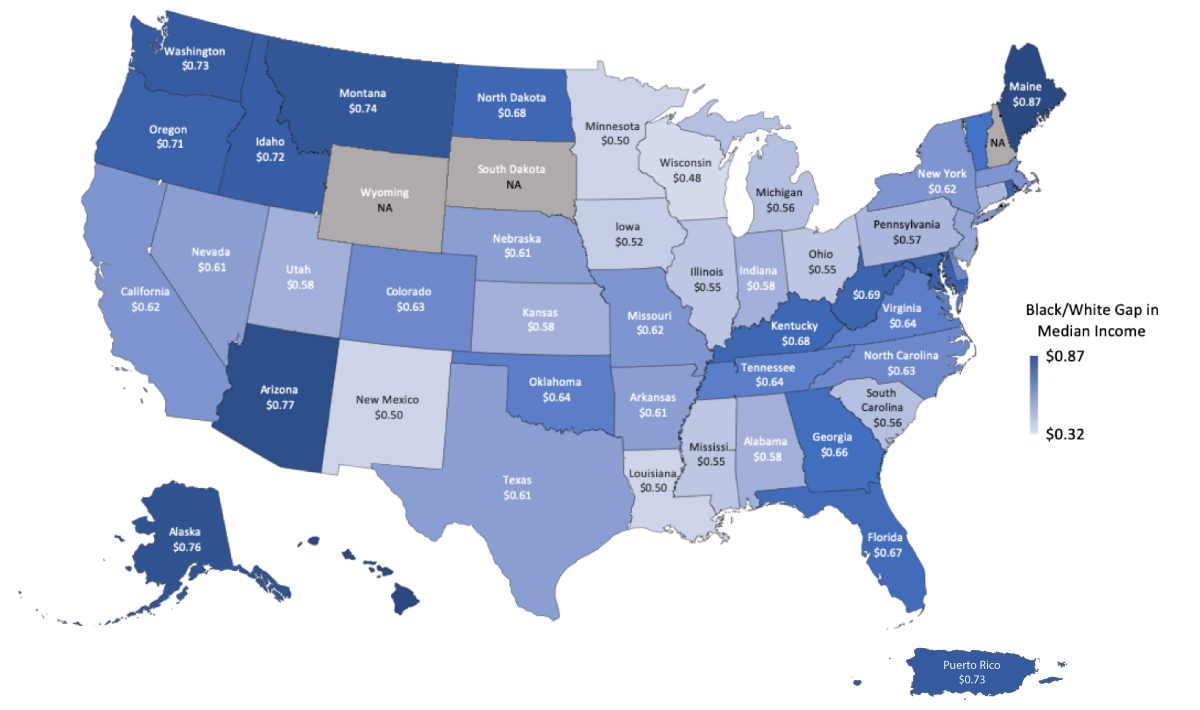
I often wonder about these.
Growing up I watched friends whose families had what you might describe as a cultural distrust of institutions, including schools, or even anyone who seemed to “think they’re better than us” (translation anyone who did well in school or a career).
They constantly made self defeating choices and seemed destined to have the same problems/ poverty as their parents.
Their distrust of institutions like schools could maybe be justified… but they were capable people who made choices that reduced their opportunities.
As an adult I watch my local schools reach out to provide services, help of all kinds and struggle to find more than a handful of takers or folks who want to try…
By no means does that mean there are no other barriers, but even trying to address those barriers/ help, you can encounter some surprising resistance/ challenges.