Hummm, not sure wood pellets are carbon neutral. I think the UK has just offshored its CO2 emissions to the US. Great video below explaining in more detail.
Wood pellet burning is a temporary distraction and distortion caused by regulation that allows it to be counted as "renewable". I believe you can make a reasonable argument wood burning is carbon neutral. Unfortunately, land used for growing forests of fuel represents a terrible opportunity cost - you could grow food or let the forests absorb atmospheric carbon, provide animal habitat, re-wilding, etc.
However, there is no long-term future in which wood pellets are used for much other than limited residential space heating. Cutting down a forest, processing it into pellets and shipping them half way around the world isn't going to be the cheapest option for bulk power production.
Don't let the foolishness of wood-burning being counted as "renewable" distract you from the broader story of the quickly improving value proposition of solar, wind, and (soon, hopefully) battery storage.
I'm not sure you can make a reasonable argument that burning wood is carbon neutral, unless you want to open the door to saying that any CO2 emission is carbon neutral because the carbon can be reclaimed when it is converted into plant matter. It is kind of an absurd argument, unfalsifiable because it also applies to kerogen-based fuels like petroleum and natural gas, both of which begin their long life cycles as organic matter.
Burning wood to generate energy puts more CO2 into the atmosphere than burning fossil fuels to create the same amount of energy, because wood has a lower energy density. Under ideal conditions, most of that CO2 can eventually be reclaimed, if the forest is allowed to regrow. That takes decades, however, during which atmospheric CO2 is higher than it would be otherwise. This creates harms from climate change, including some that are irreversible, like ice-sheet melt and permafrost thaw. But emissions from burning wood are only partially reclaimed by forest regrowth, because:
- harvesting trees results in release of CO2 from soils, which continues for decades;
- burning natural hardwood forest and replacing with fast-growing forest plantations (a common practice), permanently elevates atmospheric CO2 because plantations don’t store as much carbon as natural forests;
- cutting and processing wood uses energy, which generally results in CO2 emissions.
While Biomass should not be treated as 'renewable', the key difference between burning biomass versus coal is that the inherent carbon in biomass could be treated as a cycling of carbon that already exists in the carbon cycle (assuming where it is harvested is then replanted with trees, which many of them are) - versus the burning of coal (or any other fossil fuel) which takes 'stored carbon in the ground' that has NOT been part of the carbon cycle for millions of years and increases the total amount of carbon in the atmosphere & the overall 'natural carbon cycle'.
So - 'in the fullness of time' (decades) it is 'carbon neutral'.
But the tragedy in Biomass is not just the destruction of forests as you mention (sometimes old growth) or the loss of an active carbon sink - the carbon dioxide is still released and will be sitting around when we least need it to - it will still warm the planet.
Hopefully, the EU and other countries will abandon the Biomass retrofits and jump ahead to accelerated Solar, Wind and Energy Storage deployments.
>- harvesting trees results in release of CO2 from soils, which continues for decades;
I coppice, no tree dies, the soil is not disrupted.
>- burning natural hardwood forest and replacing with fast-growing forest plantations (a common practice), permanently elevates atmospheric CO2 because plantations don’t store as much carbon as natural forests;
There are plenty of fast growing woods - willow, beech, hazel
>- cutting and processing wood uses energy, which generally results in CO2 emissions.
Meaculpa - I use a chainsaw, but there is a future in which I can use an electric saw and and axe (I use an axe alot now anyway)
Wood pellets are at least a useful transitional resource. I'm not sure how pellets compare as a coal replacement, but for residential heating a pellet stove is a big improvement over a split log fireplace or stove, in efficiency and air quality.
Do we have carbon neutral batteries yet? Last I saw the production chain for lithium-ion was not carbon neutral over the expected lifetime of the product but rather increased carbon emissions. I’m having a hard time finding numbers to compare with wood pellets or coal, though, so I’m curious if you know.
Batteries are good for N cycles (to simplify) and take M carbon to produce. If it cycles N times and is charged with fuel that emits <M carbon, that’s going to be a net carbon output surplus. This is expected and desired from solar to have some carbon output as a tradeoff to supply bursts of demand, but needs to be compared with eg a comparable coal plant (or “wood pellet” plant I guess) in order to figure out how much improvement it gives.
You can't make an argument that it's carbon neutral -- They don't just burn deadfall, and you can't grow trees faster than you can burn them.
Prior to coal, the developed world burned massive amounts of wood, which contributed to massive deforestation. This is literally a step backwards, and not in any good way. When civilization burned wood for energy >500 years ago, sure, because demand was so low. But by the 1700-1800's demand for energy was so high that burning wood was untenable - coal literally saved the forests. Today, energy demands are exponentially higher, and there's no chance biomass is going to be better than coal from an impact standpoint.
I hate to disagree on renewables, but I think there is also no way renewables as we think of them today (wind, solar, batteries) are going to be the answer either. At best they are a tool enabling independence from grids, but from a worldwide energy demand perspective, they are untenable. I think Michael Moore's recent film did a decent job of outlining the problem. Next gen nuclear is probably our only hope save population reduction (hello COVID).
> you can't grow trees faster than you can burn them.
This is probably true for the UK (large population, not a lot of forest or areas to plant forest).
For e.g. Canada or Sweden it would seem possible. Sweden has 25k square meters (2.5 hectares, or 5 football fields) forest peer person. 85M cubic meters per year is cut down which is around 2% and roughly the same area planted (8.5cubic meters per person). The energy content of it is 150-200Twh which is comparable to Sweden’s energy consumption of 350Twh/year.
Obviously as little as possible is really used for energy because the value in wood for other products (timber, paper) is higher, but at least it shows that the forest as a source of energy is viable and largely sustainable. All that’s needed is a huge country full of mostly forest. Places that don’t have ten thousand trees per head to begin with can’t do this obviously, and countries that do have trees will much rather sell toilet paper and bookshelves to the UK than burn pellets.
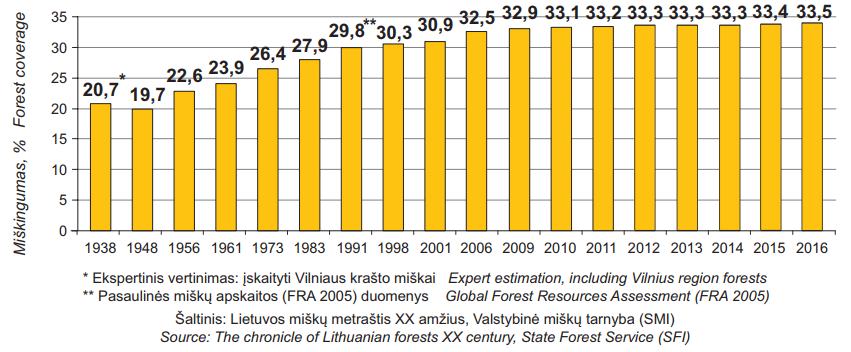
Mass reforestation is possible in a generation or two though... In Lithuania for example a lot of reforestation was done in the later half of the last century, the percentage of the land that is forested now is 33% compared to 20% in the 40s.
I explained in another comment that Michael Moore isn't the first, nor most reputable, to make these points. He's the first to expose the casual consumer to the problem set.
"pretty terrible" and "best available and most recent science" are squirrelly evaluations. To be specific, you're alluding to the idea that the most recent technology improves the efficiency of solar panels and may extend their lifespan, but these marginal improvements in efficiency and lifespan aren't enough to cast aside the incredible costs in strip mining (ecosystem destruction and fossil fuel energy use), manufacturing (energy use), transportation (energy use), installation(energy use and further processed materials), and operations/maintenance (energy use, e-waste). I mean, that's a quantifiable cost to balance against quantifiable (and intermittent) output and the numbers don't bode well for renewables scaling up/out and truly denting fossil fuel consumption.
The core problem is worldwide energy demand is climbing higher and faster than renewables will ever be able to address. For the fractional role they play, the payout of renewables is undercut by the fact that fossil fuels are used to produce and emplace renewable infrastructure, renewable infrastructure (at a facility level) has an enormous environmental footprint (read: habitat destruction), and has to be replaced in a few decades at best. They are producing energy maybe 50% of that time, and despite the improvements in storage tech (which has its own environmental issues), you still need to back up the renewables facilities with.. fossil fuels.
All this is to say that we need to be looking at other sources (e.g. safe nuclear) to displace fossil fuel.
Most of these trees are coming from temperate forests, and while tropical forests don't put much carbon in the soil, temperate forests do. Or rather, mature trees in temperate forests do.
As long as you can keep the temperate zones from moving too far toward the poles (and plant tundra aggressively as it thaws) that's another opportunity cost of cutting them down before they hit their stride.
In Sweden, our agencies classify pellets as better than fossil fuels, but with problematic local effects, and it's estimated that each year 1 in 10000 die from its pollution. (1000 people in Sweden, in a population of 10 million.)
One can assume that locally the effects must be worse?
Some back of the envelope maths, he said it takes an area 18 miles by 18 miles every year to produce 7% of the UKs electricity demand.
Pine trees are harvested around 30 years old (ignoring thinnings deliberately here). So to set up a 30 year rotation of 300 square miles you are looking at an area roughly the size of Wales.
That seems pretty unsustainable from a UK point of view but obviously there are less densely populated parts of the world where wood can be shipped from.
I'm not sure. Perhaps as a dispatchable source of power it makes sense.
There are few coal mines left in the UK so coal has the same issue. I think we can all agree that biomass might be a slightly less bad than coal solution to reliably dispatchable power generation. It's far from perfect though.
Coal is irredeemable. We don't talk about if it's neutral because you can't even see neutral from where coal is.
We need improvements, and we should encourage them. But.
If we stop shy of the goal because people start misusing terminology or using fuzzy math then we are just as dead but drag it out longer. The Earth doesn't care about spreadsheets or feelings. It only cares what actually happened.
Indeed. Japan is actually thinning its forests because its forests are largely monocultures that are so thickly grown that no sunlight reaches the forest floor. https://www.youtube.com/watch?v=VC4gRGPbTqE
Heterogeneous forests sustain more wildlife, sink more carbon, are healthier for the land and use less resources than would be the case for a farmed forest.
Cutting down trees and 'reforesting' is unlikely to be sustainable over the long term for a variety of reasons (soil depletion, inefficient water use, etc. Forests are their own resource. You can't simply grow them back.
The Netherlands, with roughly double the population density of the UK, became a net exporter of food fairly recently. I think they did this by adding a lot of greenhouses.
I think the UK probably can’t add so many greenhouses because, in my opinion, local politics means “pretty” is valued more than “functional”.
This is also why on-shore wind isn’t already everywhere in the UK even though wind farms don’t prevent agriculture.
Aside, but do you know if that means net exporter in value or also in calories? I had the impression all those greenhouses were great at making relatively expensive things like fresh salad, which you can then trade for cheap Canadian wheat etc, but I could be wrong.
To be fair much of Scotland used to be covered in forestry and has been denuded. There are some interesting projects showing what happens if the land is simply protected from over grazing (particularly by deer).
As for grid scale storage, the Tesla battery in Australia is 185Mwh, or roughly a 10th of the amount of power the UK receives from France in an hour as a result of their overproduction of nuclear power. It's a drop in the ocean compared to what would be needed to get us though a stormy night when the offshore wind shuts down in high winds.
Pumped hydro is great but is hugely dependant on topology.
There are some interesting developments like liquid metal batteries that might one day answer the storage problem but none which have demonstrated the scale required to go completely free of carbon emissions.
I think load shaping will probably play a larger part than most people give it credit for. There are some interesting developments, including solid state circuit breakers, which could be switched on and off over a network to reduce the load or to take advantage of over capacity of renewables.
"To be fair much of Scotland used to be covered in forestry and has been denuded. There are some interesting projects showing what happens if the land is simply protected from over grazing (particularly by deer)."
Interesting this popped up, as I'm studying an Ecosystem Restoration Design Course and the first week was studying exactly this, related Ted Talk here - https://www.youtube.com/watch?v=nAGHUkby2Is
But yes, overgrazing is the main culprit there (and also in a lot of other places that have suffered ecosystem collapse).
Can you explain what you mean by food deficit? What counts as food, does wine for example count? How do you measure food? As in what unit, calories, mass, or pounds sterling?
Does the UK produce enough food to feed herself, but chooses not to in exchange for foreign 'delicacies' from bananas to olives?
> Food Production to Supply Ratio is calculated as the farm-gate value of raw food production (including for export) divided by the value of raw food for human consumption. It provides a broad indicator of the ability of UK agriculture to meet consumer demand.
> A high production to supply ratio fails to insulate a country against many possible disruptions to its supply chain. The ratio in 2018 was 61% for all food and 75% for indigenous type food.[1]
My broad understanding is that showing an indigenous type deficit means that it is not _just_ a choice to not do so in exchange for foreign delicacies, as they could be grown in this country but aren't, particularly as "[i]n 2018 the value of imports was greater than the value of exports in each of the broad categories of food, feed and drink except 'Beverages'". It is worth noting that the article states "[s]ourcing food from a diverse range of stable regions, in addition to domestically, enhances food security", so some net negative may not be a bad thing, as it insulates us to some degree from issues that would decrease local production.
Furthermore:
> Domestic production of fresh fruit as a percentage of total new supply for use in the UK was little changed at 17% [...and] for all fresh vegetables was 52%[2]
Even if we were able to produce enough food, in broad terms, to feed ourselves, it may not be able to support a particularly healthy diet, making the imports more of a necessarily than delicacies.
The reason wood is considered neutral is, that most of the wood is used for construction and other stuff. If you burn it and happen to burn fossil fuel as well, nothing is neutral.
No, it's considered neutral because you plant more of it to replace the trees you cut down (not because you are trying to save the world, just because you have some land that's suitable for growing a sustainable commercial forest).
Over the life cycle of the tree from planting to burning, it's carbon neutral, though the shape of it for any given tree is 20 years of carbon sequestration followed by 20 minutes of carbon release.
1. Not nearly enough trees are being planted to offset the ones being cut down.
2. Neutral on a scale of 30 years doesn't much matter when we have to reduce the degree to which we're accelerating a highly non-linear climate change process right now.
But also perfect is the enemy of good. If wood pellets stop us burning coal in the short term while we transition to a carbon-neutral future, then that's surely a good thing.
That is the point where someone bring up photos from almost 100 years ago and make comparison photo of today and notice the obvious: there is a lot more trees in the old photos.
Not 100 years ago, maybe in urban areas that got converted to buildings, but overall, forest acreage in the U.S. has been flat for the past 100 years. If you go back to early 1800s, that would have been a time when acreage was about 25% higher: https://www.fia.fs.fed.us/library/brochures/docs/2012/Forest...
Obviously I don't mean perfectly flat, when we're talking an organic, dynamic system. The trend is flat. See page 7 of the document I linked from the USDA. Even the page you link shows: 766,000,000 acres (3,100,000 km2) in 2012 and 721,000,000 acres (2,920,000 km2) around 1920. Note: "The majority of deforestation took place prior to 1910"
What kind of vehicles do you use to move the lumber from the farm to market, how are the pellet factories powered, and what kind of vehicles are used to move the bulk pellets from US to UK ports?
Growing a tree removes carbon from the air. That's carbon-negative. Cutting it down and using it in construction is still net-negative for the wood itself. (Though probably not when you take other energy usage into account.) In the very long run, the building might be torn down and the wood might rot or burn bringing things back to zero again.
Growing a tree, cutting it down, and burning the wood is carbon-neutral. But it's very dirty when it comes to other pollutants. A catalytic converter can help.
You are right about it being carbon neutral but only from a small frame of reference.
How is the wood cut?
How is the wood transported?
How is the wood processed?
Every one of these steps add carbon to the cycle. Some steps are minimal, others are huge; it all depends on scope.
I've heat my home with a wood-burning stove for 20-odd years. I have my own acreage and friends/family/farmers all contribute. Cutting down a tree, bringing it home, chopping it size so it fits in the stove are VERY energy intensive operations.
> Growing a tree, cutting it down, and burning the wood is carbon-neutral
It isn’t though. A lot of energy is used planting then maintaining a forest for 30 years, cutting it down, processing it then shipping it.
When timber is used in the building industry it’s a bit better but it is still notoriously wasteful. A lot of material goes to site and is binned - offcuts, wastage, over order and material in the wrong place.
The difference is ff's were captured over many millions of years, and natural forces controlled the total amount of co2 in the atmosphere.
What is happening today is the ff's captured co2 is being released a thousand times faster than it was captured, and that is overwhelming natural forces and causing co2 levels to skyrocket. Wood pellets are one of the ways to counter this.
I could be wrong, but my guess is that you already knew all this and were only pretending to be ill-informed because you are a member of the fossil fuels forever club. If I wrong, then please let us know your views on global climate change.
Main difference is releasing co2 from fossil fuels introduces carbon that wood pellets don’t. Imagine we burn 100% of fossil fuels and then start burning wood pellets, versus going straight to wood pellets. The former releases a lot more carbon than the latter.
1. 'Waste wood pellet' power plants are a con job.
2. There is not nearly enough wood waste from construction sites/etc to operate them.
3. They have to be supplemented with wood cut down from forests.
4. There aren't nearly enough forests in the UK to operate these plants sustainably.
5. So, the wood they burn comes from cutting down Canadian forests, trucking them down logging roads, loading them onto barges, and shipping them across the Atlantic ocean to the UK.
By the time you're done with all that, the carbon footprint of your wood pellet plant is greater than that of a coal plant.
Most of your points are verifiable _facts_, so there is no discussion to be had there. However, the _why_ is an important point that you didn't mention.
If these 'bio-mass' operations are so obviously illogical and unstainable why are they pushed so hard?
The large portion of these operations are old coal plants and incinerators. These are effectively wood chip burning furnaces that managed to reposition themselves through lobbying and marketing in order to ride the 'green' wave and be labelled as 'renewable' on paper, enabling them to collect massive amounts of tax payer "green" funding to pay for operational costs that could never be profitable otherwise.
This is a case where you have old polluting businesses trying to avoid bankruptcy by grabbing "green" funding.
PS:
Things I've read in the past from astroturfers on this topic:
- It's "renewable" because we plant trees that capture carbon (not at the rate that you need to burn it to break even).
- It's reclaimed wood (marginal volume compared to forest wood).
- We also burn organic waste (doesn't burn as hot as wood chips).
- It's wood from responsibly sourced forestry (which you transported across oceans from Canada, Malaysia and Brazil).
- It's not sustainable now because we haven't started replacing local forest with fast growing trees (this would absolutely kill local woodland bio-diversity).
Seeing as coal is just as energy intensive to mine and transport, yeah... But I guess his point was that wood burning should be stopped along with coal, because it's nearly as bad.
to make matters worse, all the shipping involves wet wood, which makes the whole process more intensive, as you move a lot of water around, and then ultimately the water contributes negatively to the energy output when processed and burned.
I don't have a source that's likely to satisfy you - for two reasons.
1. Nobody has actually done a through, scientific carbon audit of the supply chain for these plants. You have napkin arguments in film, or on the internet, that you can trivially search for, that conclude this one way, or another, depending on their politics.
2. The carbon cost of running them is incredibly dependent on local conditions of the precise bits of wood that were sourced.
I can expand on the latter.
The hardest part about logging is getting your equipment to the logging site, building the roads to it, and then using those roads to get the logs out. I guess those are the three hardest parts about logging.
If you can cut down your logs, truck them only a few miles, toss them in a river, and then pick them up a hundred miles downstream, to load onto a barge, your carbon footprint is minimal.
If, on the other hand, you have to truck them 15 miles down logging roads, and then 90 miles down a freeway, your footprint greatly expands. (And has to include factors like building the logging roads to begin with.)
Unlike with mining, building logging roads is much harder than building roads to a mine - because you have to cover a lot more ground, to get an industrially useful amount of wood - compared to something like a pit mine. You have to use heavy equipment to drag logs over incredibly difficult, unroaded terrain, so that they can be loaded onto trucks that will go down the roads.
Not to mention importing fuel in a COVID world.
Relying on imports for strategically important resources is a bad idea. As we’ve seen you can’t get enough diversity of supply with sufficient burst capacity to get you through when the brown stuff vs. fan impact occurs.
Shortage of PPE is one thing. Brownouts quite another.
Golang, Micro-Services, Distributed, Machine Learning, Big Data, TypeScript, Cloud, AI, Platform, FinTech, Sourdough, Soylent, Artisan, Small Batch, Craft, Bitcoin (the last one is a joke)...
Ravelin is a new type of fraud company. We are pragmatic in our approach to solving the crime of fraud, which means using bleeding edge technologies coupled with tried and proven methods. We are looking for smart people who have or are willing to learn new skills (machine learning, neural networks, python, golang, cloud automation etc) and are capable of working autonomously, yet are friendly and respectful enough to work in a small team.
As a founding employee, you will be invited to have opinions about direction and product. Your background is unimportant, we care about where you want to go, not where you've been. CV and your github/whatever profiles to jobs@ravelin.com