I highly recommend finding a cloud chamber (various science museums have them) to visualize just how much radiation is flying around.
Part of my work touches high power switches. I am going to do a bad job relating this story, but one of the power engineers was talking about how electric train switches in EU (Switzerland?) were having triggering issues. These were big MW scale IGBTs, not something you want to false trigger. Anyway, they eventually traced the problem to cosmic rays, and just turned the entire package vertical so the die was end-on to space (the mountains around were shielding the horizontal direction), and the problem went away.
> just turned the entire package vertical so the die was end-on to space (the mountains around were shielding the horizontal direction), and the problem went away.
That's a pretty cool solution! For some reason I was expecting something a lot more elaborated
As a corollary, would the ~$1T of (mostly?) state-backed investments into the developed world then imply a fairly large exposure to potential asset forfeiture/freezing in the event of a Taiwan invasion (analogous to the ~$300B in Russian assets frozen pending Ukraine)?
People assume China is an incredibly smart entity who won't make major errors like Western nations do, when everything we know tells us authoritarian regimes are more incompetent. I don't think it's so deep. They are an economic superpower with deep pockets and are not averse to taking huge risks. So far it's going their way. Another thing is that they can break half the world in a couple of months if they like. They even did it once already by accident.
I mean you could be right that the Chinese govt was simply investing in overseas businesses...and by pure chance it HAPPENED to be one with a list of various CIA personnel.
...even I don't believe in coincidences so convenient however...
Out of curiosity, what happens when someone does not own a smartphone (or the battery is dead)? They just can't fly?
And, if their server flaky, does that mean all boarding will stop? If the agents can check people in manually, it seems like the small fraction of people using a paper boarding pass can't be adding much extra cost. If they are saving cost by removing that flow, presumably they are giving up redundancy. Given the quality of airline software, I predict they will see a mass outage within a year.
The whole business model of discount airlines is to cater to the fat part of the bell curve and not the long tails. If you require special accommodation at any point in the process don't fly via a super budget value airline. Even if they do support your use case, they're not in the business of making it easy and they'll hit you with a "fuck you" fee to make it worth their while.
They'll make accommodations, but those will be very budget accommodations and not comfy, just like everything else about them.
Hence why you're better off going with something else. In fact, you're almost always better off going with something else. I'm not a giant, but at 6'4" (1.93 meters) I've found that I absolutely detest most shared transit. Either my legs are too long or shoulders too broad, and even non-budget airlines can be unpleasant to fly in.
I had the misfortune of acquiring a temporary disability while I was overseas and it kind of opened my eyes to how shitty the west treats the disabled. While I was in eastern airports the staff were tripping over themselves to accommodate me. I was assigned at least one person whose entire job was to stay with me and take me where I needed to go. They handled my bags, security, even got me food and drinks when I got hungry. It was beyond respectful. But as soon as I got to the western leg of the journey home I became a burden. I basically just got a wheelchair and my partner had to push me around while juggling our luggage.
It's crazy to see real life proof that it doesn't have to be this way.
Every American I know who has spent time overseas comes back with at least one thing where they can't believe how massively we've screwed it up while also somehow ignoring that it's been being handled far more sensibly by others.
Yeah, disability accommodation laws are pretty weak, even in the countries with the strongest protections. "reasonable" accommodations often equate to situations that still don't actually provide practical accommodations for people.
I'm not sure I understand. It sounds like you're saying you don't like the leg room being so cramped that beyond a certain height you're physically required to angle your knees into a neighboring seat's space. That's surely part of the charm though?
It's bad enough when I have to fight for elbow room with the people next to me. It's a whole 'nother experience to fight for the elbow room of the people in front of me to have a place to put my knees.
It’s true, in my experience at 6’7” it is much nicer to fly private. Shared transport offers a much inferior experience except on long haul flights where you have actual first class, but even then you need to be careful while booking to not accidentally end up on some silly plane.
I once flew from London on Ryanair when the airport's passenger Wi-Fi was completely down, and 4G was completely overloaded as a result as well.
Things were indeed pretty chaotic. I can't remember if they did print paper boarding passes in the end.
> it seems like the small fraction of people using a paper boarding pass can't be adding much extra cost
You're looking at this from the wrong angle: This is Ryanair. Actual cost does not matter, only the opportunity to extract more revenue. Presumably app users are that much more valuable to Ryanair (as they can be upsold various things there, and potentially because it also acts as a filter for a generally less profitable customer segment).
It's also a marketing channel for future flights. The app almost certainly asks for notification permissions, and most people will say yes -- they're useful for knowing if your flight is delayed or there's a gate change.
Now they have a channel where they can let you know about deals, etc. I'm sure they've modeled exactly how much this is worth, and I'd be willing to bet it's a lot.
Isn't that against App Store guidelines? (Not that Apple could afford to kick out Ryanair, but I think they have other options, such as blocking updates until it's been remedied etc.)
The upsell opportunity isn't worth anywhere near $50 though. I suspect it acts as a price discrimination filter. You make people jump through hoops (ie. installing an app) to save some money, with the expectation that people who are willing to jump through hoops are more price sensitive, and would also be willing to switch to another airline.
They already charge that and more if you have to check-in at the airport for any reason. And you cannot check-in online without making an account with them. Ryanair is grift squared.
That said I never had problems boarding with a PDF displayed on the phone screen. Unfortunate that they're going away.
Stupid question here, because I haven't flown with Ryanair in like almost 10 years, but I've recently flown with WizzAir and after checking-in online (the night before) it generated a .pdf boarding pass which I saved on my phone. I was then able to get onto the plane by presenting the QR code from said .pdf, i.e. while I was at the gate, no need for internet access. Does Ryanair do things differently?
These byzantine arguments and justifications and profit motivation and incentive tea readings are so ridiculous at a certain point, I'm surprised so many people wont even consider socializing airlines.
What a cold comfort to a grandma struggling to use an upsell-focused dark patterns app when the wifi is poor at some airport to get home to see her grandkids stuck at some airport to say, "Well, this maximized shareholder revenue."
I feel like I'm in the last stages of 'anything goes' capitalism. The ridiculousness here has hit such levels, especially in the USA, that there must be pushback sooner than later. I dunno how the Irish feel about this considering this is their airline (HQ at least), or their experiences, but on this side of the pond, this has all has reached new levels of absurdity that would make even Kafka blush.
I just randomly checked Dublin to Rome route, for early December. The first 3 cheapest options are Ryanair, the 4th option (Air Lingus) is almost triple the price of the cheapest one, $262 vs $90
That’s your answer. People vote with their wallet.
Contrary to what many replies are telling you, the link clearly states that if you don't own a smartphone, you can check in online and then obtain a boarding pass for free at the airport.
(Not sure how easy that will be or if they actually verify that you don't own a smartphone, etc.)
>Contrary to what many replies are telling you, the link clearly states that if you don't own a smartphone, you can check in online and then obtain a boarding pass for free at the airport.
The press release says absolutely nothing of the sort.
Technically, the vast majority of users don't own their device. They are leasing it through their carrier. Then because it is HN, once the device is paid off, the user still doesn't own it as they cannot use it as they see fit and still must use it as the manufacturer sees fit. So this "own" word is potential for interpretation
Frontier already expects digital boarding passes. I do not own a phone, so they charged me a $25 fee to print one at customer service. Except they also do not accept cash, so I had to go buy a gift card with cash from a vending machine for another $5 fee.
For $30 I could buy an entire discount printer and print one myself.
I've once been in that situation with Ryanair: I booked through some reseller, not knowing that they'd make all bookings using some omnibus Ryanair account they would not share the password for (so mobile app use was out), and only emailed me the boarding pass PDF. But I didn't have a printer...
The airport business center did have one, with a moderate 50 cent per page fee – except if that page contains a boarding pass, in which case it was 8 Euro.
I would've photoshopped the barcode onto a Covid certificate and then ask to print it...
Isn't barcode on the PDF good enough anyway, to be scanned by a machine (either biological or electronic)? Obviously it's Scamair, so they could've imposed dumb rules like "we need the physical paper"
Yup, that's it. They explicitly weren't allowing scanning off of a screen, as far as I remember. (The code on the screen might be fraudulent, after all – can't do that on paper!)
> Out of curiosity, what happens when someone does not own a smartphone (or the battery is dead)?
Or you drop your phone. Or it gets stolen. Or for whatever reason the software fails. Electronic devices are so flimsy, even if you want to use an app it's worth having paper as a backup option. It's the same reason why I always carry cash and a card on me (and I pay in cash as much as possible anyway).
> If you have already checked-in online and your smartphone or tablet dies,
you will receive a free of charge boarding pass at the airport.
> If passengers don’t have a smartphone or tablet, as long as they have already
checked-in online before arriving at the airport, they will receive a free of charge boarding pass at the airport.
Not to mention that the hard copy always scans flawlessly at the gate. Phone scans, not so much.
Not only does the phone scan not work well, but people often aren't prepared and so the boarding line stalls while people unlock their phone and retrieve the e-ticket.
> Not to mention that the hard copy always scans flawlessly at the gate. Phone scans, not so much.
Not true. Recently I printed a hardcopy of my boarding pass at the airline's kiosk, then found it wouldn't scan at security. Luckily I was able to pull up the barcode on my phone.
Ouch. Perhaps it's a dice roll either way. I guess I just assumed everyone else also had issues with phone tickets, and not with paper. You and your sibling comment have opposite experiences however, so it seems I must retract my statement.
This is simply the mindset of discount airlines. If your battery is dead when you arrive at check-in that's too bad for you. It's in the terms and conditions.
If the server is flaky then boarding will be delayed for everyone and it'll be a whole crapshow but if their overall cost is lower than it would have been with printed boarding passes, fine.
Usually they'll happily help you out with a "late boarding pass printing fee" on the order of a hundred €/$, though.
If this really is a total refusal to do even that, I'd be slightly surprised, but I'm sure their business developers have done the analysis and it makes some sense to them.
You would also be surprised at how 'tech savvy' non-tech people are in the UK. It is quite common for non-tech people to screenshot train ticket QR codes just in case they have no signal at the station yet none of the common train booking apps suggest this.
Rest assured, Ryanair knows their passengers very well. They know that every single one of their passengers knows how to babysit a smartphone so the battery doesn't die on their flight. Let's be honest, sudden unexpected incontinence is more likely than a Ryanair passenger fluffing up their pocket device for doom-scrolling.
For more fun, Frontier's app doesn't even run on my phone. Step 1 to fly with them is to go buy a phone from the last 2-3 years (can probably get away with something a little older if iOS).
Passport/EU-ID to check you already have a ticket should be the standard. Everyone saves time and money this way BUT now they can earn more money at the gate.
That's normal in the Schengen area, you only need ID if you're checking a bag. (Or if there's a spot check by police, but they won't care if your boarding pass matches your ID, just that your ID is valid.)
Re: the "their server is flaky" (I believe you mean at the gate) case, I think any airline might be then struggling with boarding passengers, whether they have paper boarding cards or not.
>For what it is worth, at least on iPhone you can still use the bus/train pass feature in Wallet even when the battery is dead.
AFAIK that only works for NFC passes? For passes that are just qr/bar codes I can't imagine how that'd work if the battery is actually dead. The "use bus passes when battery is dead" feature only works because there's dedicated low power circuitry to power the NFC hardware, which obviously doesn't exist for the display.
It depends on the details. Last time I flew I used the airline's app to get the ticket which were then immediately loaded into wallet and read via NFC at the gate.
But this is Ryanair so it's probably going to do some stupid QR thing that will be super touchy and be a struggle to work on at least half of the devices. Bonus points if the app refuses to start if it can't make a live internet connection back to some cursed cloud service so the people waiting in line who accidentally let their phone go to sleep find they can't get it to show the ticket in the dead zone at the gate.
You need the app to download the pass (AFAIK) but it goes into your Google/Apple wallet after that. I have the app disabled (so it can't run in the background, as much as possible), and I only use it to get the pass.
I wish they'd just let me download a pkpass file, but what can you do.
We talk about ryanair, the scummiest of the bottom scum of airlines, they wanted to charge everybody 2 euros to use toilet (or did it pass? I can't imagine in EU, I would piss on their cabinets since I don't carry coins around).
I always print boarding passes, traveled enough to see tons of people struggling with their phones, with their pdf viewers or airline apps, to block everybody else to know what good manners and empathy to others (or simply less stressful travel) are. I wish I could save that atto fraction of a planet by not printing but it can't be like that with current ways of things.
Luckily ryanair is mostly absent from our airport (Geneva), its Easyjet all the way, way more than even Swiss airlines which chickened out on numerous levels on every swiss airport apart from Zurich. They are low cost with their share of issues but man, compared to ryanair they are absolute top versus rotten vomit, to keep things polite but precise.
> Out of curiosity, what happens when someone does not own a smartphone (or the battery is dead)? They just can't fly?
Yup, based on this announcement, and previous policy calls they've made, that person won't be able to fly. End of. They lose their seat, kthxbye!
Ryanair has made its way in the budget market (arguably inventing the budget market to some extent), by employing money-making practices of dubious need from charging people to use toilets on-board, to flying with so little fuel that they regularly call fuel emergencies on approach.
Their bet - that the market seems to support - is that people will put up with almost anything if it means a cheaper ticket.
They're even expecting to get clearance from authorities to get rid of proper seating and move to "standing seats" so they can get more people onboard, their theory being you'll stand for 3 hours on a plane if it means your ticket is x% cheaper.
I refuse to fly with them on principle - they're a terrible airline owned by a terrible person, run in a terrible way. It's only a matter of time before people realise just how dangerous they are as an operation. I hope it's just a data security issue they run into and people run away from the app scared, and not the increasingly inevitable hull loss that many have been predicting for years.
This is just another reason not to fly with them, for me.
This is a PR stunt that is regularly used (like the idea of standing-room-only tickets) to generate a new round of press for the company and highlight how cost-efficient and ruthless they are, which aligns with their branding and keeps the story alive.
I understand the sentiment but as sibling comment points out, you're very light in the way of stating facts to back up these claims.
There's an interview with the CEO where he explains (claims) the idea of that policy is to reduce demand so they can leave out a couple of toilets and put in / sell more seats -- it's not about the charge for the toilet per se.
May I point out that your counter-argument to "this is a PR stunt" is "no no, the CEO himself floated this idea publicly and got interviewed in the press to talk about it".
>to flying with so little fuel that they regularly call fuel emergencies on approach.
If you're talking about the recent incident, I thought that was because they tried landing several times at different airports? Is there any evidence that they routinely fly with less fuel buffer than other airlines?
Sure, I first heard about this years ago when Channel 4 (a UK broadcaster) ran a program about pilots stating they were concerned about the policy. There had been outrage within the aviation industry after three fuel emergencies in one day at one airport. [0] Ryanair sued [1], and lost: Channel 4 had engaged in fair journalism, it turns out.
Seems they're still at it, hence the recent incident.
All three flights were diverted due to weather, and none of them fell below the legally required amount of fuel. One has to wonder if it’s really reasonable to criticize them in this instance if a single weather event affected them all.
I hate just about everything I know about Ryanair but if they're not below required limits, then I'd say they're not the problem and the point is moot.
I mean it isn’t surprising people put up such abuse when I find that usually these discount airlines are half the ticket price of a major carrier for the same sort of flight. I’ve gotten remarkably good at efficiently packing my allotted small personal item bag.
Except when I asked someone who makes cheese in Switzerland, they told me almost the opposite (and mostly that they export the junk cheese to the US and keep the good stuff).
As an aside, what are the odds this article was written by AI? It has that feel (minus random bolding and bullet points).
I don't know what to make of that statement. It is arrogant, at least. Are you trashing just the 340 million people in the US with this comment, or everybody not-Swiss?
I think this is certainly the root of the misunderstandings in this (and other) spaces.
At the very-local level of course there are exceptions, but generally speaking US food is terrible compared to European food. The US optimizes for volume and cost, Europe leans more towards quality.
Yes, there's a lot of cheap rubbish food in Europe, but those consuming it know it's cheap rubbish.
By contrast, and to your point, most Americans have never experienced really good food, and so it's harder to grasp that their "regular" quality is so low. We don't miss what we've never had.
My local, nothing special, supermarket stocks over 100 species of cheese. I remember going to the US and being confronted either 3 (American, whatever that is, Swiss and Cheddar. Um, which is unlike any cheddar I've ever had. Frankly the biggest difference seemed to be the color (which is artificial).
Think is, you can't describe sailing to someone who has never seen the ocean.
Increased travel, the growth of "American in Europe" YouTube videos, have slowly started permeating though and quality food is starting to appear here and there. But (naturally) its more expensive, so most Americans will be slow to adapt.
> My local, nothing special, supermarket stocks over 100 species of cheese. I remember going to the US and being confronted either 3 (American, whatever that is, Swiss and Cheddar. Um, which is unlike any cheddar I've ever had. Frankly the biggest difference seemed to be the color (which is artificial).
When was this comparison done?
In the last decade or so American grocery stores have dramatically improved their cheese selections. I don't know if it is 100 different cheeses, but it is pretty darn close. And unusual regional cheeses come in all the time.
> In the last decade or so American grocery stores have dramatically improved their cheese selections. I don't know if it is 100 different cheeses, but it is pretty darn close. And unusual regional cheeses come in all the time.
Eh, I mean, sure, if you go to a Whole Foods or Trader Joe, you’ll find cheese that might rival a discount chain in France at premium prices. If you go to Safeway, Target or Walmart, the cheese will not be anywhere near what a French (or I assume, a Swiss) person would find acceptable.
It is increasingly trendy for grocery stores in America to have a "fancy cheese" section because the unit cost (eg dollar-per-ounce) of cheese makes it profitable. I'm guessing Europeans are paying high unit cost too, but don't mind because it's more socially engrained to seek out "quality" foods like fancy cheese.
In the USA, cheese is either a salad topping, a sandwich/burger topping, or a pizza topping, and not much else. I once bought some pecorino romano to make cacio-e-pepe and regret doing that, it's an overhyped dish.
Honest question.. where? Most bread seems to be high in additives and promoted as a “healthy food”, like additional vitamines etc.
And even when buying natural bread without these added “benefits”, it often has high levels of sodium (up to like 200mg per slice).
Bread is one of the easiest, most plain things to make, yet finding high quality bread isn’t straightforward in the States. But I do really want to know which shops and which brand you get, I’d love to find good bread lol.
Yup, agreed. The first thing my gf complained about when coming to North America for 6 months was the food. And she never stopped complaining.
Then we went to Germany and I finally understood.
Not only can I pop in to the local bakery on the corner (or the next corner, or the next) for the most amazing breads ever, but I could also go to a Rewe or Edeka and get quite good bread that's still head-and-shoulders above anything in America.
My fav right now is a walnut spelt bread roll that I get for 90 cents apiece at Edeka. A bit pricey but it's worth it. Put on some President butter [1] and some cheeses and it's divine!
Yeah, I was like that. It’s been almost 5 years so complaining is to a minimum, I got used to a lot of the food, but bread is one of those “staple foods” to me that still has me complaining every now and then haha
Search Google maps for "bakery" and sort by rating.
It's not hard to find a good bakery in any dense area in the US. I have to imagine people claiming otherwise are indulging in Yankee-bashing, a favorite European pastime.
What one considers a "good bread" or "good bakery" depends on the person. I'm from Switzerland. When I was in the United States (Bay Area, San Francisco), in 2000-2003, I did _not_ find what I consider a "good bread". I did find "bakery".
I mean, in San Francisco, you’ll find plenty of good bread and pastries, it’s the only mid size city in the US that has enough French people to have two competing French language schools for kiddos.
I live in the largest city in the US and saying that the average bread/pastry quality even comes close to Europe is insane.
Sure, you can get good bread here. However it's going to cost you 5x what it costs in Europe and it might take you up to 30 minutes to get too depending on where you live. Most bread in the US is low quality. Most bread in Europe is high quality. There is good bread to be found in the US, and there's bad bread in Europe. But the average bread just isn't even close to being equal.
I can walk five minutes to a local grocery store and get fresh bread from their bakery. Immigrant bakeries are also great, I had some buns from a chinese bakery last weekend that were a "if this is what food is supposed to taste like, what have I been eating until now???" moment
My partner is Chinese and so we get Chinese (and bread-like products from other Asian countries) quite often.
In my opinion, it’s tasty but also not quite what I would expect bread to be like, mainly because it’s so soft. It is a running joke between us that Chinese teeth can’t chew through European bread (like an actual French baguette).
But agreed, Chinese bread > American bread for flavor at least!
> Bread is one of the easiest, most plain things to make, yet finding high quality bread isn’t straightforward in the States
Finding high quality bread isn’t straightforward anywhere in EU. It either has sugar or additives or it is cooked at a too low temperature to be useful.
Wondering why someone did not solve the problem already? Of all the countries in the world US is brimming with entrepreneurs who want to "solve" a consumer problem, and with modern population I assume there is enough demand on fresh/healthier products - why on earth someone wouldn't try to fix it there?
Most Americans are fine eating stale or preserved bread. (Almost all pre-sliced supermarket bread is the latter.) You just don’t have enough people to spread the cost of baking fresh bread throughout the day outside wealthy communities.
That said, a lot of European bread is also trash. There are simply some bread-loving ones where it isn’t. Similarly, there are places in America with great bread (New Orleans, New York and Miami), and places without (Northern California and the Midwest).
> That said, a lot of European bread is also trash.
Yes thank you for pointing this out. I've noticed even the bakeries around me (in Switzerland) aren't that great; for me the best are from the farmers markets and even still you have to be discerning for which are actually good. On the other side I've had some fantastic bread in the US from specialty bakeries.
Solving the problem of european tourists being unable to figure out that they have to walk to the bakery section of the supermarket rather than the shelf-stable bread-like products section if they want something they consider bread does not sound like much of a business opportunity.
>Solving the problem of european tourists being unable to figure out that they have to walk to the bakery section of the supermarket rather than the shelf-stable bread-like products section if they want something they consider bread
Every supermarket I can locally go to has a bread-on- the shelf section, as well as a very fresh bread section. Not to mention 'bread shops' exist.
Don't underestimate the ability of tourists from anywhere to not understand how to look around a shop.
Finding bread in America that isn't over-overloaded with sugar is very difficult.
Quite a few of my family take their own bread to the US.
Of late, the problem has been solved as, apart from work, people just aren't travelling there anymore - for non bread-related reasons, of course.
For the US fam that now travel back to the eu (an awful lot) more, they go wild for eu bread: it just doesn't taste like cak, /sp - i mean cake.
Because this isn't the sort of problem some tech bro entrepreneur can solve. Its a systematic problem in the whole supply chain that end with consumer demand. And this is harder to do, once that whole supply chain has been destroyed. You need to shift the whole culture in terms of what they value and how it works.
None of the breads listed there I would consider to be of the category "bread" as a German, and what I would be looking for when I wanted one.
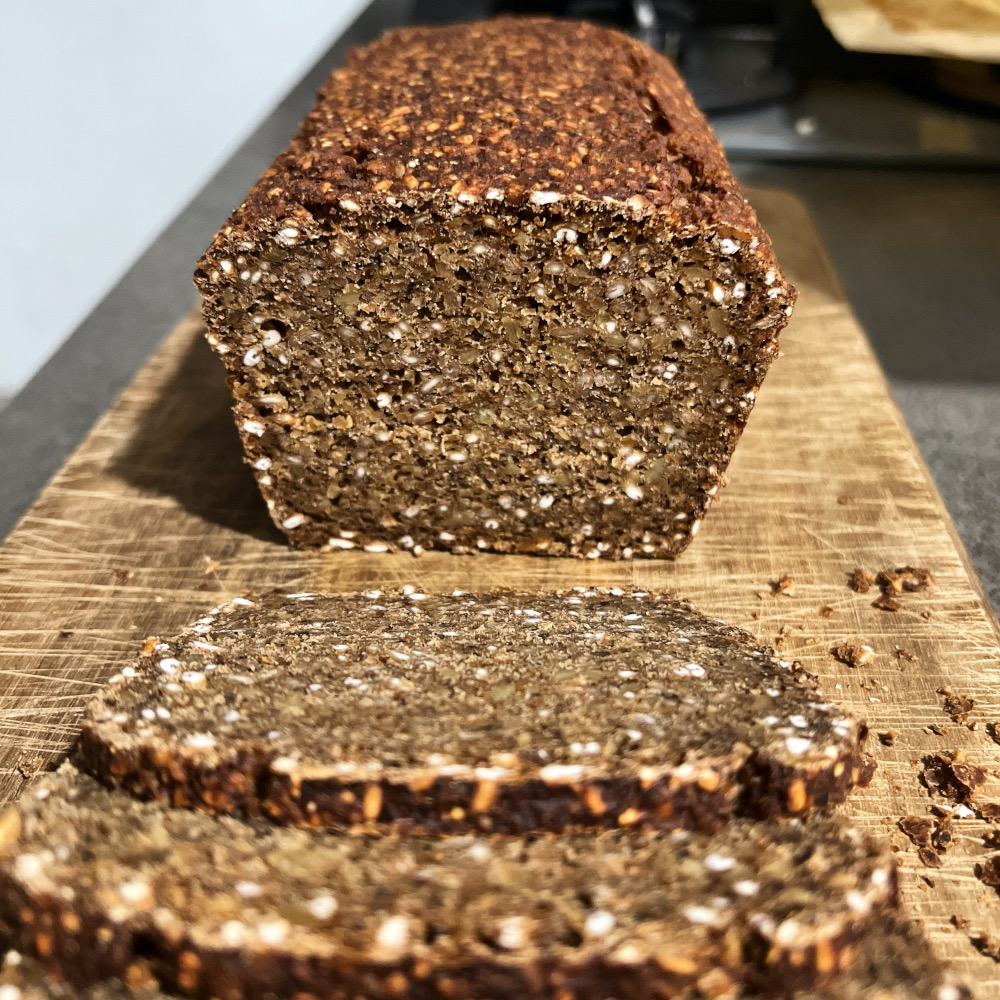
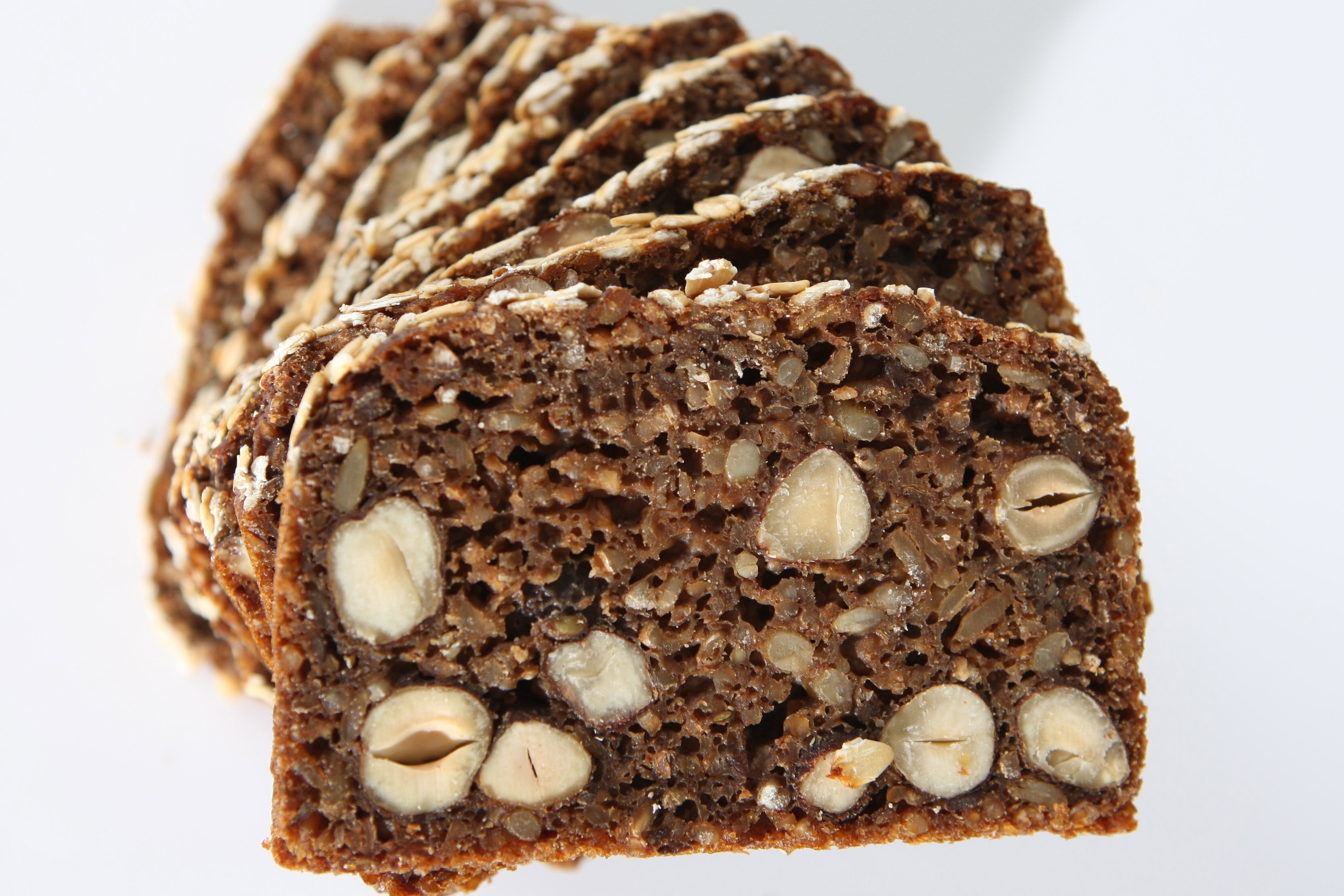
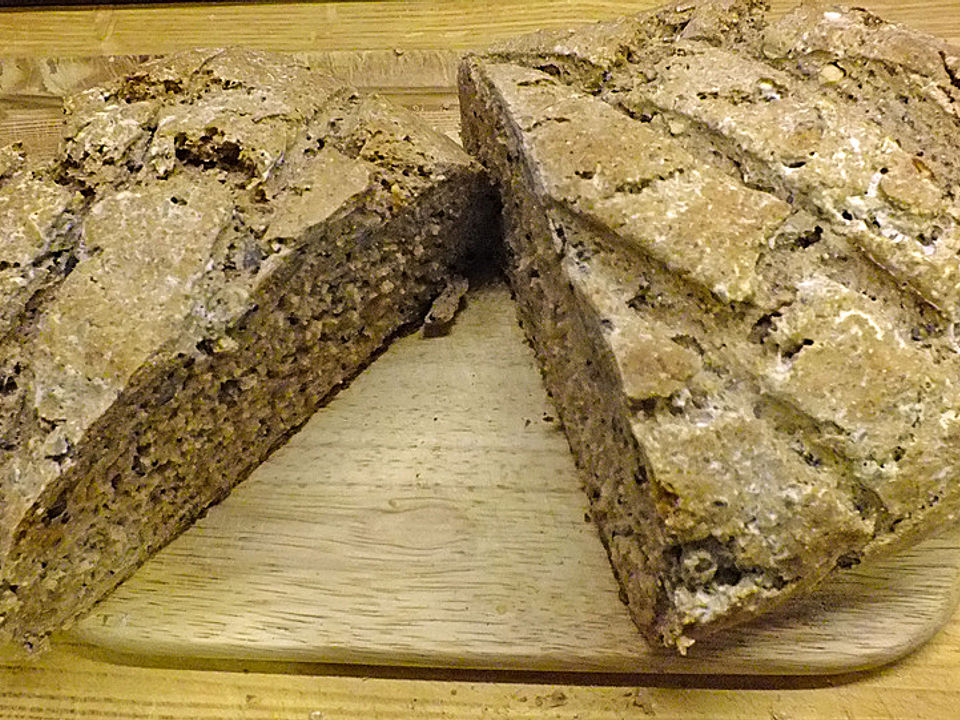
Yes, a French baguette-type soft white bread is formally "bread", but it is treated as a different/single category here, as "white bread". With examples of typical bread being, say: https://www.hofpfisterei.de/download/Hofpfisterei-Sortiment-... And I don't think the images really carry across the difference (and variety) in texture and density, to someone who simply never had this kind of "non-soft" bread. You can spread cold butter from the fridge on it without breaking it, maybe that gives away a hint towards the difference. Also note the variety of grain: rye, spelt, wheat, barley, oats, in different compositions and degrees of fineness. And this is just one brand/bakery.
Some more "typical German bread" images. I picked types that maybe convey the difference to "white bread" the best in viewing:
It's arrogant, but have you travelled to Europe? Food is generally a lot better than in the US, and I mean this starting from the ingredients themselves, so it might have some snarky truth to it.
Good cheese is hard to like, and even here we are judgmental. People who buy the cheap Emmentaler from the supermarket vs the more fancy one from the cheese shop. Most American 'swiss cheese is garbage' sorry. Then the 'Mild' here isn't that good.
I would watcher most American literally have never in their live ever seen how 'rezent' Emmentaler is supposed to look. Honestly its hard to get even in Switzerland.
A proper 'rezent' Emmentaler literally has a thick salt crust inside of the holes.
This is typical even in Switzerland, and I wager its better then most 'Swiss' you get in the US:
But to get that, you are going to have to store it a long time, and that reflects in the price. The stuff sold in the US is usually stored much shorter.
Standards come from a mixture of culture and attention. The reason SF pizza is so much worse than NY pizza is that SF does not have culture of high quality pizza (I say this as an SF native). Conversely we have higher standards for Sourdough. Seoul has higher standards for Kimchi, you get the idea.
Everywhere is like this to some extent - no people can be an expert in all things.
> It is arrogant, at least. Are you trashing just the 340 million people in the US with this comment, or everybody not-Swiss?
You’re parsing discernment as a value judgement. Don’t do that.
New York City has America’s best bagels. This is because OG bagels are best fresh, and making them fresh multiple times a day takes a lot of work. (They stale super fast because gluten is a bastard. Hence toasting.) To pay for that work at a non-ludicrous cost per bagel, you need lots of reliable demand. That really only happens when you have an ecosystem of people who have been eating bagels all their lives made by folks who have been making them similarly.
You don’t find great bagels outside New York (at an affordable price) because the demand isn’t there. Meanwhile, if you haven’t spent time in New York, you probably don’t know (or care about) the difference. Which means you’re unlikely to give excess patronage to anyone who tries to do it right if they try to do it near you. That doesn’t make anyone outside New York who likes their local bagel wrong; it’s just that economies make it very difficult, and frankly pointless, to replicate the New York bagel elsewhere.
If the people in your town will pay extra only for great cheese and the guys across the pond will pay the same price for mediocre and great cheeses, the deck is stacked. (And to be clear, you can find great Swiss cheeses in America. What you can’t is great Swiss wines.)
I'm not a fan of New York bagels. They're generally too doughy and "white bread" tasting for me. Plenty of places have excellent bagels that are pre-boiled with lye. The lye boiling process is not special. What is unique is the particular taste and texture, and it's just one kind of bagel that you can prefer or not prefer.
Your whole comment below about "discernment" and seeking New York bagels out sounds like a personal preference (bred by familiarity), not actually finding the creme de la creme of bagels.
The same goes for Chicago/New York pizza. It's not special. It's just the pizza you metaphorically grew up with.
It’s one element. The result, however, is highly perishable. You can make it last a full day in the counter, but that fucks with the texture.
> it's just one kind of bagel that you can prefer or not prefer
Sure. Same with various cheeses. Or beef.
Kobe beef is predominantly consumed in Japan. A bit makes it out. But you can generally serve someone who hasn’t spent a lot of time in Japan other wagyu and they’ll be happy. You won’t get away with that with a Kobe aficionado, and there are simply more of those in Japan for self-reïnforcing reasons. (I personally like a range of beef, and while Kobe is great, it’s not something I seek out.)
Almost every city has several bakeries that make lye-boiled bagels and plenty of other things that are baked and stocked daily. Most bakers I know will donate their stock of all breads to a homeless shelter at the end of the day and start fresh on new bread in the morning. You don't need extremely high volume for that.
But not multiple times a day. A New York bagel noticeably stales after a couple hours.
Baguettes are the same, by the way. The little handies? If made plainly, correvtly, they change immeasurably once they cool.
When perishability is measured in tens of minutes’ intervals, your economics require a large city of aficionados. (Not applicable to cheese, obviously.)
Most good bakeries everywhere stock multiple times a day as stock gets low. Even the ones selling American baked goods and things like cupcakes because all of these things have shelf lives of hours. Do you believe that New York is the only place in the US where you can get a baguette or a loaf of French bread? Do you think it's the only place you can get a cake?
Having high foot traffic and understanding supply and demand are not unique to New York. The specific type of bagel is, though, because it's a preference rather than a sign of quality. You have fewer bakeries per square mile outside New York, but you have fewer of everything per square mile outside New York. Many cities around the US are plenty dense to support people who make high-quality baked goods.
> Most good bakeries everywhere stock multiple times a day as stock gets low
The stuff that sells. In most bakeries, that doesn’t cover bagels.
> Do you believe that New York is the only place in the US where you can get a baguette or a loaf of French bread?
Nobody claimed this.
> high foot traffic and understanding supply and demand are not unique to New York
It absolutely is. New York has entire American cities’ worth of people in single city blocks. That drives niche culinary diversity in a way that’s impossible to sustain anywhere else in America.
> Many cities around the US are plenty dense to support people who make high-quality baked goods
Again, never contested. But not as wide a variety. You can’t profitably make every sort of baked good fresh every few hours in a town smaller than a few hundred thousand. You can find that within walking distance for bagels, cubanos, naan and dumplings in a lot of Manhattan.
I'm definitely not on the same wavelength as you this evening.
> New York City has America’s best bagels
That's a big claim.
You say it's because they are best fresh -- are you saying that the rest of the country does not have anybody who makes fresh bagels? That's what I get from your first comment, but then you moved the goalposts a bit by qualifying "at an affordable price." So maybe other cities in the US do have bagels that are just as good as NYC but they are more expensive?
I see there is one final qualification you've made: "the New York bagel." In that case, obviously NYC has the best New York bagel ;).
> are you saying that the rest of the country does not have anybody who makes fresh bagels?
Of the kind that stale in two hours? Yes. It wouldn’t be economical.
> maybe other cities in the US do have bagels that are just as good as NYC but they are more expensive?
Never say never, but I haven’t seen it. I have seen private chefs pull it off. But they basically required a sous chef to deal with the lye and boiling.
> there is one final qualification you've made: "the New York bagel." In that case, obviously NYC has the best New York bagel
Yup :). (I qualified the first reference with OG, btw.)
But I’m going further. You can’t make a New York bagel outside New York without hundreds of customers reliably streaming through the door who will fuck off if you try to take a shortcut.
Other cities have great bagels. (Montrèal.) But they’re not that. That’s what I mean by discernment. Literally, discerning one thing from another. If you’ve eaten New York bagels for a stretch, you can discern them from others. If you like that, you’ll seek it out, rewarding those who do the work and punishing those who dope them with preservatives. That creates symbiosis between the bagel eater and maker.
Same with cheese. Same with barbecue. Or chivitos or chaat or all the other local, perishable yummies that are peculiar in an infuriatingly-tedious way.
A minor correction to your base premise - There is a bagel shop in Newton MA that is open for a few hours in the morning that has bagels just as good as NYC.
People line to before they open and the bagels are quickly sold out in a mad rush.
There is a French bakery close to me in Seattle there makes croissants in the morning and they sell out in less than 2 hours. IMHO they are the best croissants in the city, although we have quite a few good local bakeries.
There is a near 5 star restaurant in Duvall Washington called Flavor Bistro. If you ever find yourself in Duvall for whatever reason, go eat there! The chef is super nice and the food is amazing.
Random lolwtfbbq quality restaurants are some of the best finds.
I think it is Rosenfeld but that is just random Google search, I haven't been to Newton in probably a decade. My fiancée (now wife) used to live there and I'd fly out every other month to visit her.
I also remember Johnny's having pretty good corn beef hash. 90% of the corn beef hash here on the west coast is way under seasoned.
The bagels at Rosenfeld aren't the exact same as NYC (water yada yada) but they are quality wise really good and the toppings are amazing.
Random fact - to pay for my trips I'd right up a patent application on my Windows 8.1 tablet on the red eye JetBlue flight. My LD relationship is why I hold so many patents!
> I don't know what to make of that statement. It is arrogant, at least. Are you trashing just the 340 million people in the US with this comment, or everybody not-Swiss?
Not arrogant, just a fact of life.
In the same way that the average Dutch palate is content with food produce of mediocre quality and taste, and is satisfied with food that would make the average French or Italian wince.
Being discerning about the quality of your food is something you pick-up intuitively from birth. Some cultures have it, others don't.
Different countries have different tastes (Coca Cola has a different syrup mixture for each countries for instance). There's a YouTube video from a franco-japanese guy who interview a Japanese cheese maker. He was trained by a Swiss person (but in the US, of all places) and softly complained that Japanese palate favored more bland cheese compared to what he experienced.
So it makes sense for a Swiss cheese maker to export a more marketable cheese, which are generally less strong and younger than the local one. Just like there's an export Guinness or Kilkenny that different from one you'd get in Ireland.
Of note: cheese label are strongly protected in Europe; you cannot legally sell an AOP labelled cheese without adhering to strict guideline about the raw material (including geographic provenance) and processing.
Similar thing with orange juice. The producers add 'flavor packs' to adjust the taste for different regions of the US.
My son and I travel all over the US for various competitions, and there are certain regions where he refuses to get OJ because of the flavor differences.
I never looked into why, but when I moved from Boston to Seattle, I noticed dairy products (milk, cottage cheese) tasted different in Seattle. Confirmed it again when I moved back to Boston.
What you feed your cattle change how their milk taste; where I live there's a noticeable different between summer (where cows graze on alpine meadows) and winter (hay) milk.
Modern America doesn't seem to have much of a culture of cheese.
I've just visited New Orleans, and the selection of cheese available in supermarkets was extremely limited. I recall the same issue from past visits elsewhere in the US. The fist time I visited I was horrified to see fake Bega cheese.
For more choice in New Orleans I would have needed to go to a cheese shop/restaurant chain called the St James Cheese Company (I didn't visit it).
I watched someone cooking a hamburger grab a slice of processed cheese (looked like a standard individual plastic packaged slice to me) and place it on top of the burger to melt (admittedly it turned out fine).
Oh, and all the milk I found in New Orleans was ultra-pasteurised (abominable taste) - I didn't see any standard/HTST pasteurized milk. Apparently shelflife is more important than taste. For comparison, Supermarket milk is pasteurized here in NZ (not ultra except for longlife tetrapack) and unpasteurized milk is available in Christchurch (not at supermarket, I think in a shop in St Martins or from dairy 30km out of Christchurch).
I admit that here in Christchurch for better imported cheeses I need to go to a cheesemonger. At my local supermarket today I didn't buy a yummy local aged gouda (Meyer) because it was USD40/kg : instead I bought 1 double-cream Brie (Mainland), 1 goatsmilk feta (Foodsnob - Bulgarian - cheap on special), and some "smoked flavour" processed cheese slices (Chesdale - plastic but I like it!).
For Emmentaler, the supermarket has "Swiss cheese" which isn't great. They have an imported brand from Germany Emborg Emmentaler Swiss Cheese block 200g NZD9.69 (USD12.7/lb) which you wouldn't buy for its flavour.
To be fair, Louisiana, for all its talk of culinary tradition, really doesn't have a lot to offer in terms of variety, compared to other states that I have lived in.
This state is a backwater shithole that reminds me of a war-torn Eastern European country, even in New Orleans (which to be fair, is quite small) I wouldn't let it be a typical example of the kind of variety you can find in a modern American city.
>grab a slice of processed cheese (looked like a standard individual plastic packaged slice to me)
Kraft makes a plastic wrapped slice that is "cheese food", however they also make an American cheese slice that is actual cheese. I suspect you saw the latter.
because their garbage cheese is still miles better than what other people make, and there's no cheese market large enough and rich enough to pay them what their top cheese is worth, so its worth more just to keep it for themselves
> would expect the 'best' to be some obscure cheese that neither you nor me have heard of
…why? Gruyère and Appenzeller are delicious. They’re also well known. My favorite blue in the world is Point Reyes. Controversial when I’m in France. But not some secret undiscovered jewel.
If obscurity is an important factor, there are going to be as many 'best' cheeses as there are people. For this discussion to make any sense we need something of a consensus opinion, for which Emmentaler gets nominated often enough.
That's how I felt about eggs after visiting Japan. American eggs are bland and tasteless in comparison. Backyard eggs are a general exception to that rule.
As a Swiss, I can assure you that this is false. Most cheese varieties have very strict quality requirements, if they're not met, the cheese may only end up as no-name ground cheese for pizza or something like that. But an Emmentaler, Gruyere, or Sbrinz always has the same quality, no matter if it's exported or for domestic consumption.
As a Frenchman I disagree, cheese is very sensitive to environmental condition, in particular during transport. To eat a good piece of St Nectaire, first go to to St Nectaire (eat the crust too!)
>that they export the junk cheese to the US and keep the good stuff
people who produce and sell stuff follow profit maximization. Colombia sells its best coffee on the export market because there it will command the highest prices. The people who live in wine growing regions (agricultural) do not have the disposable income to afford expensive wines, so they are shipped to cities. Great croissants are sold locally because they don't last long being shipped. It's not more than profit maximization.
We're talking about cheese. To American consumers, this is luxury, imported cheese, only available from specialist retailers. To Swiss consumers, it's everyday cheese sold in ordinary supermarkets.
You missed my first sentence. If there are 9 million Swiss consumers who are potential customers and 40 million Americans who are, then it doesn't matter if the average Swiss is richer than the average American.
Average and means have no significance in this matter. There are more Americans who can afford cheese from Switzerland than there are Swiss people.
Are there sufficiently many Americans shopping in any individual supermarket who are willing to pay for that cheese for it to be worth that supermarket stocking that cheese? Distribution to retailers is not a simple problem in the food industry.
I would suppose so. Supermarkets in both Europe and America have made gigantic improvements in just the last 7 years in variety and quality of products they offer. Most people haven't noticed since it's a constant and accumulating process, but you find much more stuff today in the supermarket than what you used to. And the reason is partly from greatly improved logistics and distribution.
There are more Americans who can afford Swiss cheese than there are Swiss people alive. If you are manufacturing food, then you have to calculate that each human only has one belly.
What you are describing holds true only if the buyer values the higher quality, which is true for coffee.
But if you can send the cheap stuff and get the same price why not do that and keep the high quality items for the local market?
Southern Europeans export their tasteless tomatoes to Northern Europe because people there don’t value tasty tomatoes that much. So southern Europeans keep the good vegetables for themselves.
> Southern Europeans export their tasteless tomatoes to Northern Europe because people there don’t value tasty tomatoes that much. So southern Europeans keep the good vegetables for themselves.
It's the other way around. The problem is that mass-market tomato varieties have been selected and bred for a long shelf life - which led to them losing taste because breeders didn't care about taste, only about durability [1]. And the flavors aren't the only thing that went away, the second breeding focus on yield led to tomatoes that don't have as much sugar any more because there's only so much sugar a single plant can make.
So if you want to ship tomatoes to Nothern European countries that actually last a few days of display time on the shelf before going bad, you'll want to breed varieties with less taste. If you were to ship tasty tomatoes, probably half the shipment would go bad before ever reaching the store.
And that's not just valid for tomatoes, it's valid for all sorts of agricultural products - including meat. You're only going to get the truly good stuff if you go local and pay the surcharge for varieties and breeds that are "less efficient" to grow but yield more flavor.
And basically you’re saying the same as I am. If Northern Europeans would value taste enough, they’d be happy to pay double (since 50% of the shipment would go bad as you write).
You can't. Tomatoes - no matter what the 24/7/365 availability of tomatoes in supermarkets leads one to believe - are a seasonal fruit so you could only do this around summer anyway, and the price difference to account for large quantities of the shipment going bad would be way too large to compete with growhouse tomatoes. You'd need to establish and tear down supply chains just for the few months of summer, not worth it.
Fun fact: The Netherlands exports tomatoes to Spain and Italy!
Southern European summers have become too hot to grow tomatoes, so during the summer they have to be imported. The native ones are only available during the winter - when they are indeed exported back up as well.
I don’t think this is true, wherever I’ve traveled the opposite has held - the finest materials are exported which is sad for the locals. Right away Wool stuck out as an example from Peru. I naively thought that going to Peru would guarantee me the finest wool at the best prices. Anyway I’d like to see some data that backs up the claim that junk Swiss cheese is exported to the US market successfully.
If you believe that price equals quality, the fact that Switzerland is an order of magnitude richer than Peru - and considerably richer than the US - might make all the difference.
I think perhaps what is going on here is that the most commonly exported variety of cheese exported from Switzerland is Emmentaler, which matches the US taste profile (and has holes), but in Switzerland is considered a rather bland variety compared to e.g. Gruyere or Appenzeller. Maybe that got a bit exaggerated and it was labeled as "junk" cheese somewhere along the chain of communication.
The canton of Bern makes an absolutely excellent Emmantaler. It’s the original Swiss cheese as brought to America by 19th-century Swiss immigrants to Wisconsin.
Emmentaler is a cheese originally from Switzerland, though many other countries now make a cheese that they call like that.
"Swiss cheese" is supposed to be similar to Emmentaler (or inspired from it?). But the fact that Swiss Emmentaler counts as Swiss cheese does not mean that Swiss cheese counts as Emmentaler, or is from Switzerland at all.
I presume you mean Emmental, the term "swiss cheese" doesn't exist or more precisely has no meaning, its like saying "american car" for example, what do you want to discuss with such a vague term.
Switzerland produces up to 1000 varieties of cheese (still nothing compared to what France produces but its a tiny country comparatively), and literally 1 semi famous variety has holes. Its not what most Swiss folks buy most of the time, that would be ie well aged AOP Gruyere or Appenzeller for example (much much better taste experience than even best Emmental can ever produce).
> I presume you mean Emmental, the term "swiss cheese" doesn't exist or more precisely has no meaning, its like saying "american car" for example, what do you want to discuss with such a vague term.
Nonsense. Swiss cheese has a particular appearance and taste profile in the US.
If you tried to sell something as "Swiss cheese" that was bright yellow and solid, you'd be laughed at.
I have heard that Denmark exports their best pigs and leaves the second best for home. Not sure why that should be any truer than what you heard regarding Switzerland and their strategy, but they seem to represent two differing strategies about how to best profit from strong points, it would be nice to figure if either is the dominant one.
Perhaps we can ask Italy what they do with tomatoes and parmigiano.
In two minds as to your sarcasm level. Anyone who has eaten bacon in Denmark or Raclette in Switzerland or a fresh pasta sauce in Italy could testify that the best stays home
I am so confused as to why everyone is talking about Switzerland, the country, acting in unison when it comes to exports. That's not really how it works... Some Swiss companies are more export focused, others are more domestically focused. There's no single central agency that goes around the country and grades cheese manufacturers and creameries and forces some to export, and others to sell to local grocery store chains...
I heard it from a Dane, but obviously your taste buds have allowed you to take a statistically meaningful sampling, that's pretty lucky.
The reason why I might give it some credence is twofold
1. I would suppose travel from point X to point Y might lead to degradation of quality and thus the top quality leaving at X might be passable when arriving at Y.
2. I suppose there are different income levels involved, Danes are pretty parsimonious.
I don't think most of them actually care about having the best, they care about having passable quality which is of course much better than a middle class person will have access to in the U.S, but perhaps they export the best and premium because obviously with a world wide market there would be enough really upper-scale rich buyers to make it worthwhile to do so.
I have to say I don't really care much, but I think there may be scenarios in which a large portion of the best quality of a nation's produce gets exported (obviously not all of it, but a large portion) and am interested in that as how economics works.
As far as anecdotes however, my Italian ex-wife said the best Italian food she ever had was at a fancy restaurant we went to in Prague. I thought it was good but I don't much care past a certain point, so I didn't notice. My favorite was a small restaurant in Vomero that just made the same two dishes all day long and all the workers came to eat there. I like Danish pork, but generally stuff like flæskesteg, which historically was yes, a luxury good, but a luxury good for peasants. So I think probably not the best.
Yes definitely anything I have eaten in Danish or Italian dishes in their homeland was better than what I ate in those culinary traditions in the U.S or England, but I doubt that was because I had a great sampling to choose from and could decide what was what based only on my experience.
> There is no free lunch, and traditional solar installations don't usually have a lot of light missing the panels.
Traditional single axis tracking installations don't miss much light. These provide similar characteristics in space constrained areas, which are also closer to electricity consumers, potentially reducing transmission costs.
Fixed panels - common in denser areas, do miss a lot of light.
Increased usage of Sodium batteries for static applications (home storage) could reduce demand for Li based batteries. This could reduce the cost of Laptop batteries.
More likely to do the opposite as economies of scale decrease for lithium - though rapidly advancing battery technology and scale in general means I'd be shocked if it ever managed to do the opposite enough to increase prices and not just slow the decline in prices.
‘Some’ X are Y, is talking about a subgroup of X, ‘the’ X are Y is talking about all X.
Beyond often it’s people trying to create barriers to something who setup these kinds of reviews not environmentalists. In old cities you’ll see people using historic preservation for similar ends.
Yeah, ultimately they denied that you could group together all these projects under one environmental review as an exception to normal rules. But many of the most influential environmental organizations, and a majority of those shaping modern permitting policy, have supported or defended regulatory structures that make large-scale energy projects extremely difficult to approve while also actively using those regulatory structures to kill major projects. Many prominent environmental groups have, at various times, opposed nuclear, solar, wind, or geothermal projects in the US: sometimes over local impacts, sometimes procedural grounds, and sometimes due to broader philosophical objections. Taken together, the net effect of those positions may have been to slow or block clean energy deployment more than almost any other political force, and therefore they may have been the largest policy contributors to climate change in much of the United States.
There we go. I think you can probably retune every comment you read with an LLM so that there's lots of hedging in it like this and then you can satisfy your own need for sufficient phatic phrases. But this one is from a human, given to you for free. If you don't like my comments, ask dang to ban me.
denoting or relating to language used for general purposes of social interaction, rather than to convey information or ask questions. Utterances such as hello, how are you? and nice morning, isn't it? are phatic.
(disclaimer that I manage a climate&energy research group)
Most of the comments here are speculative.
The TLDR is that coal plants have trouble ramping their production up/down quickly, unlike natural gas which can do so in minutes. So, if you have a grid that is being thrashed by variable production (renewables), this results in variable pricing and demand for baseload. Coal cannot economically compete in that market (and neither can nuclear, which has the same problem).
Given that renewable power power is self correlated (all the solar panels are producing at once - or they’re not, all the wind turbines are turning at once - or they’re not) - renewable energy leads to low prices when it’s produced and high prices when it’s not.
Why not put massive, grid scale batteries “behind the meter” at a nuclear or coal plant to enable continual production but only sell power when prices are high and store power when prices are low?
Batteries are also highly useful for relaxing transmission constraints. I've seen a claim that sufficient storage (at various places in the network) could increase the energy transmittable over the existing grid by a factor of 3.
An analogy here is natural gas pipelines with intermediate storage caverns, which allow the pipelines to operate more steadily even if demand various greatly over the year.
> Why not put massive, grid scale batteries “behind the meter” at a nuclear or coal plant to enable continual production but only sell power when prices are high and store power when prices are low?
Even better, if you have a functioning wholesale electricity market, you can put those batteries on the grid and benefit everybody.
No, because as the parent comment suggests, if you have solar+wind backed by natural gas and battery storage, if the battery storage isn't enough the natural gas plants can quickly fire up. But coal plants don't have this ability, so it doesn't work as well in this environment (which is today's environment).
Yeah, but sometimes the intermittency is pretty extreme, and you can get away with significantly less overpaneling and storage if you have a mix of power sources. Not many experts advocate for 100% renewables.
Right; batteries aren't really suitable for the low frequency part of the supply/demand mismatch. Daily storage, great, perhaps up to 1 week, but lower frequencies they are increasingly expensive.
But there are other storage ideas that do much better for that. For example, burning an e-fuel like hydrogen, or ultra low capex thermal storage.


- Ford & Marie Antoinette
reply