I've always interpreted the quote as meaning that good artists are able to recognize worthy work and imitate it, while great artists take that work and make it their own, improve upon and personalize it.
The Macintosh team "stole" the GUI from PARC, insomuch as they turned an academic experiment into a user-friendly, commercially viable product with its own refined sensibility and personality.
Samsung was a good enough artist to recognize that the iPhone was worth copying slavishly (albeit poorly), but they never turned their imitation into a distinct work unto itself.
Can you tell the difference between a Samsung Galaxy S5 and and iPhone 5? If yes, then why isn't the Galaxy series a distinct work with its own sensibility and personality?
Looking at images on Google ... it just looks like a bigger iPhone with a slightly smooshed home button. Reminds me a lot of all those cheap knock-off things you can buy on random markets in places like Bosnia and Serbia (in my personal experience, I know there's many more out there) where they make it look off just enough to avoid being sued.
Not to say Samsung phones are knock-off iPhones, just that you could easily sell me one as such. Especially if I wasn't a techie. Hell, I'd be surprised if my mum could tell me I'm wrong if I said Apple released a bigger iPhone and showed her a Samsung Galaxy.
So practical things look a lot alike? I don't know. But I'm almost certain you couldn't show a Pollock to a non-painting enthusiast and convince them it was a Picasso.
I love their travels through the literature to find out who may of originated a quote. That the first published instance was 1892 (which Picasso was just 11) suggests that the conceptual quote was already out there.
I've always wondered though how Steve internalized that thought. One less charitable interpretation was that he felt that 'greater artists' had more right to a concept than lesser artists because they could do more with it. The literature has certainly portrayed him as very protective of ideas that he has championed, without regard to the idea's origin.
This is certainly a well researched one. And seeing so many versions throughout the history, does make me think, if some is going to change it again :).
Well Steve Jobs introduced fonts to computer. Something that he stole from the hands of specialized calligraphers and enabled everyone to produce great content.
What? First of all, I think that you're confusing typefaces and fonts. A computer font is computer code that describes how the size and shape, orientation, etc. of a collection of glyphs should be output onto the screen. Computers had successfully output text to a screen for decades before the Macintosh.
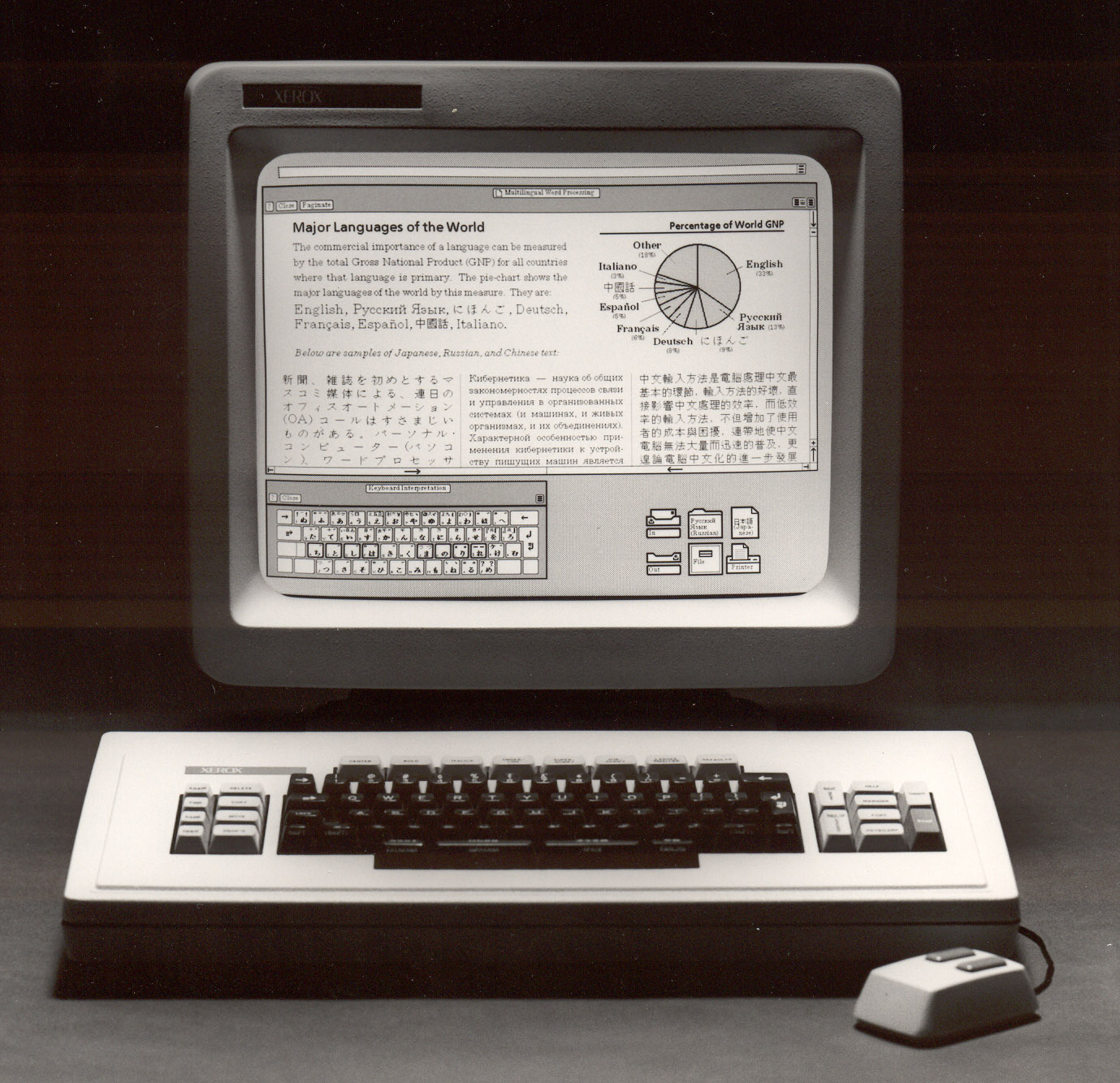
The Xerox Star, which came out in 1981, three years before the Apple Macintosh, had sans-serif and serif typefaces:
The Macintosh might have been the first popular commercially available machine that offered several computer fonts, but Jobs certainly did not come up with the idea.
I didn't mean to suggest that the Star was the first commercial computer that offered multiple fonts. I picked the Star because it came before the Macintosh there were good pictures of it available. I believe that the Alto also had a font that set a typeface in cursive, and even came with its own font editor, but I'd have to look harder to find videos or pictures of that.
I think you were correct to identify the Star (or at least the prototype of it), The article on the history of Smalltalk that was posted yesterday gives a date of 1972 for the first Xerox PARC font editor.
There were computerized type-setters well before the Mac. Back in the 70's, I wrote a fair amount of page-layout software, as well as a program to convert scanned logos into fonts. (Bask in the day when there were three USA manufacterers of airliners [each airline had to get its own version, and sometimes more than one version] we did publication of maintenance manuals for Boeing, Lockheed and McDonnel-Douglas) Full screen editor with variable font size, even all the way down to birds-eye view, but using vector graphics rather than pixels.
It's interesting how these quote with no clear attribution can take a life of their own. It's like the quote attributed to Burke that "all that is necessary for evil to triumph is for good men to do nothing." You see that quote referenced everywhere, and it is a great quote, but it doesn't appear in any of Burke's writings.
I always knew the "talent borrows, genius steals" version and it being attributed to Oscar Wilde. While I couldn't find any concrete evidence online to him having said that, I still like this version the best.
IMHO, it doesn't matter how the quote was created.
What matters is Mr. Jobs said the quote. He said artists both copy and steal. He did not say 'create'. Can we agree on this?
And following may be common knowledge on HN but let me just bring them up for the benefit of those who may not know.
1. Remember the $350 bonus Mr. Jobs did not give to Steve Wozniak, which was rightfully Wozniak's. This bonus was profit from their very first join venture, designing board for Atari.
2. And before there was the Apple Inc. the Computer company, there was Apple Corps Ltd, of the Beatles fame. The name of 'Apple' in Apple Inc (the computer maker) was 'copied' without authorization from the Apple Corps Ltd (of the Beatles). There were multiple litigations between them over the name.
I really hate to bring these up with Mr. Jobs gone but let's not forget these things happened. He was a great figure no doubt.




The Macintosh team "stole" the GUI from PARC, insomuch as they turned an academic experiment into a user-friendly, commercially viable product with its own refined sensibility and personality.
Samsung was a good enough artist to recognize that the iPhone was worth copying slavishly (albeit poorly), but they never turned their imitation into a distinct work unto itself.