There are some places in the US, that have that kind of poverty, but I have not seen them, with my own eyes.
Americans are very often blind to the poverty in their own backyards.
There are hundreds of thousands (millions?) of people in America who do not have electricity or even running water in their homes.
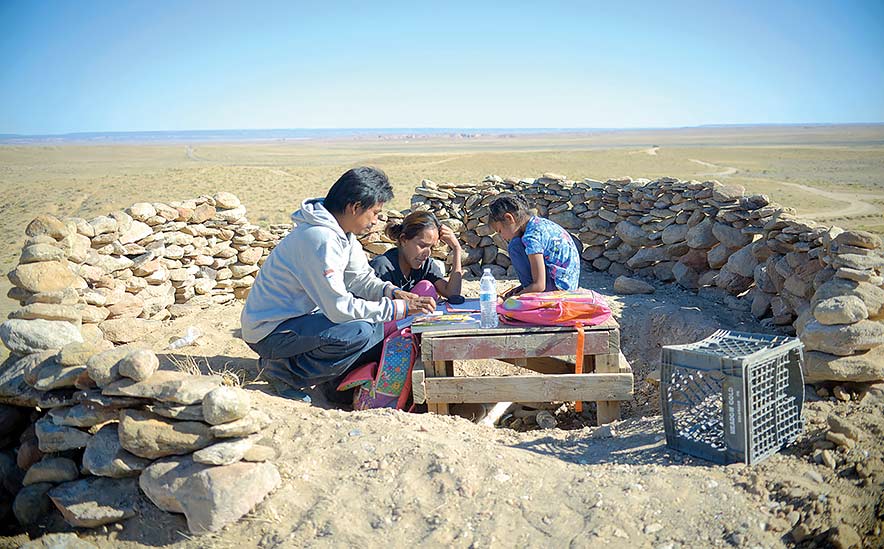
I'm always reminded of a photograph from a few years ago in the Navajo Times showing a handful of children sitting in a little clearing bordered by rocks at the top of a hill, surrounded by endless desert. That was their classroom.
No desks or chairs. Not even walls, a roof, or a floor. Just out in the open, sitting in the dirt. According to the photo caption, they had to have their classes there because it was the only place where they could get a cellular signal to do their lessons.
Edit: I can't believe I found it - October, 2020. (I took a picture of it, and it was still in iPhoto.)
Caption: Milton T. Carroll, left, and Wylean Burbank, center, help their daughter Eziellia H. Carroll, a kindergartener at Cottonwood Day School, with her school work on Monday in Fish Point, Ariz.
Carroll said he built the circular rock wall to protect his children from the elements.
I was wrong about no desk. The three of them share something that looks like it was nailed together from a discarded wooden palette. There's also a plastic milk crate nearby.
These are American citizens. In America. It's hard not to go off about the gilded ballrooms and trillion-dollar bonus packages.
Clean modern buildings, desks, air conditioning, running water, very nice. You were fooled by that photo into making a bigger assumption about the full school and situation.
The story that photograph is from is about distance learning enforced by the COVID pandemic. https://navajotimes.com/edu/hill-becomes-makeshift-classroom.... The family does not have internet access, and while they were issued a laptop and mobile hotspot, it only gets signal from the top of that hill.
OP may have misunderstood the context but I think it's a stretch to say they were intentionally fooled.
What I meant was they fooled themselves. They had negative assumptions about how Native Americans live and are treated, then they see a photo of a dirt pit, and even though it is completely implausible, assume it is a school. It is so far off reality it is notable.
Not sure exactly how obvious it is to most Americans, but the Navajo reservation is extremely poor by American standards. When I went there, the local roads were all dirt and the houses seemed to have no electricity.
I used to have Hopi and Navajo friends and I have no idea what they are referring to.
One thing I can tell you that the whole situation up there is contentious and complicated between the tribes, the states and the feds where one could support any argument as there isn't some standard "Rez Life" one can point at.
I mean, I used to have this one friend who grew up (and still had family) on a part of the reservation which was completely surrounded by the other tribe and her and my other friends (from the other tribe, don't quite remember which was which here) would get into some serious arguments at the bar over the issue where we'd have to separate them before it came to fisticuffs.
The other crime in that photo is the lack of cell service, despite billions of dollars that the USG has given ATT/Verizon/T-Mo over the years.
But these phone companies just give unfettered access to their networks to the various TLAs and everybody ignores the fact that they are not providing the cell service they are contractually obligated to.
Why would you expect there to be cell service there? Large parts of that area of the Mountain West are virtually uninhabited and have no telecom infrastructure to connect the cellular service to. There is literally nothing out in much of it except the occasional building every 10-20 miles which isn't enough to sustain a cellular network.
These days satellite would be cheaper in any case.
Why is cellular signal required for lessons? I went through 12 years of school in Eastern Europe without anyone in the entire country having cellular signal, or cellular phones. (Well mostly, towards the end they appeared, but had no effect in school). Granted, perhaps the lessons were less than perfect, but they were way better than nothing.
Look at the photo (linked to elsewhere in this thread).
If it's anything like some of the parts of the big rez I've been to, the nearest school is probably three hours away over sand/dirt roads. The teacher teaches remotely to children spread over a thousand square miles.
It's to have something better than just the bare minimum. I remember seeing similar reports about higher education in remote villages in India, with cellular networks and internet access allowing people to learn without being able to move to somewhere close to sufficiently qualified teachers.
If anyone is wondering why solving homelessness and poverty is so hard, this sibling reply is dead but I think people need to see that this opinion exists, and we need to contemplate the richest and most powerful people in this country share this sentiment:
"we're not blind to it, half of us are sick of paying for it for multiple generations, accruing interest. we're paying for poor people from 20 years ago still. let them sink, let them go away. its a test, they failed it."
Here, "go away" is a euphemism for "die from exposure".
20 years ago we had a worldwide financial crises caused by the capricious whims of the richest people in this country, they caused massive amounts of damage, destroyed people's lives and livelihoods, kicked them out on the street, and it's framed as "paying for poor people".
I often find the loudest voices with this mentality either come from well off families, or were poor enough themselves in childhood to have benefited from the government programs they wish to destroy. The first is ignorance and the second is some sort of self hatred / shame.
I rarely hear people that grew up fairly middle class and "made it" looking back at the poor as someone holding them back in this same manner.
It's always sickening to hear more educated people (compared to the average) repeating this inhumane bullshit.
Wanting people to die because they are poor, losing complete touch of why we humans even develop what we do: to the betterment of us all, to enrich all of our lives, to make the lives of future humans better. There's no other point to it, the absurd individualism is a disease, I'd much rather eradicate those from our lineage than the less fortunate, for a better future for humanity.
It's nobody's fault for becoming poor. But if you're staying poor (dirt poor) for decades, then there is something you're doing wrong. The other commenter puts it in a rude way, but there's something to it. If you evidently can't take care of yourself, then you shouldn't be given more money. You should be in some kind of institution which takes care of your basic needs.
> If you evidently can't take care of yourself, then you shouldn't be given more money. You should be in some kind of institution which takes care of your basic needs.
We used to have those in the US. Things are better for the poor now without them - a few do freeze to death in the streets today, most do not, while the abuse of those old institutions did hit most. The people who need institutions are also those least able to advocate for themselves if they are abused.
I don't like the current answer, but it could be worse and if you want something better you need to explain how it won't descend into worse. I don't have any ideas myself.
Sure, but it's the system's fault, and we can point at the people who are keeping the system the way it is. The system is what it does, and what it does is syphon money from everyone else and pumps it upward to a few individuals. That's not an accident, people are responsible for that, they like the way it works, and they're intent on keeping it that way.
Remember, in this system you get paid money for having money and you get charged a fee if you don't have enough. You get taxed more for working with capital than for owning capital. You pay more the less you buy. People always say "The hardest million was the first million". This is by design!
> You should be in some kind of institution which takes care of your basic needs.
Maybe, but we refuse to fund those because they're too expensive to operate.
Have you seen "the system" sleeping on the streets, starving, or not having enough clothes?
No matter who or what is to blame, the individual is who is paying the price and who should have the strongest interest to get out of that situation. Which means, if you're staying in that situation for years on end you have to admit to yourself you are doing something which isn't working.
Thats why people have more sympathy for somebody who is poor because they are temporarily down on their luck or born into poverty, and less sympathy for somebody who has been poor as an adult for decades.
Yes the argument that being poor is some sort of character flaw, while realistically it's just a lack of money, usually inherited from the parents. I would bet that most people who make these arguments (like everyone else) would end up permanently poor if one was to take away their money and networks.
All research (e.g. UBI trials, mirco loan experiments...) have shown that giving someone poor access to money allows them to dramatically improve their situation.
In 2024 over 700k people were homeless in the USA. That's a system failure. If you want to talk about personal failings you have to consider individual circumstances. But 700k being homeless is abjectly just not how a civil society should operate.
Yes, because human mind is famously known for being extraordinarily good at getting out of self-destructive spiraling without external help, and that help is famously known for being provided to everyone who needs it regardless of their economic status. Also, chronic lack of money has absolutely no way to contribute to that occurring in the first place. /s
I get it. Everybody gets it. For some months, even years. But after a decade or so in such a situation, you must arrive at some sort of epiphany, look at your life and say "what the fuck?".
And I don't think anybody is arguing that people shouldn't get help to get back on their feet. Rather that some people refuse to get back on their feet.
Unfortunately hackers made sure that the only reply below written by somebody who has actually been homeless was [flagged] and [dead]. That's the prevailing attitude towards poverty among the intellectuals. "Let's talk about them, not with them."
So I'll reply here, since I can't reply to a [dead]:
> And then what? You're 54 years old. No degree. No work history. Criminal conviction for drug possession. You're mentally ill and unmedicated. You realize for the first time you want to change your life. What's your first move? You have until your lucidity is interrupted by the next bout of mania and paranoid delusions to turn your life around.
You get medication and join the merchant navy as a mess hand. Not only do you get food, a safe bed, medical attention, safety, a salary, and companionship. You also get away from a destructive environment, drugs, threats, and all that shit that made life hell.
If you'd be actually experienced, you would realize that there's an autokill filter on HN and the comment in question contains the forbidden M word. Apparently my vouch wasn't enough to resurrect it.
Makes sense (I run showdead=no, so I never saw the original), but that doesn’t make my comment any less accurate. We all see this stuff happen on a regular basis.
A long discussion is going on, with people flinging poo, back and forth, and one comment appears, from someone actually in the industry/organization being discussed, or by someone with very relevant direct experience, and that comment gets immediately dogpiled; often by both sides. It’s happened to me, a couple of times. I’ve learned to just stay out of these shitfests, even if they are embarrassingly offbase.
With this kind of emotionally-charged, nontechnical topic, it’s even worse than things like OS or methodology dogma battles.
No. After a decade the ‘what the fuck’ is just a distant memory. ‘It is what it is’, ‘nothing ever works out’, other kinds of depression just win by default.
If it only pumped the money to a few individuals someone would've pushed those individuals off a cliff and seized power by now.
The magic of the system is that there's enough trickle down to motivate the petite-bourgeois (I hate Marx, but I'll be darned if he didn't enumerate some good economic tiers) to make them keep the system running.
Your media talking heads peddling division, your 200k+/yr software engineers implementing extractive algorithms to make the gig economy tick, etc, etc, etc.
No, I doubt they are. Most people who are on the streets chronically are there because they’ve burned every bridge. Most people have a dozen friends or family who would gladly give them the guest room for a few weeks if they had a job loss that put them at risk of hard times — on the other hand those who mysteriously have zero friends or family usually got that way by the same antisocial behaviors that contributed to their problems in the first place, until every last person that once cared said “don’t come around here anymore.”
Not saying anyone’s a Bad Person for this, but treating everyone like zero-agency victims or helpless children has never fixed anything. You can’t fix people without at least their partnership, and generally it’s substances and severe mental illness that gets in the way of the cooperation. “Bitter pills to swallow” as the meme goes but anyone who doesn’t admit this is kidding themself.
> who would gladly give them the guest room for a few weeks
Yeah, a couple weeks and then what? Couch-surfing is a form of homelessness, and the membrane between sleeping on a couch and sleeping on the street can be very thin, especially when your health makes it unlikely you'll find work in the near future. Something as simple as a concussion can stop you from working for months.
> but treating everyone like zero-agency victims or helpless children has never fixed anything
I hear this argument a lot, and I find it baffling. What's your proposal here? That we all wag our fingers at homeless people? The people with agency who can fix their situations on their own already did—in fact, they course-corrected long before they slid into poverty or homelessness in the first place. If they had agency, they wouldn't be in this situation.
That's why I dredged up the dead comment in the first place stating it plainly "let them sink, let them go away." At least that poster was honest about the end game.
Lot of other posters here on HN seem to feel the same way but they're rationalizing it with "well, they deserve it after all". It's their fault "because they’ve burned every bridge." It's their fault because "most people have a dozen friends". It's their fault because "substances and severe mental illness that gets in the way of the cooperation."
And if we don't agree with this assessment, it's we who are not serious. But left unstated is: their way just ends up leaving this vulnerable population to die, and they really don't have a problem with that, because according to them, it's their own damn fault.
I believe the latest solution to homelessness proffered in the public sphere was from Brian Kilmeade, who said "involuntary lethal injection, or something. Just kill 'em." A final solution if you will.
Then they need to start supporting themselves. Or at least not strew needles all over the friend’s living room and pawn their valuables to buy more meth.
Most of those friends would settle for just the latter for several months, but the worst cases 100% got kicked out of even family members’ homes for that kind of thing and that’s why they’re on the street.
10 trillion dollars of welfare, free houses, cash, whatever, is not enough to fix addicts who don’t have an insane amount of willpower. Which most people just don’t have. Drugs are mostly the problem. Most non-addicts sleep in their cars and rely on friends for a month or two and get their shit together. “Homelessness” numbers always conflate both kinds: the lost causes and the temporarily homeless.
I can tell your income bracket from this phrase alone:
> Most people have a dozen friends or family who would gladly give them the guest room for a few weeks.
No, most people do not.
I am aware of classic triad of "malignantly antisocial personality + substance abuse + criminal record" that makes people stay on the streets.
But a lot of people end up on the streets simply because they were already only one notch above financial destitution and so all of their friends and family.
Lose a job + get sick in body or mind, even temporarily = game over. "Friends and family" who are also financially vulnerable would ruthlessly shed the load of extra mouth to feed, much less to house.
The friends and family route works the first time around. You couch surf until you find a job, as you go through your contact list people are happy to host at first, but there comes the awkward "so... it's been a couple weeks... how's that job search going?". Then you have to put your job search on pause until you find a new place to live.
Eventually your job search keeps turning up "no" because they don't like the answers to "can you explain this gap on your resume?" and they really don't like the answer to "do you have a permanent residence" or "do you have any drug-related convictions?"
Hopefully you find a job before you've exhausted the good will of all your friends. And pray to GOD it doesn't happen again because the next time around, each one will have an excuse as to why they can't host you. "Oh sorry, we've got our inlaws, try X, Y, Z"... who are also "unable" to host.
So then your car is your home. If you're lucky enough to have one. But the point is "just have friends" isn't a solution.
I wouldn't say so. A large percentage of the population - double digits - have never had any job security in their lives, or any guarantees whatsoever. We've learnt to adapt and know we can do it again. People aren't allocated 1 job per person for life and if we loose that job we're in the shit for life. Most people know they can get another job.
Legality only matters insofar as people use it as a mental shortcut to turn off their brains.
Which TBH I think is way less than it used to be, but feels like it's more because so much more stuff involves law and government than it did 50yr ago.
I grew up in Kentucky and spent a lot of time in the areas around the Red River Gorge in the southeastern part of the state. Some of the poverty there is shocking. The movie Winters Bone actually seemed to do a decent job of showcasing similar areas.
It's difficult to find trustworthy statistics quickly, but the penetration of electricity and running water in US households is only about 99%. At the scale of the US (~130 million households), 1% of households lacking electricity equates to over a million households and somewhat more in terms of number of people. So yeah, there's probably about 1-2 million people in the US without running water and/or electricity.
Where are these people? Probably the largest concentration of such people are on the various Native American reservations (I believe ~15% of the Navajo Reservation lacks running water). The hinterlands of Alaska also likely has a high number of these houses.
"Energy insecurity" transforms the problem from lack of "energy" into an emotional problem. The problem isn't feelings of insecurity, it's lacking electricity. But now we can feel all self-righteous that we're making people feel better because we don't call them homeless and hungry and in the dark. Now they "have housing insecurity" and "have food insecurity" and are suffering from "energy insecurity".
I lived for a month in a dorm in China quite a few years ago, where they had running water for an hour every other day. Hot water for tea was delivered in a thermos every morning. Nobody had "heated water insecurity". Everyone knew exactly how it worked, and they all showered two or three to a shower. I couldn't bring myself to do that, so I showered after they were all done, usually in cold water. The problem was very clearly lack of hot water, not "insecurity".
I mentored a kid for a few years whose family occasionally couldn't afford meals, so they had "fend for yourself night", where he had to figure out how to get a meal on his own. His problem was not "food insecurity", his problem was that he was hungry. Any "food insecurity" he might have had was distinctly downstream from his lack of food, and would have been entirely eliminated with regular meals.
I'm not saying literally everyone in America has electricity/running water. I'm saying it's a rare exception, not "hundreds of thousands (millions?) of people".
And when it is a problem, it's usually a problem with the system denying people access rather than literal inability to afford.
Municipality would rather some house be vacated (perhaps based on a "poor people drain services, kick-em out" policy posture) so when a storm takes out your utility pole guess who isn't getting a new meter drop until they bring their shit up to current code at a non-starter price... and oh look here it's illegal to live in a house without electricity. I guess that means someone's getting evicted, what a shame...
This is just not true. America has many problems but access to electricity/running water simply is not one of them.
You are disconnected from reality.
I can take you to places in Texas, Arizona, New Mexico, West Virginia, and even California where people have to live without electricity, running water, or both.
I'll take the word of what I've personally seen with my own eyes over someone who created an HN account three minutes ago.
> I'll take the word of what I've personally seen with my own eyes over someone who created an HN account three minutes ago.
> I can take you to places in Texas, Arizona, New Mexico, West Virginia, and even California where people have to live without electricity, running water, or both.
But can you provide us with a source other than your own eyes for the "millions of people" you claim to be living in such conditions?
There are Americans who have open sewage in their yards [0], because their counties are predominantly Black or Latino, and their state deprioritizes any infrastructure work. It’s structural racism.
Even better, the Trump administration canceled [1] an attempt to right that wrong, citing that it was “DEI.”
What the Trump administration canceled didn't right that wrong. What the Trump administration canceled was an agreement for the local county to stop issuing fines, which had already been in effect for over two years. And within those two years, the local county built zero sewers, zero hookups. They literally built nothing in two years.
The original agreement under the Biden admin, which to be clear, the President doesn't personally oversee these kinds of agreements, this is sort of all within the DOJ, but the original agreement doesn't even require them to build the sewers. It literally just requires them to run a public health campaign and not issue fines.
I guess the DOJ saying not to fine these people is a nice gesture but in practice local fines don't mean anything in a situation like this unless the poors on the property are unlucky enough to be on a property that the municipality wants to lien and take for whatever reason.
Whatever the dollar number is, it's likely some insane punitive number (hundreds to thousands per day) that nobody could ever pay and never will actually be enforced, it's basically just a threat and you wind up going to court over it in the end or you fix it and they drop it or fine you a reasonable amount (thank the 8th amendment).
This sounds like a standoff situation. Municipality wants trailer park to pay for its own sewer. Trailer park can't afford it. Municipality fines them. Trailer park gives them the bird because they're so poor they're basically judgement proof. Municipality doesn't push the issue because if they take it and kick them all out then they will pick up the tab for remediating, etc, etc.
What should have happened in the original agreement is that the fed pays for the sewers at a very cheap rate and the municipality does the work and owns it for eg 10-20 years.
That's actually a really common agreement. I don't know why DOJ had such a derp moment here and instead demanded billboards about health risks for people who don't have the money for basic medical care much less exploratory lab testing.
They're called sewage "lagoons" and work basically the same as septic systems from a environmental impact perspective.
They only really work well in certain climates and even then you need to have enough spare land to just locate a sewage pond somewhere. Even in richer areas it was dirt common for schools and prisons (which aren't likely to be located in the center of town like other government stuff is) to have them way deeper into the 20th century than you'd expect since it's not like they were short on land (just use more taxpayer money).
Normally the plumbing runs underground but those people have a trench solution likely because they added a bunch of trailers to the property and more lines were out. There's probably some weird government rules at play here. Like they don't want to dig pipes into the ground because screwing with their grandfathered in lagoon would be "state problems" level illegal whereas right now it's "municipality problems" level illegal and the latter doesn't wanna stomp them with the jackboot for obvious political reasons.
The clean water act and it's knock on rules really act as a huge impediment to "it won't make it compliant, but it will make it a hell of a lot better" fixes in cases like this.
I went to school with kids who didn't have winter jackets. In Northern Maine. I studied with kids who didn't have any food to eat, almost ever. My mother taught kids that were kicked out and homeless at like 16. One child was named after a beer. Entire classrooms worth of kids being "raised" only by an impoverished grandparent who wasn't able to leave the house and couldn't really do anything and had only minimal social security checks for income.
There was a family that lived in a 10ft by 10ft shack and had 6 kids and basically nothing else to their name. One daughter was hit by a dump truck getting off the school bus and died.
My own family was impoverished for a long time. Sometimes the only food left in the house was old flour with bugs in it. The mental toll it took on my mother is still clear and evident, and I myself still have deep "scarcity mindset" behavior, and our situation wasn't even that bad. We technically were above the poverty line. We had a home that was clean and well built and very cheap ($400 a month mortgage). My mother had an education and a career, and my dad's employer was in control of making his child support payments, so they were always on time. My mom was really smart and extremely good at stretching money and playing the games required to cover your bills when you literally make less money than it takes every month to be legally alive, like making friends with the telecom neighbor who will set you up with free cable for a bit out of pity. Her job in government ensured we had good health insurance and visits to doctors. We had much wealthier family who kept us clothed with truckfulls of handmedown clothes from the previous decade. She had great credit and could manage credit cards very well.
It almost killed her a bunch of times though. Once when I was 12, she called my dad to come get me because she couldn't get herself out of bed and was bawling and openly talking about suicide. She couldn't really afford therapy and the local therapists in bumbfuck nowhere aren't good at their job anyway. Turns out there's a medically important distinction between "Therapist" and "Psychologist" and in the 90s neither was equipped to handle "Undiagnosed neurodivergent driven to the very end of their wits and surviving exclusively on adrenaline".
Yet there are people on this very board insistent that people do not starve in America (before Trump decided we didn't need to report on it and thus killed the program tracking it, it regularly reported millions and millions of American children literally go hungry. Free lunch and breakfast programs reliably improve grades and education outcomes still because children are hungry)
There are people who insist it is cultural or based on making bad choices.


Americans are very often blind to the poverty in their own backyards.
There are hundreds of thousands (millions?) of people in America who do not have electricity or even running water in their homes.
I'm always reminded of a photograph from a few years ago in the Navajo Times showing a handful of children sitting in a little clearing bordered by rocks at the top of a hill, surrounded by endless desert. That was their classroom.
No desks or chairs. Not even walls, a roof, or a floor. Just out in the open, sitting in the dirt. According to the photo caption, they had to have their classes there because it was the only place where they could get a cellular signal to do their lessons.
Edit: I can't believe I found it - October, 2020. (I took a picture of it, and it was still in iPhoto.)
Caption: Milton T. Carroll, left, and Wylean Burbank, center, help their daughter Eziellia H. Carroll, a kindergartener at Cottonwood Day School, with her school work on Monday in Fish Point, Ariz. Carroll said he built the circular rock wall to protect his children from the elements.
I was wrong about no desk. The three of them share something that looks like it was nailed together from a discarded wooden palette. There's also a plastic milk crate nearby.
These are American citizens. In America. It's hard not to go off about the gilded ballrooms and trillion-dollar bonus packages.