The findings of the original study were called into question by a larger 2018 study[0]. The original study had 90 students. Some folks did a study with 900 people. They found the same correlation that the original study did. But when they controlled for household income, they found most of the correlation disappeared.
The obvious conclusion is that household income is a predictor of both:
- inability to delay gratification, and
- higher academic achievement
This makes sense when you consider that someone growing up in a poor household may have both:
- less reliable/continuous/predictable access to material things, meaning they would rationally seize immediate opportunities rather than taking the risk of a larger future opportunity, and
- less academic support
Now, this new study (OP) goes even further, finding that the correlation itself is weak.
[0] Watts, T. W., Duncan, G. J., & Quan, H. (2018). Revisiting the Marshmallow Test: A Conceptual Replication Investigating Links Between Early Delay of Gratification and Later Outcomes. Psychological Science, 29(7), 1159-1177. https://doi.org/10.1177/0956797618761661
Household income is a predictor[0] of a lot of things.
It strongly correlates zip code (almost identical) and from these you can make good predictions of race and even politics. A naive mistake a lot of people often make is thinking that removing explicit race data removes race from your model. It's still there, but now only expresses itself indirectly. This is not just true for things like race or politics, but for a lot of factors, which is why causal statistics is such a different (and harder) ball game.
[0] Predictor means correlates with, not causal. I see some people confusing this in the comments. I've never liked the word because of this result.
If you move to a rich zip code your child goes to a well funded school, hangs out with rich kids behaves like a rich kid. Moving to a rich zip code (and supporting your child’s education) is a fantastic way to get your family on the path to generational wealth.
It really is. In fact there's some good studies that suggest that this is even true with race, where you don't need to move zip codes but simply move schools (a la "Everybody Hates Chris"), if the kids are young enough.
But clearly the causal connections here are not zipcode, but schooling, culture (or rather the knowledge to understand and navigate a culture), social connections, etc.
1) Causal relationships are directional. Which then follow your own logic. You can reason that it is directional because you can see that there are many ways to get into rich zipcodes without being rich.
2) You can find many rich people that don't move into wealthy zip codes.
So actually, it is just correlating. If we use Judea's ladder, then it is causal in that sense, but that's the lowest rung and not what we'd call causal in a colloquial (or even statistical) sense other than to be pedantic.
It just is a thing, tbh. It manifests in the data pretty clearly.
In aggregate, in large data sets, race comes through - especially with a few datapoints. For example, when I worked at a fintech company: with household income and zip code, we could accurately target race with >80% accuracy [0]. Add a few more datapoints, and this would very quickly get closer to 95% accuracy.
That was an _actual_ party-trick[1] demo we did, alongside also de-anonymizing coworkers based on car model, zip code, and bank name.
[0] I worked as a SecEng and were trying to prove that we were(n't) inadvertently targeting race, for compliance reasons. In the end, the business realized the threat and made required changes to prevent this.
[1] We were doing this to make a case for stricter controls and stronger isolation/security measures for storing non-PII data. The business also saw the light on this. Sometimes we'd narrow them down to 30 or 40 people in their zip code, and sometimes (such as a coworker with an old Bentley), it was an instant hit.
Not accounting for race comes up in scary ways. I was part of a program that used a totally neutral database (race/gender were not in the database). People were selected by criteria and then emailed asking them to attend an introduction meeting online. Only when the webcams were turned on did we realize nearly every volunteer was none-white female. It was a very bad look. It seemed that we had selected them based on race/gender when in reality that data wasnt availible until the first video call. By ignoring race/gender we had somehow made it the most obvious selector.
(The program involved having children who were in regular contact with the criminal justice system.)
Did it turn out that the selection process actually didn't represent the makeup of the target audience?
If the participants did represent a subset of the target audience, I don't really see what the problem is if that audience happens to be heavily weighted towards a particular race, sex, etc. It seems like you'd be doing a disservice to the program to purposely control for those factors and end up with a population that physically looks more diverse at the cost of missing people who actually most need the program.
A lot of people have gotten into a weird place where they think that acknowledging that the descendants of slaves in the US are in a dire situation is a form of racism. Acknowledging that being injured has caused an injury has become either extreme right-wing bigotry (if you're a liberal who demands that every subset of people be a racially representative mix), or "the soft bigotry of low expectations" (if you're a conservative who can't admit to yourself that you inherited hundreds of thousands of dollars from a parent who also paid for your private school, car, and rent, then found you your first job.)
Sure, there are a lot of interesting and compelling angles to consider why these kinds of things happen. In such a specific case as the parent comment here, it really is more interesting in my opinion to see what was found.
For example, it stood out to the team that they group of people that were on the call paint a certain picture when considering how similar they were (specifically by surface-level factors like race or sex). Is that response justified when they dug in and found that the group didn't represent a similar makeup of the total population despite having completely ignore sex and race? Or did it turn out that the population is actually that homogenous? If it is that homogenous there are great questions to dig deeper on, like why that happened and what may be done to help correct that.
It's not racist show, point out, or claim that data racially skews in one direction. If that were true, then you couldn't even claim that minorities are under privileged. Right? Then how could you help them if you aren't able to recognize the areas that the biggest challenges? You're right when interpreting this way.
But the thing you do care when you want to attribute causality. In part this is an issue because people naturally associate correlation with causation (there is good reason but that's a long discussion. See Judea Pearl's The Book of Why). At the end of the day, we really are always after causal relationships, because we want to do things with the data (somewhere along the chain). So it's not that you want to remove race from data, but rather that you want to be wary and ensure that your variable is not confounding the real issue. Though this happens outside of race too.
And note that at times there where race does play a causal role. (I suspect not likely in the parent's case) For example, different races may be more prone to certain illnesses or genetic disorders.
If it helps, maybe it is easier to frame it as it's easy to be lazy, but the pressure around race makes us more likely to revisit our analysis and look for confounding variables. The thing is, this will improve your stats even for the non-minority settings because the truth of what you're (hopefully) doing, is just making better models.
I think we're getting at roughly the same idea here, I don't actually think its about racism at all though. The parent commenter clearly didn't select a population based in their race or sex. This may be an unpopular opinion, but I have always viewed racism as very much linked to the person's intent, something that may unintentionally have a bias isn't racist in my book and really lumping it in would cheapen the argument when the intent really was there.
That said, in this case I really am curious if it turned out that there was an unintentional bias somewhere. Say they ended up with 90% black women and in reality that is only say 40% of the total population of kids with regular interactions with the judicial system. There's certainly something there they missed and it'd be interesting data to understand how that happened even when they purposely ignored race and sex. It usually boils down to an otherwise benign detail of the selection process that makes way more of an impact than would have been expected.
> I have always viewed racism as very much linked to the person's intent
Certainly this is one of the most critical factors. I'd argue that this is critical in being not racist in the first place, since it is easy to misinterpret actions. Not to say that how it is received doesn't matter, but that we're in a globally interacting community and we're bound to step on one another's feet, so it is important to recognize that not knowing the dance is not the same as intentionally attacking nor that not knowing the dance is inexcusable in the first place. As this would need to go both ways and then we'd all be at fault. We should try to learn at least.
But I do want to push back a bit, and I think this connects to the prior point of the statistics. I do think it is possible to be unintentionally racist. Just like you can intentionally harm someone and you can unintentionally do so. In either case harm is still done, right? But it is with good reason we distinguish these in our legal system.
The world is much more complicated than it used to be, and this is the burden of advancement. As we advance, lower order approximations are no longer sufficient to solve problems, so we must become more nuanced, more forward thinking, and we must slow down so that we can move fast. The burden of our advancements is that we are now the gods who destroy cities without even knowing what we have done. The same way a butterfly does not know the hurricane it creates, because it's the interaction of its actions combined with so many others. But this does not change the end result. A more connected world means that our actions have more paths to travel through, and thus can do more. The question more is if we'll deny this or if we will try to do better. Maybe it is impossible to live without stepping on cities, but even if that is true, it doesn't mean we shouldn't try to look where we step and minimize the damage.
So what I'm saying is to me it didn't sound like they were trying to deny the correlation of whatever they were studying had to do with race, but rather that we've advanced as a society enough that correlation is insufficient. And at least in this domain we've recognized how it is easy to fool ourselves with data. Because I'll tell you, most people fool themselves with data, including experts. The difference is the expert always reserves some doubt. Most people confuse what data analysis does. It doesn't answer questions, it can't. Instead it eliminates potential answers. If you remember this, doubt is a natural consequence. If you don't, you'll always be the fool, lying to yourself.
I think it’s more reflective of the reality of living in the US than of your company’s selection process. I’m curious what you did after realizing this. Did you pivot away, or create a program designed to be useful for the volunteers? Assuming that the volunteer pool accurately represented the larger group.
You're overconstraining what I've said. You're perfectly right that zipcodes in Appalachias account for many poor people that are also white. But actually, you're correctly inferring that you can still infer race out of this, because you're inferring that the majority of these zipcodes are also white. Right? White people are also a race. You're correct that zip code is also able to strongly indicate poor white people. In fact, it is also even able to strongly indicate rich black people. Though you might guess not to the same degree as the overall rate is lower, but people do congregate.
Think about it in a different framing: zipcode strongly correlates with people congregating together who are culturally and economically similar.
I think this version should make sense (especially as the locality affects the culture), and that from here you can extrapolate to recognize that people of varying demographics aren't homogeneously distributed among zipcodes of similar economic bins. I part of this is easily explained by a simple fact: when people move, they like to move to where they have friends, family, or other connections.
it's scale-invariant and self-similar. pick a big city or a sundown town, the demographics change but you're measuring a consequence of modern/historic systems larger and longer-lived than either place
I don’t know about children but it makes sense that poorer adults have worse impulse control. Poorer people have more worries and less to look forward to. Maybe a 12-hour workday rather than an eight-hour one.
I’m sure that overworked wealthy people have plenty of vices, i.e. “poor impulse control”. But they have successful careers so those things are coping mechanisms, really. It’s compartmentalized.
In any case my cynicism would just be vindicated if a study just turned out to rationalize (as an emergent property because, duh, there is a population overlap between researchers and this group) the position of the upper-middle class.
or better grabbing-opportunity skills. If you repeat the experiment and the "doubling" of the marshmallow turns into "a teen barging into the room and stealing the marshmallow", who'd be the wiser kid?
A factor in this study that I don't know was mentioned in 'trust'. Did the kids trust the adult to deliver on the promise of the extra mashmallows. If the kids had low trust in adults, its very rational to take the marshmallow you see rather the ones you don't.
>In 2008–12, the rate of violent victimization was highest for persons in poor households (39.8 per 1,000) and lowest for persons in high-income households (16.9 per 1,000) (table 1). This pattern was consistent across all types of violent crime.
It makes me think of the scenario where mom gives the kids each a marshmallow. You decide to keep yours for later, the other kid eats theirs.
Later you decide to eat your marshmallow, but the other kid sees this and demands half. He goes to mom and she makes you share.
Lesson learned: either hide what you have or don't delay gratification.
I feel like this scenario is becoming more common in (US) politics these days (eg student loan forgiveness, housing bubble in 2008). Or it could've anyways been happening and I just didn't notice.
I also wonder, I think there probably a continuum between patient academic strategist and like driven tactical disruptor. I would say I deploy lots of tactical impatience to get shit done.
I'm reminded of one of the stories from "Poor Economics" (Abhijit V. Banerjee and Esther Duflo, ISBN: 978-1-58648-798-0).
Consistently, those in poverty (living on < $1 per day) do not simply 'try harder' to save and make better financial decisions by being restricting their impulses. Instead they find clever ways to outwit themselves.
One mother in India, intent on accruing $2000 (?) for her daughter's dowry, knew she didn't have the willpower to "just save $200 per year over 10 years", though her annual income was greater than $200.
But she had the foresight to take out a $2000 loan from a bank, immediately move it to a saving account, and pay back the bank. The interest on her loan was almost like an extrinsic-motivation fee.
This mirrors things I've read in Gregory's Savage Money.
Most people on this website live in cultures where the value system places prestige upon accruing money, so it's easy for us to do so because the incentives line up. In parts of India that's not so. To simplify a little, their value systems places prestige upon spending money on social events/life cycle rituals, so it's easy for them to spend money on e.g. a funeral but significantly harder to hold onto the money.
This, in Gregory's view (which I symphathise with) has nothing to do with being rich or poor. The rich in Bastar also spend a lot on life cycle rituals, but they outearn their spending.
The mother forced herself to save by punishing herself if she did not.
The $2000 in the saving account was earmarked for the dowry, and she would not touch it. So, she had to save every month to pay back the loan to the bank. The longer she took to do this, the more interest she paid.
This is a kind of non-rational trick that some people use to "trick themselves into doing the right thing". This is like paying some random stranger $100 if you do not accomplish some task.
1. Immediate use of the home
2. Collateral that can be taken back of the loan isn't repaid
3. Often the collateral gains in value over the duration of the loan
4. The interest rate on the loan is way lower than a personal loan or a credit card.
However, (3) is a bug that's just commonly encountered (hopefully temporarily) in some countries that restrict construction way too much at the moment. One can hope.
The mother knew (from experience?) that she did not have the necessary impulse-control, or intrinsic motivation, to save money for such a long-term thing as a dowry.
I was really taken by this example because my initial reaction was "just try harder". My first-world perspective has always been "if you failed, its a personal short-coming. You need to become better".
This mother's solution is based off a fundamentally different philosophy; "I am not capable of that kind of self-control. I'll modify the environment".
The acoup blog series on medieval agrarian societies made an interesting point that resonated with me.
Things that look like failures in long term planning (to people with resource surpluses) can actually be optimal decisions (to people without resource surpluses).
In that case, it was the observation that maximizing currency profit from farming in a society that experiences arbitrary taxation and repeated famine is useless -- if no one has food then no one will sell you any, assuming your saved currency hasn't already been seized.
In contrast, optimizing for familial and social ties were much more reliable ways to see yourself through then-common perils.
If you're poor and don't have a stable living situation, delaying gratification presents risks to you. (ones that people with money and stability don't have to consider)
Sometimes people are dumb, but sometimes they're optimizing for factors others are oblivious to.
People might reply, "Well, take the risk," without acknowledging that risk is two-dimensional. There's a range of success and and range of consequences. Something traditionally considered "high risk", like investing millions of a billionaire's money in a start-up, might have low consequences for the direct investor. It sucks if the start-up fails, but they're still a billionaire, probably. Their lifestyle doesn't change substantially. Compare to a low-income worker choosing a car: maybe a cheap used one that could break down at any time, or a more expensive one is less likely to break down (if you stay up-to-date with expensive maintenance), or a much more expensive new car that is unlikely to break down (but that puts them in a substantial amount of debt). In every case, there's a way for the prospect to go sideways in a manner that would likely end with the worker losing their job, with (statistically-speaking) no savings cushion. However you rank the risk of each (at least one being the lowest financial risk), you have high negative potential consequences.
My impression is that people who say "take risk" literally always mean "take bets where you have little to loose and a lot to gain". And they look down on people who took actual risk and lost.
What "take risk" means is that you should try to be entrepreneur in situation where you can fall back and be well paid programmer again if it does not work out. Or that you should risk someone elses money.
EDIT: I guess good rephrase would be that "take risk" usually means "overcome irrational fear when you are in perfectly safe situation". That is what actually people mean.
They also look down on people who could not take the risk, calling them cowardly, lacking boldness, entrepreneurial spirit, etc.
"Sell everything and fund my startup" is fine when you've got a 12 month emergency fund, living in a paid-off home, , and you parents are able to bail you out. It's not fine when failure means you're penniless and homeless.
Further: it's much less of a risk when you have a metaphorical rolodex of wealthy friends from university or business school. You're not cold pitching - not even slightly. Doors open for you, instead of being slammed in your face.
Yet they'll tell you shit like "Try hard enough and you will succeed! I worked long and hard, people saw that, and were willing to invest. Good hard honest work is rewarded."
The people working on their startup 12 hours a day who don't have connections have no idea that the bit left out is that "people were willing to invest in my idea because we chugged beers together in the basement of Sigma Chi."
This nails it. If Elon Musk loses 220 billion, he still does just fine. If a subsistence farmer in a remote place loses his couple hectares cassava crop, he and his family risks famine.
> Something traditionally considered "high risk", like investing millions of a billionaire's money in a start-up, might have low consequences for the direct investor. It sucks if the start-up fails, but they're still a billionaire, probably.
That's not so much about being a billionaire, but about diversification.
Fortunately, even people of very modest means have access to diversified index funds these days.
If you have a few thousand stocks in your index fund (eg like VWRA or VT), then in doesn't matter how risky any individual stock is (like the startup in your example), as long as holding them has positive expected value.
> But because these households wobble on the edge of disaster continually, that changes the calculus. These small subsistence farmers generally seek to minimize risk, rather than maximize profits.
> [...] Consequently, for the family, money is likely to become useless the moment it is needed most. So while keeping some cash around against an emergency (or simply for market transactions – more on that later) might be a good idea, keeping nearly a year’s worth of expenses to make it through a bad harvest was not practical.
> In that case, it was the observation that maximizing currency profit from farming in a society that experiences arbitrary taxation and repeated famine is useless -- if no one has food then no one will sell you any, assuming your saved currency hasn't already been seized.
> In contrast, optimizing for familial and social ties were much more reliable ways to see yourself through then-common perils.
Social ties are no more helpful in a famine than currency is. People who can't sell you food can't give you food either. They are insurance against the case that your crop fails, not that everybody's crop fails.
Currency is fine in that scenario. The tendency not to grow the most profitable set of crops is a method of avoiding crop failure, not a method of mitigating it when it happens.
> Avoiding risk for these farmers comes in two main forms: there are strategies to reduce the risk of failure within the annual cycle and then strategies to prepare for failure by ‘banking’ the gains of a good cycle against the losses of a bad cycle.
> If you only farm one crop (the ‘best’ one) and you get too little rain or too much, or the temperature is wrong – that crop fails and the family starves. But if you farm several different crops, that mitigates the risk of any particular crop failing due to climate conditions, or blight (for the Romans, the standard combination seems to have been a mix of wheat, barley and beans, often with grapes or olives besides; there might also be a small garden space. Orchards might double as grazing-space for a small herd of animals, like pigs). By switching up crops like this and farming a bit of everything, the family is less profitable (and less engaged with markets, more on that in a bit), but much safer because the climate conditions that cause one crop to fail may not impact the others.
Under "Banqueting the Yields":
> The most immediate of these are the horizontal relationships: friends, family, marriage ties and neighbors. While some high-risk disasters are likely to strike an entire village at once (like a large raid or a general drought), most of the disasters that might befall one farming family (an essential worker being conscripted, harvest failure, robbery and so on) would just strike that one household. So farmers tended to build these reciprocal relationships with each other: I help you when things are bad for you, so you help me when things are bad for me.
You might notice that this is exactly what I said above. What did you want me to see?
> Social ties are no more helpful in a famine than currency is. [...] Currency is fine in [a famine] scenario.
Social ties are more helpful than currency, even in a famine, because at that point resources are shared based on relationship rather than value. Triage, not optimizing future gain.
See also all the bits about why currency at that point was a terrible store of value.
Currency wasn't a terrible store of value. The essay says as much:
> Ok, so why not sell the grain and store something less perishable, like money? Sure, you can’t put it in a bank, but you can just keep it. And indeed, our ancients do this
The problems with currency are listed as:
1. Someone can come into your house and take it.
2. Ordinary farmers cannot afford enough currency to replace the value of a failed harvest. (An entire year's revenue.)
3. In the event of a famine, the price of food rises, making currency a poor hedge against famine.
Only #3 applies to how valuable currency is in a famine, and it remains superior to local social ties when the famine strikes.
But because of its unaffordability and undesirable correlation with famine, it is not the favored solution to famine. It's just a much better solution than local friendships.
You read the wrong essay; the standard defense against famine is discussed in the following one:
> So we’ve established what the big landlord gets out of working with the smaller subsistence farmers around them – they get labor to put more of their large holdings under cultivation and even a degree of labor flexibility with wage laborers and sharecroppers drawn from the existing rural population. In this sense – and I want to stress this – the large estates need the rural small farmers to survive. This is why, even in periods of rapid growth among large landholding estates (like the steady expansion of latifundia in the Roman late Republic and early Empire), there remained lots of these smaller farmers. But what do the small farmers get?
> Just like the smallholders could establish horizontal ties with fellow small farmers, they could also try to establish those ties with the big fellow in the big house. Of course the mechanisms for establishing the ties were different: few peasants could banquet an aristocrat and most aristocrats would be insulted by a suggestion of an alliance through marriage. Instead the ties were strictly vertical – that is they were unequal. They often began with the farmer working at least a bit as a tenant on the big farm, but also typically included political support, sometimes military support (that is, coming out to fight when the large landholder did, often as common troops in his retinue) and no small amount of social deference.
> In exchange, in theory, the large landholder could provide the ultimate backstop against catastrophe – even a catastrophe that might ruin an entire village or rural area all at once.
In the event of a famine, the farmer has two options:
1. Leave the stricken area, in which case he's dependent on his stock of currency.
2. Hope for relief to be delivered by his social superiors, which depends on their stock of currency.
Poor people are better at cash flow management. That's why poor people like the dollar store. They're not dumb. They know you can buy soap in bulk at Costco, but buying a small $1 bottle is better than the 55 gallon barrel to manage cash flow.
Likely this is related to the marshmallow. I need to eat. I will eat it now. I cannot guarantee the marginal return on more marshmallows. I mean maybe if real life was like "wait one minute and double your money" people would do it, but typically it's like, lock up your cash for weeks, months, years at a time for margins, not for doubling your marshmallow count.
In real life, realized savings or gains of 1 or 2 or 4 percent for a 6 month wait is not worth the RISK of locking up that marshmallow (or T-bond) when having that marshmallow locked up may result in say, no housing.
Coke isn't comparable to boots in this case. Unlike boots, there is relatively little difference in price or quality in colas and the price is low enough that almost everyone can afford them. On the other hand, there is a dramatic difference in price and quality in footwear.
Sam's Cola is $8.54 for a 24 pack while Coca-Cola is $13.48. (Both prices taken from Walmart).
Cheap work boots are $30 at Walmart while Red Wing Super Soles are $250 while Iron Rangers are $350.
> I mean maybe if real life was like "wait one minute and double your money" people would do it
In that kind of scenario, everyone's savings are constantly wiped out; there's no difference between "wait one minute and double your money" and "wait one minute and all your money disappears".
I would dispute that line of thinking. Wealthier people who are used to getting what they want when they want it would have worse impulse control. Poorer people are used to having to wait already.
I think it's more complicated than both of these, honestly.
Past a certain level of desperation, there can be a hard-to-escape level of nihilism - "why bother saving, something's going to take it and I'm going to be fucked tomorrow no matter how much I do". Whether this is an accurate description of the situation or not is going to depend, but I have met a number of people who think like this even when they've not been that desperate in decades, and it bites them as soon as they stop making so much that it masks the problem.
And in some cases, it can be practically true - there's various systems that are designed with nasty edges where if you have enough resources accrued, you stop being given support, but the thresholds, by design or incident, are far below the point where you might be able to escape the pit, so you can't save your way out of it - you'll suffer a catastrophic penalty for accumulating wealth, and then be worse off.
Once you get past a certain level of instability, you start seeing gains again from saving if you do it, but not necessarily immediately - after all, if you're earning $9 an hour, at perhaps 160hr/month, and you're spending $800/mo on rent, that's $640 ignoring taxes to spend on anything else, so even if you somehow spent _none_ of that on taxes or food or w/e, it'd take more than a month to save one month's rent. So the benefits of saving are slow to accrue, when your income is not much past your expenses, and it can be hard to convince someone who's never had that level of safety and stability that it's worth it when it's going to take a long time to be worth it.
If your income is outsized enough to your expenses, then it can be more obvious much faster, _but only if you've ever had to think about it_ - if you've been externalizing your life expenses to your parents or a trust fund, it's even more foreign to you than the people described above who have concluded saving isn't useful, because you've never had to think about money as a resource in your life, it's just a thing you spend unendingly.
This is not the point. Wealthy people have no rush, because they are always guaranteed to get what they want when they want it as you said. Poorer people can't risk to miss the opportunity, even when they don't necessarily want it right now.
I don't think poor kids has less candy than rich kids, normally it is the opposite poor kids are fat since they eat too much candy. If it was money, sure, but this is candy.
It's not just impulse control. That poor adult probably needs the "marshmallow" now while the wealthy adult has enough resources to "invest the marshmallow". There is also perceived risk. If the marshmallow is there for the taking, you are guaranteed to receive that marshmallow if you take it now. The promise of receiving more marshmallows now is just that, a promise not a guarantee. (And, of course, many real life future gains are not even promises. Many people invest a lot into their homes with the expectation that it will increase in value. For most it will. For some it won't.)
It may sound silly when everything is framed in terms of marshmallows, but it's probably a safe bet that lessons learned in life will carry over to an experiment unless they carefully consider what the experiment is asking of them.
I think if you're trying to make a choice yourself then making it sound silly is a good way to take the emotion out of the decision.
Another way I've seen people reason over things like this is in terms of an MMORPG/ARPG. 'You need to invest in your character to get stronger to beat the next boss. That will pay back in X amount of time, but if the value of the loot drops too much in that time then it's not worth it.'
> But when they controlled for household income, they found most of the correlation disappeared.
This does not really prove much, since attitudes to long-term gratification are probably shared within households due to the effect of idiosyncratic cultural factors, which might affect both income and academic achievement. One would need to look for a "natural experiment" where divergence in income was totally exogenous and not due to any shared factor in order to conclusively resolve the issue.
In Table 3, being white is a very significant predictor (p=0.007) of being able to wait at least 7 min, but in Table 7 they don't report white among the races at all. Does this mean the difference among white kids is entirely explained by SES and other covariants? Conversely, does this mean being black has an effect not explained by other covariants? That seems pretty controversial.
Yes, and likely with environmental reinforcement. High income/high IQ -> self sorting, and assortative mating. That will lead to households with kids who have both genetic traits, and an environment that's going to teach and reward self control.
It doesn’t even have to be genetic. Parents which are able to raise their children to be functioning adults probably were raised by functioning adults and were able to find a job that leads to higher household income. We‘re talking about statistics here, so outliers are not relevant. Unfortunately this often prevents lots of meaningful discussions, because that would imply that a) it’s not just „you need to work hard to be successful“ (which one side of the political spectrum does not like to hear) and b) where and how you grew up is very predictive of how capable you are (which the other side does not like to hear).
I agree. There very clearly is a causation link between certain behaviors and long term success. Household income is something people have direct control over. I can go out and immediately cut mine in half tomorrow if I choose to. Doubling it would be harder but i imagine I could do that too if I took the appropriate actions.
being able to double the household income is a privilege you have. what makes you think anybody could do it but is chosing to live with half the income instead ?
> Parents which are able to raise their children to be functioning adults probably were raised by functioning adults and were able to find a job that leads to higher household income. We‘re talking about statistics here,
What is a functioning adult, and where are those statistics from?
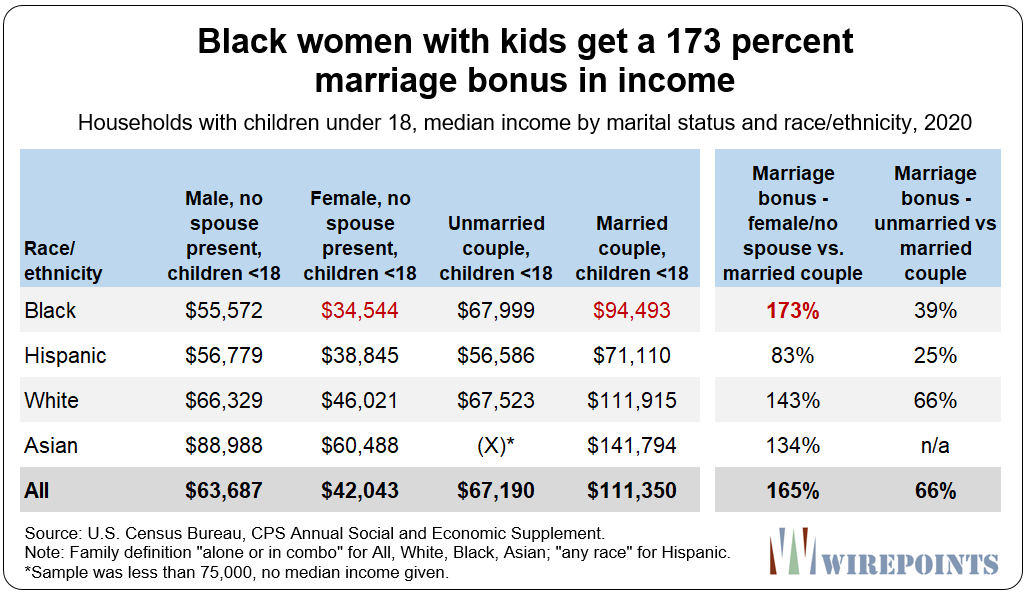
Why would marriage matter? Marriage may be an indicator of something, but there are plenty of successful single parents. I can think of several exceptions I know, all of whom are reasonably successful - one a somewhat well-known academic, one, last I checked, a rabbi somewhere, one, now deceased, a...actually, I forget what she did, but she managed to have a home in NYC and didn't come from a rich background, so she must've done something for a living (her kids were both academics.) When I can think of that many examples of reasonably successful people who break your rules without thinking too hard, there's probably something wrong with your theory, or at least my interpretation of it (sorry if I'm misreading what you wrote!)
"For instance 2-parent households will either be able to provide a much higher average income in the case when both parents work, or a more supportive environment when only 1 parent works."
I knowed a single-mom-family of 20 (twenty persons most under 21y), so if that mixed comment seem to look like 'that 2 parents build a safety-net for their children, if one becomes ill - for example - no the heck if you think how worse it is when a child got ill, 'horrifying!', think in that family of 20, on a regular basis _all_ got ill. At the same time. So you've to get a complete medical "lazarett"-team (doctor, sisters, helper,...) but to underline it (for the extreme... with the 'working parents') or there may be a need for an nanny-state-scenario... that may be called 'social'...
And for the original question: "Why would marriage matter", cos marriage seem to be often about rule and expections, not? Um But if i remember correctly, there were some academics, centurys ago speaking about "Moralstats" ("Moralstatistik" in German), where one finding was that not been married correlates with bad-tooth.
It's a question of what is the rule and what is the exception. Single parent households correlate extremely strongly with many negative factors, relative to 2-parent households. This doesn't mean that somebody can't live a good life coming from a single parent household, but that on average they are much less likely to do so than somebody coming from a 2-parent household.
And while correlation is not causation, many of these factors are obviously causal. For instance 2-parent households will either be able to provide a much higher average income in the case when both parents work, or a more supportive environment when only 1 parent works.
> And while correlation is not causation, many of these factors are obviously causal.
You might think so, but the negative factors are sharply divergent between single parent never-married households and single parent widowed households.
Maybe that was misleading. The statistics I’m talking about are from the article, and the sentence before was just my guess - but I really think this is common sense, isn’t it?
Hard work is only a path to success if you're working on the right things. For example, if I decided to be an Olympic athlete, and worked like the devil, I have zero chance of making the team.
In regards to a and b, wouldn't someone who thinks the former likely be someone who also thinks the latter? Those don't seem contradictory and, indeed, one is a possible explanation of the other.
People who lean right, tend to think movement from lower classes to higher classes is possible with hard work and that a person’s starting point doesn’t matter as much.
People who lean left tend to think where you start is the biggest predictor of where you will end up regardless of how hard you work. Hence the reasons one side favors the social safety net more than the other side does.
I think that the difference is probably that one side thinks that being a parent that raises healthy functional adults comes down mostly to personal factors. The other side believes that societal/structural factors play a large part.
So they don't exactly disagree on what the circumstances for success looks like as much as they disagree on the degree to which those circumstances are under an individual's control.
That would be true if these issues were discussed in rational terms, but unfortunately because it's predominantly political, it means rational terms are not the basis of these discussions. That is presupposing either point A or B is even true.
Yes, this is exactly as I see it - but as you can see in the downvotes many people very strongly think just one of these is true and very aggressively disagree with the other one.
people really don't want to accept that beyond the most extreme cases(starvation, lead poisoning, complete neglect, no school access at all, etc.), environment really doesn't play that big of a role. Twin studies have shown this for literally decades
That’s not what the twin studies have shown. It’s not only the most extreme cases, it’s anything short of the very good circumstances. For example, the stable homes families have to prove they have to adopt.
That's not true, for example metacognitive ability studies have shown environment plays the dominant role. Twin studies on trust provide the same, in which genetic component while large at 33% certainly doesn't indicate what you're stating that it's only "extreme cases". Even in studies re-assessing conventional twin studies and educational attainment, the conclusion was that while some is genetic (sometimes even a large portion) the correlations between a mother and father's educational attainment points to environment playing a large role (unless you have the belief that the mother and father are siblings I suppose).
You'll be extremely hard pressed to find researchers conducting these twin studies who minimize the role of either genetic or environmental impact on certain aspects in the way you did.
There's a tricky (and super interesting) thing with IQ studies. Environmental factors play a dominant role early on, but genetics becomes more and more dominant as a person ages; significant privilege or disadvantage earlier in life notwithstanding (excepting major physical impairment by nutrition, lead, etc)! Most studies tend to find the heritability of adult IQ at around 80%.
Any research on this area is walking on egg shells and so researchers are highly incentivized to overemphasize possible environmental explanations. Nature formalized this threat/risk with their relatively recent announcement [1], but it seems to have been an unspoken 'rule' for decades at least.
Heritability is, literally by definition, the measured difference in some value (like IQ) between people that is attributable to genetics alone. There's quite a lot of clever ways to control for environmental factors, like twin studies. And I simply think you're not engaging in good faith whatsoever if you don't see how that Nature article creates a huge chilling effect on any discussion of genetics.
Heritability is the ratio of genetic variation to total variation. Lipstick-wearing is highly heritable; the number of hands and feet you have is not. As I said, and as you can see, the heritability of a trait tells you nothing at all about its genetic determination.
I don't know what to tell you about the cite you gave, since it simply doesn't say what you said it says.
You sound like you're thinking of things colloquially, to put things in a kind way. Heritability is not a colloquial term and in biology/genetics refers exclusively to genetic factors. In particular it's the percent of difference in some value that cannot be explained by non-genetic factors. So e.g. if my IQ is 130 and yours is 90 then we'd have a difference of 40 points. With an adult IQ heritability of 80% we'd expect that about 32 points of that would be unable to explained outside of genetic factors.
Heritability does change over time because environments change over time. For instance in an area where starvation, lead poisoning, and malnutrition was common, the heritability of intelligence (or height) would generally be quite low, because the aforementioned environmental factors would be able to explain a large chunk of the differences between populations. But in a society where everybody had practically identical relevant upbringings and opportunities, the heritability of intelligence would be 100%, because the only difference between people would be genetic.
One of the many ways to test for heritability is twin studies. You'll likely find the correlation between lipstick wearing between identical and non-identical twins would be near to 100%. This means that the heritability of the trait would be near 0%.
No, I just provided you the literal technical definition of "heritability". It should be immediately apparent to you why lipstick is (highly) heritable and hand count isn't†; if it isn't, you're the one working from the "colloquial" understanding.
† lipstick: highly dependent on XX vs. XY; hands: set by highly conserved Hox genes, variation virtually entirely due to environmental factors.
I'm going to assume you're not trolling, and I am also going to assume you're the type of person that would take Wiki as a reliable source, so here you go:
---
"The concept of heritability can be expressed in the form of the following question: "What is the proportion of the variation in a given trait within a population that is not explained by the environment or random chance?"[2]"
---
The within a population part is critical. I'd encourage looking up twin studies to understand one way this percentage is estimated. I assume you think you know how they are done - you do not, because it directly leads into an understanding of how things like lipstick wearing would be near 0% heritable, while things like handcount at birth would be near 100% heritable.
I'm not making up that lipstick is heritable; it is a classic example of a non-genetically-determined heritable trait, as is hand count (in the other direction). I think you need to do some more reading: you are clearly using the term as a synonym for "genetically determined", and that is simply not what the heritability statistic tells you.
For what it's worth, you can mechanistically work out lipstick and hands from first principles; just plug rough numbers into the formula.
When you say things like lipstick wearing is a classic example of a non-genetic heritable trait, you sound like a guy claiming that a cat is a classic example of a non-reptilian reptile. It's somewhat of a contradiction in terms that doesn't make much sense.
"Heritability is a statistic used in the fields of breeding and genetics that estimates the degree of variation in a phenotypic trait in a population that is due to genetic variation between individuals in that population."
You are using the term in a colloquial or folk sense. Do you think accents are highly heritable? After all, a child will almost always share the accent of their parent. So in the colloquial sense this would be a 'heritable' trait, but in the genetic sense the heritability of an accent is zero.
While commonly thought, this isn't how twin usually studies work. The way it works is you look at the correlation between identical and non-identical twins on some given thing. If there's a much stronger correlation between the identical twins, then it's probably primarily genetic. What this does is helps to eliminate environmental factors because identical vs nonidentical twins will both be raised in basically the exact same environment.
So take height. If identical twins have identical heights while non-identical twins have varying heights, then it's safe to assume height is largely genetic. Interestingly separated twins would actually be worse in many cases because you reintroduce environmental deviation. For instance with height, differences may well be down to e.g. nutrition, but when you have them in the same household you can usually assume roughly identical nutrition.
Alternatively, ability to delay gratification could be heritable and/or influenced by parenting styles, in which case controlling for household income doesn't make sense. Parents with high time preference tend to not do as well financially AND to have children with high time preference. I have no idea how much these factors are at play, everything is at least a little bit nature and at least a little bit nuture. But science must find out rather than acting squeamish. We know that patience can be improved through training and maybe eventually we will even have meds like we have for ADHD. If these things matter, we could improve millions of lives.
One of the big psychology books mentions this study. Maybe Thinking Fast and Slow?
All it tells you really is whether the person has to grab what joy they can now because their life experience has taught them that promises about tomorrow sometimes do not come. You see that marshmallow, you enjoy it while you can.
And that’s also ignoring the joy of small things. Three marshmallows is as enjoyable as fifty. So now you need to decide if one is enough joy or if you should wait for ten or whatever the reward is.
And trust. Does the kid trusts the researcher they will actually get more marshmallows? Or is their life experience such that adults promise candy and then dont deliver?
There is one big variable here that is being overlooked - which is the test itself.
I remember my mother doing the marshmallow test on me, aged 3. She put two packs of play-doh moulds on the stairs where I could see them - one with three in it, one with five in it.
She told me that if I didn’t touch them, then she would give me the pack with five for my birthday a week later, and the pack with three to a friend. If I did touch them, she would give them both to said friend.
After passing them on the stairs for the umpteenth time, after a few days, I caved, and opened the small pack.
She made good on her threat.
This was 40 years ago, and remains seared into my mind as a learning moment, and I have, since that moment, been absolutely ruled by delayed gratification - I never made that error again.
So, in short, merely administering the test likely influences the outcome, as humans have memories, and children learn from experience.
> The obvious conclusion is that household income is a predictor of both:
> - inability to delay gratification, and
> - higher academic achievement
> This makes sense when you consider that someone growing up in a poor household may have both:
> - less reliable/continuous/predictable access to material things, meaning they would rationally seize immediate opportunities rather than taking the risk of a larger future opportunity, and
> - less academic support
While this is all true, there's another factor that no one ever brings in: wealthy people are likely to possess attributes that lead to wealth accumulation like conscientiousness, intelligence, ability to delay gratification, etc. Those traits are quite heritable, so their children are likely to have higher income.
People are allergic to the idea that outcomes have something to do with heritable characteristics. And allergic to the idea that economic success is related to positive personality traits.
Some people attribute success to raw ability. You get good grades because you know the material, you get the job because you're the best at doing the work.
There's also a component of giving others the perception that you're capable. Seeming smart, navigating the politics of a school or workplace, fitting in. A lot of this seems like it's obviously learned, and that affluent people will be ahead.
It's both. Higher household income means better nutrition for their children (which also maxes out your genetic disposition), better education, more secure attachment, focus on careers, etc, in addition to the points you raised.
> wealthy people are likely to posses attributes that lead to wealth accumlation like conscientiousness, intelligence, ability to delay gratification, etc. Those traits are quite heritable, so their children are likely to have higher income.
It's just as likely that proximity to these characteristics is sufficient. As heritable as those might be, inheritance of assets is protected by law. What more heritability is needed?
> People are allergic to the idea that outcomes have something to do with heritable characteristics.
Heritable only through learned behaviors, imitating family. Too many playboys squandering grandpa's hard-earned wealth to think otherwise. The right lessons just weren't taught for some. Positive personality traits do relate to economic success, but too few who have those have the parenting skills to transfer those to the next generation. Their genes certainly aren't doing the heavy-lifting.
Assets are typically inherited long after the income generating years have been determined. You could argue that the promise of high likelihood of a future inheritance event affects choices (and I’d agree that a positive effect), but I think most people receiving inheritances of notable size are middle-aged.
Perhaps if they inherited the ability from a parent, the parent is more likely to have an income as a result of investing in their education for example.
I mean, maybe, but this is definitely doing causal modeling backwards
Yes, it's possible that there are strong genetic predictors of household income, as a lot of people seem to want there to be for some reason, but when predicting the behavior of a child, their immediate circumstances are a much more parsimonious explanation for their behavior than some genetic factor strongly predicting both the circumstances and the behavior. I'm not saying that genetics being somewhat causally upstream of income is an inherently bad hypothesis, but this kind of correlation analysis doesn't support it as well as it does an environmental influence on time preference
This is the crux of the controversy. Some people think behaviors have 0% genetic inheritance and some people think it’s >0%. To assume low income parents can only cause low future orientation, but not the reverse, you must be in the former camp.
> Some people desperately want poverty to be due to individual moral failure, as opposed to a systemic failure
There are zealots on both sides. Brilliant people are poor because they were never given an opportunity while rich nincompoops accumulate aristocratic power. At the same time, plenty of people are poor because they can’t make good decisions or have zero emotional self control while a few go from rags to riches. The problem is blended, and it shouldn’t be beyond reproach to question whether some factors are heritable, whether genetically or through cultural transfer.
But one of those opinions flows power from the many to the few while the other the opposite. It is in and of itself political.
It of course shouldn’t be beyond reproach to do the research but it seems reasonable to be more critical of research that implies some implicit reinforcement of the current power structures because that’s what we’d get from bad research too.
> one of those opinions flows power from the many to the few while the other the opposite. It is in and of itself political
This is true of many things. That doesn’t mean asking the question is tainted. Anyone using either hypothesis as the basis for policy is similarly flawed in my view.
> seems reasonable to be more critical of research that implies some implicit reinforcement of the current power structures
There are massive power structures that benefit from the promulgation of either hypothesis.
> Anyone using either hypothesis as the basis for policy is similarly flawed in my view.
This is a tacit endorsement of the current power structures. I don’t think that is _wrong_ just a political position. One I agree with which is uninteresting given the forum.
Your second hypothesis is one we might test. Can we formulate an experiment that asks how often brilliant minds cross class boundaries? Or idiots bring their house down?
> This is a tacit endorsement of the current power structures
Not really, rather than assuming either theory is right just test giving resources to poor and sees if it improves outcomes. If it does and the resources were well spent, preventing people from becoming criminals or other burdens on society has massive value so continue and maybe do more of it. If it did little then don't, why spend on stuff that doesn't help?
That is much better than just assuming one is true and implementing measures mindlessly, like many governments do today. For example there is no evidence that diversity training improves any metrics, yet it is still required by many governments.
When people just assume one explanation you get a lot of effort put into things that doesn't improve the lives of anyone.
And some people are open to the possibility/probability that personal actions and choices have an influence over the propensity to experience poverty, in order to understand (and intervene where feasible) to break the observed cycle in a structural way.
> household income is a predictor of both:
> - inability to delay gratification, and
I'm not sure we can draw that conclusion. Household income is a predictor of higher education -- that is well established -- and higher education as a child could mean you are more likely to have learned lessons on the benefits of waiting vs instant gratification (the principle behind savings and investments).
So higher education _might_ be correlated with delayed gratification, but not household income itself.
The direction of causality is just hard to determine. The “obvious” conclusion could be that ability to delay gratification is a predictor of:
- the offspring’s ability to delay gratification (genetic; what is tested in the experiment)
- household income
- higher academic achievement (for the offspring)
>> less reliable/continuous/predictable access to material things, meaning they would rationally seize immediate opportunities rather than taking the risk of a larger future opportunity
THIS — the environment definitely changes what is the most rational behavior.
In economics, this is Counterparty Risk — the risk that the other party will fail to fulfill their obligation. E.g., as a vendor it is rational to accept a piece of plastic from a complete stranger without a word, because the issuer of the card is good for the money, and has taken on the problem if the buyer doesn't pay their bill that month.
For kids in affluent stable households, it is rational to expect that they'll get the second cookie in 20 minutes.
For a kid in an unstable household, being told by someone who neither looks nor talks like they do, that they'll get two cookies in 20 minutes, it's often rational to take what you can get NOW.
The marshmallow test measures mainly environmental counterparty risk in everyday events.
Seems when controlling for those factors, the 'marshmallow effect' disappears.
This is good science. Discover an effect. Generate a hypothesis. Keep testing until you find the limits of that hypothesis, and/or hidden variables.
It's more of the same slop we've seen for decades from the social sciences. We know most traits are heritable. We know that low time preference yields higher lifetime earnings. Of course an experiment is going to show no effect when it controls for the effect! What else would you expect?
Psychology is messy. If you assume that impulse control and the ability to delay gratification is an inherited trait, then the income of parents becomes supporting evidence rather than a confounder.
Time to do some GWAS to see if there is indeed a genetic component :)
Why do people make up inherited traits and apply them as if that is a legitimate critique?
The entire reason they did the marshmallow study is because most studies on impulse control cannot avoid confounding factors.
Time value money matters if I am offering you money now vs later. E.g. if you are in debt money later effectively involves the interest earned on that money at likely 25% or worst case 900%. If you aren't in debt the alternative is investing at 7% with risk or 2-5% without risk.
Trust is incredibly important. Money now is money now, money later might be money later if they actually fulfill the promise. And this isn't income agnostic as the risk of this varies wildly based on the impact of the money. A "get back on your feet" amount of money today or a slightly larger amount in a year implies a lot more risk than some spending money on either case.
Additionally while genetic markers have sometimes been effective at predicting even those have trouble with the random nature of gene transference.
All traits, psychological or otherwise are heritable. The hard question to answer is how predictive those inherited genetics are relative to other factors.
Yes, but tiny variations in phenotype will foster rather largely different outcomes. People forget that a lot of your genetic traits are there as potential, but not as fact. Its not even necessarily and upbringing thing. Epigenetica systems, multi generation genetic markings (like famine). Its very hard to say how a certain genetic trait becomes an observed psychological trait.
Right, but I think in this case people mostly about whether there's causation. Because, if there is, then you can do an intervention to train willpower.
> But when they controlled for household income, they found most of the correlation disappeared.
Controlling for things is mostly bad statistics, although of course all social science is bad statistics.
Confounding variables are bad controls more often than they're good ones, so controlling for them introduces collider bias. Also, finding a result and then controlling for something is a multiple comparison fallacy.
The correct thing to do is to have a theory of causation and then design a study that's capable of detecting it, not the other way round.
In this case household income is the parents' household income, so it can't be affected by the child's (future) academic achievement.
Can controlling for household income introduce collider bias?
(Sorry I know the words you're using, and a few years ago I started reading Pearl's book, but I did not finish it and do not have a strong grasp of the concepts.)
More simply: people who grow up hungry learn to eat whenever they can because being hungry is awful
It doesn’t even need to generalize. This is just a basic food security thing and is part of the reason why obesity is counter intuitively common among people who suffer from food insecurity.
An extreme personal observation of this was my grandmother, who grew up during the Great Depression with 9 siblings. They managed better than most and helped out neighbors (having both land and descending from farmers); she would in her later years (when I knew her) have massive stockpiles of processed long-shelf life food stored everywhere. Also, all the pickled/preserved food from her garden that was left over. For the longest time, I thought it was common to have multiple freezers, and a couple fridges, in a garage stocked with food. Including, months old leftovers from cooking enough of whatever soup/stew for 4-5 full families.
It's true but it winds up carrying in weird ways. (my family history is awkward but suffice to say the main reason we weren't called out for being broke all the time was a factor of my mother being very involved in communities... perhaps it was her penance for her actions in causing the situation in the first place?) On top of my family history, treatment for what was then-misdiagnosed ADHD caused me to literally lose just about everything but my job and car in 2011... Lots of months eating ramen, cereal on sale, and baked beans.
As an example: my parents bought used Dodge/Plymouth/Chrysler products and my brothers first used Jeep wound up being a hot mess that caused a large blast radius. I purchase the cheapest 'new' vehicle that fits my needs [0] and only bought one used car (as a backup for all the fun accidents my ex-wife got into.)
As another more painful example: My first few years in the workforce alongside student loan debt, then alongside the 2008 crash, on top of my adolescent observations an helping my now-ex-wife through college, caused me to wait way way way to long to start contributing to my future retirement.
Semi-positive counterpoints:
1. I buy stuff that lasts, it takes more research and sometimes more up front but as I get older it saves me more and more money compared to people who live in a more disposable culture. I'm not afraid to shop/wait for deals and I make sure to think about every major purchase I make. I take good care of stuff I own.
2. I've been able to learn how to fix a -lot- of stuff (working at a bike shop helped) and it has both saved me money and save waste in general.
3. I can fit all of my mementos -and- important stuff including work desk (aside from bed/couch/etc) in a portable storage unit if needed.
[0] - Except the WRX, that was a 'my life is in a terrible spot but I survived a year'. OTOH I got a base model with only a couple options and it was <30k before taxes.
> part of the reason why obesity is counter intuitively common among people who suffer from food insecurity.
Bigger elephant in that room is the nutritional content provided to people in that category as well as access to that nutrition.
That depends on the country. In rich countries it is rare for poor people to go hungry because food is cheap compared to median income and poverty is defined relative to median income.
It is rare for poor people in rich countries to starve to death, but missing meals and going through periods of hunger is unfortunately not uncommon at all.
Counterpoint: I've visited the US. Poor children go hungry there, at least in WV. I've talked with a teacher who baked white rice everyday to give it to 3 children in her class, since they couldn't afford the school's restaurant and didn't had lunch.
Every public school in the US has free school linches for those in extreme poverty. This is especially true in more poverty striken areas (like West Virginia):
"Extreme poverty" in the US is such a crazy low bar though. A huge portion of America is literally working poor. Not technically under any poverty bar, but that's not enough to pay rent and also buy enough food for everyone.
For those people, the $2 a day that school lunch costs (or even 50 cents for reduced price lunch) is literally too much money, because it is. So those kids go hungry. I knew plenty of those kids that all of you are insisting don't exist (for some reason) and no, the existing welfare is just not enough, even in an extremely low cost of living area, in a state with significant state level aid.
The bar for free school lunches in America isn't "extreme poverty". You've responding to HideousKojima's characterization of the program as though it is accurate, but he's wrong and if you're actually familiar with the subject matter you should have recognized that he's wrong.
Most working class families qualify for free or reduced price lunches. If you're at or below 130% of the poverty line your kids get free lunch. At or below 185% of the poverty line gets kids a reduced price lunch. How many children a family has is part of this calculation; the poverty line is set higher for larger families. This program spends something like 5 billion dollars a year giving lunches to tens of millions of kids. It's not a niche thing few qualify for. There are many schools where virtually every student is in the program.
Furthermore, schools will not allow kids to skip lunch. They are given lunch whether or not they have money and the matter is settled with their parents later. The few times I tried to skip lunch in school it turned into huge dramas and food was given to me even though I had chosen to not eat it.
As far as I know schools provide free lunches to children that need it.
In my area it is a school policy that a kid would not be denied food even if they had no money in their account - and every place I lived had organizations that would eagerly step up to address such a problem if and when it manifested.
For what it is worth, during COVID and a few years after, in my state every kid got free lunch in school regardless of their income.
I'm pretty sure the parents have to fill something for their children to have lunch, and I'm pretty sure the parents were too gone to care.
I met the teacher following a photograph who tried to document the opioid epidemic, crica 2018 (we were young and naive, video is probably the only communication medium that's worth anything when you're independent, photography is harder), while I kayaked/hiked/rafted/climbed everywhere I could for the two month I was there. I think she work for a magazine now. And I'm still convinced West Virginia is only lacking a huge lake or a sea to be the best place on earth.
In a recent study by the USDA, Household Food Security in the United States in 2022[1], it is estimated that "17.0 million house-holds were food insecure" (meaning that "they had difficulty at some time during the year providing enough food for all their members because of a lack of resources") and "5.1 percent of U.S. households (6.8 million households) had very low food security" (meaning "food intake of some household members was reduced,
and normal eating patterns were disrupted at times during the year because of limited resources").
That's 17 million HOUSEHOLDS that struggled to provide food and 6.8 million HOUSEHOLDS that had to skip meals. I wouldn't call that rare.
Clearly, but they're saying that only attempts to explain why those particularly in poverty had the associated results. When referring back to the original study's actual claims it was more than just correlation with poverty incomes, it was claimed for all incomes and not so obviously linked to food insecurity.
"Some folks did a study with 900 people. They found the same correlation that the original study did. But when they controlled for household income, they found most of the correlation disappeared."
So original study didn't control for income. If the original study claimed it across all incomes, and then it mostly went away when others controlled for income, then the delayed gratification strong correlation wasn't really for all incomes, right?
No, you are the one claiming something in your original comment. What the person you are responding to is insinuating is that what you are claiming is more of the same pseudoscience as the original study.
> More simply: people who grow up hungry learn to eat whenever they can because being hungry is awful
> It doesn’t even need to generalize. This is just a basic food security thing and is part of the reason why obesity is counter intuitively common among people who suffer from food insecurity.
Share the study that backs your assertions. If you don't have a study then everything you've claimed has no scientific basis.
yeah but that's too simple. as an adult who wants to live as long as possible, if I have to choose between eating one meal today or being able to eating two meals next week, I'm going to ask who the psychopath is that's imprisoned us, because we live in normal world and why would I ever be in that sort of a situation? Seriously, think back to as early as you can possibly remember, then as the marshmallow question. then ask it again to yourself, again and again, until your parents bringing you into a strange room with some weirdos, saying these are your parents now and have a marshmallow, isn't traumatizing
Cost of food has grown significantly just in the past year or two. In 2022 alone, there was a 45% increase in food insecurity in children of the USA. [0]
Common sense says kids are not growing up hungry. If you look at actual times when they were, like the great depression, kids were rail thin. The opposite is true now. If you read the fine print on these reports they usually boil down to something like: “there is not enough variety in the household”.
You can be hungry and not rail thin. The notion that you need to be starving from malnutrition to be hungry is rather ridiculous.
I was hungry as a child and teenager. This involved things such as not having any food prepared for school, and not having money to buy something myself. Yes, we had dinner, and no, I wasn't starving to death or rail thin. But I was also hungry.
The definition of food security was changed in 2006 to eliminate any reference to hunger.
> Low food security—Households reduced the quality, variety, and desirability of their diets, but the quantity of food intake and normal eating patterns were not substantially disrupted. [1]
In other words, by new definitions, if you ever reduce the quality, variety, or even desirability of your food throughout the year, you are considered food insecure.
EDIT: It looks like I'm not allowed to post in this thread anymore. I am quoting the USDA website. Nothing is cherry-picked. I've added a citation.
Decline in food quality is ostensibly a decline in food security. But any sensible design would not use that as a threshold for defining food security.
Rather than appealing to some unnamed source’s cherry picked definition, you would do better to look at an actual study of food security and see how it was defined. Because a very small amount of common sense suggests to me it’s not what you’re saying.
It’s actually both. It ends up being “eat as much as you can of low quality ultra processed foods that are high in empty calories and low in nutrients,” because that is what is inexpensive
This statement is correct. Don’t downvote it. It also compounds as calorically dense ultra processed foods lack the nutritional content make you stay full
>The obvious conclusion is that household income is a predictor of both...
Correlation, but of course, not causation. We need to be very careful about storytelling, especially when it comes to behavioral studies, where it's easy and intellectually satisfying.
Yeah. The reality is exactly the opposite of the headline. The study is confirmed, not refuted. Low time preference is heritable no matter what you believe the mechanism might be.
Wut? The causation can flow the other way as well. Having high tike preference results in lower household income. And time preference is probably genetic. They literally controlled for the variable they were testing for....


The obvious conclusion is that household income is a predictor of both:
- inability to delay gratification, and
- higher academic achievement
This makes sense when you consider that someone growing up in a poor household may have both:
- less reliable/continuous/predictable access to material things, meaning they would rationally seize immediate opportunities rather than taking the risk of a larger future opportunity, and
- less academic support
Now, this new study (OP) goes even further, finding that the correlation itself is weak.
[0] Watts, T. W., Duncan, G. J., & Quan, H. (2018). Revisiting the Marshmallow Test: A Conceptual Replication Investigating Links Between Early Delay of Gratification and Later Outcomes. Psychological Science, 29(7), 1159-1177. https://doi.org/10.1177/0956797618761661