I was interested in seeing the kind of job opportunities this would create. Especially after reading Chip War [1] which goes into the history of the offshoring and globalization of Fab processes.
Here are a few of the openings Broadcom's openings at the Fort Collins, CO site [2]:
- Material handler, Manufacturing operator: 12.25 hour shifts, 3-4 day work weeks, ~$19-25/hr. Night shift in higher demand
- General Mechanical Technician: $20-37/hr, alarm response a big component of role
- ASIC Digital Design Engineer, Fab Quality Engineer, R&D Software Engineer, Cleanroom facilities project manager: $78-150k + equity, BS/MS + related experience requirements
These are in Fort Collins, CO. It's the 151st largest metro area in the US, so it's not really a tech jobs hub. Getting up to $150K plus equity and benefits wouldn't be a great salary in San Jose or Seattle, but it's not out of line with a lot of tech jobs in less populated metro areas.
Even in New York and Boston there are a lot of programmers and other midlevel ICs making making ~$150k. Not everyone is lucky enough to work at Google.
I work in New York at a tech company with more than 200 employees that's a household name among below 50s and considered a hot brand and I only get paid 150.
Last I checked, $150k/year was enough to afford a decent house in a place like Penfield. It's a completely different world. I'm talking about NYC metro. Interestingly it seems like just about all of New England is more expensive than comparable areas in Western NY.
Basically all places in the US with anything resembling urban density and don’t have a reputation for decline have been on this housing cost trajectory for several years now.
Most people seem to, which is a thorn in the side of anyone who has lived outside of NYC in the big beautiful state of NY. It's annoying having to regularly clarify "the state, not the city".
California outside of LA/SD/SF is dramatically different (with the exception of some coastal areas). Even then housing and rental competition can be pretty bad. My brother in law has done 4 hour round trip commutes to the Bay Area for contracting work while managing to find an area with affordable housing.
Yup — they’re out that way and it’s still pricey. It’s unreal — the last time I heard the subject of renting here come up there were only 3-4 houses available in the whole town.
ASIC design is a much more ratified skill set than you'd need for a normal programming job. I always found it sad that salaries in the hardware industry are so comparatively low.
It's even crazier when you consider that readily available knowledge for cutting edge hardware is much more scarce compared to software. There are no massive communities of knowledgeable people all trying to show you what you are doing wrong.
Especially for something like silicon design, there is virtually zero knowledge available outside of institutions.
I think in some ways this actually is better though.
I find that when I want technical info about hardware-specific topics, I do not find the same kind of dumpster-fire articles like I would about say, ReactJS, or something similarly trendy.
Its always some basic html/css website with extremely well written technical information from an old-head that is a master of whatever he is talking about.
I understand what you mean by better but you have to admit the much lower compensation is weird given how much higher the bar is to be an SME and how many fewer the engineers are.
There is nothing "sad" about it. It is simple economics. The return on investment (ROI) is so much higher in software, compared to hardware. Correspondingly, the profits margins are way higher in software, compared to hardware.
Related: When you look at salaries for robotics engineers who work in a factory, the salaries are so much lower than you would expect. Plus, your factory is probably in a rural area due to very cheap land prices.
One more: Anything "embedded" usually pays surprisingly low salaries considering their skill-level (much higher than mine!).
> There is nothing "sad" about it. It is simple economics. The return on investment (ROI) is so much higher in software, compared to hardware. Correspondingly, the profits margins are way higher in software, compared to hardware.
I've seldom seen a more classic example of econ bro arrogance than this comment. Apparently economics doesn't just tell us which neoliberal policies to support, it also tells us when we can be happy and sad too?
There are relatively fewer employers seeking hardware skillsets compared to employers seeking software skillsets. People may say, "there are way more software engineers though! hardware is SO hard!!" as a counter, but they don't realize there is a proportionally crazy amount of software employers out there trying to hire engineers.
Your pay is capped by what you make your employer (the ROI you mention), but actually determined by how hard it is to replace you. Hard being defined as the difference between "# of Positions" and "# of Employable People". You could make your employer 10 million a year but you won't see a dime of that if anyone on earth can replace you within 5 minutes.
The fact that rural areas pay less has more to do with lower bargaining power of the employees than it does the cost of living. If one quits, the literal million dollar question is where are they going to go work instead? Is there another major manufacturer out here in the middle of nowhere? "Shut up, take what you get." Many build out in these areas for precisely this reason.
If the rate hikes cause a mass startup extinction we'd see an equalization of pay.
Housing in the NE isn't amazing, but it's dramatically better than the bay area. You need to make 225+ (300 realistically) in the bay area to be a home owner, and even then you're living in a marginal area with a lot of compromises
I don’t think 225 or even 300 would be enough. Especially if you have kids. I don’t think people truly realize how home ownership has become completely out of reach for most, even for tech workers.
My wife and I live in a suburb of the Sacramento, CA area and have a combined household income of $400k and we have 20% saved for a $700k house (avg price in this area). But the mortgage costs would still be insane. We could either pay $2500/to rent a nice house (3-4bed 2b 2000sqft,we have no kids) or $4000-5000/mo for pretty much the same.
At this point in the housing market, buying makes no sense. I wish people would stop pushing the "American dream" of NEEDING to own a home. Homeownership is not a necessity, it is a luxury.
This American dream philosophy has caused very unfair policies where people who make $60k qualify for housing assistance and can buy houses for 0 down because the govt pays for some of their down payment[0].
If I can't enjoy the luxury of owning a home, why do my tax dollars pay for that luxury for those who earn less? I'm not anti socialism at all, either. I'm just stating that home ownership is a luxury in this day and age. Pay for people to live somewhere, yes. Provide them with mental health care, yes. I don't mind my tax dollars being used for those necessities. Helping with home ownership? In a market that already has fierce competition and low inventory? It's ridiculous.
I have often seen people on HN with mind boggling (to me) incomes to whom houses that seem relatively very inexpensive are inaccessible. Why is that? Naively I would think you could rent for 30k/y and save enough in just a few years to buy a house without a mortgage
At the same time people start earning those incomes, they are also paying $20k to $30k per year per kid for daycare. Couple that with $50k+ retirement savings (max 401k and HSA) and 2 $50k cars, and it can seem tight.
Also, the higher the pay, the rarer the source of income, and so lower probability of replacing your income if you lose your job. That means you might want to put down more than 20% to ensure your monthly mortgage payment is still possible even if your income drops by 30% to 50%. Such as if the wife has pregnancy complications and cannot work, etc.
People always crap on tech for being useless while ignoring that 95% of fintech companies exist solely and completely as a vehicle to generate money for a very small group of people.
>> "Many high-tech companies have relocated to Fort Collins because of the resources of Colorado State University and its research facilities. Hewlett-Packard, Intel, AMD, Broadcom, Beckman Coulter, Microsoft, Rubicon Water and Pelco all have offices in Fort Collins. Other industries include clean energy, bioscience, and agri-tech businesses."
Maybe not a hub yet, but it's headed that way. It's also only an hour away from Denver.
Most of these companies are there because of the HP campus set up there in the 70s/80s. HP liked setting up offices in small towns near colleges where they were the essentially the only tech employer. Broadcom bought HP's fab facilities after they divested. Microsoft started an office there because they wanted to hire optical mice engineers who were working for HP.
Source: Used to work at the Microsoft office in Fort Collins (HoloLens group). Some of the folks I worked with were the original folks that set up the office.
It's sadly been moving a bit the other way. HP/HPE have significantly downsized and Microsoft's office is pretty tiny. I"m not sure AMD even has an office here anymore, if so, they took down the sign on the building it used to be on.
HP, Broadcom, Intel, and AMD used to all be on the same intersection.
People who have been to Fort Collins know that that city needs a _lot_ of infrastructure work to become anything more than it is now. FC already bulges under the pressure of college move-in/out and tourism there is fairly big for Coloradans. I also don't think residents are the kinds that would go for large expansion. Denver still has more than enough room to grow before they push out into the smaller towns, and if they did Boulder would go first since it already has a startup ecosystem IMO.
Fort Collins is not near a San Jose or Seattle level of tech employment but then, neither is anywhere else in the USA. Any tech worker who ends up there won't be hurting for employment opportunities, especially if they are willing to commute to Denver or Boulder.
Just don't be surprised when the cost-of-living ends up higher then one might expect. Housing is still a good deal by Bay Area or NYC standards, though.
There's a lot of housing in the $500K range in Fort Collins. I can speak with some authority on this situation; I run the MLS for Northern Colorado. :-)
edit: MLS = Multiple Listing Service, that thing you do when you "list" a house.
Keep in mind the posted salary is negotiable. It's a rookie mistake to assume that if you are offered the job, your only option is to take the offer at the amount listed in the public job offer.
Negotiating salary well is an important career skill.
That has worked for me precisely never; in fact I gave up negotiating over job offers at all because what I always wanted was more time off, and all I got was "sorry, we only distribute vacation time based on seniority".
Median house price is still $590k there, which is $4200 a month plus taxes and PMI. $150k is $8800 a month take home pay after taxes (including CO state). Making $150k and still spending more than half your post-tax income (after taxes/PMI/repairs/HOA) on housing is wild.
It's not unfair to say Fort Collins isn't a tech hub, but it's also not too bad. Trivia: One of the first non-CA Hewlett-Packard plants is down the road in Loveland. They also have a big campus in Fort Collins, which is where the Broadcom site is now.
I am from Colorado and went to school in Fort Collins. It maybe be small nationally, but it’s probably the 4th biggest tech area in CO after Denver, DTC, and Colorado Springs. Cost of living is surprisingly high unless you live in student housing.
For apples-to-apples, you’d look at Denver. We’re talking about the state’s 4th largest city which is 65 miles away from the capital and otherwise in the middle of nowhere. It’s extremely expensive for what it is
My daughter had grand plans of "renting a big house with a bunch of her friends" for her first year out of high school in Fort Collins. A couple of weeks ago she told me how all of her friends now plan on staying at home. Apparently she looked up rental prices. :-)
General Mechanical Technician is another name for mechanical maintenance. in my experience, if "alarm response" is a big part of the gig then run for the hills because this company intends to run their equipment until its literally a pile of flaming grease and beeping melted plastic.
alarm response means you as a mech tech/mechanical maintenance have failed proactive or preventative work and will spend the rest of your career working mandatory overtime to fix what aint fixable anymore. the reason for this failure is nearly always management pushing for higher uptime and output. alarm response should never constitute a new factories big ticket issues.
Yeah, I remember meeting someone who designed ASICs back in 2000 or 2001 and he made ~$260k/year ($1000/work day) as a salaried employee for a certain large printer company.
I hate the fact that I agree - feeling cynical myself.
At this point when I read about $megacorp moving production to the US, I see an indication of globalization-level exploitation and profits being applied to the US labor market.
> At this point when I read about $megacorp moving production to the US, I see an indication of globalization-level exploitation and profits being applied to the US labor market.
What do you expect or want to happen? Companies will pay the lowest price they can to adequately fill the role they need to fill. As everything it comes down to demand and supply. If lots of folks are available who can fill the role well, the comp is gonna be pretty low. Do you want companies to pay more just out of charity? When apples are on sale, do you ever just pay double the price because it feels fairer? The only place where we do this is with tips and that's usually already priced in.
At that pay band they are looking for warm body levels of fill. Like we need a guy to sit in chair for compliance reasons but he probably shouldn’t touch any of the controls level of pay. Like for reference brown bear car wash pays 22 per hour and a straight out of 2 year trade school mechanic gets 37 with union benefits in Washington state (outside Seattle)
I too am hoping that we could account for negative externalities and therefore would love to see a carbon tax for example. Can you explain what the unaccounted externality is in this case?
Those are still quite livable wages, I'm not seeing tremendous wealth but I'm not seeing any exploitation either. I imagine in fifty years some people will be getting paid minimum wage accomplishing basically the same output that a masters degree + 250k+ salary is pulling in now, it all depends on the technology in the tools.
I've got to admit I was pretty surprised when I learned about the pay + hard work setup for semi engineers at TSMC in Taiwan. I'd be curious if anyone has any first hand experience with it.
A (westerner) friend who lived in Taiwan for a few years returned recently. He keeps on saying the general lifestyle and living conditions in Taiwan are really lousy compared to Australia.
eg the climate is so wet/humid in Taiwan that the buildings tend to generate mold, most things are run down, and that kind of thing.
Didn't sound like a good place to live (yeah, as a generalisation), if you've got a choice in the matter.
Total comp for onshore TSMC engineers is surprisingly low compared to finance or tech jobs in the US. Yes, cost of living is lower in Taiwan, but most of the big factories are outside mid-sized, unappealing cities. (I'm looking at you Taichung and Hsinchu.)
That may be true for highly labor intensive roles but a fully automated operation is _more_ profitable when the few jobs that are required are staffed by trained personnel.
That is one of the reasons this factory isn't located in a poorer area. It's in Ft. Collins _because_ the profitability projections assume they can operate at somewhere better than 97% uptime.
> don't replace your iPhone every year, because now it costs 50% more
This flattens down the experience curve [1], meaning the technological edge advances slower. That, in turn, exposes the entire industry to more-agile competition. This is the recipe for undermining competition behind a protectionist wall: cut costs to beat bigger competition with movement and then scale.
No, I said it won't play out like that given the race to the bottom. My comment was from an idealistic pov, because the parent comment gave me the opportunity to choose two, and those are the two I would choose if I was king :)
  - extreme corporate profits
  - better wages
  - US jobs
  - lower prices
You can’t optimize both for extreme shareholder returns and extreme wealth at the top and also pay first world good wages/living standards and have lower prices. Unfortunately, in this race, shareholder returns is often still the last thing compromised on, it seems.
That's not actually pick three. It's that if you have uncompetitive markets (and therefore high rents/inefficiency), you end up with worse wages, loss of US jobs and high prices. Because then the price companies can charge is no longer tied to their labor cost, so they can cut labor costs without lowering prices.
This is clearly what's happened and needs fixing, but even after that, you still have a trade off between high-paying US jobs and low consumer prices.
But the answer to that one isn't as obvious because it isn't linear. In a competitive market, competition with labor in other countries might cause you to get paid $1000/year less, but lower your cost of living by $2000/year.
> can’t optimize both for extreme shareholder returns and extreme wealth at the top and also pay first world good wages/living standards and have lower prices
Ignoring new entrants, sure. In a competitive market, shareholder returns entice new entrants. Flatten those and you lose that edge.
For many markets, the competition caveat is missing: this is something we can improve with policy. But pushing down profits for labor's sake is a false economy; it leaves the industry less resilient in a global context. Put another way, a solid repeatable business plan is finding a market leader suppressing shareholder returns and exploiting what they're missing from a separate jurisdiction.
I understand that, but if better wages lead to increase costs, it should be a zero sum game in the grand scheme of things. But, at least, you are not dependent on China for making stuff.
If you try to argue that the well-being of capitalists and the well-being of regular people/workers are one and the same you run into contradictions very quickly.
The main class of capitalists in the US is regular people with 401k accounts. (After that is small business owners, who I agree are evil but most people like.)
12 hour shifts are 13+ hours of actually being there because of lunch / breaks. For example Genentech in SF / Vacaville are "12 hours paid shifts" with 1 hour mandatory lunch. So no it is not required for an overlap because there i already a required by law break (lunch) that forces overlap (assuming this applies to more states than just CA).
This is the way it was handled when I worked in a place that had 3 8 hour shifts. You actually were there 8.5 hours with a 30 minute lunch, so this additional .25 hours just seemed odd that it was necessary.
Apple is basically building redundancy into its supply chain here. Just in case they are cut off from China, they will be able to set up final assembly elsewhere and will already have supply of the critical parts.
Mexico is becoming the new China for manufacturing. Even many Chinese companies are building factories there. Also recently Mexico is offering work visas for workers from central America. Check out this Wendover video on it.
they are just using Mexico as a way to get around tariffs and other trade restrictions. On paper it might say "Mexico" is the biggest trade partner for the US, but the reality all the stuff is still coming from China with an extra hop to do final assembly in Mexico. China is doing the same thing with manufacturing in Vietnam, all the money still flows back to China in the end
Mexico has none of the actual infrastructure or skilled workforce needed to be an actual manufacturing powerhouse that makes things from scratch
> China is doing the same thing with manufacturing in Vietnam, all the money still flows back to China in the end
Eh they do a lot in Vietnam in reality. And yeah Chinese own a lot of these factories directly or indirectly, but a lot of the money (and the toxic fumes) stays in Vietnam.
Isn't this how china got its start in tech in the 90s? all the "smart" people were in US/western countries and they just used china as a final assembly spot. but in doing so gave china the access to all the cool stuff, which they used to learn about it and build it themselves.
And Apple did the same thing when Cook prostrated himself before Trump pretending like “Macs were being manufactured in America” when it was actually only a few Mac Pros and they were doing final assembly here.
That is true. But now China is getting expensive and the population is getting older fast and the Chinese leadership is getting less predicable. Mexico meanwhile is much younger and labor cost is lower than China. Its a neighboring country and part of a free trade agreement. Canada and Mexico now at par with China in their total trade with US. The threat of future pandemic and global conflicts and their impact on supply chains has made companies more cautious. Its of just offshoring, its instead onshoring, nearshoring or friendshoring. A lot of the stuff onshoring will be higher value or those of national security or highly automatable.
Doesn’t matter. It’s a cultural thing. Mexico can get as young as they like. Won’t matter. Look at the work culture in China vs Mexico. That’s where all the answers lie.
With Biden repeatedly threatening to invade China and destroy the factories in Taiwan, it's clear Apple is just making sure they have a good fallback plan.
You have to parse through the rhetorical dishonesty to understand the meaning. In the mind of the radicalized Chinese nationalist, Taiwan is China (remember, they do not give a damn what the people inside Taiwan actually want, those people don't matter), so if Biden says that he will defend Taiwan if it gets invaded, that is equivalent in the mind of the nationalist to Biden saying he'll invade China.
"In the mind of the radicalized Chinese nationalist, Taiwan is China "
Acknowledged formally by the US also. The United States One-China policy was first stated in the Shanghai Communiqué of 1972: "the United States acknowledges that Chinese on either side of the Taiwan Strait maintain there is but one China and that Taiwan is a part of China".
Americans appear to be very eager to forget this for some reason. Sure the US can decide that the Shanghai Communiqué is no longer since China is now becoming a super-power - but it should at-least be recognized that breaking this effectively means a full-fledged War with a near peer military power. No one in the US should pretend to be surprised about it.
I always knew Broadcom as "that company that makes WiFi+BT chipsets that are a pain to use under Linux", vs Qualcomm "the company that dominates the Android ARM SoC market".
Android ARM SoCs are a tiny part of Qualcomm. What you should actually know Qualcomm as is: "The company that developed or acquired all of modern wireless comms tech, and thus gets paid very high license fees for everything that includes anything that talks to anything else over the air."
Although I think they are building up the ARM SoC business because some of their key patents are about to expire?
>The company that developed or acquired all of modern wireless comms tech, and thus gets paid very high license fees for everything that includes anything that talks to anything else over the air.
This isn't a great summary of Qualcomm. Their cell modems are the best in the business. Apple has been working on developing their own, and were rumored to try using them in their phones this year, but it's sounding like this still won't happen because they're not up to snuff yet. One needs to only read /r/GooglePixel to find out how well Samsung's modems work, and the news there isn't good. This is true even for 5G, which Qualcomm don't have locked down in patents so well as LTE.
>Although I think they are building up the ARM SoC business because some of their key patents are about to expire?
What? Their ARM SoC business has been on the same steady path for a decade now. Apple's SoCs are better, but no one gets to buy those. Everyone who has a choice uses Qualcomm SoCs, except again, Google Pixel, which use Samsung SoCs. Not even Samsung uses Samsung SoCs in their phones anymore.
I interviewed at qualcomm once, and when entering the building you are greeted by a reception desk flanked by two prominant walls on either side. Those walls are covered, top to bottom left to right, in golden embossed plaques of all their patents.
> The company that developed or acquired all of modern wireless comms tech, and thus gets paid very high license fees for everything that includes anything that talks to anything else over the air.
Apple tried. Recall the huge IP licensing battle from a year or two ago where Apple challenged Qualcomm on base price for royalties and what was considered FRAND given some of the patents were incorporated into the communication protocol standards.
Regulated for what? For spending the highest amount of R&D per Revenue to further improve an insanely complicated field of technology, much more so than CPU or GPU but no one understand, not being talked about, not hyped up, and no media knows anything about?
It is worth pointing out Qualcomm isn't just sitting here doing nothing and collecting money. That is the narrative Apple's PR spend years trying to put a spin on. When it was Steve Jobs himself who first put a high value on Qualcomm's patent. May be preciously because he understand the value Qualcomm has to offer. And even at the time Tim Cook was unhappy about putting another $7 on COGS.
For monopolizing the technology that became standardized, and thus required, for all of modern communications.
"Boo hoo, they spent good money for all those patents to make sure they were the only ones you could turn to to make these things!"
They've been wiping their tears away with the stacks of money they charge every single hardware manufacturer for access to that technology for far too long now, including very clearly breaching the spirit of FRAND at least in their dealings with Apple, based on the hard facts that came out with that case.
>For monopolizing the technology that became standardized, and thus required, for all of modern communications.
In that case every single one of the patents holding are "monopolizing" the technology. ( No that is not monopolizing means ). That is including Ericsson, Nokia, Samsung and LG. I am not even counting ZTE and Huawei here.
> based on the hard facts that came out with that case.
Hard facts? You mean charging Apple double the amount of the next total six patent holder?
>gets paid very high license fees for everything that includes anything that talks to anything else over the air
And I think this is the major reason why they have stagnated and have not come out with any ARM SoC's capable of matching what Apple has. They can just rest on their laurels collecting rent from all their license fees while releasing an unimpressive new SoC every once in a while
I really hope one of the big x86 chip makers decides to dip their toes into ARM at some point
Honestly the only reason Qualcomm develops ARM SoCs is so that they can bundle their modems into them and give customers that one chip solution they are looking for.
The current Broadcom is actually a spin-off from HP. This spin-off (Avago) has been on a massive mergers and acquisitions spree over the last decade. This culminated with Avago buying Broadcom and renaming itself to Broadcom.
Some of the crappy Wifi+BT chipsets that were sold under broadcom were actually sold off to another company, Cypress Semiconductor.
Oh, well this deal will definitely help with the openness issue!
(I like a lot of things about Apple but their lack of interest in documenting hardware is one of this things I don’t. It’s ironic given that without Burrell Smith and his doc there would have been no Macintosh).
They have their hardware repair documentation online as part of their self service repair program, although I don't think they have finished adding all their products to the program.
> Read the repair manual for your iPhone, Mac laptop, Mac desktop or Apple display model to familiarize yourself with the steps required and the parts, tools, and materials needed for your model and repair type.
I’m sure it was part of their calculus, providing a crucial part for this kind of hobbyist/introductory device can’t hurt business. Sort of like giving away free academic software.
As I understand, the bulk of single board computers are now being used by manuf.s for assembly line automation. That is the reason why they were so hard to source for hobbyists in the last 2 years. That said, when it started, I doubt Broadcom execs were thinking about manuf.s.
Because outside of F500 and legacy tech, VMware is largely irrelevant now. It's an interesting footnote, nothing to get excited over as for most of us it makes no difference.
Is that still true? My home built router and my server are both running Broadcom 10G ethernet cards I didn't have do so anything outside of enabling with ifconfig.
For the record, the OS's I tried this on were ClearOS and Nixos, but I have no reason to think it wouldn't work with other Linuxes.
They used to require installing a proprietary driver, IIRC, which meant you'd have a bootstrapping problem with your new laptop if you didn't have an Ethernet port handy.
For that reason I'd usually replace the WiFi chip in my Linux laptops with an Intel 7265 or later, as those had in-kernel support.
The drivers have a penchant to break with routine updates too, which is irritating to say the least. There's been a few times where on a machine with Broadcom wifi I've found myself without a connection after updating and no ethernet connection handy, forcing me to tether from my phone to get wifi working again.
I'm happy that Intel WiFi+BT chipsets have been popular in recent years. Those work great basically everywhere and don't randomly break.
yep. i will forever get a sick feeling at any mention of broadcom. they could cure a disease or something and i’d still be like “grumblegrumblegrumblebroadcomsucksgrumblegrumble”.
i sometimes wonder if my great grandchildren will have inherited some dna trait to hate broadcom lol.
i just can’t ever forgive them for the way them and their products treated linux.
And for what it's worth today's Broadcom is actually Avago - which got its start as HP's semiconductor division - after having acquired Broadcom and adopting its name.
It's tempting to say that the only people with longer memories and deeper resentment than the descendants of Eastern European blood feuds are the OG Hewlett-Packard employees who were there when Fiorina took over. But the truth is, Boeing employees who predate the McDonnell-Douglas merger make them both look like gracious exemplars of forgiveness.
Those folks are sore. Their lines will carry the grudge against McDonnell's management for a thousand years.
I can understand the confusion. I thought I could remember more technology companies with names ending in "com" (or "comm"), but all that come to mind are 3Com (now Cisco) and Worldcom (MCI). Others I can find are: Microcom, Freecom, Eurocom, Gericom, DASCOM, GENICOM, Dexcom, Omnicom, Paycom, Swisscom, Vodacom, Millicom, Mediacom, Bulsatcom, Escom, Vivacom, Classicomm, JCOM, and Finecom, but most of those I've never heard of.
However both are fabless design companies. By "manufacturing" in the US they don't mean building their own fabs etc but rather contracting with a US based company vs Chinese, South Korean or Taiwanese.
No. Go on any other site with this story and read the comments and it's full of "Apple's crawling back to Broadcom with it's tail between it's legs, because it couldn't design it's own LTE chips", referring to it's relationship with another company, Qualcomm.
Might be too much exposure to RAF Luton (e.g. the Lancaster provides Bouncy Operational Ordnance Ballistic Services), but I was expecting those capitalised words to spell something out.
Perhaps, but if we all queue up to clown on you others will take note and lay off the bullshit for a short while but LLMs will keep hallucinating in blissful ignorance.
I might be a bit of an idiot, but Realtek and Broadcom seem to occupy basically the same spot in my brain. They're two companies that do nominally similar things and I'm not smart enough to always differentiate them.
I could totally see someone hearing a vaguely similar name working on vaguely similar products and getting them confused.
So, Apple decides to make their own 5G cellular modem. Now, apart from Baseband, some of the RF in the cellular is hard (modulators with low power consumption, Envelope trackers, diplexers, duplexers). Some of these were designed by Qualcomm and some from Avago (Broadcom got acquired by Avago and renamed to Broadcom), Skyworks, Analog Devices, etc. So it is not surprising that Apple wants Broadcom's help for next few years until when Apple decides to again vertically integrate and make those components as well ( but they may decide it is not that cost competitive to do do).
The hardest part was Qualcomm's cost and paying them FOB royalties (which got capped at some point by DOJ/FTC involvement).
Lots of companies are cutting ties with China, Apple is obligated to do so. But the more companies cutting ties with China, make it easier for both China and US to have Military conflict on Taiwan. Replicating TSMC is in the making by intel but It will take Years, and would have been nice if APPLE, AMD and Nvidia would Start a Fab Together in the US as a part of the Chips ACT.
The whole point of bringing countries like China into the world economic system is to make sure that they realize that aggressive action is counterproductive and they refrain from doing so.
Unfortunately that hasn't really worked with China, which is why the world is starting to decouple from China; the CPP still prioritizes its institutional needs over "The People", which is ironic since they're supposed to be working for "The People."
That's probably why the CPP is scared of the people and tries to control them.
The world is really decoupling with China because it is so unpredictable. Xi made himself forever leader only 10 years ago and it's been a unpredictable rollercoaster of policy since then.
Stability is the foundation of every working relationship. Everyone wants to latch onto you when you are stable. You can even work with an adversary as long as they are stable. China had it for a while before Xi.
Most countries have yet to achieve long-term stability. Stability is super difficult to achieve.
Authoritative leaders inherently cannot be predictable because one person has a lot of power and can easily make sweeping changes.
Even though any organization led by a large committee is absolutely terrible at making long-term, coherent decisions, it also means that everything moves at a snail's place and any outsider can react faster than the committee can, and decisions also never stray too far from a certain point because there are too many cooks in the kitchen. America in a nutshell.
Plus the forever leader thing only happened ~10 years ago. That's too recent. I would only ever call a country politically stable if it hasn't changed in like 100 years. The US, for better and worse, politically has barely changed in 250 years. Sucks for Americans (but not entirely) but great for the world. When Xi declared himself forever leader, that basically reset the clock back to 0 years. Plus once Xi goes out of power, that basically resets the clock again because new leader, new policy.
At the end of the day, when you have a lot of something you want to keep safe (like your business), you want to put it with the person whose situation hasn't changed in the longest time. You don't even care necessarily whether that person is good. You just want that stability.
> the more companies cutting ties with China, make it easier for both China and US to have Military conflict on Taiwan
The coefficient of trade and belligerence is about 0.2, i.e. "a doubling of trade on average leads to a 20% diminution of belligerence" [1]. And trade with China continues to grow [2]. I wouldn't read the semiconductor re-shoring as materially changing the odds of a war per se.
I listened to an interview with the former CEO (and now chairman) of Microchip the other day. Microchip actually turned down money beyond $150MM from the chips act because it had too many strings attached to make building a fab with it worthwhile.
If ST gains customer because of their better lead times ... that means Microchip must really, really sucks.
Fun fact: ST management panicked at the start of the pandemic, started immediately downsizing, afaik they still haven't been able to catch up to demand.
We use both at my job, sustaining products with microchip and pre production with ST, it’s about even for terrible lead times. At least with ST I don’t have terrible debug hardware on top of my terrible lead times. I don’t know why anyone would use microchip for a new product, maybe bought in to the Atmel ARM chips already?
>Lots of companies are cutting ties with China, Apple is obligated to do so.
Not only is Apple not obligated to do so, they literally double down their investment as recently as 2021. In 2022 their total Chinese Suppliers were still rising. And that is excluding some suppliers slotted into other countries via different HQ strategy.
To see how many people believe Apple is doing the right thing just shows another master piece of Apple's PR.
Presumably because they care so much about privacy being a human right, and every day This Page[0] exists it breaks their heart. Breaking ties with China would be a great way to start getting tough on autocratic privacy overreach.
Oh ok, that I understand completely. I see why there are compelling reasons for them to do so, but I didn't understand the language of "obligated" to do so. That made it sound like there's some formal obligation, legal or otherwise.
As a third party, it's kinda sad that the US is so invested in going to war and seeking even more conflict.
All this energy could be invested in cooperating and building together. Instead, it's being wasted in preparing for yet another pointless armed conflict. It's not like we don't have enough problems already.
I mean you can stick your fingers into all your various sensory orifices and ignore the growing turmoil between Taiwan and China all you want, but the reality is that there is nothing the US can or will do that will prevent China from doing what they please with regards to Taiwan.
I'm aware of the politics of China (I have acquaintances in both mainland and Taiwan).
But a foreign country having internal issues isn't an excuse for the US to suddenly decide it's a good time to invade it (or to threaten to invade it and destroy its factories).
Just wondering what your thoughts are on China's self determination in deciding to invade or not? Why are you acting like the US is the one invading another nation?
If you examine military actions over the last several decades, it's not that difficult to form an opinion that the United States is the most aggressive military on the global geopolitical stage.
Perhaps this impression is wrong, I would be happy to read any statistics that demonstrate that this is not actually true.
> As a third party, it's kinda sad that China is so invested in going to war and seeking even more conflict.
FTFY. China is the actively belligerent party when it comes to Taiwan. The US doesn't want to invade either one. Don't forget the ongoing Uighur genocide in Xinjiang.
Complete nonsense. Cooperating with Putin lead to the invasion of Ukraine. Cooperating with the Chinese Communist Party can only lead to the invasion of Taiwan.
> The idea that the world will isolate China on behalf of Washington
Countries are doing it because of economic coercion.
China has banned Australian products from import (in violation of WTO rules) because of its position on Taiwan, Quad, Chinese foreign investment etc. Similarly for Sweden.
Which is one reason why EU has not been keen on a comprehensive FTA with China.
It's a stretch to call it "coercion" when it is directly in response to offenses committed against China [1] and primarily driven by Washington. Framing every negative action as coercion, regardless of causality, drains that word of meaning.
The bottom line is China wants to do business, but Washington wants China to be contained.
> China wants to do business, but Washington wants China to be contained
China expelling diplomats and cutting economic ties because an Australian college student said something mean or Baltic nation didn't agree with the party line on Taiwan is not wanting to do business.
> virtually every case these are explicit tit-for-tat actions
Zig versus zag. The point is economic repercussions for diplomatic faux pas means you aren’t just looking to do business, you’re leveraging business as a political tool. That’s a novel risk environment compared to before Xi.
You weren't clear what offences Australia has committed to China or why you are making this about US.
Banning Huawei over national security concerns or asking for an independent inquiry into the source of COVID is hardly offensive. And they are not excuses for refusing to abide by WTO rules and inventing reasons to prevent free and fair trade.
What is offensive is China providing a list of 14 grievances that Australia must address (e.g. supporting China's take over of Taiwan) in order to maintain a normal economic relationship.
In East Asia, China-South Korea relations have turned rocky over the past ten years, due to frustration on the part of China over South Korea's continued military alliance with the U.S. (e.g. the THAAD radar issue in 2017 that ended by ruining the burgeoning Korean Lotte network of shopping centers across China). Samsung used to be huge in China, but now it's largely domestic brands Huawei, Xiaomi, Oppo et al. Samsung had a massive phone assembly plant in Tianjin, but moved to northern Vietnam.
From a Korea perspective, the proprietorial attitude of many Chinese ("Korea used be part of China" Xi Jinping told Donald Trump), and the penumbra of nationalism in the PRC have resulted in a major shift in public opinion from 2000. Now some 80% of South Korean youth view China unfavorably, and that seems unlikely to improve in the near future.
> The multi-year agreement with Broadcom will see Apple use 5G radio frequency and wireless connectivity components, including FBAR filters, that are designed and manufactured in the U.S.
I don't think it means that. It seems to say that Apple will buy components for RF, not necessarily modems and antennas.
I'd be very surprised if Apple gave up on their internal modems. Not sure about whether the plan was ever to make antennas or just to have IP protection for option value. But there are a ton of other parts in the RF stack.
>- Paid $4.5B to Qualcomm to settle the lawsuit & gain modem/radio patents
They gain access to modem / radio patents. They settled with Qualcomm so they can continue to do business with Qualcomm and purchase modem as well as paying patents to use it.
This news means they are going ahead with their own modem. And judging by this announcement date it will be iPhone 16 at the earliest before their Modem ship.
If I'm not wrong, I believe Apple in the late 80s and 90s manufactured in the US, and again in the 2010s with the Mac Pro. I remember reading somewhere that they lost a ton of money because of it.
Steve was fanatical about automated factories for the original Mac and NeXT cubes. He kept bragging that their factories were the most advanced in the world, better than Japanese, etc.
Cook went the other direction, outsourcing to humans on other continents.
The "garbage can," model. I have one. It was double the price of the previous generation MacPro, 1/4 as upgradable and had some serious thermal issues. It is considered a flop, but I liked mine. I got it used.
That depends. The US is really cheap if your factory is fully automated, and Apple makes enough phones that full automation seems like it should be a win. For smaller production runs cheap labor is cheaper than the cost of building automation. Optimizing these curves is hard. (Note that China is really a lot cost of labor country anymore, and so production is moving away, but this is a long slow process, not to mention China is investing in automation and reportedly doing well)
My read is this is primarily radio filters, and all the stuff they were already buying from Qualcomm. There are a lot of them in 5G iPhones. Biggest loser here in my read is Skyworks, who provided a lot of the front-end-modules.
Does this mean that those iPhone components will be manufactured in the US, then shipped overseas to be incorporated into new iPhones, which will then be shipped back to the US?
I understand that this makes sense, but at the same time, I wonder how many tons of CO₂ will be emitted because of this kind of "onshoring".
Shipping of tiny electronic components around the globe doesn't have any substantial CO2 emissions, as long as they are shipped in bulk (and preferably by sea), simply because each component is so small/light.
Shipping your bags of clothes when you go on holiday has a far bigger impact. Those are shipped by air (~50x the CO2), are far larger/heavier, and in a weeks time will be shipped back, perhaps unused.
The big corp I work for has dedicated logistic dudes who fly with crates full of wafers around the world. While 30 years lifecycle FPGAs from Xilinx feel well in the container in open sea, project specific parts manufactured for specific client’s specific product with lifecycle of 2 years go by plane. Saving 1000$ and risking loosing business is not worth it.
And even then, it is normally planned that finished goods are shipped by sea, and it is only when things fall behind schedule that air shipping is used as a way to get goods into the right place in time for release day.
iPhones are shipped by air to Louisville, KY to distribute throughout the central USA. It shuts down UPS for a whole week when iPhones launch. All employees can be required to unload and move iPhones, including engineering.
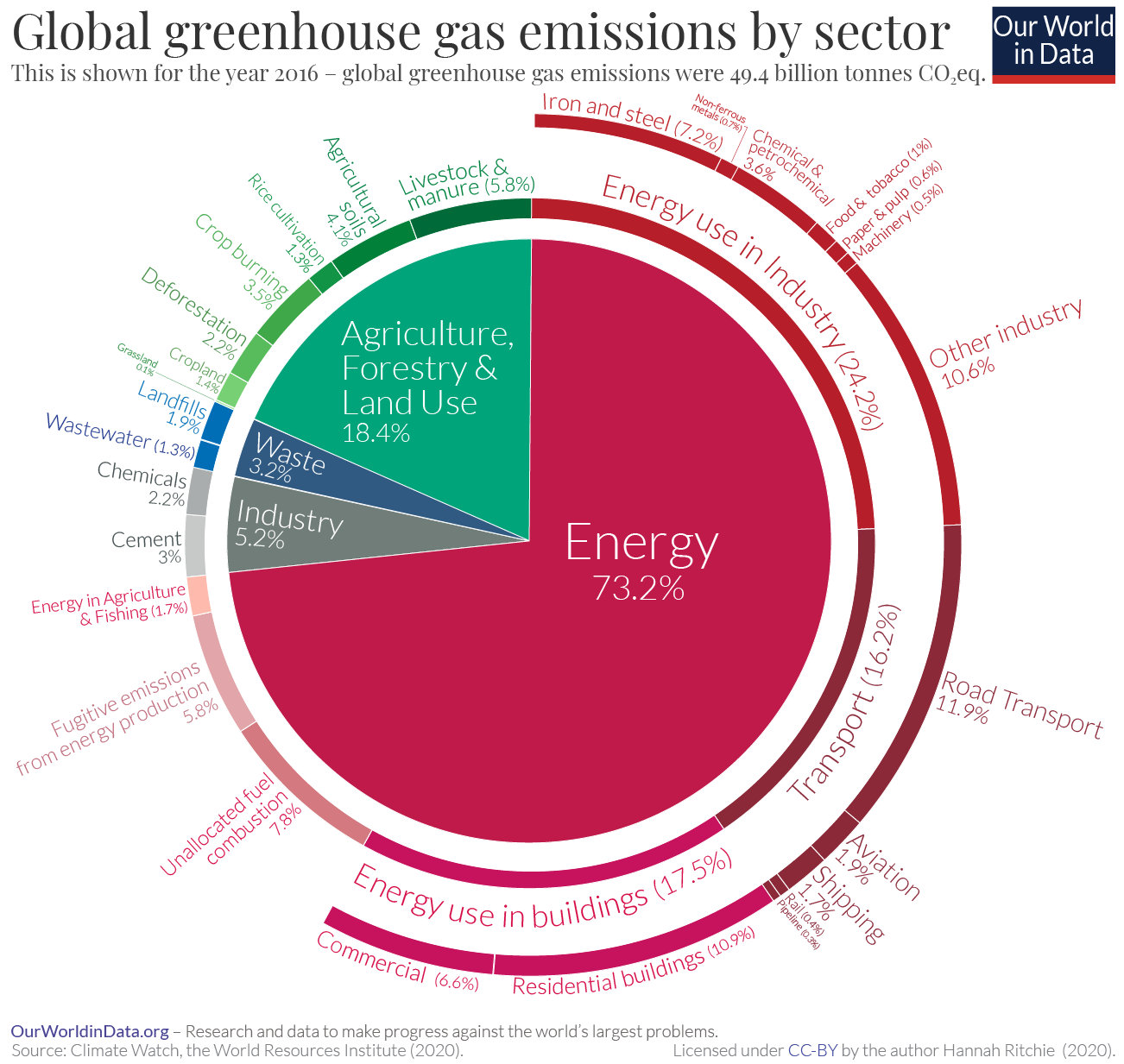
It's a good question, and a very good thing to think about. It turns out shipping is actually surprisingly low on the list of contributors to carbon emissions. All global shipping together contributes about 1.7% of global emissions. That's in comparison to, say, industrial energy usage (24.2%) or passenger cars (11.9%) or residential buildings (10.9%) or animals raised for food (5.8%). Should carbon emissions of shipping be a factor in decisions like this? Unquestionably, yes. But at worst it's going to be a small tick in the negative column, and could actually come out ahead depending on other factors like local emissions regulations, etc.
One unrelated correction - you mentioned passenger cars are responsible for 11.9% of global emissions, but your source says this figure is for the whole road transport. Passenger cars AFAIK account for the third of that.
Yes, good catch. I was getting that mixed up with the US EPA's stats[1]. FWIW they say passenger cars account for 58% of all transportation emissions within the US, more than all trucking, flights, and shipping combined. Again, within the US.
Apparently shipping is slightly unusual as it produces a greater than average amount Sulfur Oxide due to bunker fuel's higher sulfur content though it is not considered a greenhouse gas such as in the graph. This is where headlines like "One cargo ship emits as much pollutants as 50 million cars" comes from, though the calculation is debatable.[1]
For comparison gas or diesel is something like 10-15ppm Sulfur in the US now while historically bunker fuel is historically more like 3-5%, though it has been decreasing with regulations. [2]


Here are a few of the openings Broadcom's openings at the Fort Collins, CO site [2]:
- Material handler, Manufacturing operator: 12.25 hour shifts, 3-4 day work weeks, ~$19-25/hr. Night shift in higher demand
- General Mechanical Technician: $20-37/hr, alarm response a big component of role
- ASIC Digital Design Engineer, Fab Quality Engineer, R&D Software Engineer, Cleanroom facilities project manager: $78-150k + equity, BS/MS + related experience requirements
[1] https://www.amazon.com/Chip-War-Worlds-Critical-Technology/d... [2] https://broadcom.wd1.myworkdayjobs.com/External_Career?locat...