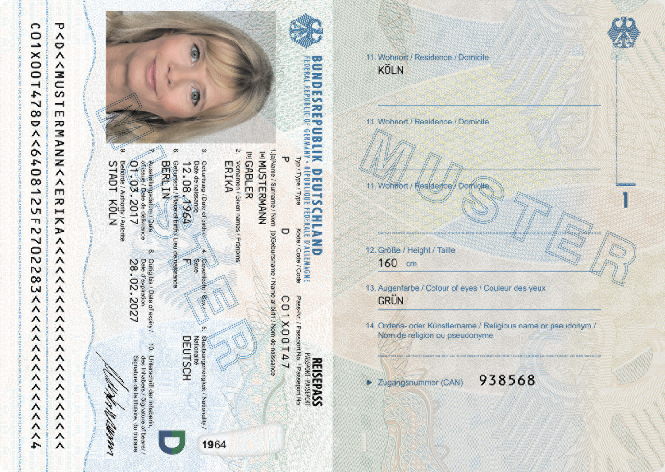
You have an address on your passport? I can see how that could cause issues if the address isn't valid. If I'd have to determine if your order was fraudulent or not, I'd err on the side of caution rather than risk having you abuse my server infrastructure (in the case of Hetzner).
A lot of people confuse the passport (Pass) with the national identity card (Personalausweis). There's no place of residence stated on the German passport, but it is part of the Personalausweis. Since German citizens by law are required to own a Personalausweis (there's no mandate to carry it around, just having it somewhere in a drawer suffices), practically all businesses in Germany do rely on the Personalausweis to validate identities. And of course if the place of residence stated on the Personalausweis doesn't match the actual place of residence this is going to trigger some red flags.
This is a very German thing. I’ve never seen ID cards from other countries that include an address of residence. Also the obligation to own an ID card is a very foreign concept in most other countries.
I had that issue with German companies before, especially those who rarely deal with international customers. For example in Austria only a few people own an ID card (most people have a passport, but not everyone). So the german companies were very surprised when I gave them a copy of the Austrian ID card, that also doesn’t have an address on it.
> I’ve never seen ID cards from other countries that include an address of residence.
In the USA the driver's licenses are ID cards and have addresses. Or if you don't have a license you can get a regular ID card, which has an address. The laws vary from state to state about how long you can go after you move before it gets updated. I'm not aware of a legal requirement to have one though, unless you're driving.
I thought the only way in the US to prove your address of residence is collecting your last few phone bills and bank statements. It was a huge LOL moment, when I first heard about that.
Yeah, it's really odd and circular. You can often present a lease agreement if you're renting an apartment or house. If you own, you can usually present a mortgage statement. If you own and don't have a mortgage (because you purchased with cash), you can use bank statement and/or phone statement. But what's funny is, how do you get the bank statement and/or phone statement? You usually have to show a lease agreement, mortgage statement, or some other proof you own the place you live. It's fairly difficult for someone coming from another country to get those things when they first arrive because all the documents they have are from another country and the entry-level employees that have to take them would have no idea what to do with them. My foreign friends and neighbors have stories about having to use a secured credit card (basically a debit card but the machines think it's a credit card) for 6-12 months before they could get a regular credit card. It's very confusing (and arbitrary and broken) if you're not on the easy path.
This is true in the UK - driving licenses have your address on them, but for some reason they're not usually accepted as proof of address. I assume this is because you only need to renew the license (i.e. get a new copy of the physical piece of plastic with an updated photo and expiry date) every ten years, so in theory your driving license could be evidence that you lived somewhere nine years ago but not evidence that you still live there today.
Providing a recent utility bill or bank statement is a much more common ask.
Spain also has the address in the DNI (national document of identity), and as the Germans Spain's citizens are also required to have such a document. Many public and private services will ask for your DNI if they need to validate your identity.
Yes we do have government provided ID cards. Your driver’s license (or if you don’t drive there’s a non-driver version that’s just a card). There is no mandate to get one or carry it (except for driving).
We have issues with voter registration because it’s been politicized. Poor people are disproportionately less likely to have ID cards (because it costs money, takes time, and most people get it to drive which is expensive), less likely to have it up to date. It’s disenfranchising to mandate IDs. Whether or not it’s a problem falls down party lines and your favorite statistician’s analysis. But that’s why it’s “an issue”.
South American countries with per capita incomes that sometimes are an order of magnitude smaller than the US managed to have national IDs for free to their entire population, and have required voter IDs for decades.
This is a mind boggling American superstition, it is not reasonable to suppose that the poors in America are so poor that they can’t have access to something the poor in Peru or Paraguay have.
Part of the issue is that you don't need an ID in America for most of your daily life. Most people get it to drive - if you don't have a car (which is actually expensive) then you may not get an ID at all. Yea most people will get an ID, but it's not something people need.
When it comes to the cost of the ID, part of the cost is taking time out of work to sit in a crummy office and fill out paperwork. They require certain proof of identity paperwork that can be hard to get for certain walks of life. Its quite an edge case in society that can't produce a small amount of paperwork to self-identify, of course.
Its a small cohort that truly don't have the resources to get an ID, but there is almost no observed downside to not requiring IDs to vote - American elections are and have been perfectly legitimate (or until 2020, depending on who you ask...). Why would we put up extra barriers to vote when we could just... not?
We have government issues ID cards, but we don’t have free government issued ID cards as far as I know, which is one of the problem with these voter ID laws.
In Austria it is fine to vote without an ID, if the members of the voting committee know you. On the countryside they usually do know their people. It’s mostly minor politicians (from all parties) that are in the voting committee, and they sit there all day to verify the election is not tampered with. And those politicians usually know everybody from their neighborhood.
You need to be on their list though, but you get added automatically by the city to the list. When you move you need to register your new address, so they know that you live there.
In the US the states decide these rules, the federal government just sets limits. So, in my state, I just tell them my address, if I’m registered to vote they’ll have my name in the list, no need to show an ID or anything. They have a list of registered voters, so I guess if multiple people tried to give my name at my address, it would get flagged when the second person showed up. I actually don’t know what the procedure is. I think it almost never happens, at least, I’ve never heard of it happening to anyone.
Individual voter fraud is a silly way to influence an election, you have to get away with it thousands of times to make a dent.
True, but in Europe usually everybody has an ID at some point, because you need it for traveling. And an expired ID also works to prove your identity.
But in theory you could also bring two or more „identity witnesses“ that either have an ID or are known to the people at the voting station, that can vouch for your identity.
Practically it works fine in many areas of the US as well—just, good areas that don’t want to put up hurdles for voters in the first place. But, give an extremism a means to disenfranchise anybody and they’ll go for it
Morally, even if it works out OK, it ought to bug you if you don’t have a cost-free way to vote.
I don't disagree at all to be honest. I don't think voter fraud is an actual concern (if bare mininum measures are taken, like voter registration or even just "checking in" individuals with their adresses), but I think it's weird that it is considered to be such a huge issue in the US when it is actually the norm in most of the world.
Especially since it's usually white people using POCs as almost "noble savages" who can't figure out how to vote, get an ID, or have a drivers license.
I agree and think that some of the “it is just impossible for minorities to get IDs” stuff is, like, uncomfortably low expectations. I think this is sort of condescending and not really helping our case. If you took the average person from a minority community, I happy to believe that they are equally able to get an ID as a person from a majority community.
But in every community there is a range of willingness to deal with bureaucratic annoyances to vote. Adding more hurdles bumps some people from the voter to non-voter bucket. The reason it is a big issue in the US is that we have a well documented history of adding those hurdles selectively in order to suppress votes from particular communities. This is part of a really dark chapter in our history so people have a visceral reaction to it. I mean, since you are Canadian—I guess people would be a little skeptical if someone tried to start a conversation like “Well lots of countries have boarding schools so here’s my plan for education in some underserved communities…,” right?
Apparently, it isn't obligatory to have an ID card here im Germany. My friend researched this last time his ID was about to expire and decided to go with passport only. The only problem is when you have to verify your address, since that's usually done via ID.
True. I just checked the ID cards for a few EU countries, and most of them don't seem to include an address of residence (I checked Poland, Netherlands, Belgium, Finland and Switzerland). France includes an address too.
The law has been changed numerous times since then. However, the requirement to possess an ID was introduced with the start of WW II. So it's not completely wrong to call it a Nazi invention.
German law requires you to own a Personalausweis or Reisepass (passport). If you have a passport, you are not required to also have an ID card/Personalausweis.
To add to this, it is actually forbidden to have a different main residency than the one on your Personalausweis if you live in Germany. If you move, you have to change it within a few weeks.
If you have residency permit, that gets updated. If you don't have (EU citizen) then having done the registration is enough. (I think GPs wording isn't particularly precise: what matters is the registration - and if you have a German ID document, then that gets updated at that point)
Yes, there's address on all three - passport, national ID and driving license.
Passport and national ID are from southern EU country, driving license is northern EU country and I live in Germany.
I have no intention on changing any of addresses on any of my IDs or driving license until legally required (10+ years from now).
German Passports have the City/Region you life in on them. The ID cards have your full address. So if the address of your ID card doesn't match your passport something is definitely fishy as you would have to get them updated when you move.
German (and most other?) passports feature the name of the issuing authority and place of birth, no other location, and remain valid irregardless of your current registered address.
Side note: It seems like many African ID cards list the profession and I've had to explain to several suspicious border guards why my passport doesn't.
EDIT: I've always wondered about this and apparently the body that sets passport specifications is ICAO, the International Civil Aviation Organization, as mandated by the UN. Specifically through ICAO document 9303.[1]
The German Passport has field for your Residence, which is mandatory and needs to be updated when you move. It is generally the general location you live in, usually your city.