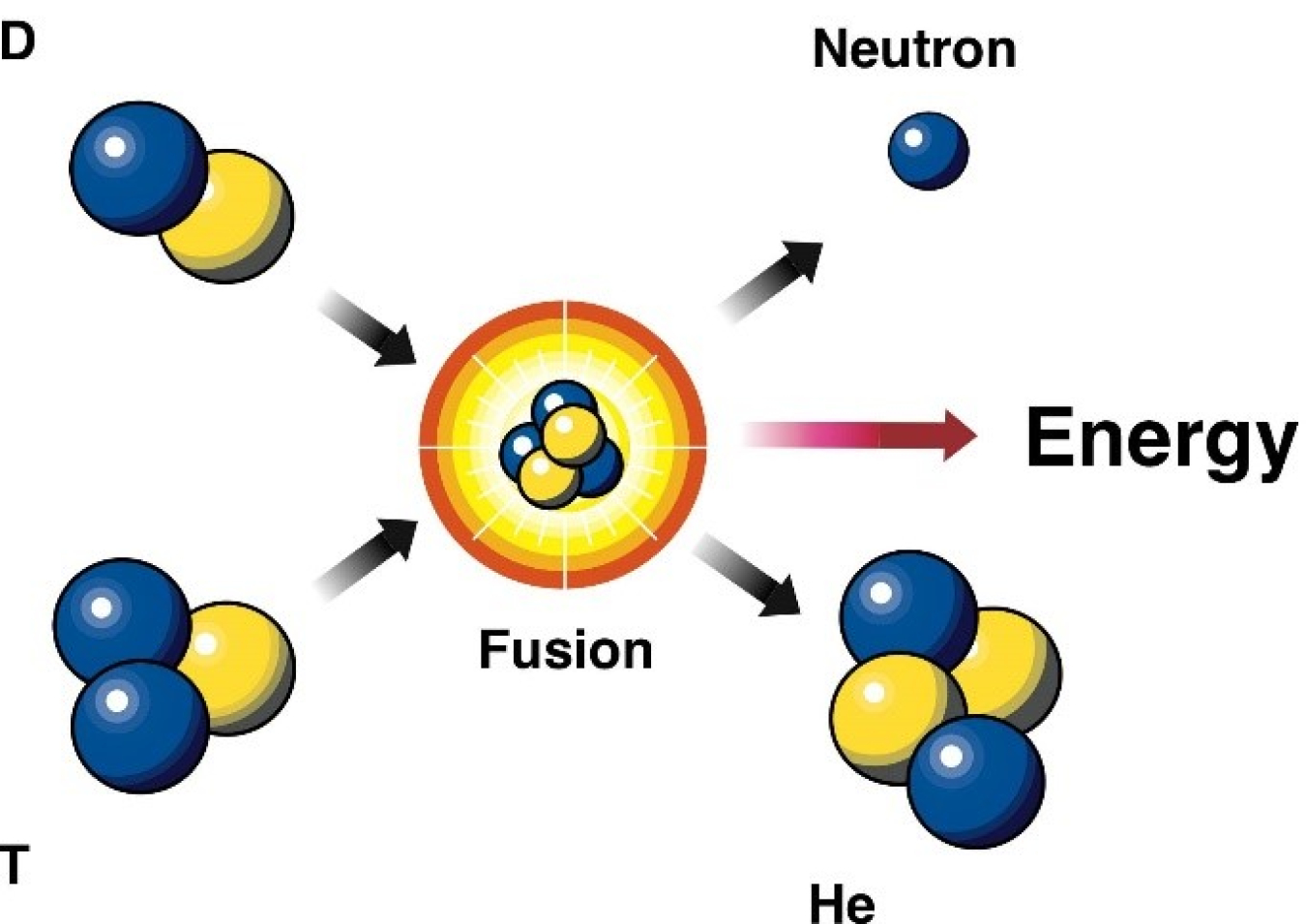
If you look at the mass before of their fuel, 1 deuterium atom + 1 tritium atom:
2.01410177811 u + 3.01604928 u = 5.03015105811 u
vs the mass of the fusion products of 1 helium atom and 1 neutron:
4.002602 u + 1.008 u = 5.010602 u
You'll notice that even though we started with 5 neutrons and 2 protons and ended up with the same number there was some additional binding energy that is unaccounted for in the new configuration. This is the energy released by the fusion reaction via E = mc^2. Here we see the mass difference is:
5.03015105811 u - 5.010602 u = 0.01954905811 u
Converting that to energy you find that is 17.6 MeV. As you go up the periodic table fusing nuclei you will get less and less marginal energy until you get to iron where at that point fusion become net negative and fission is then takes over where breaking nuclei apart gains energy, marginally more as you go up the periodic table. That's why you want to fuse light particles and fission very heavy particles. It is also why there is so much iron as it is kind of the base state of both of these reactions.
Tangentially related, but I think this is an interesting fact, all the atoms in our universe/galaxy/solar system with a mass up to that of iron are formed in the core of stars in stellar fusion. Hydrogen fuses into helium, and as a star nears the end of its lifetime you get heavier elements like lithium, carbon, and so on. Under normal stellar fusion no elements heavier than iron will be produced, and iron is only element number 25. If you just looked at nucleosynthesis through the lens of stellar fusion, it isn't obvious that there should be any heaver-than-iron atoms at all in the universe.
These heaver-than-iron elements are created in a very interesting and exotic process. When a large enough star dies it explodes in a supernova, and a huge amount of energy and neutrons are released in a very short period of time. This supernova generates enough energy and neutron material that small amounts of heavier elements like gold, platinum, etc. are created through exotic nuclear fusion reactions, even though these heavy fusion reactions are energy-absorbing.
It's interesting to think when you're wearing jewelry made from gold or platinum, all of those atoms in your jewelry were created during the death of a star.
  “The nitrogen in our DNA,
  the calcium in our teeth,
  the iron in our blood,
  the carbon in our apple pies
  were made in the interiors of collapsing stars.
  We are made of star stuff”.
  – Carl Sagan
  We have calcium in our bones,
  iron in our veins,
  carbon in our souls,
  and nitrogen in our brains.
  93 percent stardust,
  with souls made of flames,
  we are all just stars
  that have people names"
  Nikita Gill
I understand this is a poem that is focused on artistic expression and not scientific accuracy, but I find the line about “carbon in our souls” to be out of place. I guess the rest of the poem is incidentally correct (when not abstract)
I think it might be an allusion to alchemy. Basically, the alchemists believed that ash (what was left after burning something) was the soul of all things...And-- this is where my complete lack of understanding about science shows-- I'm pretty sure Ash has lots of carbon? It's, you know, poetic. Many have claimed that poems are the "language of paradox" so it's okay for it to be a little non-literal. My interpretation of it, though, is that the soul is something impure that you must burn away, or maybe that the soul is polluted by our own words and behavior. It's definitely not meant to be scientifically accurate.
Sure, the word “soul” comes from the proto Germanic “saiwiz” (for sea or ocean).
But not because “you are like a drop in the ocean,” but because “you are like an ocean in a drop.”
The idea of soul can be objectionable when it is based on an immortal being or on a vitalist life-force (like “anima” of the Latin). But it seems fine when it is based on the psyche (like the “Psuche” of the Greek).
I embrace taboo words like soul because they 1. are common 2. are useful for referring to things that seem pretty important (like avoiding soulless companies or products or buildings) and 3. are challenging to my normal (scientific) understanding of the world.
Still, I’d be more comfortable if the poem referred to the “carbon of our souls” rather than “carbon in our souls.” Hmm…
You could define soul as the fuel engine for life, which is basically burning carbon. As long as that furnace is functioning you're alive == you have a soul.
You and I are complicated but we're made of elements
Like a box of paints that are mixed to make every shade
They either combine to make a chemical compound or stand alone as they are
Quadrillion now, but costs will drive down and once is turned to gold, it stays gold. In the far future where all gold was mined this will be the only process left to get more. Or explode stars and capture gold from them.
I joke with my Son all the time about turning Mercury into gold (He works in the nuclear industry).
Once you get past the enormous energy costs to do this you have a secondary problem, all the gold produced this way is radioactive and it beta decays to.. Mercury.
Actually current modeling has supernovae as being only a small contributor to the measured abundance of heavy nucleii. These guys tend to come from a more exotic source still: material thrown off as a neutron star is tidally disrupted during a merger event with another neutron star or black hole.
I'm not sure but this has some interesting info such as-
>Some whole galaxies have average metallicities only 1/10 of the Sun's. Some new stars in our galaxy have more metals in them than the original solar nebula that birthed the Sun and the planets did. So the amount of "metals" like oxygen and carbon can vary by a few orders of magnitude from star to star, depending upon it's age and history.
Phosphorus is supposed to be rare in the wider world. Considering how central it is to everything important, life might find it very difficult to start in our temperature range, without.
I'm always fascinated by the sheer and unfathomable amounts of energy that is thrown around in these events. Just thinking about the fact that a single spoonful of neutron star matter contains more mass than Mount Everest fills me with wonder about the world we live in.
What happens whena tablespoon of neutron soup gets thrown out of the well of a neutron star? Does it suddenly expand to the size of everest? Where do the electrons come from?
In terms of "where do the electrons come from", an ordinary neutron in free space has a half-life of about 10 minutes, decaying through beta decay which produces a proton, an electron and a neutrino.
That sounds fairly energetic... So after 10min you'd have some odd mix of heavy elements probably approaching a decent fraction of the volume of everest. Half the volume of everest x (densityofgranite / densityoflead)
That kind of expansion rate has to rival any explosion imaginable.
It's essentially a giant atomic nucleus, so absent a star's worth of gravity holding it together it's going to decay rapidly into stable isotopes. So essentially it would act more or less the same as a huge fission bomb of the same mass.
I'd imagine some of the energy and degenerate matter consisting of neutrons would convert to protons and electrons, and nucleosynthesis would take place to form elements.
I have no idea, though, but I'm pretty sure I watched a video about this.
So that means that for life to form, we probably need a star to die so that the heavier atoms used in complicated life forming chemical reactions (correct me if i am wrong here as what I'm about to say depends on it), hence it could be the case that if the universe is 13.5 billion years old, then we humans are appearing in the universe at the earliest possible time.
13.5 billion years seems like the time required to create a star, have the star die and blow up, have all that material settle and create a new star, then the planets are formed, than enough time on one of those planets needs to pass for life to form, then complicated life.
Not necessarily. First generation stars were, theoretically, enormous both due to low metallicity of the collapsed medium and a higher average concentration of said medium. These stars lifespans were extremely short, shorter that blue giants we see today. So novas due to the death of these stars happened fairly early in the lifespan of the universe (talking about few million years after the big bang).
Therefore, life could have developed in a few tens to few hundreds of millions of years after the big bang. That's still true even if we assume that heavier elements are created mainly when neutron stars collide and not by super/hypernovas as we theorized before LIGO/Virgo observatories.
Consequently, we likely are not a "progenitor" civilization in the universe if we only consider planets formation. We might not see anyone out there either because there's a great filter for intelligent life to emerge (so the bottleneck is in our past) or because few/no civilizations get to have an impact on their host stars (the filter is in our future) that would allow us to see them.
Basic life (single-celled?) requiring the elements above lead might have a chance at that time, but complex life like us wouldn't do so well if there were still supernovas going off left and right. There's a theory with decent evidence that at least one of the mass extinctions was caused by a supernova: https://www.space.com/supernova-caused-earth-mass-extinction...
That being said, I wasn't aware of how LIGO changed the understanding of how heavier elements are usually formed, guessing it changed the expected neutron star prevalence? Do you have any additional reading on that?
You are right about supernova hampering life evolution, but it's unclear how long the fireworks lasted. In my comment I argued that it is possible to have the conditions of life emerge much earlier than 13.5 billion years. Not that it necessarily happened.
Regarding the second point have a look at https://www.ligo.org/science/Publication-GW170817Kilonova/in... . That isn't my field of specialization, so I am not sure about recent publications. At the time though this was a big deal as kilonovas seem to be the primary source of heavy nuclei in the universe. That particular event crested between 1/100th to 1/1000th solar masses worth of heavy ( heavier than iron) nuclei. This is a greater rate than supernovas estimations.
> how LIGO changed the understanding of how heavier elements are usually formed, guessing it changed the expected neutron star prevalence?
It's not about the prevalence, but about the light curves observed during the event AT 2017gfo. They indicate significant heavy metal ejection but, what's interesting, also production.
> mergers of neutron stars contribute to rapid neutron capture (r-process) nucleosynthesis
I'm just a layman but I believe by the time our sun has formed, we've gone through multiple star cycles. The early stars were very pure - made basically purely of hydrogen (maybe some helium?). They were huge, burned very bright and died comparatively quickly. Each time stars died, more heavy elements (and heavier elements than before) were produced. Over time the heavy element content (called metallicity) has increased in all stars. I believe there are also theories of white dwarf mergers undergoing runaway fusion and a lot of heavy elements being generated during the explosion.
You raise an interesting question though: what is the earlier point of time where the heavy elements were abundant enough for life (as we know it) to form? Just because we started existing at +13.5 billion years, it doesn't mean carbon based life couldn't have formed much earlier.
Very much a laymen also, however funnily enough I was listening to a bbc program called in our time, a couple of nights ago, where a similar topic was discussed one comment was that life is carbon based and for carbon to exist a star has to die, so yes therefore we are in the early stages. Will try to fin the episode….
I have zero ability to answer your question but I would love to know about about this. If life (like we know it) requires the explosion of aged stars, what is the earliest it would take. What is the minimum time needed to form, grow and explode a single star? Has there been time for this to occur 10s, 100s of times since the Big Bang? (obviously they can happen in parallel, but I'm thinking about how many in series).
> 13.5 billion years seems like the time required to create a star, have the star die and blow up, have all that material settle and create a new star, then the planets are formed, than enough time on one of those planets needs to pass for life to form, then complicated life.
Maybe for a main sequence star, but there other processes that involve nucleosynthesis.
Iron is always spoken of as the dividing line, but I'd like to know whether iron is exactly on the line, on one side (which?), or it depends. IOW, does fusion of iron atoms release energy (hydrogen side of the line), absorb energy (uranium side of the line), neither, or either (depending on conditions)?
That's because the periodic table is essentially about chemistry (i.e. about electron orbitals), not about nuclear physics (i.e. the atom's nucleus). For example it doesn't talk much about isotopes, aside from usually reporting the average atomic mass.
It will happily fuse further. It just won't support the outside of a star against gravity, while doing it. So the star collapses, fuses lots more stuff even heavier than iron, and then explodes. Most of the iron and heavier stuff fuses into the core of a neutron star, the ultimate in energy-consuming fusion.
Iron will not happily fuse further because this NEEDS energy and where would that energy come from?
"heavier than iron" elements are produced when a star explodes because that collapse produces enormous amounts of energy.
During the collapse, the outer edge of the star is accelerated to something like 20% of the speed of light, that is an ENORMOUS amount of energy slamming down on the core.
Lastly, neutron starts don't produce energy, they are the incompressible remnants of a dead star.
You answer your own question: the energy for further fusion, all the way to neutron degeneracy, is provided by gravitational collapse. The outer layers fusing provide energy for the explosion.
If I understand this right, I think some of the lighter than iron elements are also created in those exotic processes. But yes, unlike for the heavier-than-iron elements, the lighter ones are _also_ created in normal stellar fusion.
And on a total tangent, this fact played a part in worldbuilding done by the author L. E. Modesitt, Jr.
> When I initially decided to write The Magic of Recluce in the late 1980s, I'd been writing science fiction exclusively... I conveyed a certain dismay about the lack of concern about economic, political, and technological infrastructures in various fantasies then being written and published in the field...
> I faced the very real problem of creating a magic system that was logical... Most fantasy epics have magic systems. Unfortunately, many of them, particularly those designed by beginning authors, aren't well thought out, or they're lifted whole from either traditional folklore or gaming systems and may not exactly apply to what the author has in mind.
> I began by thinking about some of the features and tropes of traditional fantasy. One aspect of both legend and folklore that stuck out was the use of "cold iron" to break faerie magic, even to burn the creatures of faerie, or to stand against sorcery. Why iron? Why not gold or silver or copper? Not surprisingly, I didn't find any answers in traditional folklore or even contemporary fantasy. Oh, there were more than a few examples, but no real explanations except the traditional ones along the lines of "that's just the way it works."
> For some reason, my mind went back to astronomy and astrophysics and the role that nuclear fusion has in creating a nova... Each of these fusion reactions creates a heavier element and releases energy... The proton-proton reaction that produces iron, however, is different, because it is an endothermic reaction...
> At the same time, the fact that metals such as copper or silver conducted heat and electrical energy suggested that they were certainly less than ideal for containing electrical energy. Gold and lead, while far heavier than iron, do not have iron's strength, and other metals are too rare and too hard to work, particularly in a low-tech society.
> At this point, I had a starting point for my magic system. I couldn't say exactly what spurred this revelation, but to me it certainly made sense. Iron can absorb a great amount of heat. If you don't think so, stand on an iron plate barefoot in the blazing sun or in the chill of winter. Heat is a form of energy. In fantasy, magic is a form of energy. Therefore, iron can absorb magic and, by doing so, bind it.
Do we know how much tritium is needed for a city's energy generation? What about a state etc? Reason I ask is the only uses I have seen for tritium is on old watch dials made in the pre-90's. Curious how much of this resource is out there.
Tritium has a half-life of 12 years so there is no deep pool of tritium upon which to draw. The primary source of tritium on earth is cosmic-ray interactions in the upper atmosphere that produces 7.5Kg of tritium a year worldwide.[1]
Isn't that going to cause a serious problem if it requires 323Kg/yr of tritium just to power New York City?
Apparently no, because it can be made by the fusion process itself, via contact with lithium, and there's enough proven reserves of the latter to supply us for 100s of years.
Nobody knows how to get tritium at PPB concentration from the thousand tons of radioactive molten FLiBe it is dissolved in. You have to process all of it every day because you need that tritium for fuel tomorrow.
> According to a 1996 report from Institute for Energy and Environmental Research on the US Department of Energy, only 225 kg (496 lb) of tritium had been produced in the United States from 1955 to 1996.[a] Since it continually decays into helium-3, the total amount remaining was about 75 kg (165 lb) at the time of the report.
The concentration of deuterium in the ocean is about 150-160 parts per million and with 1233.91 quintillion liters covering the earth we have approximately 8.2260667e+12kg worth of it to extract, so we've got a bit to work through!
Tritium however is far more rare with only trace amounts of it being available within nature and barely more than a kg produced per year. Producing the 100s of kgs required per year still seems to be an unsolved problem, although my quick searching shows there's a couple viable solutions for it.
The solution is that fusion power plants can breed tritium and become net producers of it...
Though in practice enough will be lost that probably they'll still be somewhat net consumers-- just not nearly to the extent predicted by a simple thermodynamic model.
Still, even if fusion becomes a net producer of tritium, the whole tritium-is-hard-to-get problem will likely be a constraint that we'll be fighting as we ramp up use of fusion power in the future.
That such a small amount of matter could generate so much power is pretty remarkable. I might be way off base but from what I can find online it seems you'd need over 2000 times as much uranium?
Tritium is very popular on gun sights as well- as it's a glow in the dark sight that doesn't need to be charged. I'm now questioning the practice of appendix carrying with tritium sights.
Tritium decays by beta-decay (an electron). The electron can not travel very far in air (1/4 inch), and is stopped by even the thinnest piece of metal. It's even stopped by the dead outer layer of your skin.
Not quite: beta decay will penetrate the skin enough to damage living tissue - beta burns are what caused the fatalities of the Chernobyl first responder fire fighters.
They spent a few hours covered in dust on their coats, and did a bunch of subsurface skin damage which manifested as third degree burns. Sepsis, not radiation poisoning, generally killed them.
Well, it lasts for several years, but considerably less than even a human lifetime: Tritium's half-life is only about 11 years, so gun sights, dark-proof glow-in-the-dark signage (usually reserved for critical industrial plants, ships and offshore platforms due to expense), etc, will become seriously degraded in just a few years. (Since the glow is directly proportional to the remaining low-level beta radioactivity, which can barely penetrate the glass envelope in the first place - you'd get more radiation (from radium) living in a brick house than carrying 24-7.)
FWIW, tritium and a phosphor granule encapsulated in glass microspheres have been developed for self-illuminating runway paint, but again, no one really uses it because tritium is stupid expensive, and again, it' loses half its brightness in only a decade.
On the other hand, I've been told that Trijicon will replace their tritium gun sights for the lifetime of the original owner. I plan to live long enough to cost them money...
And the (otherwise excellent) channel is supposed to soon post an adv... I mean informer... I mean "exclusive documentary" about "repeat after me we're totally not a scam - we just play one on YouTube" fusion startup Helion.
Which I'm going to watch, because even though everything I hear about this company gives me insane Theranos vibes... Well, if they pull it off... They might light a bulb with fusion in my lifetime.
If I understand correctly, tritium is the result of bombarding lithium with neutrons.
I'm not sure how tokomaks are expected to work; do you just add lithium and expect the tritium to get where it needs to go to keep the reaction going, or do you actively remove gases from vessel, filter out the tritium, and re-use it as fuel?
Either way, I don't imagine it'd be too hard to recapture the stuff.
> It is also why there is so much iron as it is kind of the base state of both of these reactions.
I always thought this is the interesting takeaway, both fusion and fission funnel their constituent matter towards iron, as the final stable state of matter. Far future civilizations will have a lot of iron on their hands.