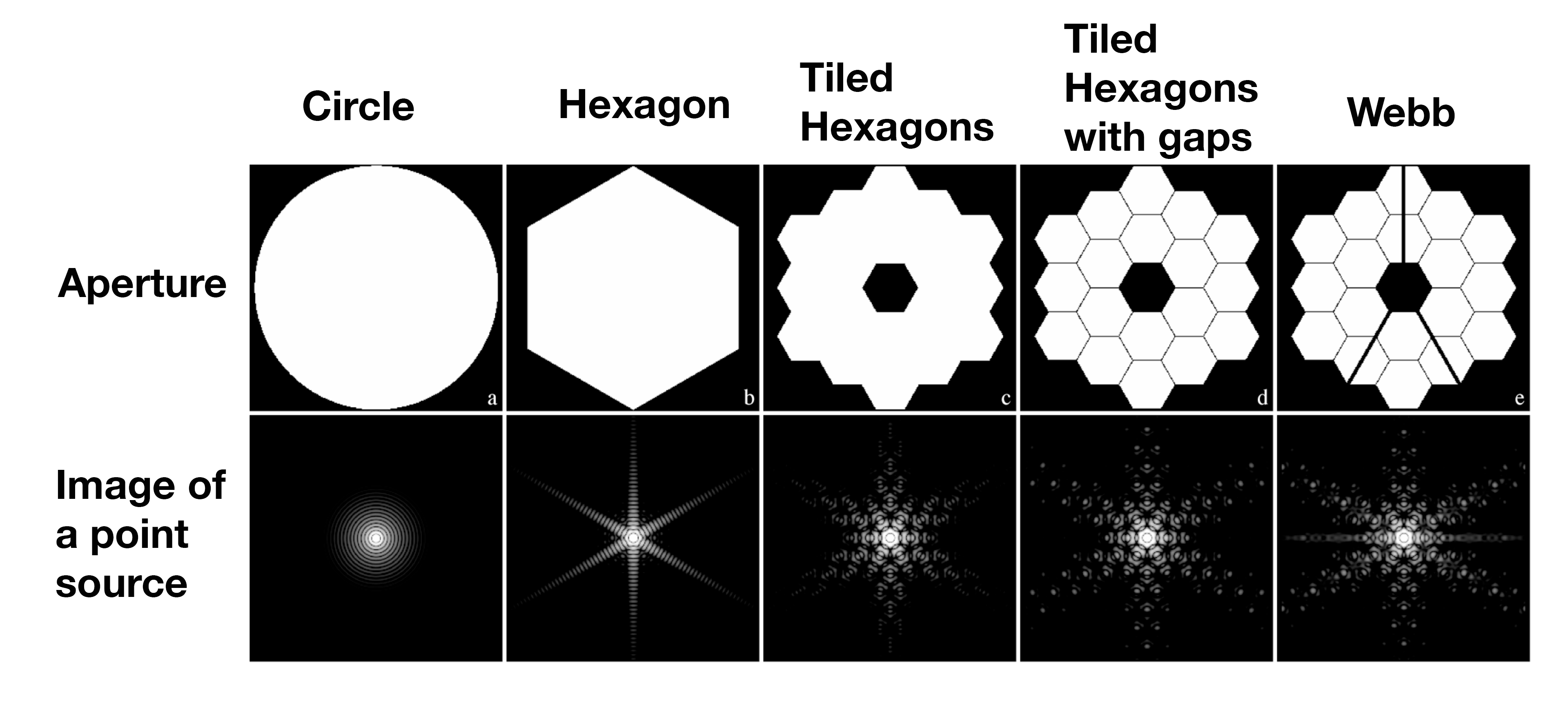
A lot of the pictures have some bright stars with 6 long lens flare like points coming out of them in a consistent pattern. Is that because of the hexagonal shape of JWT's lenses/mirrors?
That's quite exhaustive, but it makes me wonder why isn't anything done to correct for that. Like for example instead of taking one 15h exposure, why not take three 5h exposures and roll the telescope 5 degrees in between, then median filter out the artefacts?
Mainly because it doesn't matter. They're not looking at the stars in the foreground, they're looking at the background which is much further away. The diffraction pattern is actually super dim -- those foreground stars are just very bright due to the exposure.
It took like 5 months to cool web to operational temperatures rolling the telescope would create so much heat all new images would be useless until it cools down again.
That makes no sense, they have to rotate it every time they take a picture otherwise they'd be looking at the same spot all the time. Motors don't emit that much heat and neither do torque wheels.
Though I suppose now that I think of it, it's possible the main mirror assembly actually has no built in roll control but only pitch, since the yaw part could be done by moving the entire telescope while remaining shaded. I've never seen any videos showing the full movement, but the previews for LUVIOR show it having full 3 degree articulation relative to the heatsink segment, so I assumed the Webb also has it given that they're extremely similar designs.
> otherwise they'd be looking at the same spot all the time
It's in an orbit around L2, so it's not statically positioned in space. L2 also moves with the earth around the Sun, so it's not statically limited to any one region of the sky.
LUVIOR is not web. Web doesn't have articulation like LUVIOR its fixed only the mirror segements move. also they don't rorate everytime they take a picture there's limitations beacuse its an infered telescope. https://jwst-docs.stsci.edu/jwst-observatory-characteristics.... Web also has a field of view 15x hubble
I think you also had a similar comment and linked the same article under the previous topic about JWST's first image?
The article is very informative, but my read of it is different: the three major "spikes" are in fact due to the hexagonal shape of the mirrors and how they're laid out. The struts also add three spikes, but: two of them coincide with the mirror spikes, while one of them (from the vertical strut) is visible on its own, and causes the smaller perfectly horizontal spike.
The image I'm basing this on is in your article with a caption starting from "The point spread function for the James Webb Space Telescope" [1]
From the other comments, I understand why it's there, but i wish they would photoshop them out.
The images take on a more synthetic and fake quality when the technical physical man-made constraints of our telescope get projected out onto the natural very much NON-man-made universe.
Yeah, it's the hexagonal shape. The objects with the 6 diffraction spikes are overexposed compared to the rest of the objects in the picture, so they're generally brighter and/or closer objects.