Most of the "evidence" against lab-leak is just weird insinuation.
Speculation about how the virus wasn't created wholly synthetically: nobody is seriously arguing it was, or it wouldn't be SARS-family.
Arguments that the spike protein binding domain wasn't synthetically engineered: it didn't have to be. It could have been serial passage in humanized mice, considering that's what Daszak and co had literally proposed years before the outbreak.
Arguments that because the original SARS-CoV-2 wasn't perfectly optimized to bind to ACE2, it obviously didn't come from a lab: Obvious nonsense. Why would you expect serial passage through a small number of humanized mice be as effective at optimizing binding to ACE2 as an epidemic sweeping through tens, then hundreds of millions of humans?
The Laos expedition is interesting, but having only just skimmed it I'm not yet convinced it means anything. Any samples with very similar spike proteins collected AFTER SARS-CoV-2 became an epidemic could indicate that SARS-CoV-2 had recombined with existing bat coronaviruses, rather than being a zoonotic source of the SARS-CoV-2 spike protein.
The sloppiness and drumbeat nature of these anti-lab-leak essays makes me not trust them. The lab-leak argument is speculative, sure, but we've sent people to prison for murder based on speculative inferences from circumstantial evidence; meanwhile, none of the arguments against lab-leak are solid.
Very well put. One thing I’d add, is that this entire debate regarding the lab leak hypothesis is entirely politicized, and I feel few people actually have legitimate scientific interest in discovering the truth. Either theory is perfectly viable given the evidence we currently have.
> I feel few people actually have legitimate scientific interest in discovering the truth. Either theory is perfectly viable given the evidence we currently have.
This has been extensively investigated by scientists - it’d be a career making move if you could prove something that juicy! - but the problem is that the conclusions aren’t completely certain but rather comparing probability & the limited evidence to conclude that the lab leak hypothesis is increasingly unlikely. That doesn’t make the news and it especially won’t convince conspiracy theorists when there’s a raging political battle.
Scientists aren't going to prove lab leak one way or the other because the evidence isn't going to be in the virus itself.
The for or against lies with the lab and the staff working there and the PRC is not going to allow an open and honest investigation to either prove or discount it.
So unless it can be proven to have come from somewhere else, you are likely never going to settle whether it was lab leak.
But we've pretty much established that it was a virus of natural origin - all of our molecular techniques leave signs, so an honest discussion would foreclose that possibility. That doesn't eliminate the possibility that it was a natural virus which had been collected and subsequently escaped due to bad lab technique but the former is too attractive a conspiracy theory to let go..
This is not true. Ralph Baric developed (and patented) a seamless technique to assemble coronaviruses in 2002 [1]. Baric was a close collaborator of the Coronavirus group at WIV.
Since then there has been even more progress. Since 2015 or so it's been possible to "print" DNA of any sequence.
In fact as COVID started to spread in China and the sequence was released, a Swiss lab used this technology to print the genome of SARS2, inject it into some yeast cells, and voila, you have the virus. They wrote this up in Nature [2].
If you wanted to change a naturally sampled virus using this technique, say, to insert a Furin site, swap out an RBD, whatever, you can literally do it with a text editor and copy and paste.
Yes, Seamless Ligation ("No See'm" technology) has been written about since at least 2006 for its potential to be used in creating biological agents that lack signs of laboratory manipulation.
In light of this, people that are confidently dismissing or playing down the possibility of a lab l̶e̶a̶k̶ origin at this point seem to be exhibiting some kind of ideological commitment.
> That doesn't eliminate the possibility that it was a natural virus which had been collected and subsequently escaped due to bad lab technique but the former is too attractive a conspiracy theory to let go..
For some reason most discussions claiming that the lab leak hypothesis is a conspiracy theory focus 90% of their effort arguing against being a bioengineered weapon and little time arguing against the actual strongest lab leak hypothesis: a zoonotic virus was collected and brought to a virology lab, where it was passed through humanized mice, a worker contracted it, and accidentally spread it in the city the virology lab was based.
The fact that people can pick out whackadoodles in Congress who argue for stupid theories doesn't make the strong theory weaker.
A zoonotic jump that happened to occur inside of a wildlife research facility due to bad lab technique is not that scary. If it's proven true, it's pretty likely that the lab operators will fix it. Could you imagine being the guy who caused the COVID-19 pandemic by forgetting to sanitize some tool? I bet whoever did it would be the single most careful and clean research scientist in the entire world after that kind of episode.
The bioweapon theory, however, is politically useful. If you want to start a war, or at least trade sanctions, a villain is a good place to start. Someone violating international law and gene splicing themselves a pandemic in a bottle is exactly the right kind of comic book supervillainy, without being technically impossible.
> The bioweapon theory, however, is politically useful. If you want to start a war, or at least trade sanctions, a villain is a good place to start.
This is precisely Nature's gambit. She carefully engineered SARS-CoV-2 in a matter of weeks (to conceal the evidence, which was eaten), all naturally of course, but carefully, subtly made it appear like it might have been designed by mere mortals... and for this very purpose. Armageddon. When there's an imbalance, Nature corrects. And no one would deny there is an imbalance in the Earth regarding our species alone totally messing it up for all living things.
What I will tell you is a thing that I have read, and I hold close:
Forgive one another, and you will be forgiven.
In order to forgive, we must have the truth. Without it, we are in a fog of blind judgement and accusation.
Clarity of the source of this misfortune allows us to forgive.
I cannot say that I hold the full pantheon of the origin of these words to be true, but the four books that imparted this teaching to me have left an indelible imprint, and I cannot escape their mercy, justice, and hope.
I have read many other books, of course, and I believe in compassion. Though great calamity has befallen us, we might find any who have acted wrongly to be worthy of forgiveness.
When we grow beyond apprehension of recrimination, blind to fear of punishment for a cataclysm caused by ourselves and others, and only seek to salve our unwilling harm, perhaps then we will be able to say "move!" to a mountain, and it will move.
Yes, I have loved these books. Sometimes, they are my only solace.
For what it's worth, I neither think the lab leak hypothesis is definitely proven nor that the scientists involved are worthy of some kind of punishment. It's a matter of increasing security at scientific research facilities and banning certain lines of research altogether as too risky.
The USA just launched a major assault on the human rights of 55% of its population (women and homosexuals), after a yearlong assault on the foundation of our democratic government, all
under the guise of four books of "mercy, justice, and hope".
Modern molecular techniques don't really have to leave signs. Indeed scientists synthesised a copy of sars-cov-2 from the sequence data a few months after the sequence was published:
"it is possible for researchers to reconstruct the virus in a lab, using either fragments of virus from patients, or fragments of DNA that are synthesised chemically by biotech companies. " https://www.varsity.co.uk/science/19172
It seems you can basically type any sequence you want and have it made up.
Serial passaging is effectively all “natural” (but intentional) infection. That wouldn’t leave signs of molecular techniques since none would be involved.
Anyone claiming to disprove the lab leak hypothesis by making a claim against solely molecular engineering is either hilariously uninformed or intentionally misleading you.
>But we've pretty much established that it was a virus of natural origin - all of our molecular techniques leave signs, so an honest discussion would foreclose that possibility.
I've only heard crack pots claim it was man made up to this point. I think repeatedly bringing it up or acting as if that's what lab leak means to most is disingenuous at this point.
>That doesn't eliminate the possibility that it was a natural virus which had been collected and subsequently escaped due to bad lab technique
That's what everyone is actually talking about. The man made conspiracy theory is a red herring that only serves to strawman and shut down legitimate discussion.
They’re not going to have a video of it jumping, no, but they can look as probabilities as they’ve done. This has ruled out the bioweapon theory which got a lot of chatter a couple years ago, and it’s shown that zoonotic origin is heavily favored as the likely candidate. That doesn’t rule out something like a natural virus infecting a worker who made a lab safety error but it hasn’t made that look extremely likely, either.
For anyone honest, the big question here is how we prevent this from happening again. The conclusions seem pretty solid: be careful about pushing humans into wild animal populations, better surveillance for emerging diseases, and continue pouring money into research on things like rapid test and vaccine development so response times can shrink.
"it’d be a career making move if you could prove something that juicy!"
That's absurd. We know the grant that funded the WIV lab work was signed off by Fauci during a time when GoF research was banned in the USA. If you proved the virus came from a lab funded by the guy who literally funds your colleagues you would never work in the field ever again.
We know in science that sometimes scientific results for analyses based largely on suppositions regress toward the mean, and this effect is stronger when prestige or politics are on the line. This is called "ideological hegemony" and it reproduces itself in the halls of power because those who occupy those halls are all funneled through the same conditioning programs.
I'm not sure what to say further other than "I guess we're going to have to find a way to be comfortable never knowing". The analyses are compromised because the topic is too charged now. Too much is at stake based on one or another direction to trust any conclusions.
Too much is at stake based on one or another direction to trust any conclusions.
One could still say "My god! This virus could have been even worse, more deadly! Lab leak or not, the entire planet should double check conditions at all labs, ensure proper containment and processes exist!"
> and I feel few people actually have legitimate scientific interest in discovering the truth
Not to be glib, but what would be a legitimate scientific interest in discovering the truth?
That this plausibly could have been of natural origin would seem to override any value in discerning where it actually came from.
If it was a lab leak, "Oops." We hastened it occuring naturally by some amount of time. Lots of people died, but that would have happened in an inevitable spillover event anyway, albeit farther in the future.
If it wasn't a lab leak, well there we are.
Or, in other words, what would we do differently if it were a lab leak? Increase biocontainment protocols? Okay, so we've made human-origin less likely. We still have to deal with naturally-occurring in the future.
> Or, in other words, what would we do differently if it were a lab leak?
If the virus is a laboratory construct (e.g., a recombinant of two novel natural viruses with a human-chosen FCS; we can argue about how likely that was, but no genomic evidence can exclude that), then it would near-certainly never have existed without that laboratory manipulation. The pandemic could near-certainly have been permanently avoided simply by not constructing it. This was a matter of controversy long before the pandemic; such work was banned in 2014, but the ban expired in 2017:
If the virus is naturally-evolved but sampled and released accidentally by scientists, then it might otherwise later have been released accidentally by infected non-scientists. It wouldn't have been necessarily though, especially since WIV researchers sampled remote bat caves that no other humans routinely entered. Sampling of sites with significant existing human traffic (farms, markets, tourism sites, etc.) seems like a clear benefit, a negligible increase in the existing risk of natural spillover. Sampling of remote sites without such traffic seems much less clear.
There's something weird about public attitude to biological risks. When the government did a controlled burn in New Mexico that got out of control and destroyed hundreds of houses, everyone involved recognized that they'd screwed up, even though fires also occur naturally, and even though controlled burns are a valuable tool in controlling natural fires. It seems that intuition doesn't hold for lab-origin pandemics. The 1977 flu originated from scientific research (although the exact nature of that research--whether it was a failed vaccine, or a vaccine challenge trial, or an experiment at the bench--is disputed), and it killed about 700k people. No one seems to care, and I don't really understand why.
I'd argue should be doing more to ensure lab biohazard safety regardless of the origin of COVID-19, which is one reason I don't think knowing the answer has a lot of practical significance.
If you'd like to see greater regulation of biological research, then I'm pretty sure strong evidence that it killed millions of people would help with political support for that? So I'm not sure why we wouldn't look, especially when many obvious paths (e.g. subpoenas for all data potentially containing early viral genomes as contamination, like from Illumina's cloud services) remain unexplored.
I think practically it would be used to generate hostile sentiment between countries and wouldn’t drive good regulations. But maybe I’m just a pessimist!
Hostile sentiment between which countries? The WIV was on Chinese soil, but received American funds and had many American collaborators; so I don't think either country is in a great position to blame the other. On the other hand that gives China and the USA a shared interest in discouraging investigation of the cause, as seems to have occurred.
That's really sad about the 1977 flu. Was there evidence that it was human-caused, and that proper procedures weren't followed? Could local prosecutors have pursued a case based on something like manslaughter or criminal negligence? Would it even be possible to still build such a case? (i.e. maybe the statute of limitations didn't expire yet?)
She goes on to say it wasn't a "laboratory accident", because it was probably a vaccine accident, either an incompletely attenuated vaccine or a trial in which vaccine recipients were deliberately challenged with live virus to test their immunity. That distinction seems like a legalistic game to me, intended to distract from the lesson that pandemic may teach us about this one; but I believe her historical background is good.
I don't know any mechanism by which those responsible would be punished, even if the exact truth came out, and even if they're still alive. I'm not even sure they should be--virology was still in its infancy then, and the escape presumably really was an honest mistake. Of course the more times this happens, the harder it gets to accept such an excuse, especially when deliberate efforts are made to minimize and distract from the lessons of the past.
>Not to be glib, but what would be a legitimate scientific interest in discovering the truth?
Meaning, someone who didn’t walk in with a bias and look around the room for things that support said bias. This debate is packed with armchair experts who seem to have a larger interest in the politics than the science.
>If it was a lab leak, "Oops." …
Oops?!
>Or, in other words, what would we do differently if it were a lab leak? Increase biocontainment protocols?
If you’re like most of us on HN, at work, when we make big mistakes that cost our companies money and users, we have thorough retrospectives, learn from our mistakes, identify root causes, build for redundancy and high availability, and prevent the same incident from ever happening twice. That’s what I’d expect to see if the lab leak (which you strangely keep calling human origin, as if a naturally occurring virus can’t leak from a lab) were proven.
> Okay, so we've made human-origin less likely. We still have to deal with naturally-occurring in the future.
We have naturally-occurring forest fires, yet as a society, we sure seem to put a lot of effort into stopping “human-origin” fires. This sounds a bit “fuck it, why bother trying to make anything better, something bad will always happen”.
> If you’re like most of us on HN, at work, when we make big mistakes that cost our companies money and users, we have thorough retrospectives, learn from our mistakes, identify root causes, build for redundancy and high availability, and prevent the same incident from ever happening twice.
Depends on the process. If the retrospective process is a big PITA that goes nowhere, and management is only going to support changes that it wanted before the incident, regardless of any knowledge uncovered by the evidence, then minimize the reporting and hide under a rock for a while, try not to get management attention again.
Which scenario seems more applicable to a government lab in Wuhan?
I don't think we're going to get the straight information from the lab, because the incentives aren't there. If they admit they did it, everybody is mad, and CCP has to take action to save face, and the lab team doesn't want to face that. If they admit they didn't do it, nobody believes them.
Outside of finding some lucky samples, like a good match from outside the area in say October or November, I don't think we're going to get anything definitive from forensic analysis of virus DNA. I'm not an expert in the field, but the same sequence gets interpreted different ways by different experts; and usually with some wishy-washyness.
The data quality for the early pandemic isn't getting any better or more independent from the same officials we don't trust.
If we can't get a story we trust from the horse's mouth, and we can't figure it out through forensic analysis, the best way forward is to figure out what interventions would be reasonable if we assume lab origin and what would be reasonable if we assume natural origin and do the practical interventions.
>what would we do differently if it were a lab leak? Increase biocontainment protocols?
Ban gain of function research.
There are many virologists who make compelling arguments that the hypothetical benefits of the research (which have yet to materialize) pale in comparison to the risks.
Every day that goes by that GoF research fails to materialize any of its hypothetical benefits makes the case against it ever stronger.
You underestimate the time value of not having a pandemic today, as opposed to perhaps hundreds of years in the future. Serial passage through humanized mice is not exactly something that happens in nature.
But I also look at it the other way: COVID was perhaps the smallest scale event that could produce fundamental change in the way we (as in, humans) approach biodefense and disease control.
If we needed a wakeup call, better to have it now than ~2100, when we're estimated to reach peak population + continued concentration in cities.
This is what I've been saying all along. COVID-19 is just about the gentlest possible practice run for a seriously nasty pandemic. From what we've seen so far, if we did encounter something more deadly, we would not do well.
Game theory effects on future lab technicians, administrators and security personnel. We punish crime and criminal negligence to deter it in the future by public knowledge that it will be punished.
You raise good points, but note that not everyone is rational here. Covid has in fact shown irrational so many people are, even in the 21st century.
If it were discovered to be a lab leak from something previously discovered in the wild, especially from a NIH funded lab, hell would break lose and it would hurt many aspects of biological and medical research.
If authorities decide based on political considerations to not investigate a mistake that led to millions of deaths and tens of millions more lives destroyed, they lose an enormous amount of credibility in the eyes of the public.
Full integrity is the only chance we have of having a healthy political atmosphere where the public can trust the establishment.
There is no way to say if there would have been spillover, or it coming from nature. This feels a bit like the way people have said "every new variant is less dangerous." There are no guarantees on that one, there is equal possibility that COVID turns into something worse. COVID doesn't have to kill you, it just has to copy better.
If it turns out it was a lab leak, from using SCID mice or other human analogues, we might get new systems to prevent such a thing from happening again. Maybe researchers have to work in a diving bell system, who knows. We get to decide! We can create whatever we think we need. The system is not fixed. Look at animal research support systems like IACUC, created in the 80s, and now a useful fixture in biomedical research. In the lab, we lament IACUC sometimes, but they are a good check in the system. Why couldn't someone like IACUC raise the bar?
I agree with you that knowing it was a lab leak does not fix the past, and can increase the blame game near term. On the longer arc, it is important to know.
Perhaps we could hold those responsible accountable? Especially if it came from research Fauci said wasn’t happening but actually was? Specifically gain of function. Look at how BP got hammered for an oil spill. Why wouldn’t China proportional penalties given that if it were a lab leak it lead to a global economic and health disaster. That it was coincidence that the virus happening near a research facility where they were researching similar viruses is beyond belief. The mental gymnastics being used to discredit the lab leak (or intentional release) theory is astounding. People have been sent to prison for life on far weaker circumstantial evidence.
What would we do differently? We put people like Fauci in prison for funding dangerous research that was specifically prohibited by the Obama admin —- then lying about it. We’d defund and disband the WHO for lying to our face while carrying water for China. Even the name “Covid” was made up to protect the Chinese. The WHO didn’t rename MERS, Zika, Ebola or any number of dangerous diseases with a regional connection. But for Covid? They bent over backwards to obfuscate Chinese responsibility. And Fauci? Lying to the American people and Congress over and over again while knowing good and well he helped fund it. And note the NIH and other US federal agencies aren’t required to disclose royalty payments from scientists in their employ. People making decisions about this virus literally got paid from the very corporations creating the treatments. If any scientist that had any influence got paid a single dollar from a company benefiting from their decisions — that’s a conflict of interest of extraordinary proportions. If an Army general gets paid a royalty from a defense contractor that general would be thrown in prison. Rick Marcinko went to federal prison for allegedly doing when happens all the time in our national health agencies.
The world should be outraged and Fauci should be in prison. What would we do differently? Not fund Chinese research. Demand full and absolute transparency from our public health agencies especially when it comes to research funding and financial ties to those who profited immensely from this.
Rand Paul’s questioning of Fauci was spot on. But people are too blinded by political parties to open their eyes.
It wasn't "Chinese" research. It was Chinese-American research.
Same as how the toxic trash USA sent to China for fake recycling was USA trash, and same as how the outsourced manufacturing of "American" products to American specs is Chinese-American manufacturing.
Hard to not conclude that in the US with our complete disinterest in finding out what happened.
The whole thing is so strange. I think back to the odd videos from China at the very start of people collapsing in the street. Only the first videos the world seen of the pandemic and they had nothing to do with reality but no one cares. No big deal.
The comment you are responding to, talks about alleged malfeasance, and morally bankrupt acts.
Your response is, oh well?
In terms of spillover, there is zero guarantee it would happen naturally. For any virus, it could, it may, and for some it has.
But for any specific virus, it is absolutely not guaranteed.
And purposefully training for human compatibility in a lab, clearly makes that maybe, a certainty, and if insufficient precautions are taken, that is a crime against humanity.
This whole thing is absurd. We go after corps for spying on people, governments for bias, but if the truth is a lab leak killed 100s of millions, "Oh well".
Come on!
What's the goal here? Is this some weird US political "my guy vs your guy" thing?
And if we banned thalidomide, how much would that help pregnant women with morning sickness? The fact that you're trying to prevent one kind of harm (morning sickness, natural-origin pandemics) doesn't excuse causing unlimited amounts of a different kind of harm (birth defects, research-origin pandemics).
The non-absurd version of this argument is that risky virological research will provide a public benefit offsetting the possible harm. None of its advocates seem able to articulate significant examples of that benefit yet, though, and even a small probability of millions of deaths is quite a lot of harm.
I haven't said it excuses it: I've just said that I don't see blame as productive. Something can be morally wrong and also less important to pursue.
The non-absurd version of this argument is that we can't police everything, everywhere, especially across national borders with sovereign, independent governments in power.
So taking that into account, there's always going to be a fog over truth in certain places.
We can spend substantial amount of effort trying to pierce that, probably fruitlessly, or we can focus that effort on things we can actually change and improve.
>>The non-absurd version of this argument is that we can't police everything, everywhere, especially across national borders with sovereign, independent governments in power.
By that logic, why bother trying to stop human CO2 emissions, or nuclear profileration. Afterall, controlling them requires policing phenomena that occur across international borders under the jurisdiction of numerous independent governments.
It would not, but it would sure as hell reduce the risk of a lab leak. The whole idea of GoF research was to preempt evolution on bad viruses. If instead, the research is causing the evolution of bad viruses, it should be shut down.
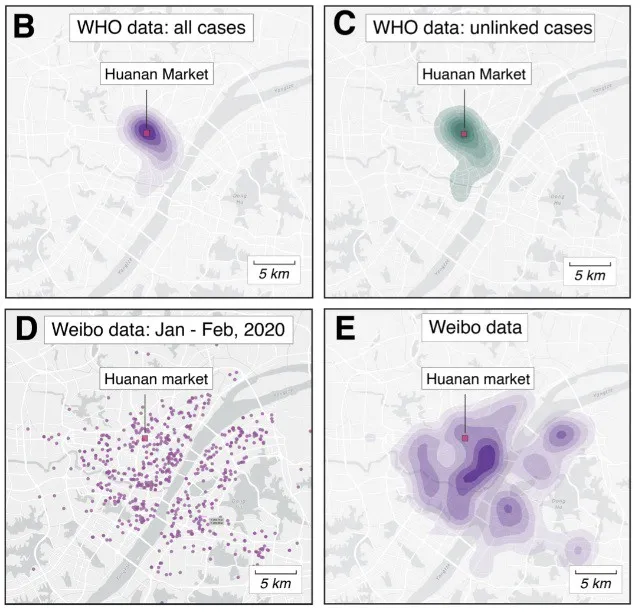
I sort of lost faith in the article's willingness to take lab leak seriously when they threw this map up[0] and inexplicably did not label where the Wuhan Institute of Virology is on it. For reference[1].
It's not at all far-fetched to think the virus piggybacked 10 miles before finding a nice home for itself at a wet market, after which it went gangbusters and infected lots of people. Obviously the virus proliferated in the market, but that doesn't necessarily make the market the origin. The two bottom 'Weibo data' maps from the first link show clusters on both sides of the rivers and also very close to the lab.
That's just the most obvious bit of bias, but I'm confident that article isn't being as fair-handed as it's pretending to be.
You do realize that your two points are in direct contradiction?
You're mad at the author for not pointing out the WIV (Which had 0 confirmed cases anywhere near it until much later in the pandemic which is what the two bottom charts are referring to) but then you also grant that it looks like the market was the center of spread?
In any case, they directly address this;
> Importantly, even pneumonia cases that had no association whatsoever with the market (no work, travel, visits, or contacts there) still centered around the Huanan market and could not have been subject to ascertainment bias. The market was the only place in Wuhan where early cases had a clear association. There are no other epidemiological links to any other place in the city, other clusters only started forming later in Jan-Feb (Weibo data, shown above) and became more representative of the city’s population density.
> It is worth mentioning here that the Wuhan Institute of Virology (the alleged ‘escape’ laboratory working on CoVs, not shown in map) is located on the other side of the Yangtze River, South West of the Dong Hu lake, more than 16km away from the Huanan market, and no sickness clusters of cases were shown anywhere close in December 2019.
As for:
> It's not at all far-fetched to think the virus piggybacked 10 miles before finding a nice home for itself at a wet market, after which it went gangbusters and infected lots of people.
You still need to explain how there are two distinct lineages at the market among the first cases!
Picking and choosing one data point to be skeptical of is useless, the totality of the evidence needs to be weighed.
> You're mad at the author for not pointing out the WIV
Yes, an article comparing two possible originating locations should obviously show both on that graphic (especially when both places are well-within the frame of the image); I can't see any good reason for the author to have omitted that.
> but then you also grant that it looks like the market was the center of spread
Yes. And that's not contradictory to the lab leak idea, because people aren't trees and they go places after work. I think it's entirely reasonable to hypothesize that the virus escaped from the lab on a person and ended up successfully taking root in a less-than-sanitary wet market just across the river. If two-headed turtles started showing up at a Popeye's 20 minutes away from the Turtle Experiment Laboratory, would you say that Popeye's was the source of the two-headed turtles?
> You still need to explain how there are two distinct lineages at the market among the first cases!
Again, there's no reason both theories can't be true here. The caged, dirty animals definitely seemed to be the virus' first stronghold, but that doesn't mean that the new bat virus couldn't have come from the New Bat Virus Laboratory 20 minutes away from the wet market.
> Picking and choosing one data point to be skeptical of is useless, the totality of the evidence needs to be weighed.
My point is that it made the bias of the author nakedly apparent. It's an pro-wet-market argument piece, not an objective look.
There are two key problems with this analysis. The first is that the data to which we have access has been subject to gatekeeping by the Chinese authorities. (Is this a conspiracy theory? Yes, very much so, and rationally so given the way the PRC operates.) The second is that workers at the WIV aren't going to leave work and then hang around on the street outside, infecting passers-by in the immediate vicinity, causing a cluster that radiates around the WIV itself. They're going to get on transit and head home, mainly westwards.
> You still need to explain how there are two distinct lineages at the market among the first cases!
Actually, YOU do. You need to explain how a virus made two separate rare hops to humans in the same place, at the same time, in two different forms. This is possible, but statistically unlikely. The (vastly) more likely hypothesis is that it made only a single cross-species hop, which then spread and mutated later.
That's the Wuhan CDC. It's across the street from the market and has a virus lab. Google Maps will not show you the correct location but you can put the address (湖北省武汉市江汉区马场路288号) and it's close enough. Or use Baidu Ditu and find it's right in the middle of the clusters in your first link, ~300m south of the market.
No, there's a lab in there. This was the lab originally called out by Chinese whistleblowers.
Also you have the wrong address, put in the Chinese name on Baidu and you'll find it's in walking distance to the market. Like literally just across the street.
You don't understand biology. It is possible to date the divergence of genomes using a genetic clock. So they know if those spike proteins had been recombinated.
Serial passage in mice can't be ruled out but is quite out there. Lots of theories can't be completely ruled out, but wild speculation like that is not very productive.
For the lab-leak theory to be true, a "pandemicable" zoonotic virus (a VERY rare thing) has to somehow make it into a lab undetected. Additionally and alternatively scientists have to undergo something like this "serial mice passage". Which is not proven that it could work. And then they would need to somehow let the virus escape through an accident even though they knew it could be dangerous. And it would have to accidentally be able to infect Humans extremely well (which is a tall ask still). It's just... highly improbable.
> For the lab-leak theory to be true, a "pandemicable" zoonotic virus (a VERY rare thing) has to somehow make it into a lab undetected.
That's not a necessary condition and it's ridiculous to think that's the only hinge by which the hypothesis stands. Another far more plausible idea is that a mistake occurred somewhere and it was covered up. This has occurred before in authoritarian regimes before.
An input to a molecular clock is a mutation rate, which I imagine would be hard to quantify given the unknown source and the possibility of gain of function research.
Of course it is a necessary condition. In order to leak from the lab, the virus has to be collected and be propagated in the lab. And all the rest isn't plausible if they knew the bat virus they had in their vials had the potential to cause a pandemic. But it must have had some rare "talent" that was as yet undiscovered. Otherwise nothing of the "lab leak" hypothesis makes sense. You can't "gain-of-function" just any virus and end up with a killer pandemic.
You can interpret a molecular clock or a phylogenetic tree qualitatively, and you would expect to see multiple samples with the protein in question, but which have individually acquired so many mutations that they must have diverged before the dynamic. That would mean the protein sequence in question predates the pandemic by a long shot, unless you think the Wuhan lab tested the Virus in Laos...
I guess the disagreement is around the word "undetected". It's possible some failure was covered up and I trust the Chinese government to be capable enough to do that.
> virus has to be collected and be propagated in the lab
That's a weaker statement than the one I replied to. I'm referring to the how it's necessary that it needs to a "pandemicable" virus that enters a lab "undetected" and I guess leaves the lab "undetected". There's several possible ways the virus could have made it into Wuhan:
- Improper handling occurs somewhere in transporting the samples from bat caves (w/e) to the lab.
- Improper handling of samples in the lab.
- Improper disposal of samples in the lab.
- Entering a more speculative area; bat samples are used in experiments and improper handling or disposal occurs.
- Deeper into speculation: Improper handling/disposal of viruses used in gain of function research.
And when any of the above occurs, use the state's staggering power to cover it up.
> You can interpret a molecular clock or a phylogenetic tree qualitatively
I'm sure that could work but I imagine the error bars are quite wide as otherwise that's definitive proof and we wouldn't be discussing this online.
> unless you think the Wuhan lab tested the Virus in Laos
Nice attempt at absurd rhetoric. Strengthens the argument doesn't it?
The whole point is that the virus that was collected would already need to have some properties that predispose it to become a dangerous pandemic. Which is unlikely because those Viruses are pretty rare.
And the rest of your comment just tells me you know nothing about biology.
So the crux of your argument is that it's more likely that a virus with that type of predisposition occured in nature in a specific area around the Wuhan market as opposed to being sampled from one of many areas, potentially modified, and then leaked into said area? Seems unlikely considering the rarity as you pointed out.
>And the rest of your comment just tells me you know nothing about biology.
No need to resort to ad-hominems ; all it achieves is tainting your future responses on the topic with a lingering question of whether they are being made in good faith.
It's not ad-hominem if it's true. I really don't have the energy to debunk every "argument" that is borne out of misunderstandings about basic biology.
The alternative hypothesis is not that a very dangerous zoonotic virus emerges in a specific area around Wuhan (which also isn't really the agreed upon origin anyway), but rather that it emerges anywhere and causes a pandemic. Your argument here is a basic misunderstanding about how random processes work. Our observation that Wuhan was the first epicenter of this pandemic already preconditions us to assume a pandemic-capable Virus emerged there in some form or another.
Such viruses are indeed rarities. But they exist and every once in a while they come into contact with Humans and cause a pandemic. However this is not the same likelihood as with the lab leak hypothesis, because collecting viruses for labs is an event that happens multiple orders of magnitude less often than contacts between animals and Humans. So while it is a rare coincidence that a lab would collect a killer virus when randomly collecting bat viruses, it is not so strange that every once in a while a novel pandemic virus makes the jump from animals to Humans somewhere in the world.
Non sequitor. That's not the statement I'm referring to. It's certainly the case a virus emerged from nature with all or most of the properties we saw in the original. Unless it was engineered in Loas lol
Good job defending your point. If the error bars weren't so wide on the biological clock idea why we would we be having this discussion? Does the west supress that, and you're one of the few smart ones who have the truth?
Wait, wait...does this whole debate hinge around the idea that you think the WIV staff are reliable, honest agents? The very idea is hilarious. They operate within an authoritarian regime that restricts their freedom of speech and makes threats against them and their families for non-compliance. It is irrational to trust anything they report as being true.
Well, that's an interesting question. If the public health dept wants to inspect a restaurant to make sure its hygiene standards are adequate, and the restaurant goes out of its way to try to delay or block such an inspection, should we lean towards:
a) The restaurant has something to hide and is therefore likely to have poor standards
or
b) It is irrational to hold ANY position on the hygiene standards of the restaurant, given the lack of dispositive data
I completely reject he analogy between health inspections of a restaurant and blaming a country for a pandemic using a highly speculative theory. It feels so ridiculous I don't know where to start.
> covered up. This has occurred before in authoritarian regimes before.
To be fair, cover ups aren't exclusive to authoritarian regimes.
Futhermore, in this case, The West seems to be willingly and shamelessly towing the Communist Party line. Can we add conspiracy to the smell being given off?
Science should be obcessed with truth. Geez. Looks like science isn't immune to cover ups and conspiracy either.
"What is the source?" will take a place next to "Who killed JFK?".
p.s. Slightly off topic, but off the media sources mentioned (e.g., CNN) how much of their revenue comes from Big Pharma or Big X that wouldn't fare well if lab leak could be supported?
To be totally honest I don't even believe in my comment but it felt like the right retort, I have literally know clue what OP is saying. Can you flag balderdash?
> "pandemicable" zoonotic virus (a VERY rare thing) has to somehow make it into a lab undetected.
This is the opposite of what I understood the lab-leak theory to be: that an initially-zoonotic virus was identified and bred in a lab until someone working at that lab with lax security standards accidentally brought it out of the quarantine. This is plausible at face value.
I think a lot of the really extreme vitriolic reactions to lab-leak theory are conflating it with the accusations that a secret cabal purposefully engineered and released this virus to sow harm and discord. But that's not at all the connotation of "leak" IMO -- leak implies a lack of intention.
There's a spectrum... The zoonotic virus would need to have some rare "talent" to start with. Then there is the ominous "breeding" part, which many people describe as reckless or evil. In any case this isn't done in Humans but rather some kind of humanized model (and it's not clear that could work at all). Which is why it is quite a coincidence or accident that this process would end with a virus so well adapted to Humans that it is able to cause a pandemic. It's like winning a chess tournament after training for a Marathon.
It's only plausible if you know very little about biology. Very few people who know a lot about viruses believe that this is possible and even those usually say the zoonosis hypothesis is more likely.
> Gain-of-function research is medical research that genetically alters an organism in a way that may enhance the biological functions of gene products. This may include an altered pathogenesis, transmissibility, or host range.
Isn't the goal to end up with an infectious agent? I don't understand why it seems so implausible that they would succeed? Why would someone give a lab money for a truly impossible task?
A virus that is optimized for mice or bats doesn't normally work well in Humans. If a bat virus somehow evolves in a lab into a pandemic in Humans, without essentially breeding the virus in Human subjects, that would be somewhat of an accidental development because the viral particles aren't specifically selected for that reason.
Something tells me those scientists were more interested in the effects on humans than on mice, and do their best to modify their analogues (ie "humanize" them) to achieve comparable results.
What does "date divergence of genomes using a genetic clock"? I am curious to learn about such a tecnology. If you mean https://en.wikipedia.org/wiki/Molecular_clock that is highly non-quantitative.
Can you give me a link to a good example of that (ideally, non-covid)? my understanding is that it's only good for relative rates over evolutionary time so I'd like to see a counterexample.
Thanks- personally, based on my experience in functional genomics, they have far too many assumptions to be trusted as "clocks", even relative ones.
Here's the second paper's methods:
a molecular clock signal was estimated on the ML tree using TempEst v1.532. BEAST v1.10.433 was used for Bayesian MCMC analysis to estimate temporal nodes. As recommended in Patrono et al., we selected the simplest model: strict clock and constant population size with a HKY substitution model and four Gamma categories7. An MCMC model was run with 50,000,000 generations and a burn-in of 25,000 sampled trees. All other parameters were by default. BEAST executions were completed checking chain convergence and sufficient sampling of the posterior space (ESS > 200) with Tracer v1.7.1. The final chronogram was generated using TreeAnnotator v1.10.433.
I'd call these "time-scaled trees", not molecular clocks.
Their accuracy is completely subject to stable mutation rate and frequency of sample -- with that second paper, they were working with ~10 samples from 15 years ago vs. thousands of samples with hourly granularity and entirely traceable transmission chains in the early days of Covid. Completely different capabilities arise with Covid-level specificity.
It's more a matter of decreasing the error bars on the rate of substitution, to have extremely specific dates for the oldest infections in each clade and the ability to run real-time backtesting to make sure your assumptions are solid. The rate of spread of Covid was a curse but was important to this type of work -- when we were looking at contact tracing and trying to assess the rate of substitution on mutations, it was useful to know that e.g. on Jan 1st there was no Covid in NYC and on Feb 1st there was.
My point is that if you find multiple samples with the same protein sequence, and those samples have independently diverged, you can easily assume those viruses did not originate by recombination from the Wuhan strain.
Undetected? The lab was specifically searching for and storing pandemic-capable viruses, and had applied for grant money to insert furin cleavage sites into them!
Nope. It was looking for bat viruses. There is no way to tell if such a virus is even able to infect Humans, without testing it out on Humans.
The grant application is not proof that they either performed such experiments at all, that they did it on that particular virus nor that it worked. And there's still a long distance between a random bat virus with a "furin cleavage site" and something that is good at infecting Humans. All this theory is so far is wild speculation.
The WIV was in Wuhan due to the proximity of coronaviruses and other bat-borne diseases like rhabdovirusus.. this line of logic is akin to blaming shark research centers in South Africa for nearby attacks.
It was not. This is a widespread misconception. The local bat populations in Wuhan were negligible and their viruses were not being studied. Indeed, the local human population in Wuhan was used as a control in the WIV's studies because of their lack of any significant encounters with bats and their diseases.
Shi Zhengli, the "bat woman" who conducted most of her research 1000 miles south, in Yunnan province, had this immediate reaction to an epidemic of bat-borne sarbecoviruses starting in Wuhan:
“I wondered if the municipal health authority got it wrong. I had never expected this kind of thing to happen in Wuhan, in central China.”
Her first panicked thought was that the outbreak might have started as a leak from her lab. Which is kind of curious, don't you think? She reported being relieved later when she found no evidence of this, but...why was that her initial thought?
There is no proof that the Virus was passed directly from bats. And as far as I recall there was evidence for at least one intermediate host. Which makes the bat-hunting rather pointless.
There are bats almost everywhere in the world, including Wuhan. The question isn't bats, but bats carrying sarbecoviruses related to SARS-CoV-2, not just betacoronaviruses. Dr. Shi herself has stated that she didn't expect such bats anywhere near Wuhan:
> We have done bat virus surveillance in Hubei Province for many years, but have not found that bats in Wuhan or even the wider Hubei Province carry any coronaviruses that are closely related to SARS-CoV-2. I don't think the spillover from bats to humans occurred in Wuhan or in Hubei Province.
I've responded to you with this link before, and you didn't reply. It begins to feel like you are willfully disregarding all evidence contrary to your predetermined view, which is unfortunate.
The WIV was not set up in Wuhan to study bats in Hubei. That is a total misconception. It was set up in 1956 with no connection whatsoever to bat-borne sarbecoviruses. That specialization arose later, but studies were made principally in Yunnan province. There is no connection between the bat specialization of the WIV and its location in Hubei.
The biggest single reason against the lab leak is this:
Its really fucking hard to reliably grow human virus. Yes, the Wuhan lab does it, but for like ~10 strains. It takes years of planning, and lots of money. Its not like you can easily hide that kinda shit.
Its not like you can dump the virus into a Petri dish, shove it in a incubator and have done with it. You need hosts and proxies. And guess what? something that replicates well in hosts doesn't replicate in humans. Not only that, there is a strong chance you have to modify the hosts to better accept the virus.
Also, its not like SARS-like virus is rare. MERS is relatively recent. MERS didn't catch on because you are very symptomatic.
I'm sorry, this is totally tangential to the topic, but... between all those versions optimised to bind to this and recombined with that - how do you manage all those changes? Do you have something resembling commits and branches?
That's the problem with lab-leak theory that it's basically unfalsifiable. No matter how strong evidence you gather against it you can always dismiss it with ease.
Ditto for zoonosis. The problem is that people treat the zoonotic transfer hypothesis as some kind of default, the incumbent to which we must defer in the absence of compelling evidence to the contrary. This is a mistake, given the proximity to the WIV and the nature of the work being done there. If the pandemic had started in some remote village nowhere near a lab this line of argument would be far more compelling.
To disprove zoonotic origin it would be sufficient for one person to step out and say "I made covid" and present a sample very similar to originally discovered covid strain and maybe some documentation regarding his experiments. It would immediately disprove theory of zoonotic origin of covid.
Nothing like that is possible for lab-leak theory. Even catching animal that has a virus very close to original form of covid wouldn't disprove lab-leak theory because lab-leakers would just say that the animal just got covid from humans.
As for validity of zoonotic origin hypothesis it's a default because every virus ever that troubled us came to us from other species of animals without any additional technological assistance from us. Unless you count hunting, cooking or husbandry a technological assistance.
It's now very well known that coronaviruses have huge variability, are able to mutate quicly and cross barriers of species so it's overwhelmingly more likely that sars-cov-2 came to us without any technological intervention.
We have no idea where the pandemic started. Only where it was noticed. Vast majority of covid cases give only flu-like symptoms. First cases might have happened in some village that had too few people to notice any spike in severe cases. Only when a person from the village visited market of a densely populated city and thousands of people got infected so that tens of them started landing in the city hospital the whole thing had a chance of getting noticed.
A standard serology chain through animal populations showing a plausible path to Wuhan would make the lab leak hypothesis unlikely, or at the very least redundant.
We do know that the pandemic started in Wuhan, or certainly that that’s the first major population centre it hit. Had it started elsewhere that’s where all the early hospitalizations would have been.
People have various definition what they found plausible. Majority of researchers think path leading from bats through civets is plausible enough given the evidence.
As you said, Wuhan was only the first major population centre. First human patient or even first hundred patients could be from a small village that don't even have hospital nearby to have a hospitalisation and one or two elderly village dwellers dying because of "flu" wouldn't make anyone curious or cautious.
This virus could have evolved a lot in those first few patients because there selection pressure for improving human to human transmission was the strongest and there was a lot of low hanging fruit for the virus.
> Majority of researchers think path leading from bats through civets is plausible enough given the evidence.
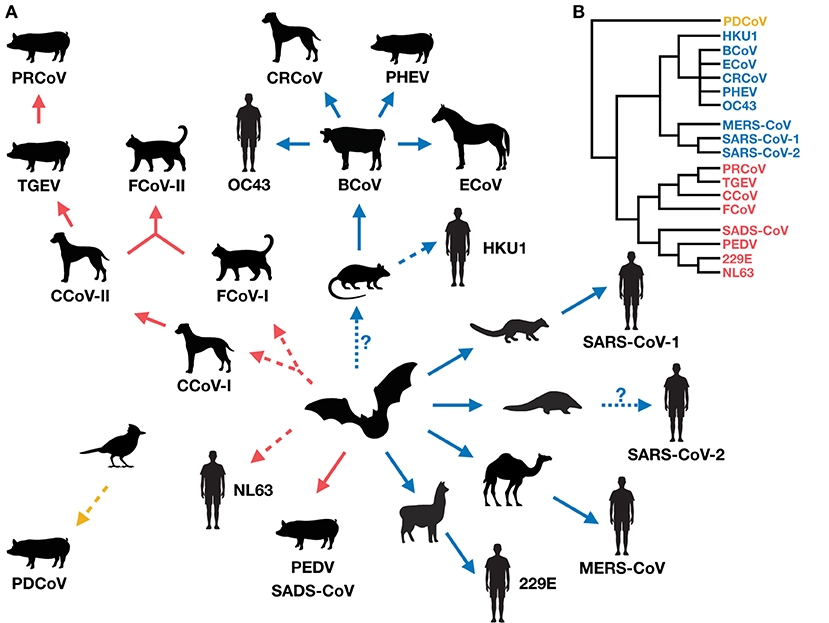
Are you thinking of SARS-1 here? There's reasonably strong evidence that SARS-1 entered humans from bats via civet cats, since infected civet cats were found in the markets. For MERS we have very strong evidence of zoonosis, since many infected camels have been found and the phylogenetic tree shows evidence of repeated introductions.
No animals infected with SARS-CoV-2 have been found, except those infected by humans. Various researchers have proposed various natural zoonotic paths, but I don't think civets are a leading contender. It's hard to say what a majority of researchers believe, since most have stayed prudently quiet.
Pangolins were proposed very early in the pandemic, but have been pretty much abandoned. It eventually came to light that all the pangolin papers were based on the same one batch of smuggled pangolins. This makes it more likely that those pangolins were infected by a smuggler (in the same way that housecats or mink have been infected by people), and not the other way around:
Lately I've seen proposals that raccoon dogs were the intermediate host, or that bats directly infected humans. All of these are speculative, since no infected animal (except animals probably infected by humans) has been found. The absence of infected animals isn't proof of unnatural origin, but it's different from SARS-1 and MERS, despite a much greater effort to search.


Speculation about how the virus wasn't created wholly synthetically: nobody is seriously arguing it was, or it wouldn't be SARS-family.
Arguments that the spike protein binding domain wasn't synthetically engineered: it didn't have to be. It could have been serial passage in humanized mice, considering that's what Daszak and co had literally proposed years before the outbreak.
Arguments that because the original SARS-CoV-2 wasn't perfectly optimized to bind to ACE2, it obviously didn't come from a lab: Obvious nonsense. Why would you expect serial passage through a small number of humanized mice be as effective at optimizing binding to ACE2 as an epidemic sweeping through tens, then hundreds of millions of humans?
The Laos expedition is interesting, but having only just skimmed it I'm not yet convinced it means anything. Any samples with very similar spike proteins collected AFTER SARS-CoV-2 became an epidemic could indicate that SARS-CoV-2 had recombined with existing bat coronaviruses, rather than being a zoonotic source of the SARS-CoV-2 spike protein.
The sloppiness and drumbeat nature of these anti-lab-leak essays makes me not trust them. The lab-leak argument is speculative, sure, but we've sent people to prison for murder based on speculative inferences from circumstantial evidence; meanwhile, none of the arguments against lab-leak are solid.