I was born and raised in Brasília, currently living in New York. The city is indeed unique and beautiful and building it in about 4 years is an incredible feat, but the airplane-shaped urban design is terrible.
It is easy to cross the city from east-west but quite painful to do so north-south. Things are quite far from each other, so it isn't common to simply walk: you either drive or take a bus (and the public transportation system is awful) even for the most mundane things. Retail suffers a lot because there is simply not enough people walking close to stores. No day-to-day coffee shop survives because people don't take their cars for a regular coffee (only gourmet ones thrive). Even worse, the city is more or less sectorized (hospitals, government buildings, hotels, industry etc are clustered in specific zones), which drives up the number of cars in these areas.
Also, the city was planned for ~500k people, up to 1M. The metro area currently has 3.5M inhabitants and is one of the fastest growing metro areas in Brazil. Since the airplane sector cannot be modified, most people end up living in dorm-cities around Brasília even though 95% of them work in the airplane. A commute of 20-50km is pretty standard, so the traffic during rush hours is horrific.
At the end of the day, in my opinion, the design really influences how people behave in the city for the worse. Since I left Brasília to live in "normal" cities, both in Brazil and abroad, I came to the conclusion that Brasília became a failed experiment of the Brazilian modern architecture and urbanism.
Feel free to ask me anything about my hometown or even disagree with me if you also lived in Brasília!
North-south painful? Haven't you swapped the axes? North-south is the axis which the the Eixão lies on, which is a three lane express way. Meanwhile, every day around both noon and evening all the streets and roads on the east-west axis will be crammed with cars, to the point of blocking the roundabouts, because most of them are single lane roads chockful with roundabouts and pedestrian crossing.
Edit: changed, from "pedestrian way" to "pedestrian crossing."
My Brazilian in-laws maintain that the site of Brasilia was chosen because it's exactly in the middle of the country and not close to the established power cities of Rio and Sao Paulo. True?
I wouldn't say it was the only reason but probably one of them. I've also heard that the federal government buildings were placed in a super wide avenue [1] because even huge crowds of millions wouldn't be able to pack the street (and, then, it would feel emptier than it really was).
Also, the very first Brazilian constitution had an article about moving the capital to a more geographically centered place, a plan that was developed while Brazil was an empire [2]. One could argue that the move was simply a matter of fulfilling this constitution article.
Another reason could be that the Rio and São Paulo areas are full of mountain chains and make the task of building a new city quite difficult.
Yet another reason is that building the capital in the São Paulo state or Minas Gerais state would bring back old political rivalries (Brazil was controlled by politicians by these states for decades [3]). Same for the surrounding states. Hence, moving it to a more neutral area.
Anyway, hard to pinpoint one specific reason. The city is interesting, though, with nice people trying to define their own cultural aspects. Unfortunately, most Brazilians have never visited it.
True. Rio used to be the capital, and the many revolts were one if the reasons. The middle of the country was also very unpopulated, so the location was chosen more or less as a “middle of the road” to incentivize development
People often compare Brasilia to an airplane, this is common even among locals. But Lúcio Costa — the mastermind behind Brasília's urban project — used to compare Brasilia to a butterfly, not an airplane.
This is one of the most debated things in Brasília. The current understanding is that the design is neither an airplane nor a butterfly, but simply a cross adapted to the topography of the region [1]. The confusion comes from the words "Plano Piloto" (literally, "pilot plan" or "pilot design"). The butterfly metaphor, apparently, was a lyrical comment by Lúcio Costa, not a literal source of inspiration. Anyway, the intersections do resemble butterfly wings [2].
It's growth is mainly driven by migration from other states by people attracted by the high quality of life (highest in the country) and high-paying government jobs.
However, the designed neighborhoods are currently noble areas where only rich people can afford renting/buying apartments. Poor families are forced to live far from the city center (think 2-3 hours by bus) in dangerous places controlled by organized crime. For instance, Sol Nascente will most likely become the largest favela in Brazil (even larger than the ones in Rio since it can grow without being limited by surrounding mountains).
That's correct, the city was designed to house high paying government workers and politicians, still like this since the growth is controlled by the government so house development does not meet the demand. People that can't afford living there go to more dangerous and poor cities around Brasília. The city is also not designed for pedestrians and does not have a good metro system. Brasilia is unique but it also shows the worst from Brasil.
Brazil is a big country with a big and centralizing government. The national capital gets a lot of well-paid federal jobs - politicians, their staff, a huge chunk of the government bureaucracy.
I haven't traveled enough around the US to be able to give you an appropriate answer. I'd say Washington DC share some characteristics (federal capital, planned city etc) but it's still a "normal" city in my opinion: you can walk through it, buildings are in old-style architecture, there are people on the streets...
Probably, the older cities, such as Boston and even downtown NYC are quite different from what I was used to in Brasília. There is less urban planning and more organic growth.


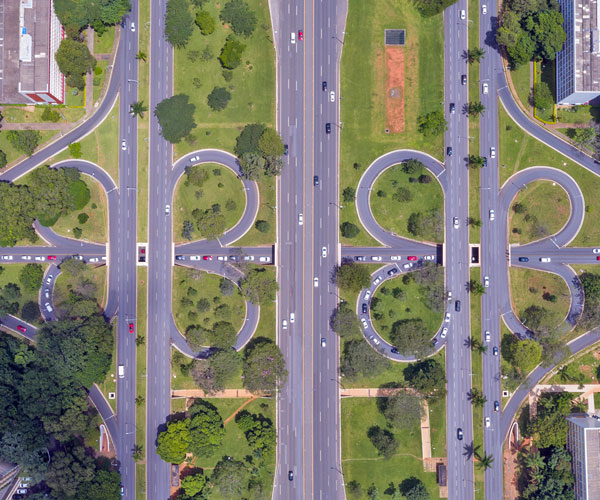
It is easy to cross the city from east-west but quite painful to do so north-south. Things are quite far from each other, so it isn't common to simply walk: you either drive or take a bus (and the public transportation system is awful) even for the most mundane things. Retail suffers a lot because there is simply not enough people walking close to stores. No day-to-day coffee shop survives because people don't take their cars for a regular coffee (only gourmet ones thrive). Even worse, the city is more or less sectorized (hospitals, government buildings, hotels, industry etc are clustered in specific zones), which drives up the number of cars in these areas.
Also, the city was planned for ~500k people, up to 1M. The metro area currently has 3.5M inhabitants and is one of the fastest growing metro areas in Brazil. Since the airplane sector cannot be modified, most people end up living in dorm-cities around Brasília even though 95% of them work in the airplane. A commute of 20-50km is pretty standard, so the traffic during rush hours is horrific.
At the end of the day, in my opinion, the design really influences how people behave in the city for the worse. Since I left Brasília to live in "normal" cities, both in Brazil and abroad, I came to the conclusion that Brasília became a failed experiment of the Brazilian modern architecture and urbanism.
Feel free to ask me anything about my hometown or even disagree with me if you also lived in Brasília!