The kits have a value beyond the food, they teach you how to be more confident about your cooking. Americans are terrible cooks on average, they don't learn good cooking skills at home because their parents are not very good cooks either (gross generalization but accurate if you compare the US with for example Italy).
My wife now can cook a much wider variety of meals after a few months of meal kits. It also has reduced dramatically the thinking it required to plan meals in advance. If grocery stores want to compete they will have to work with their providers to create smaller packages of items to assemble and a team to design and forecast demand for different types of meals. Not impossible but definitely not easy, I see acquisitions happening in this space.
When I was a student, the local Sainsbury's supermarket had a selection of recipe cards by the entrance. Here's the front of a newer version [1], the back is presumably something like this [2].
I wouldn't say they taught me to cook, I didn't learn any new techniques. But, I did get a lot of ideas from them, and it led us to eating a wider variety of food.
I'm now curious -- what do typical American university students eat? Do they cook, or are all meals provided? (Surely not at weekends?)
Universities usually have a dining hall that's open 7 days a week. Students that live on campus will eat there for the majority of their meals because dorms usually don't have much in the way of food storage or prep areas beyond a mini fridge and microwave. Off campus students have more options.
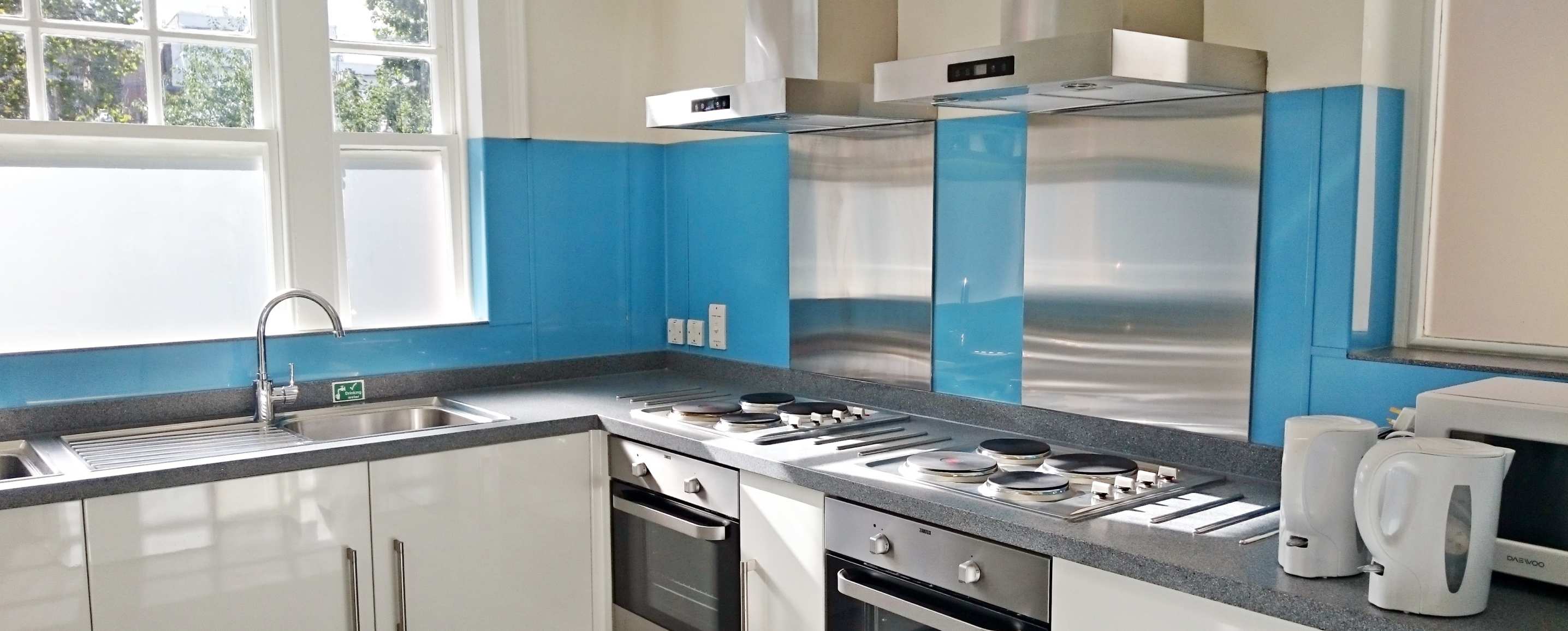
Dorms in the UK usually have a decent kitchen. Mine was like this [1] (the adjacent building to the one pictured), which is nicer than the houses affordable to students in London.
Only one dorm offered cooked evening meals, and then only Monday-Friday. It was a fair bit more expensive to take this dorm.
In any case, most universities only offer dorms for the first year.
That may be the case in the US and/or other countries. Most of the accommodation in the UK is self catering however, private rooms with a shared kitchen between 5-10 people.
Most Americans, including students, cook standard American food such as hamburgers, hot dogs, eggs, spaghetti, roast chicken, ramen, steak etc., as well as a lot of canned soups, frozen vegetables, and boxed casserole mixes.
But these kits are for people who want to eat something novel every meal, and certainly not mundane working class food. I mean, you don't need a recipe for a hamburger.
For us, and I think we were probably a bit better cooks than is normal, hamburgers would count as a lazy meal, assuming you mean cooking something like [1] from the fresh meat section.
Hot dogs, eggs alone, or ramen -- no; this is food for when you've arrived home alone drunk at 4:30. Or woken up hungover.
Roast chicken or steak is fine, so long as there's also some vegetables and some kind of sauce.
Average meals would be things like curries or stir-fries made with a pre-prepared sauce or spice mix, chicken/turkey fricassees, risottos, or casseroles. I think we discovered fairly quickly that £3 tetra pak wine improved most dishes, so long as one didn't drink it.
The Blue Apron recipes have fancier ingredients than we would have bought when we were 18-22, and a little more effort in the sauces. Looking at things like [2] and [3], the skill required was well within what we could make, although we'd probably use dried herbs, cheaper vegetables (canned sweetcorn, normal size tomatoes), and normal meat rather than anything special.
In fact, the "Fresh Basil Fettuccine" is almost exactly like our "use up what's left in the fridge" meal.
The time I tried Blue Apron, one of the dishes was a gourmet hamburger which took some ridiculous amount of time to prep and I didn't even think it was that good. And PeachDish has Grass-fed Beef hot dogs with ketchup and mustard on its menu--which sort of blew my mind.
So you'd be surprised. But, for the most part, these services justify their relatively high prices with recipes that may look a bit intimidating for many people to pull together on their own.


My wife now can cook a much wider variety of meals after a few months of meal kits. It also has reduced dramatically the thinking it required to plan meals in advance. If grocery stores want to compete they will have to work with their providers to create smaller packages of items to assemble and a team to design and forecast demand for different types of meals. Not impossible but definitely not easy, I see acquisitions happening in this space.