When holidaying in Italy I had the luck to pick the day trip one day. Really glad I found Paestum (an ancient Greek city): it is every bit as captivating as Pompeii imo.
Went to Italy for the first time a few years ago and picked paestum randomly when we needed a break from Naples. Went back last year and will probably go again.
> I am pretty sure there would have been a small group (or at least one) of tech people in there who knew all of this and tried to get it fixed, but were blocked at every level. No idea - but suspect
I recall there was a whistleblower Richard Roll who said that engineering did know of the bugs and flaws
A general quadtree implementation question that puzzled me when I was implementing it myself for hobby games was: do you store a rectangle in the smallest node that completely contains it?
Most code that I saw that used quadtrees were treating things as points and storing them only at the lowest level.
I also made mine auto-divide by counting items that are entirely in a quadrant as they are added to the node, with allocate and split triggered if a count went above a certain threshold.
One of the reasons you mostly saw point operations and very few rectangle operations is because quadtrees aren't great for range operations.
Quadtrees might look like natural generalization of binary trees, but some things that work very efficiently in binary trees don't work for naive generalization of binary trees into quadtrees. For a full binary tree with W leaves any segment can be described using log(W) nodes. Almost every use of binary tree more interesting than maintaining sorted list of numbers depends on this property.
What happens in 2d with Quadtree, how many of quadtree nodes are necessary to exactly describe arbitrary rectangular area? Turn's out you get O(W+H) nodes, not log(N), not log(W)*log(H).
If you stored a rectangle in smallest node that completely contains that avoids the W+H problem during insertion operations, but during read operations you may end up with situation where all the information is stored at the root. This is no better having no quadtree at all and storing everything in plain list that has no special order. Such worse case scenario can be created very easily if every rectangle contains centre of area described by quadtree, then all rectangles will be placed at root.
Dynamically subdividing and or allocating tree nodes on demand isn't anything particularity novel. If anything the cases where you can use fixed sized static trees outside textbook examples is somewhat a minority. Not saying there are no such cases there are enough of them, but large fraction of practical systems need to be capable of scaling for arbitrary amount of data which get's added and removed over the time and total size is not known ahead of time and the systems need to be able to deal arbitrary user data that has maliciously crafted worst case distribution.
Every B-tree will split leaves into smaller nodes when necessary. Almost every self balancing binary tree can be considered of doing automatic division just with threshold of no more than 1 item per node. For 2d many uses cases of k-d tree will also subdivide on demand.
When I made a quadtree for some simple 2d games I handled AABB areas, since it was aimed at broad-phase collision detection of what were essentially sprites just rendered w/GL.
Similar to yours I split the leaf nodes when they became too full, with some simple fixed threshold defining "full". Only leaf nodes contained references to the indexed objects, and all overlapping leaf nodes would reference the objects they overlapped. Search queries were done also using an AABB, and would iteratively invoke a callback for all overlapping object AABBs found in the overlapping leaf nodes. IIRC the object references hanging off the leaf nodes had a fixed number of linked list slots to be put on a results list during a search, to deduplicate the results before iterating that list with the provided candidate-found callback. Since any given indexed object could be on many leaf nodes in the index, if they spanned a large area shared with a high density of other indexed objects for instance.
It was up to the callback to do the narrow-phase collision detection / control the results list iterating stop vs. continue via return value.
I recall one of the annoyances of sticking the search results linked list entry in the object references hanging off the leaf nodes was it set a limit to the number of simultaneous searches one could perform against the index. Basically the game would initialize the index with a fixed maximum concurrent number of searches to handle, and that set the number of results-linked-list slots the object references would be allocated to accommodate. As long as that was never exceeded it worked great.
It's been a while so I may have gotten it wrong, but that sounds right to me.
In 3D this has to be dealt with in the form of polygons and I think it was common when people were using acceleration grids and kd-trees to split the polygons so they fit neatly.
That being said most ray tracing seems to do bounding volume hierarchies now, so maybe a bvh is the best way to deal with things that have volume.
The US has been like that for a long time. But Western European and American interests were well aligned for a couple decades. First the whole WW2 business. Then Western Europe needed funds for rebuilding and a strong deterance against further expansion of the Soviet Union, while the US felt threatened by the idea of communism. Then in the early 90s we had a couple years where we had common ground in commercializing and integrating post-Soviet states.
During the Bush and Obama eras Europe was at least important as a staging ground for war in the Middle East, but the US wants to get away from putting boots on the ground there.
But now most of the common ground is gone, and the gloves are coming off
You talk about Europe as it were a single country. I live in Switzerland and basically nothing of what you say is or was true here. What you describe is losing the few allies you had here, not "Europe". Trump is using these words so wrongly it hurts. There never was a common Europe on Americas side to begin with.
Not even a fifth. However other than the cold trading war with the US we haven't been in any war situation for a while.
And we don't exactly need military against you guys. We attack with rolex and suited super rich
Edit:// if Russia is such an easy problem? How comes orange man did nothing so far even thought he spends days talking about how he did?
We are also actually the main sponsor for America by capita. (As in owning state papers and your dept) So essentially we finance you guys to do the dirty stuff!?
Nobody's under any illusion that this was a good decision, including the people that made this decision. It was just a means to an end, the end being lowering tarrifs on the EU.
There's still quite a few steps between the current state and the dominance of US cars on European streets. It's still an empty promise from the EU side.
> Is anyone in Europe really believing the USA still has our back?
Can't speak for my whole country, but the opinion among the people in my age group at least is that the US would expect a ROI on military interventions in Europe
Are you German by change? There is barely any America positive sentiment in our media anymore as far as I can tell, since the last time orange man won (which been a while).
From the media I can see it's only Germany who has a really weird relationship with the US. Switzerland, Italy, France, .. are pretty clear in what they think and how they will act.
No I'm French, and we always had mixed feelings with the Americans. But for anyone following the topic, it's pretty clear that most other European governments are still pretty convinced that they just need to brace for the next three years and appease Trump.
See the debates about how the European funds (ReArm Europe) should be spent, and whether or not it should be allowed to be used to buy US equipment. Or the recent procurement of additional F35 (at least Belgium, Netherlands, Italy and Germany have ordered more).
Also, none of the re-arming plans seem to consider the assumption that the US logistics (airlift & tankers) could not be relied on.
The article says road deaths in USA are up 30% over last 15 years and links to https://www.transportation.gov/sites/dot.gov/files/2024-02/2.... That doc talks a lot about initiatives but what is the normal American's sense of what's going on on the street?
I'm an American that doesn't drive. I've lived across multiple states across multiple coasts, so I can speak a bit to the issues here as someone that is primarily a pedestrian. There's a bunch of different things that add up into an absolute mess.
The first thing and the most obvious is that for 99% of people, you need a car to live. I've been able to work around that issue, but you simply cannot exist anywhere without a car. Our public transit networks are terrible, our roads are terrible and our commutes are even worse. Half-hour to an hour commutes are normalized among a lot of people. I don't see a need to hammer this point any further as I'm sure almost everyone who has tangential knowledge of the US knows.
The more insidious problem is that Americans are also incredibly afraid and incredibly self-serving, and our law system is set up to benefit that. Drivers can very easily get away with vehicular manslaughter because our system is tilted in favor of drivers. This is why we see larger and larger cars, because people want to protect themselves at the cost of everyone else. And if they do hit a kid or murder a pedestrian it was an accident and not their fault. This is also why Americans drive like absolute maniacs. Our police also rarely enforce traffic laws and drivers have only gotten worse as a result.
So we have a bunch of people that should not be allowed to drive on the road because they have to drive, where they rarely get punished for breaking the law and where the law is set up to benefit them when they do break it. This has been a universal constant across every state I've lived in, though notably Virginia was worse than both Texas and Washington in terms of drivers.
European living in the US here. Around my mostly suburban area, I see mainly SUVs and crossovers with a few vans and pickups sprinkled in. Outside the urban areas, pickups and other monsters like nine seaters seem more common.
I also see a lot - and I mean a lot - of people holding a phone while driving, even in dense city traffic. Add to that non-walkable streets in some places and unsafe rules like legal right turns on a red light. Cyclists often have to squeeze into a narrow bike lane that is level with the car lanes instead of raised onto the sidewalk. That adds up to a much higher amount of latent dangers than in Europe.
There's something you can learn from the broad scale, but SF has pretty decent tracking and perhaps there's something you can learn from looking at one city too. SF has a Collisions Report[0] and also traffic citations data is open data[1] so you can see how enforcement has changed. Subjectively, I notice a lot more red-light running, and objectively the red-light camera near my apartment illuminates the ceiling of my home office every day.
I'm now a father so one cannot discount the amount to which my tolerance of bad actors has changed, but my experience has been that the lack of enforcement for violations (right-turn red lights in SF are rarely obeyed) is definitely taken advantage of by many drivers. However, the collisions report does make it somewhat clear that a non-trivial amount of the new fatalities are due to new traffic modalities: people now have the stand up OneWheels, and there are many more food delivery drivers on e-bikes.
But one gratifying thing is that the newer parts of town where people are having children have a lot more safety construction. I was walking home from the gym here in Mission Bay when I saw a group of kids between 6 and 12 on their little scooters.
I dunno about the last 15 years, but my sense is there is a fairly widespread perception that drivers have become more reckless and oblivious since COVID. This isn't just about car standards (although there is probably a connection terms of things like touchscreens becoming more and more prevalent in cars) but it's a thing.
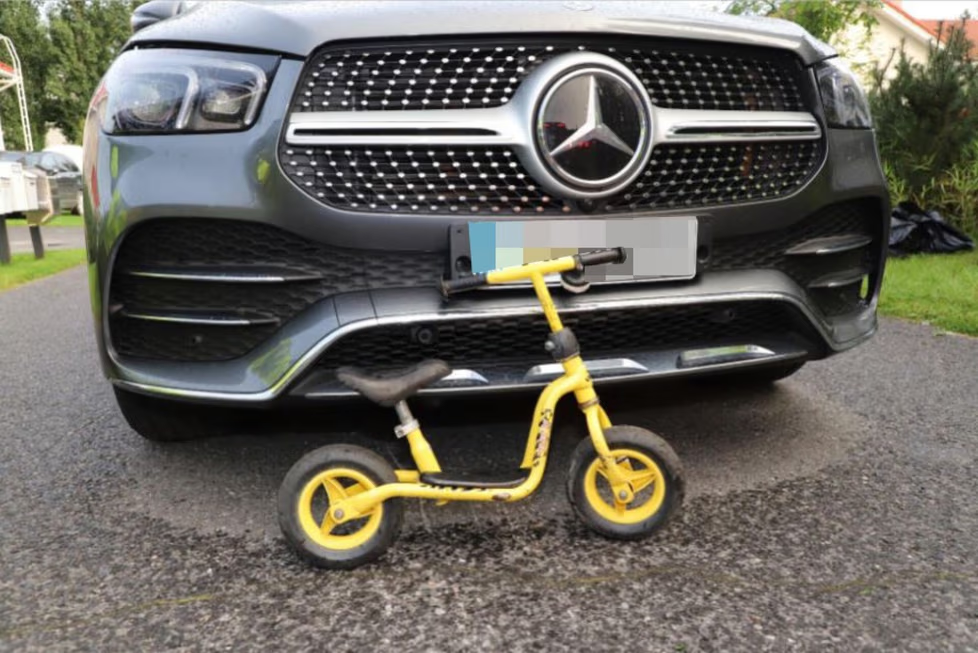
People driving "Brodozers(tm)" can't see shit near the vehicle due to both the big hood and being super high up, while the gigantic, flat front grille kills people rather than crumpling them over the hood.
And while I call them "Brodozers" to be derogatory, a significant number of really tiny females are driving them as well in the name of "safety". And they REALLY can't see anything over the hood.
The combination of gigantic blind spots and complete energy transfer is good at killing unarmored people.
Images like that evoke feelings but you have to evaluate each on what would have occurred with other vehicles - even a bike hitting a child at speed is likely to be tragic.
No, because we're talking about the physical laws of nature here. A vehicle of that size hitting a child even at a low speed is going to impart much more force than a bike hitting a child at even high speeds. And that's before you get into the other physical design issues of modern cars pulling people under the vehicle in collisions.
Sure - but the point is everything is tradeoffs and we're working on what tradeoffs to focus on. A train hitting someone imparts way more force than a bike, but that doesn't necessarily mean we ban all trains.
And if the incidents of vehicle/pedestrian collisions are directly attributable to reduced visibility, then they should be resolved (the "school bus arm" in North America). But if the collisions would have occurred even with a perfect visibility bike, then changing the vehicles won't solve the desired issue.
For example, there is no way to have any vehicle traveling safely through a school yard at 70 miles per hour; no change to the vehicle makes that work. You have to separate or reduce speeds to crawling.
> Sure - but the point is everything is tradeoffs and we're working on what tradeoffs to focus on. A train hitting someone imparts way more force than a bike, but that doesn't necessarily mean we ban all trains.
No one is advocating for this.
> And if the incidents of vehicle/pedestrian collisions are directly attributable to reduced visibility, then they should be resolved (the "school bus arm" in North America). But if the collisions would have occurred even with a perfect visibility bike, then changing the vehicles won't solve the desired issue.
Which is exactly what you were responding to: a massive vehicle with low to no visibility of pedestrians in front of it.
> For example, there is no way to have any vehicle traveling safely through a school yard at 70 miles per hour; no change to the vehicle makes that work. You have to separate or reduce speeds to crawling.
This is false. Smaller, older vehicles were designed with exactly these issues in mind. That's why pedestrians would be lifted over and on top of the hood, which would reduce the total surface area of impact and prevent pedestrians from being pulled under the vehicle (which is drastically worse). And even worse, some designs of cars will outright shear pedestrians when they hit them at high speeds.
American regulations created a dichotomy where there's no middle ground. Big car or sour cream dollop with no space and no power.
Americans want big because big means "safety". An SUV feels safer next to the semi than a Smart car. They also want big to haul the occasional furniture between moves, go on the occasional road trip, bring all the gear when camping, or bring back a massive shopping haul.
American housing is way less dense outside the cities. There's no reason for a compact car if you live in the burbs apart from gas mileage.
At the same time, more and more people want to build bike lanes and people infra near roads. "Strong Towns" movement, etc.
We're putting more bicyclists on the roads next to big cars now.
That is not the only reason for a big car. You have to find special forward facing child seats to put 3 wide in a Tesla model 3 rear row, then do yoga to try to insert the children into them. To run the child seats facing backwards as long as possible, you need to be something like 5’4” or less to be comfortable with 2 seats in the back. That’s pretty standard in the “normal” sized car market, having a SUV or a minivan makes sense considering that.
I know. Sold my Tesla, now drive a Land Cruiser. A small car is just an exercise in pain when you have kids and need a car to get everywhere. If I had safe bike lanes to get the kids to school and practice and the grocery store, I’d just have an urban arrow… but I’m not contending with the aforementioned kindercrushers that aren’t looking for cyclists and risking my kids with the way our streets are designed. I would happily support changes that fix this, but this is the world we’re in as parents.
I once had a Volvo wagon with a rear-facing third row, but I don't think anything like that has been made for over 30 years.
You're right though, if we hadn't moved to the Netherlands, we'd have bought something like that too, to make sure we'd win in any crash. Luckily we do, indeed, use an Urban Arrow instead.
Ironically I can hold more kids on the Urban Arrow than I could in my last car - 4 small kids can ride on the bike (3 in bucket, one on a seat on the back), plus the rider of course.
>I once had a Volvo wagon with a rear-facing third row, but I don't think anything like that has been made for over 30 years.
Trunk based 3rd rows were eliminated at the behest of the 30yr ago equivalent of people like you because they performed very poorly in rear end crashes.
The answer you get will depend on how much a person has to travel or has traveled in the US. If someone lives, works, and never travels outside (for example) a 100 KM radius then what they do every day will play a big part. Frequent road travel for work, family, or other reasons probably will look towards the smallest or most efficiant car that can fit their need.
The average weather pattern of the region a person lives in plays a part, the amount of public transportation avaliable plays a part, how densely packed cities near you are plays a part. What car is avaliable is obviously a big part. All that stuff will be probably be considered before the "overall safety" of the car you want (and can afford) to get.
The people who can afford to think about safety will most likely be considering "passanger safety" rather than at the societial level. The more big cars around them the more someone concerned about safety will feel the need to own and drive in a big car. Sometimes you need the bigger car for the larger range a bigger gas tank allows. There are still places where you can find around 400 km between gas stations, especially if you are driving outside normal buisness hours.
One topic for the American car market has been how the "mid-sized" or "mid-range value" car space has been vanishing. That the options are increasingly moving towards either minimal passanger/storage Eco-Cars or the larger Trucks and SUVs. That plays a part, the used car market plays a part, and other world events play a part.
So at least from one point of view here all that leads to a lot of topics like this where there are people who have only lived in the US (and often not even moved around to other parts of the US) pushing their world view on others. You also have people who "have been to the US" claiming qualified expertiese based off their point(s) of reference, valid or not. The "US needs better public transportation" crowd will usually come out as well with sometimes more militant views against car use and ownership.
But all this circles back to the idea that the "normal American" has time to think about this or try to act on any of this. Some do, some don't, most won't really think about this unless a headline prompts something from their brain. The hard thing for the "normal European" to understand is the economics of distance and scale at play in the US given just how much space between cities and towns there can be.
People can blame the "American Dream" or the auto-industry, or whatever else you might want to imagine has contributed to the damage done in the last century of road construction and sprawl. The end result is that most Americans don't have a choice but to own a car, and may be far too tired to be trusted at the wheel of a vehicle. Multiple people driving less than a few miles to work may be involved in an accident with someone who had driven hundreds. Miles driven in a year is part of insurance calculations for a reason.
This was much more comment than I intended to give.
I have had both frustration and joy working with AI. Just some anecdata:
I have found it is far better at understanding - and, with prodding, determining the root causes of bugs - big sprawling codebases than it is at writing anything in even simple code bases.
Recently I asked an AI to compare and contrast two implementations of the same API written in different languages to find differences, and it found some very subtle things and impressed me. It got a lot wrong, but that was because one of the implementations had lots of comments that it took at face value. I then wrote a rough spec of what the API should do and it compared the implementations to the API and found more problems. Was a learning experience for me writing specs too.
I repeated the exercise of comparing two implementations to track down a nasty one-line bug in a objc -> swift port. I wasn't familiar with the codebase, or even remember much about those languages, so it was a big boon and I didn't have to track down people who owned code until I was fairly sure that the bug had been found.
Also recently I asked an AI to compare two sets of parquet files and it did sensible things like downloading just bits of them and inspecting metadata and ended up recommending that I change some of the settings when authoring one of the sets of parquet files to dramatically improve compression. It needed esc and prodding at the halfway point but still it got there. Was great to watch.
And finally I've asked an AI a detailed question about database internals and vectorising predicates and it got talking about 'filter masks' and then, in the middle of the explanation, inserted an image to illustrate. Of 'filter masks' in the PPE sense. Hilariously wrong!
OLAP and batch analytics is just getting so much more common. Thinking back 30 years ago, column stores were rare and SQL was all about OLTP CRUD. It still does all that, but it's also become mainstream as the data science and analytics becomes ever more routine and approachable too.
And the dialects of the language itself, SQL keeps getting more relaxed and interoperable and forgiving. With WITH and CTEs and things it keeps getting easier and cleaner to express things, so it's going steadily in the right direction. There are still a few slight differences in the syntax for window functions between bigquery and duckdb, for an example I fight often, but they are all a lot closer to each other today than they used to be back 30 years ago when you had to use SQL differently and construct complicated queries differently just to run on Oracle vs MySQL vs Postgres.
My experience was that data science was doable but clunky and ugly with pandas. It got slightly better with polars. Only really slightly better. Then, for me at least, it jumped lightyears ahead with duckdb.
These days I run some big query on an OLAP database and download the results to parquet stored on the local disk of a cloud notebook VM and then mine it to bits with duckdb reading straight from these parquet files.
The notebooks end up with very clear SQL queries and results (most notebook servers support SQL cells with highlighting and completion etc), and small pockets of python cells for doing those corner case things that an imperative language makes easier.
So when I get to the bottom of the article where it shows the difference between Python and R, I'm screaming "wouldn't that look better in SQL?!" :)
Duckdb can see and manipulate dataframes too. Duckdb has it's own storage, but other table storage - e.g. the parquet files I mentioned or even csv files or even dataframes from pandas and polars - are first-class citizens. Duckdb lets you query them quickly and expressively.
Are there croquet machines yet? Googling is really confusing with lots of forum people saying there aren't any true ones, and lots of webshops claiming to sell them.
Trust takes a lifetime to build but just a moment to lose. The rest of of the world is not going to risk the deep dependency vassal state relationship that it had with the USA. Things don't reset like that.


reply