I like it, although colorful banner ad at the bottom does not fit well with this design. On the other hand, banners ads rarely fit well with any design.
Just the fact that they didn't have a way to record and verify whether the deployment was done properly boggles my mind. When I worked at a bank we had package management to do deployments, a separate tool for taking inventory of installed software (in case of users managing to sneak third party programs on to their system), and on top of that a web framework for tracking milestones during projects that allowed for manual entry by technicians and automated input from scripts so tasks that had to be done by hand like replacing hardware could be coordinated with build scripts and management could monitor the whole thing from a dashboard.
Wow! Bookmarking that one. What a great cautionary tale both for developers and devops. I may well need to use that as a teaching aide. Though a security principle, I cannot tell you how many times I have to point of the need for defense in depth in the design of software.
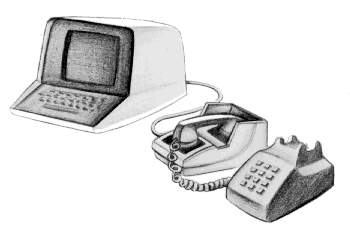
Back in My Day when people had POTS modems [0], I once downloaded the ~20 disks of the b'a'se and 'n'etwork slackware disk series in windows 95 and rebooted to install, hoping that none of the disks were bad.
It turned out that all of those disks were fine, so I continued downloading the other disks in the series by minicom'ing to my ISP's shell account, ftping them to the remote disk, and zmodem'ing them to my local disk. I played nethack on another virtual terminal while this was working.
Well, I switched back about 5 minutes later to check on the progress and it was just crawling, like 4KB every few seconds. I moved the mouse to hit the 'cancel' button on the zmodem transfer window, and the transfer rate shot up just then. I thought "well, okay..." and went back to nethack.
A few minutes later same thing happened. Move mouse, transfer speed goes up. I didn't understand IRQs at the time but I grasped apparent causality. I decided I'd try moving the modem to a different IRQ but that required a reboot. I wanted to finish the current disk set, so I sat there with a book in one hand, twirling the mouse in little circles with the other.
That's my hand-crank modem story.
To this day, whenever the network is slow, I twirl the mouse in little circles subconsciously.
I logged in to upvote this story because I encountered the same problem on a military communications system once (!) There was an interaction between the system beep() function and message processing throughput. If a large number of alerts ever queued up, communications slowed to a crawl as the CPU spent all its time going "beeeeeeep...beeeeeeep...beeeeeeep..." for a few minutes. Moving the mouse caused a rapid-fire "bebebebebebebebebebebeeep" as the buffers flushed and throughput returned to normal.
Even worse was illegal software. There were 720KB (Double Density) and 1440KB (High Density) 3.5" diskettes (amongst other sizes). The disk drive would detect the difference by an extra hole in the disk.
People would buy cheaper double density disks, drill a hole in it, so that the same diskette could be used as a 1440KB disk. Of course, they were of a far lower quality, and 'arj' (which was popular at the time) would often fail after the n-th disk.
I used an Xacto knife to create an extra notch in Commodore 64 5.25" disks back in the day so that I could take the single-sided disks and make them double-sided.
I would take one disk flipped over the other, mark the notch with a permanent marker, then cut out the outline. Most disks, like Elephant Memory, would work fine. You just flipped the disk over and inserted back into the 1541 to read the reverse side.
I did the same. And disks were a bit expensive to a kid like me, so I'd even do the cut on various game disks I had, since many of them were single side only, and it was like getting a free disk.
Haha, yeah, there was this thing that was advertised as a "disk doubler", and all it did was drill a hole through your 3.5 single density disk. In retrospect it was quite the ingenious scam.
I'm guessing that 3.5 disks were binned, so maybe you could get away with it once in awhile? Of course, the only way you could find out was to actually lose data...
Yea, pretty much. That's why you had backups of any important software (copying floppies was a really fun process). Once the disk died, you were screwed if you didn't have a backup copy of it.