These church-owned entities in Germany are almost 100% government fincanced [1], while abusing a loophole in the German constitution to discriminate their employees for religious reasons. For example, the Catholic ones are notorious for firing employees that get divorced. This system is an absolute disgrace, but the churches are still too powerful in German society and have so far been able to block any attempt at fixing the constitution.
It’s not uncommon in the U.S. either. Providence Health is a Catholic nonprofit that owns 51 hospitals, including several of the big ones in Seattle. It was a big deal when they bought Swedish and people were afraid they would stop offering abortions even in cases of medical necessity.
Parent edited their comment. It used to just say “In Germany.” as if to dismiss the comment for not being about the United States.
I was not intending to say that Catholic healthcare providers in the U.S. are notorious for firing employees who get divorced. In fact, Providence got caught in controversy for firing an employee who refused to provide contraceptives on personal religious grounds.
I am not fine with government funds being used to support "prayer" as a means to a more healthy end. In fact I think this arguably violates the 1st Amendment to the Constitution.
Germany’s constitution (the Basic Law) does protect freedom of opinion and expression, but it explicitly allows restrictions via “general laws” to protect personal honor, youth, and human dignity.
Recent enforcement shows how this plays out: police raids have targeted individuals posting “hate speech” or “extremist” content online. What constitutes hate speech or extremist content is “conveniently” interpreted at times.
The OP claimed that people's homes got raided for "daring to insult the ruling class", your source claims that people's homes got raided for posting extremist racist speech online. Unless you believe in some ridiculous conspiracy where ZE JEWS CONTROL ZE BANKS, this has absolutely no relation to your ability to insult the ruling class: Black people and Muslims are not "the ruling class".
And if you do believe in such a conspiracy, please post your personal information such that I can forward it to the relevant agencies and have your house raided. Because we have been through that shit in this country and have no desire to ever see it again.
Your comment has been debunked countless times. This man's home was not raided for his antisemitism (which is really damn bad!) but for calling a guy an idiot [1]. I suggest you stop spreading lies.
That's a different case though. The Habeck meme thing happened somewhere near Bamberg, the CBS article recounts "state police [...] raided this apartment in northwest Germany".
Look, I'm not saying that the police or the ministry of the interior never abuse their power, far from it. (There was also the Andy Grote case a few years back.) But please remember that the original claim we are discussing, from a few comments up in this chain, was that Germany has neither "Freiheit noch Sicherheit" right now. It's ridiculous rabble-rousing to insinuate that because of these outlier events, while concerning, Germany has neither freedom nor security.
Germany does have limited Freedom. I won't move an inch in this matter. The exact paragraph behind the Habeck or Grote case is now being abused by the literal thousands each year. And violent crime is on the rise, we are currently back at a 2005 level. It is very easy to find sources on this matter.
Your claim is blatantly false. Any claim of the contrary is wrong. I won't go as far as to insult you in the way you did. I was talking about violent crime, which is indeed on the rise [1] (here sourced by the far right "Tagesschau" \irony), you are linking a study on crime, which includes non-violent crime such as petty theft. Violent crime is at a level not seen for 15 years. I suggest you read the comments of people thoroughly before embarassingly accusing them of spreading propaganda - which can be disproven with a 5 second google search.
No place has absolute freedom, not sure what you are rambling about. Making up some extra categories that suit your own narrative doesn't change reality.
You are making typical argument shifting excuses. No one is talking about "absolute freedom" no matter how that is defined, notwithstanding even your infantile attempt at using insult in your absence of rational argument.
Please don't paint an - given wired and unjust - incident as the norm and not as am exception.
Extrapolation from one local incident to Germany is unfree is like extrapolation from one politically motivated murder, that a country is in a civil war...
Sure, I have painted the incident, let‘s paint the norm. Just two ministers of the last government have sued 1400 people using 188 StGB [1]. An FDP politician sues 250 people this way in a month alone. We have seen an increase of lawsuits using this paragraph of 215% in the last three years.
Propaganda is painting this as something different than it is.
Here we consider speech for what it is: something you can express freely, within the limits of civil society. If you pass those limits, then you incur in problems.
Germany let someone speak freely a tad too much in the twenties and thirties, and they don't want to make that mistake again.
I understand the point of "absolute free speech", and I would subscribe to it if it wasn't that groups like AfD, or Trump's flavor of conservatism, hide behind it to achieve their authoritarian goals. To avoid that authoritarian result, you have to police certain types of speech like Germany does.
I say it again, it's nasty and needs a very strong set of counterbalances, which Germany - unlike the US - still has. Therefore this remains a much more freer country than Say-whatever-you-like-on-Rogan America. Freedom for us is free healthcare, a welfare state, an ethics-based concept of societal rights and obligations.
We don't market ourselves as the beacon of free speech and FREEDOM by making both empty words fueled by extreme individualism. We still believe in Solidarität and on social-oriented policies, both on the right and left side of the isle. We have ferocious political battles about topics that are too violently policed, by the way, like right now about Palestine and Israel, and people take to the streets FREELY, despite some despicable police brutality episodes. We do have the contradictions and complexities of any modern western society.
Yet we don't have too many runaway billionaires that are more powerful than governments, and we are still ALL a bit better off because of that.
It's boring, but it works.
AfD is against all this, and it is because it's provenly funded by Russia and other enemies of the west. They appeal to the Volk, but in reality are infested by double-standards, hate, and a specific type of political individualism and authoritarian views that need to be stopped with all legal and societally-acceptable means possible.
It’s worth remembering who actually made the strategic choices that strengthened Russia’s hand and left Germany dependent and militarily weak. Those weren’t the AfD’s doing — they came from the CDU–SPD coalition governments, the same lineup that’s currently in power again.
• 2011: Under Angela Merkel (CDU) and the SPD coalition, Germany decided to abolish nuclear power after Fukushima, dismantling one of the few sources of domestic energy independence.
• 2011–2015: The same governments backed and defended Nord Stream and Nord Stream 2, tying Germany’s critical infrastructure even closer to Russian gas — despite repeated warnings from Eastern European neighbors.
• 2011: The abolition of compulsory military service further weakened Germany’s defense capacity and NATO readiness.
These weren’t minor policy missteps — they systematically made Germany more vulnerable to Russian influence.
And it’s also worth noting a historical irony: Angela Merkel’s family moved from West Germany to East Germany in 1954, one of the very few families to go in that direction. Between 1949 and 1961, roughly 2.7 to 3 million East Germans fled the communist East for the capitalist West — virtually nobody went the other way.
> Yet we don't have too many runaway billionaires that are more powerful than governments, and we are still ALL a bit better off because of that. It's boring, but it works.
A literal millionare is chancellor.
> reedom for us is free healthcare,
Last I looked I paid 10k a year for government mandated healthcare. Where can I apply for the free one?
I wonder what is the point of debating like this on the internet.
I say billionaires, you mention a "millionaire" chancellor.
We don't have anything against becoming rich. But if you think that Herr Merz, who I haven't voted for and politically dislike, is anything close to a tycoon, well I think we're swinging in two very different planes of reality.
He's a high-income lawyer who invested and has a net-worth of about 15 millions. If you think that's anything close to problematic, I don't know what to say. Maybe you should research the order-of-magnitude differences there are between a millionaire and a billionaire.
Re: free healthcare: if you have the means, and you work, you rightfully PAY INTO THE SYSTEM. If you can't and you are poor, it is free for you.
That is how a social-democratic society work.
The system is not perfect and could be better, but that is what "Free" healthcare is.
Also, we're so good at freedom that we do have private healthcare, so you could have payed into that system and gotten yourself your little indivisualim-tingling services.
You are arguing with a person who doesn't care what people say, facts are just other's propaganda against their emotionally held beliefs, the story is set in their head and thats it. Not a discussion really. Usual avoiding of hard facts that challenge their fantasies.
A fairly typical behavior I've seen countless times in topics about russian war in Ukraine in recent years. No point at all, a wasted time.
> facts are just other's propaganda against their emotionally held beliefs,
This is dishonest at best. It's a matter of opinion. I rarely - if ever - think of anyone who disagrees with me as spreading "propaganda". This is a dangerous narrative you have built in your head. I suggest you stop.
> But if you think that Herr Merz, who I haven't voted for and politically dislike, is anything close to a tycoon, well I think we're swinging in two very different planes of reality.
Of course I don't. I actually like his history, he is a successful man. But he is again so far removed from my own situation that I do not trust him to do what is best for me.
> If you think that's anything close to problematic, I don't know what to say. Maybe you should research the order-of-magnitude differences there are between a millionaire and a billionaire.
It is problematic. Yes, he studied and worked hard. But he has been wealthy for a larger part of his life than he has not been.
> e: free healthcare: if you have the means, and you work, you rightfully PAY INTO THE SYSTEM. If you can't and you are poor, it is free for you.
So it's not free.
> The system is not perfect and could be better, but that is what "Free" healthcare is.
I too, can redefine words beyond their meanings to fit my narrative.
> Also, we're so good at freedom that we do have private healthcare, so you could have payed into that system and gotten yourself your little indivisualim-tingling services.
You forget that people with chronic illnesses can just be declined of that option.
I’m far more concerned about a government led by people who have no formal education beyond high school, have never worked outside of politics, lack subject-matter expertise in the fields they oversee, and can’t even speak a foreign language — yet are sent abroad to represent the country — than I am about a self-made millionaire serving as chancellor.
Germany’s economy feels like a freight train rolling downhill — momentum without direction, and no one in the cabin who knows how to steer.
And no, the health care system is not “working.” It suffers from systemic distortion and ideological decision-making. Doctors face strict budget caps and fixed, low reimbursement rates for treating regular patients, but those limits don’t apply when treating certain publicly funded cases — where compensation is higher. That incentive structure inevitably leads to unequal treatment. I’ve experienced it firsthand with my own child and couldn’t believe it. As in: they denied taking my kid in but took in two “publicly funded cases” while I was there.
> Which then becomes a question of how much time/money to they invest in features for 1% of users? Now how much time do they invest in those same features when the 99% will stumble in there, turn a bunch of stuff off, then call support and ask why their weather widget isn't updating?
The features I was referring to would be a control panel to list all the various remote calls to let uses micromanage what calls they wanted and which ones they didn’t.
Inside of those settings could be options to enable/disable telemetry, sure. But also push notifications, weather updates, virus definition updates, etc.
That's how it should be if all was fair, I feel like what we have here is a "dark pattern" whereby keeping all the telemetries opaque ... enables one to keep around the nasty sort of telemetry the company very much wishes to remain opaque.
The article, then again, specifically talks also about telemetry.
The parent commenter conveniently chose to ignore them because of the Apple reality distortion field.
> fbs.smoot.apple.com - for crash reports, analytics, or user feedback.
Australia hat a similar situation. They cut that number down to basically zero when they publicly announced that no one entering Australia that way would ever be able to settle in Australia in any way.
> Yet to many Europeans the idea that free expression is under threat seems odd. Europeans can say almost anything they want, both in theory and in practice.
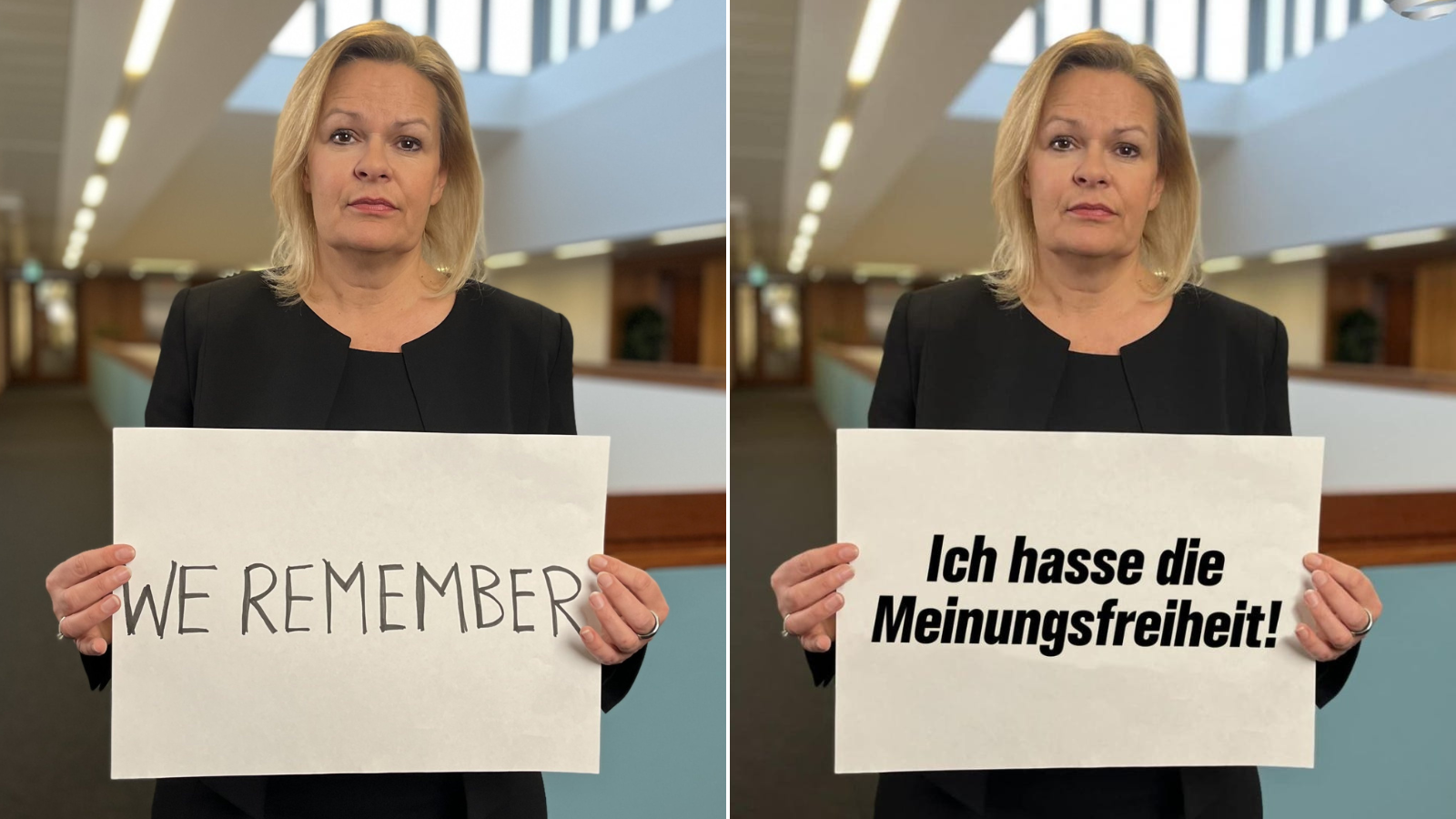
A journalist in Germany was just sentenced to seven months for posting a meme of a politician where she holds up a sign saying "I hate free speech".
Seven months for that seems insane to me. It looks far more like a meme/satire than an attempt to create a realistic fake, given it's just pure-black impact font and an implausible message ("I hate freedom of speech!") to be holding up on a sign.
You have to consider the target audience, they believe German culture gets erased because a discounter sells chocolate bunnies as sitting bunnies instead of Easter bunnies while the leaflet is full of Easter named articles and Milka sells its chocolate bunny under the name Schmunzelhase (Smiling bunny) for decades.
In these circles, false quotes have been repeated as true again and again for years.
A simple “satire” in the article would not have been enough, but it would have had the same effect.
> In these circles, false quotes have been repeated as true again and again for years.
Even if people did go on to repeat it as if it were a real quote (can't find evidence of this, from a quick search), I don't feel the fact that not everybody got the satire should turn it into defamation, so long as a reasonable person would recognize it as satire and the intent is humor opposed to deception. Should the fact that The Onion/Clickhole articles and quotes have often been circulated by people believing them to be real result in sentences for their editors?
> A simple “satire” in the article would not have been enough, but it would have had the same effect.
Confused by what you mean here. To my understanding Bendels posted the meme on X/Twitter, not in an article. By "would not have been enough" do you mean that even if it were explicitly labelled as satire, it would've still been defamation?
When there's a blank template of someone holding a sign, and people are adding on messages intended to be humorous/satirical (e.g: https://x.com/Wrdlbrmpfd_Wrdl/status/1618755937355063296) then spreading it on social media, that'd generally be called a meme.
> The photo is based on a real photo of her holding a paper with „we remember“ written on it.
I linked the original and edited version above, yeah.
To be pedantic, Bendels' edit appears to be based on a blank template used by other posts (e.g: https://pbs.twimg.com/media/FnrNpDzXgAEsmtI.jpg) and not directly on the original photo itself.
> Those satires have lead to insults and death threats in the past and people like him know that.
People sending death threats or calling for violence should be prosecuted. But I do not think it's reasonable to criminialize satire like this on the basis that it might "lead to insults" from other people.
Or at the very least, if you do hold that view, you should see why others would consider it an impediment on free speech.
As mentioned above, journalists with a wide reach should be held to different standards, similar to doctors who are anti-vaxxers, facing massive consequences and an immediate cancellation of their licenses. They are endangering people's lives.
Context matters a lot. It's different if we talk crap at home with our friends vs. broadcasting a message to 10M people.
It is, but see what the article has to say about that (translated with google translate):
> Among other things, they complain about the inappropriate severity of the justice system against an allegedly satirical statement. What is left unmentioned, however, is that the trial only took place because Bendels previously refused to pay a fine of 210 daily rates imposed by the same district court in November.
I know nothing about this person or this case, but it sounds like he has done this before and refused to pay a fine, so the court said "enough is enough" and sent him to prison.
It's hard to say without more context. Maybe that was not hist first fine, it just got to that amount after a few "satirical statements" and lower fines.
I have no idea, and I'd have to know more context before thinking my opinion matters. For example, just off the top of my head: (1) What are the fines for comparable things in other countries (in an out of Europe)? (2) "Bendels has no criminal record" -- does that mean he was never convicted of defamation, or is that a red herring because defamation a civil (not criminal) matter?
I can't help to notice how with just a little bit of context we've come from reacting to "A journalist in Germany was just sentenced to seven months for posting a meme" to deciding if a fine was disproportionate.
With all that, the only sensible answer I can give is that I don't know. It's useless to be outraged by something that might be a non-story.
> I have no idea, and I'd have to know more context before thinking my opinion matters. For example, just off the top of my head: (1) What are the fines for comparable things in other countries (in an out of Europe)?
Even in Germany, I don't believe a meme like this one would typically incur any fine.
> (2) "Bendels has no criminal record" -- does that mean he was never convicted of defamation, or is that a red herring because defamation a civil (not criminal) matter?
My understanding is that he has now been convicted of criminal defamation (so it should probably be past tense), but had no such prior convictions.
> I can't help to notice how with just a little bit of context we've come from reacting to "A journalist in Germany was just sentenced to seven months for posting a meme" to deciding if a fine was disproportionate.
I don't personally believe there should have been any fine or prison sentence for posting the meme. I ask you whether you think the fine seems disproportionate based on current information because I see that as the smallest and most likely concession for you to make, assuming you can be intellectually honest, not because the fine being disproportionate is the full extent of my stance.
> With all that, the only sensible answer I can give is that I don't know. It's useless to be outraged by something that might be a non-story.
We've got the original post, the court's sentence and reasoning, and most other information you want to know could be researched online. There has to be some point at which we start publicly discussing an issue - that doesn't prohibit us from updating our views if there really is some decisive new evidence.
> I see that as the smallest and most likely concession for you to make, assuming you can be intellectually honest, not because the fine being disproportionate is the full extent of my stance.
That would make sense for someone with all the relevant context about this story. While I agree with you that "most other information [I] want to know could be researched online", that would take a lot of time (I can't read German) and energy which would be best spent learning about way more important stuff happening in the world right now.
I've often seen people criticize scientists for not engaging with crackpots, with the argument if what they're saying is really dumb it should be easy to show that. I see that as naive -- there's only so much time in the day, you can't disprove every crackpot, so pick your battles.
This case feels like the same thing -- it started with someone claiming that a journalist was jailed for sharing a meme, then I learned this is a complete distortion. So I assume I'm dealing with a crackpot (not you, but the person who made the original claim), and so I refuse to spend more energy on this.
And if I'm being honest, I'm only writing this reply because it doesn't feel good to read "assuming you can be intellectually honest" while engaging in what I assumed was a cordial exchange, so I can't help but defend myself -- which I think I'll stop now and just let go.
> That would make sense for someone with all the relevant context about this story.
Earlier, for instance, you said "it sounds like he has done this before and refused to pay a fine". Could you not similarly say whether, based on the information we have now, it sounds to you as if the fine is reasonable?
My understanding of the context is that:
1. Nancy Faeser was photographed holding a sign saying "WE REMEMBER"
2. That picture was turned into a blank meme template to fill with text intended to be satirical/humorous (e.g: https://pbs.twimg.com/media/FnrNpDzXgAEsmtI.jpg - not actually humorous, but intended to be by its author)
3. Among those posting memes was David Bendels, who put "I hate freedom of speech!" (in black impact-font text) on the sign and posted it on X/Twitter
4. "Faeser was reportedly alerted to the post by the police, and subsequently filed a criminal complaint"
5. Bendels, who "has no prior criminal convictions", was initially ordered by the court to pay his daily income times 210
6. Bendels "filed an objection against the penalty, which automatically led to a trial"
7. The court considered the Bendels "made a deliberately false factual statement", and Bendels subsequently recieved a seven-month suspended prison sentence (plus a €1500 fine, and must "apologise in writing to Faeser")
> This case feels like the same thing -- it started with someone claiming that a journalist was jailed for sharing a meme, then I learned this is a complete distortion.
The original claim in this chain was:
> > A journalist in Germany was just sentenced to seven months for posting a meme of a politician where she holds up a sign saying "I hate free speech".
Which still seems true to me. I don't think anyone here is a crackpot.
> And if I'm being honest, I'm only writing this reply because it doesn't feel good to read "assuming you can be intellectually honest" while engaging in what I assumed was a cordial exchange, so I can't help but defend myself -- which I think I'll stop now and just let go.
Sorry - that probably came across as more accusatory than I intended. Meant to be read more as reasoning for my belief that you could admit it seems disproportionate based on current information, as opposed to an accusation that you haven't been intellectually honest thus far.
The "suspended prison sentence" part is important context too and significantly changes the effect of the sentence. I'm not sure how it works in germany, but in the U.S. it basically means "if you screw up again you're going to have to serve this sentence so be on your best behavior".
I think the discussion originates from the fact that if you compare today's Europe to the USA of 20 yrs ago, today's Europe has less free speech.
Things is though, the same would apply to today's Europe vs Europe of 20 yrs ago - and the same if you compared Europe of 20 yrs (more) vs USA of today (less).
Both Europe and USA has lost a lot of their free speech privileges, both via social norms and actual regulations/application of law.
Now, wherever Europe or USA currently comes out on top os - in my person opinion besides the point: its bad either way.
That decision might be overturned later, I'd also consider it very questionable. It's in a weird space as it was about libel, but based on edited text in a photo like often used for memes. I think that decision is wrong based on what I know about it, it should be clear enough that this is not a direct quote.
Not defending this specific decision, but you can find individual cases like this in the US as well. Overall the laws in Germany are somewhat more restrictive in certain areas, but I don't think that fundamentally affects free speech.
But it's not, words have meaning. Why did Trump say France should "FREE Marine Lepen" ? She isn't in prison, he probably read "sentenced to XX years" and assumed she was.
> And a court saying it’s defamation doesn’t make it a good law. It’s anti free speech.
Would it be free speech if I convinced 10 teenagers to go on record and say that you sexually abused them? Or would you say it should be illegal for me (and them) to do that?
The differences in the two examples would be the damage caused by the speech. Additionally, sexual assault is a crime while hating free speech is not. Are you organizing this conspiracy with an intent to hurt me? Are you making false police reports? Do you believe the accusations yourself?
The definition of defamation is that it causes damage.
> Additionally, sexual assault is a crime while hating free speech is not.
Completely missing the point: nobody committed a sexual assault here.
> Are you organizing this conspiracy with an intent to hurt me? Are you making false police reports? Do you believe the accusations yourself?
What kind of questions are those. "I didn't intent to hurt them, and I believed they were consenting" make it okay to have sexual intercourse with a non-consenting person in your book?
The question is more something like: did it hurt the person and was it meant to look like it was true? It's free speech to make fun of Elon Musk because he made nazi salutes. It's not free speech to make fake, realistic video of Trump making nazi salutes and pretend it is real.
Yes I suppose the question is 1) did it rise to the illegal level of harm (I would say no in the example of the meme) and 2) was it intended to believed (I would also say no here). These would vary country to country here based on precedence and culture.
Defamation is still not a criminal statute in the US - it’s a civil statute. The other things I mentioned are actual crimes that the US government can imprison you for - I actually don’t think your example of the fake video is a jailable offense in the USA without some sort of conspiracy attached to it.
> I actually don’t think your example of the fake video is a jailable offense in the USA
And I don't say that the US are wrong: that's how it is in the US. Now that's not how it is in Germany, and maybe it doesn't mean that Germany is wrong?
And Germany has taken its stance on Gaza to extreme levels, where publicly defending Palestine's right to exist can cause you to lose your visa. So yeah, things could be better in the free speech area.
> And Germany has taken its stance on Gaza to extreme levels, where publicly defending Palestine's right to exist can cause you to lose your visa
In practice, even on this website, I have great difficulty figuring out how to phrase anything I want to say on Palestine and Israel in a way that's not likely to induce vitriol.
Hmm, I've just noticed something: you say "Germany", but some of the news I've been seeing from the USA is people losing their visas by supporting Palestine…
> Hmm, I've just noticed something: you say "Germany", but some of the news I've been seeing from the USA is people losing their visas by supporting Palestine…
There was a similar case (though actually had a judge and a court process involved) in Germany recently.
This is going to be the whataboutery Olympics, isn't it.
That particular case seems egregious, especially the jail part (edit: oh, it's a suspended sentence, so zero jail time). On the other hand a world where news organizations can just photoshop any sign onto any politician and claim they support whatever doesn't seem great either.
But neither does using ICE to snatch people off the streets for making social media posts. (Someone will reply to this with some variant of "oh, but they're immigrants, they don't deserve the freedom to criticize the US", and then we're back at the whataboutery Olympics)
Perhaps it's only worth getting worked up about free speech when the speech is true, authentic and accurate?
(epilogue: this whole topic was at the top of HN for about a minute before it got flagged off, lol)
That last paragraph is nicely stated. I’m going to borrow it.
All societies regulate speech. There is no such thing as free speech in the literal/absolute sense of the word. Probably every society has an instance that someone can point to as stifling speech. Your phrasing succinctly gets to the crux of the matter.
Who decides what speech is “true, authentic and accurate”?
In the US, the restrictions are left to things like yelling fire in a crowded theatre. Because that is harmful to society.
The focus should be on the real damage of the speech - not the “authenticity”. Also we should not restrict people from expressing their opinions regardless of whether or not they are authentic.
These ideas are meant to prevent a tyrannical government from jailing individuals because it doesn’t like its speech.
Who decides what speech is “true, authentic and accurate”?
As with all laws and regulations interpretations are handled by the judiciary.
I like the phrasing OP makes because it grounds the discussion of free speech in a more reasonable fashion rather than nitpicking about some extreme situation.
The meaning of “true, authentic, and accurate” is easier to twist than “harm to society” - suddenly proclaiming trans people exist is a crime because it is not “true”
As stated I like the phrasing OP used. You are free to use another phrasing. What I’m not going to do is get into a debate on how to precisely define the terms used. One can nitpick any phrasing of any law/regulation. That’s why there are lawyers in every society. But I’m not engaged in a legal discussion at this time. If you don’t like OP’s wording then don’t use it.
I’m arguing the principles of “is this speech virtuous” as a prerequisite vs “is this speech harmful” as a disqualifier - not the exact definition. Whatever virtue test you use for the speech, it can be more easily abused than a harmfulness test.
Why are you making such an argument? This is a rhetorical question I don’t actually care what the answer is. It’s fascinating you feel the need to chime in about this when all I did is like someone’s way of stating things. No one cares about the pedantic nitpicking you are engaged with. Well, no one should care.
Eh, "obviously badly manipulated image posted on twitter" would be a good indicator of satire, if obviously untrue drivel posted on Twitter hadn't just taken over the world.
> "Crap! Robin Hood airport is closed. You've got a week and a bit to get your shit together otherwise I'm blowing the airport sky high!!" (for the benefit of my MI5 handler, that is a quotation not a threat)
> The court concluded that Bendels had altered the lettering and deliberately created the impression that the Interior Minister had made a corresponding statement on freedom of expression.
> [...]
> What is left unmentioned, however, is that the trial only took place because Bendels previously refused to pay a fine of 210 daily rates imposed by the same district court in November.
So I don't see "sentenced to seven months for posting a meme of a politician where she holds up a sign saying 'I hate free speech'".
What I see is "mislead people into thinking the politician said something she did not, and then refused to pay the fine imposed by the court".
I for one am pretty happy every law that curbs racism. It has worked great so far. The people that play victim are just cosplaying and looking for attention.
Do they really hate Palestinians because of their race? Jews and Palestinians are mostly the same race, their difference is religious and cultural. it's important not to dilute words.
German politicians are known for lodging countless complaints for the slightest insults online. [0]
The 60 minutes segment was also quite revealing of the (in my opinion, poor) state of free speech in Germany. [1]
As Bill Maher said, "Germany is so afraid to look like their Nazi past, that they're knocking on people's doors, taking people's phones and computers if you insult people online."
It's a defamation case. Journalist David Bendels posted a doctored picture of politician Nancy Faeser holding up a sign saying, "Ich hasse die Meinungsfreiheit" ("I hate freedom of speech"). Faeser filed criminal charges against Bendels for "üble Nachrede und Verleumdung" (defamation).
Bendels was sentenced to a 7 months suspended sentence and a fine of 1500 Euros, has to remove the image and apologize to Faeser. Bendels will appeal the decision.
I'm going to guess that this will be overturned on appeal. Every country has stupid courts that make bad decisions. I think this is kind of an edge case between satire and defamation, since Bendels is ostensibly a real journalist who reports on real facts—it seems odd to me that he would publish doctored pictures. Still, I think this will lean towards satire in the end, since I don't think most reasonable people would assume the picture of Faeser was real.
Having to clarify satire ruins its point. In a case against a man who creatd a fake Facebook page of his police department and was subsequently raided, the Onion submitted this amicus brief: https://www.supremecourt.gov/DocketPDF/22/22-293/242292/2022...
It's really quite interesting to read at some point, but I believe that nobody should have to "clarify it was doctored". Because that image was also very obviously fake - it's literally a meme template, and nobody should be prosecuted for that. I do have to question your judgement if you believe that is real.
I honestly don't really understand how it is not obvious, so I question if those decisions are made in bad faith. It's literally a meme template, and that's somehow not obvious?
I'm not speaking from a legal standpoint, I'm speaking from a common sense moral one. We cannot cater to the most mentally challenged in society to make sure they cannot harm themselves.
Satire is entirely ruined once you put a /s behind it. Let me quote the Onion here -
The court’s decision suggests
that parodists are in the clear only if they pop the bal-
loon in advance by warning their audience that their
parody is not true. But some forms of comedy don’t
work unless the comedian is able to tell the joke with
a straight face. Parody is the quintessential example.
Parodists intentionally inhabit the rhetorical form of
their target in order to exaggerate or implode it—and
by doing so demonstrate the target’s illogic or absurd-
ity.
Put simply, for parody to work, it has to plausibly
mimic the original.
The Online Safety Act in the UK has been discussed here before and it is part of a general trend to prevent "harmful" speech including specifically "legal but harmful speech".
After the man posted the image, Robert Habeck (the politician in question) made a criminal complaint. When the Criminal Police investigated the case, they found additional evidence against the man, which prompted the search. His house was not searched for calling Habeck an idiot, but calling him an idiot triggered the investigation, which triggered the search.
>The politician in question has filed more than 700 criminal complaints about what people have said about him
I'm not sure why that matters in the context of this discussion. He is free to file as many criminal complaints as he wants, no? Living in a free society means that idiots can do idiotic things like filing 700 criminal complaints.
>The problem is that merely insulting someone can be a crime at all
I disagree that this is a problem per se. Pretty much all jurisdictions across the world have laws like that. It really depends on how exactly the law is implemented.
In fact, American libel and defamation laws are, in some ways, more problematic than many European ones simply because of how the legal system works. If you are sued in a place with no SLAPP laws, the mere lawsuit can be so expensive that it can have a chilling effect on free speech, even if the defendant ultimately wins the case.
(I do agree that laws singling out politicians are stupid.)
If bad economy leads to better social welfare programs than we need more "bad economy". It seems to be good for the people. It is strange that sometimes it is forgotten that economic growth as an indicator only makes sense if at the same time it improves life of the people. Economic growth can also be decoupled from people wellbeing, which happens easily if one doesn't fight against inequality and monopolies in capitalistic societies.
No, it's not good for most people. It's only good for those who rely on welfare programs. It's not sustainable as the money has to come from somewhere. The government has never before seen tax revenue but they still cannot pay the bills and they constantly come up with new ideas to take more money from people.
Let me give you an example. Regular workers in Germany pay for health insurance - people on welfare don't. It's paid for by the government. The government raised welfare payments and promised the insurance companies that they'd cover the costs of insurance for those on welfare. The government then said "Well, we'll pay amount x" but amount x is not enough. The insurance companies now need money so they've raised the rates for every working person to make up for this.
Other people living on welfare is good for you, too. Because if they don’t get welfare, they might turn to crime, drugs and violence to survive. And of course you are overlooking that it can happen to you, that you get sick, workless and poor. The social safety net is there for you, too.
And regarding German healthcare: The rich also don’t pay for public health insurance in Germany. And even if they do their amount is lower compared to their income, see https://de.wikipedia.org/wiki/Beitragsbemessungsgrenze
If the insurance companies need money they should and could take it from the rich. And this would be fair and good for everyone.



https://en.wikipedia.org/wiki/Malteser_Hilfsdienst_e.V.
reply