I feel like this is very much a personal preference thing.
They even called out Horizon Zero Dawn for looking very bad, and Zelda for looking very good.. while in my opinion the exact opposite is true.
I do see the point of the author: HZD goes for a "realistic", high-fidelity 3D fantasy world, yet the lighting makes no sense in physical terms. The contrast and brightness shown in the picture are all over the place, and can only be an artifact of visualising a world through a computer screen which has a very limited dynamic range - it is immersion-breaking. The Resident Evil 7 picture below looks much better. The video I linked in another comment explains why: in the physical world, the stronger the light, the more washed-out the colour will become. HZD is a saturated, high-contrast mess with too much compression in the low light, because of a bad colour mapper in their pipeline.
One can claim HZD's look is an "artistic choice" and that's inarguable, but the author believes it's simply not enough attention to the tone mapping process, which is a very complicated topic that's not usually taken seriously in game dev compared to film production.
To be fair - if I remember the location correctly - that screenshot is somewhat misleading because it's camera position is from the inside of a large ruin, with the ceiling and right wall of the "cave entrance" being just outside the frame.
No, the author posits that Zelda explicitly goes for artistry and ignores any pretense of realism (that then falls flat on it's face when using an over-contrasting tone-map like in the HZD screenshot).
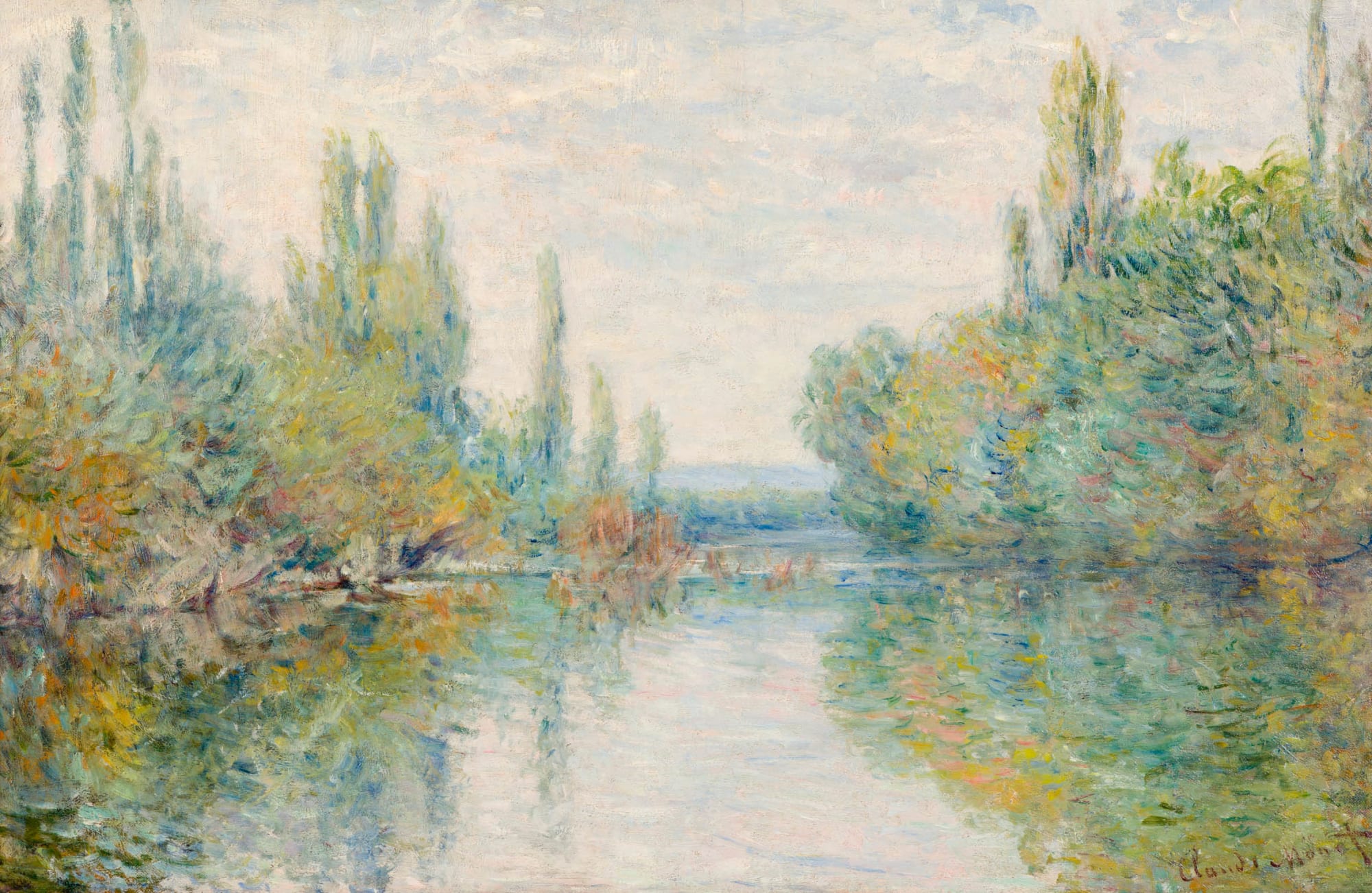
The problem I personally have with the Zelda example given is that it looks really bland to me - the landscape looks really washed out - the author says "Somebody would paint this. It’s artistic.", but I don't think anyone would paint with such bleached-out colours.
In the painting there's a delicate interrelation between colours - you have browns/greens/blues in the dark parts, and more whites/yellows/blues/pinks in the light parts. I wouldn't describe it as bland, though it is in a sense washed-out. BotW doesn't, and probably can't have that level of handling of shades colour in the enviroment graphics if nothign else because of the technical constraints of the Switch hardware.
Looking at the screenshot, what can you say - you can say that it's nice that the green/yellow of the sky is mirrored in the green landcape with yellow rivers. And the back-lighting of the sun is helping give definition to some of the mountains/hills, which is nice. But I don't see very much subtle going on with the landscape.
Looking at the art, you can see a lot more dynamic range, clearer silhouetting of mountain ranges at various distances, whereas the actual game is more monotone-green. You can also see the fog doing a lot more work of making the shape of the land clear. There are some bits of fog/mist in the screenshot as well, but they're not doing as much heavy lifting in terms of giving shape to the landscape.
The Switch is really limited on the hardware front, and I can't imagine what kind of trade-offs the art team had to make to get to where they are - it's a very difficult balancing act that I only understand a small part of. Nintendo also tend to be very conservative/restrained in their 3d style (I remember being somewhat unnerved by Ubisoft's "Mario + Rabbids Kingdom Battle" Mario game, because it went super high-production-quality).
It feels a bit cheap to give as an example, but the 3D MMO Love by eskil steenberg tried to emulate the impressionist style, and did a striking job:
https://imgur.com/9U18eRZ
The bloom effect is doing a lot of heavy lifting to make the bright colours pop, but even in the less glowy areas there is quite subtle layering of colours going on and one does have the feeling that the colours are playing with eachother.
( https://www.youtube.com/watch?v=Cc02ijaw-Tg a video of it in action, if you are curious ).
As another comparison, looking at elden ring you can see they've gotten 'using fog to make landscape silhouettes pop' down to a fine-art (maybe they're even over-reliant on it)
https://imgur.com/a/5GEePwL
And looking at the landscape you have really nice looking brown/oranges in the fields in the foreground, black/greys/browns in the mid-ground, rocky cliffs, fog is actually glowing, and you have some green forests in the top-left. That's a lot of nuance for what's essentially a brown landscape. BoTW doesn't have that - would it have it if the team had the hardware capabilities and time and budget? Who knows...
Oh, I see. I disagree that the original HZD had a pretense of realism though. The remastered version does and well illustrates the uncanny-ness https://www.youtube.com/watch?v=IlWK_ELBW08 . The outrageous god rays, bloom and lens flare in the remaster compensate for that because you can't actually see anything due to them blinding you...
I think with enough exposure to the overdone contrast ratios, you start to get tired of it. It sacrifices a lot of clarity.
I agree it does look good in some cases, for example I enjoy the look of Battlefield 1 a lot, but when playing it I often noticed I had issues seeing detail in darker areas.
The question is: is AI breaking the system, or was it always broken and does AI merely show what is broken about it?
I'm not a scientist/researcher myself, but from what I hear from friends who are, the whole "industry" (which is really what it is) is riddled with corruption, politics, broken systems and lack of actual scientific interest.
It really depends on the use-case. I currently work in the video streaming industry, and my team has been building production-quality code for 2 years now. Here are some things that are going really well:
* Determine what is happening in a scene/video
* Translating subtitles to very specific local slang
* Summarizing scripts
* Estimating how well a new show will do with a given audience
* Filling gaps in the metadata provided by publishers, such as genres, topics, themes
* Finding the most "viral" or "interesting" moments in a video (combo of LLM and "traditional" ML)
There's much more, but I think the general trend here is not "chatbots" or "fixing code", it's automating stuff that we used armies of people to do. And as we progress, we find that we can do better than humans at a fraction of the cost.
I know this is just a casual comment, but this is a genuine concern I have every day. However, I've been working for 10 years now and working in music/video streaming has been the most "societal value" I've had thus far.
I've worked at Apple, in finance, in consumer goods.. everywhere is just terrible. Music/Video streaming has been the closest thing I could find to actually being valuable, or at least not making the world worse.
I'd love to work at an NGO or something, but I'm honestly not that eager to lose 70% of my salary to do so. And I can't work in pure research because I don't have a PhD.
What industry do you work in, if you don't mind me asking?
It's not a casual comment in the sense that I have genuine concern every day that the current world we are living in is enabled by common employees. I'm not saying everyone should solve world hunger, "NGO or bust" - and yes, the job market is tough - but especially for software engineers, there are literally hundreds of thousands of companies requiring software work and who do net good or at least "plausible" harm, and pay an above average salary.
Also I only read the comment above, it's you who can judge what you contribute to and what you find fair. I just wish there were a mandatory "code of conduct" for engineers. The way AI is reshaping the field, I could imagine this becoming more like a medical/law field where this would be possible.
I work in IoT telemetrics. The company is rumored to partake in military contracts at a future point, that would be my exit then.
I work in R&D, and although I haven't signed an NDA, I think it's best if I don't elaborate too much. But basically we have a large dataset of shows and movies for which we already know how well they did with specific audiences, but we didn't know why exactly. So we use LLMs to reverse-engineer a large amount of metadata about these shows, and then use traditional ML to train a model that learns which feature appeal to which audiences.
Most stuff is obvious: nobody needs to tell you what segment of society is drawn to soap operas or action movies, for example. But there's plenty of room for nuance in some areas.
This doesn't guarantee that it actually becomes a succesful movie or show, though. That's a different project and frankly, a lot harder. Things like which actors, which writers, which directors, which studio are involved, and how much budget the show has.. it feels more like Moneyball but with more intangible variables.
For me it depends on open tabs: with modern firefox 4 digit number of open tabs on a 64GB machine is no problem. Chromium crawls to a halt at low 3 digits.
I've been satisfied with Firefox speed for several years, ever since Chrome manifest version 3 crap started to become reality.
I keep many browsers on my laptop and use whichever one I must for in-compatibility reasons and primarily Firefox which makes me generally a happy camper. Mac os.
I don't understand what you feel is "protectionist" about this? I would say that the US pressuring the EU on behalf of big corporations is arguably "protectionist", but I don't think that's what you mean.
But even if policies make companies less "capable" and less "competitive": that completely ignores what effect they have on society. I bet that a company that was given a free pass to use slavery would be very capable and very competitive -- but is that what we want for our society?
The only "feel" is pretending that these rules don't have a protectionist outcome. It's -widely- observed by economists, and even the EU's own statements include language that infers protection of local industry.
The EU rules also require a fair deal of transparency about these matters, so sticking one's fingers in their ears is not an option. Here for example you can view Spotify's very active schedule with the EU parliament:
https://www.lobbyfacts.eu/datacard/spotify?rid=365747616583-... (which includes various click-throughs to the official EU publishings.) That's an outsized representation for a business of their revenue and service model. It's on par with significantly larger businesses such as pharmaceutical companies and banks.
In matters concerning the app store, the EU met with Spotify not less than 65 times, prior to fining Apple for app store practices. In that same window of time Spotify has increased their prices when competitors did not, all while introducing no features (not even those which were promised), while all major competitors introduced a steady stream of innovation and near-unanimously froze prices.
With this you are directly observing the aforementioned symptoms of protected businesses: prices go up and the product doesn't improve. Meanwhile competitors not receiving those benefits are offering a more competitive product.
That quote doesn’t apply at all. Verbose writing doesn’t immediately indicate a lack of skill, otherwise every fiction book would’ve been reduced to a pamphlet of a summary.
If you are writing to explain, being concise is a useful asset. If you are writing to entertain, or for pleasure, verbosity and flair can be better.
I don’t get the feeling the author is trying to convince anyone of doing anything. They are sharing their experience, probably writing for themselves above everyone else. They should do it however they prefer.
I was replying specifically to the statement that writing verbosely is a form of "skilled writing", which I don't agree with. Simply being verbose does not make your writing any better.
It's really a choice: do you want to waste compute or do you want to waste potential?
While prioritizing higher scorers for selecting progenitors will initially mitigate some of the problems, you will eventually end up with hundreds of thousands of agents that only learned to repeat the letter "a" a million times in a row, which is a huge waste of processing.
I'm not sure if it's ridiculous if you factor in something like copilot. Heck, even just your IDE's built-in autocomplete (which only finishes the current variable name) can get close to being responsible for 20% of your code, with tools like copilot I think you can even more easily hit that target.
Me laughing as a human non-frontend dev having to do anything related to CSS
The number of times that my manager or coworkers have rejected proposals for technical solutions because I can't make a webpage look halfway decent is too damn high.
The one thing "AI" actually does well enough for me is writing CSS. It's actually the only thing I trust it with, because there is very little consequence to trusting the output when it writes CSS.
I have a designer on my team that adds their polish to the basic HTML and CSS I produce, but first I have to produce it. I really don't care what the front-end ends up looking like, that's for someone else to worry about. So I let the "AI" write the CSS for buttons and other UI elements, which it is good enough at to save me time. Then I hand it off to the designer and they finish the product, make the buttons match the rest of the buttons, fix the padding, whatever. It certainly has accelerated that part of my workflow, and it produces way better looking front-end UI styling than I would care to spend my time on. If I didn't have the designer, the AI-generated CSS would be good enough for most people. But, I wouldn't trust the AI to tell me if a page "looks weird". I have no doubt it would become a nuisance of false-positives, or just not reporting problems that actually exist.