Why not just … sell the gold? What good is gold to a society anyway, regardless of where it is placed?
Instead of drawing the anger of the US, just .. slowly over time, sell all the gold off, and move the money back. And use it to build infrastructure or something. Much better than gold.
> The president who is willing to fix this will have to bend the knee.
A similar instance of this is happening currently in the talks between EU/UK — The EU is demanding a „Farage“ clause. They want a guarantee that the damages are paid for in case Farage becomes prime minister and will roll back all treaties and trade deals and what not.
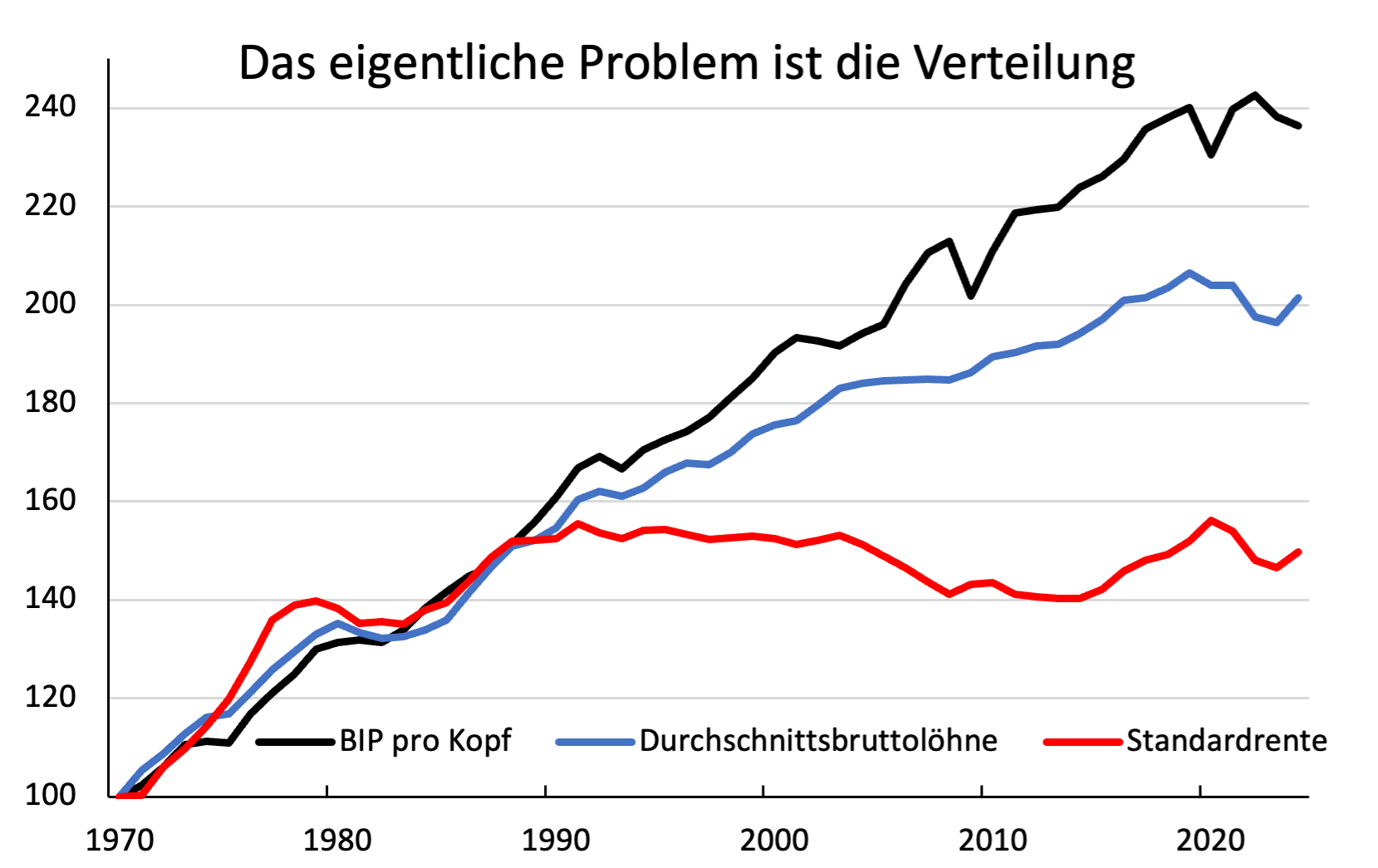
This apparent conundrum breaks away if you consider who holds the wealth now vs. in the 60s. In the 60s-70s, there was a wealth tax in Germany. Shortly after WW2, a law was drafted to redistribute wealth: All individuals and companies whose assets remained largely intact were required to pay 50% of their net wealth (as assessed on the day of the 1948 currency reform).
This means that the working class had immense wealth and so simple jobs could support a family on a single income, buy a house, etc.
Compare that to today — the two richest families in Germany hold more wealth than the bottom 50% COMBINED.
It is no wonder that normal families cannot afford to buy property anymore; and are forced to rent. This further exacerbates the wealth gap.
(Black line - GDP, blue line - avg comp; red line - avg pension)
In short - the productivity increased; but ordinary people are being squeezed out of the gains regardless. No wonder that everyone turns sour at some point.
1) the 50% net wealth tax vis-a-vis 1948 currency reform?
2) which 2 richest families in Germany hold more wealth than the bottom 50% combined?
3) most wealth distribution plots I have seen show a significant negative start (people in debt) then a large number of people with effectively 0 net wealth (what is earned is spent) and then a rise towards the haves. From such plots for different nations I am not surprised that the lower 2 digit percentages effectively have net 0 (with those in debt balancing those having a mediocre surplus), so it would seem trivial for this factoid to be true in many nations (with a slight change of the 50% number or a slight change of the exact number of richest families)
The perspective you give is certainly remarkable in the sense that the Nazi rise was basically a counterreaction to the rising popularity of communist ideas, with the end result... a redistribution of wealth after all, not even a holocaust could stop the wealth redistribution.
3) theoretically people could own via the state: if the state has resources (eg. hospital buildings, schools) that benefits all people ~uniformly. However, due to privatization more and more government wealth is also sold off.
Wealth redistribution is the only way the living standards of ordinary families will improve. I’m just hoping we can skip the war part, this time. I think its possible.
No. Mass building (while not touching inequality) will NOT solve the issue.
It’s easy to see why: there already IS enough housing around for everybody. If there wasn’t, you would see a massive amount of homeless people. And even in the US where that might be the case - the amount of empty real estate is larger than the amount of homeless people. You could easily house them if you wanted. It’s a question of distribution.
The other reason to see why this doesn’t work is: there is no country that managed to do it. Miraculously, the housing crisis has hit all (western) countries on the planet. All of them try to build their way out of it, no one succeeds. Why?
If you just mass build, the new units will be bought immediately by the rich, and the working people will have no housing still.
> It’s easy to see why: there already IS enough housing around for everybody.
Maybe in Detroit this statement is true, or a ghost town in the middle of nowhere. The fact that housing costs money mostly anywhere else is trivially evidence that there isn't enough of it to go around.
> Miraculously, the housing crisis has hit all (western) countries on the planet. All of them try to build their way out of it, no one succeeds. Why?
Very few western countries are trying to "build their way out" in a meaningful sense. Folks aren't buying that housing en masse for no reason; they just expect it to become even scarcer and more expensive in the future. If you fail to build any more, that becomes a self-fulfilling prophecy.
Most western countries have not tried. They prefer a capitalist let-the-market-decide approach, and also have tended not to cut down the mountains of red tape they've associated with building.
The handful of countries that have really tried, have succeeded. Jordan and Finland are the two I'm aware of.
Yep, people in this thread are claiming that this doesn’t work.
In fact, it does work, and it is already implemented! Here in Germany we also have the concept of „Bürgerräte“, and we have similar problems as in France (no political power to implement their solutions).
However, one takeaway was that people vastly underestimated how carefully the participants would try to understand the topic at hand. People that would usually just regurgitate angry propaganda were forced to form their own opinion and they did!
IMHO it’s this is a great tool for democracy that is yet underused.
But how useful is it as a tool if nothing is implemented in the end ?
What's worst is that, at least in France, there was an elegant solution to the problem : just ask the general population to approve or reject the proposals in a referendum. Even if the referendum was consultative, and even if the lawmakers were to make the law in the end, it would have massively made it harder to ignore the result.
And I would have loved to see the "popular jury" campaign for or against the measures.
Very well put. I am working on tooling that will likely increase developer productivity by a large factor; and will most likely be used to lay off more developers as their labor is no longer required.
I often ask myself whether that is ethical or not. But in the end, it’s not the tooling that’s unethical. Productivity increases are good for everyone, under normal circumstances.
It’s the fact that all the gains are being collected by the already uber-wealthy that’s wrong.
> I often ask myself whether that is ethical or not. But in the end, it’s not the tooling that’s unethical. Productivity increases are good for everyone, under normal circumstances.
So if I'm reading your comment right, you think it would be ethical under normal circumstances, but also believe we don't live under those normal circumstances? In that case i think the answer you're looking for is: it is not ethical to develop these tools under the current circumstances.
The problem isn't the benefits per se, it's that the downsides are shouldered by everyone else while the benefits accrue to 0.1%. At which point it's just stealing from the commons.
Im seeing the same in Germany. Here’s an incomplete list of all books that I read as mandatory high school assignments, which I can recall from memory.
* Die Vorstadtkrokodile
* Faust I
* Die verlorene Ehre der Katharina Blum
* Antigone
* Die Verwandlung
* Bahnwärter Thiel
* Der Sandmann
* Die Räuber
* Hamlet
* Der Besuch der alten Dame
* Im Westen nichts Neues
* Unterm Rad
* Woyzeck
Im probably missing 5 books or something like that. Many of these books have had a profound impact on my views on the world, more than I would have guessed at the time.
I graduated high school less than a decade ago and I had to read about 90% of those books. And those are just the German ones, there were at least half as many English and French ones too. I have younger cousins who are in the school system now and I am fairly certain that it is still the same. Actually I think it is probably mandated by the curriculum.
There's still plenty of mandatory reading. It's not unusual for high schoolers to have to read at least two books per semester.
Here's the problem though: It's just too easy to... you know... not do it. Teachers have no way of reliably telling the difference between those students who complete their reading assignments honestly and those who make due with summaries and AI assistance. Don't ask me how I know ;-)
I will only do things from memory, you can use Google yourself.
* Die Vorstadtkrokodile
"The suburb crocodiles", which is also how the youth gang in the book is called. Boy wants to be part of the gang, which has idiotic tests of courage. Plot twist is that the guy who refused to do this idiotic tests ends up being the tough guy. I don't remember if this was the main character or not. Ends up saving some other boy in a wheelchair, I think while they play in a collapsing old industrial building.
* Faust I
Maybe the most famous German book from v.Goethe. https://en.wikipedia.org/wiki/Faust,_Part_One Old professor Faust makes a deal with the devil that he can take his soul, if he is able to provide him with true joy. Professor gets young again, parties, seduces a flawless faithful girl, makes her kill her mother, she ends up in prison being pregnant, devil proposes to save here if she ditches god, she refuses. Faust flees, huge cliff hanger until v.Goethe gets to write Faust II at the end of his live.
"The visit of the old Lady" https://en.wikipedia.org/wiki/The_Visit_(play) The old (now rich) lady visits her home town, which has seen better times and demands the death of her youth lover for a huge amount of money for the town. In the beginning all swear loyalty to the guy, in the end all demand his death, inviting the international press. In between the slow transition is described being framed by the protagonists as the most ethical thing ever.
Soldier Woyzeck gets exploited by both his superior and his doctor. The doctor puts him on a only beans diet, he becomes crazy. The doctor comments his mental struggles with "Very interesting, very good, should also try this ..." Ends up killing his spouse due to jealousy and later maybe himself. Never got completed by the original author, and the order of the acts is disputed, which makes for a quite different ending. https://en.wikipedia.org/wiki/Woyzeck


Instead of drawing the anger of the US, just .. slowly over time, sell all the gold off, and move the money back. And use it to build infrastructure or something. Much better than gold.
reply