> ..individuals basically lose completely their ability to understand and produce language as a result of massive damage to the left hemisphere of the brain. ...
The right hemisphere almost certainly uses internal 'language' either consciously or unconsciously to define objects, actions, intent.. the fact that they passed these tests is evidence of that. The brain damage is simply stopping them expressing that 'language'. But the existence of language was expressed in the completion of the task..
The actual problem is upstream of that at the abiogenesis stage.
For evolutionary selection to occur the machinery for selection must exist. Specifically information storage (DNA/RNA), replication(polymerases) and actioning (transcription) all are needed, and must continue to be able to exist for long enough to matter.
Without selection pressure and inheritance you're just left with requiring a big enough universe and enough time for randomness not to matter.
The critical difference is evolutionary only needs relatively short sequences to be randomly generated, and there’s many valid sequences.
Building a book by generating a single random text string is practically impossible, but if you lock in any given word that’s correct and retry that’ll quickly get something. You’ll have most 8 letter or shorter words correct after 1 trillion runs, and many 9 letter words. It wouldn’t be done, but someone could probably read and understand the work at that point.
Further it’s possible for a few even longer words to match at that point. People think it’s unlikely that specific sequences happened randomly, but what they ignore is all the potential sequences that didn’t occur.
The many valid sequences are relatively nothing compared to the infinitely many invalid ones, right?
> You’ll have most 6 letter or shorter words correct after 1 billion tries.
You think that's "quick" for dna which is made up of billions of 6-base-sequences and for a species that can only reproduce sexually once every decade or so at best?
> many valid sequences are relatively nothing compared to the infinitely many invalid ones, right?
There’s finite invalid sequences, DNA isn’t infinitely long. It’s also not a question of valid or invalid we live with sub optimal DNA, so yea most people aren’t born with some new beneficial mutation. However, not winning the lottery isn’t the same things a dying, and even smaller wins still benefit us.
As to our long reproductive cycle, there’s a reason we share so much in common with other primates. Most of our DNA has been worked out for a long time. We share 98% of our DNA with pigs, and 85% of it is identical in mice which has practical application in drug development. Of note common ancestors were more closely related to us because both branches diverged.
Hell 60% is shared with chickens, and half of it’s shared with trees.
> only reproduce sexually once every decade or so at best?
Many sperm and fetuses die from harmful mutations, live babies are late in the process here. Also, because order doesn’t matter you get multiple chances to roll the same sequence for every birth.
PS: There’s also quite a bit of viral insertion into our DNA, it’s mostly sexual reproduction but we have some single cell ‘ancestors’ in our recent history.
> The many valid sequences are relatively nothing compared to the infinitely many invalid ones, right?
I dont know about the relative numbers but I don't think you do either? Are you begging the question or can you quantify?
> You think that's "quick" for dna which is made up of billions of 6-base-sequences and for a species that can only reproduce sexually once every decade or so at best?
We didn't start from scratch, we are very very late in the game, and the groundwork for us was laid by millions of other species that can replicate quickly, often very quickly.
Unless you believe the Earth is only six thousand years or so old, in which case we might as well leave the discussion where it is.
>> If the answer is "they just don't get access anymore" or "a panel of their peers attests to them", your fantasy authentication system also needs a fantasy species of sentient beings to serve as users, because it won't work for humans.
>This has been my single biggest argument against fiat currency stuff for years: the "lose your money, lose your money" thing is fundamentally incompatible with real users. Humans need to be able to recover from their mistakes.
And yet, for the very longest time, it was the default position for humans.
The motivations of a person who disproportionately helps western governments is troubling to you? Or is it that you don't consider exposing criminal conduct helpful?
They were reducing the speed limit in part of the UK from 30 to 20mph. Some people believed it would save 4 or 5 lives a year. I worked out that it would cost an extra 50 lifetimes a year sitting in traffic.
I never posted this as the value of a life didn't feel proportional to the value of a lifetime, though i never really objectively understood why. Feels like a similar paradox to the repugnant conclusion.
There’s also something to be said that sitting in traffic is life. At least as much as getting wherever you were going to go faster, likely to just sit there instead.
> I worked out that it would cost an extra 50 lifetimes a year sitting in traffic.
Sitting in traffic is not the equivalent of being dead, so it's not as bad. The other side of the argument is that the people sitting in traffic are missing out on their peak years, while the reduced lifespan from a traffic death removes the last years, which at best are less enjoyable.
> Sitting in traffic is not the equivalent of being dead, so it's not as bad.
I would argue that it is considerably worse, since people sitting in traffic generally have to be conscious during the experience, which is not the case for being dead.
It's not a joke. Losing 30 minutes of your life when you're 25 costs you 30 minutes when you're healthy and full of energy. The average person experiences all kinds of problems after 75 (hips are bad, diabetes, effects of stroke, and so on). Conditional on having to choose when to give up part of your life, which is the tradeoff I was responding to, virtually everyone would choose after 75 rather than a younger age.
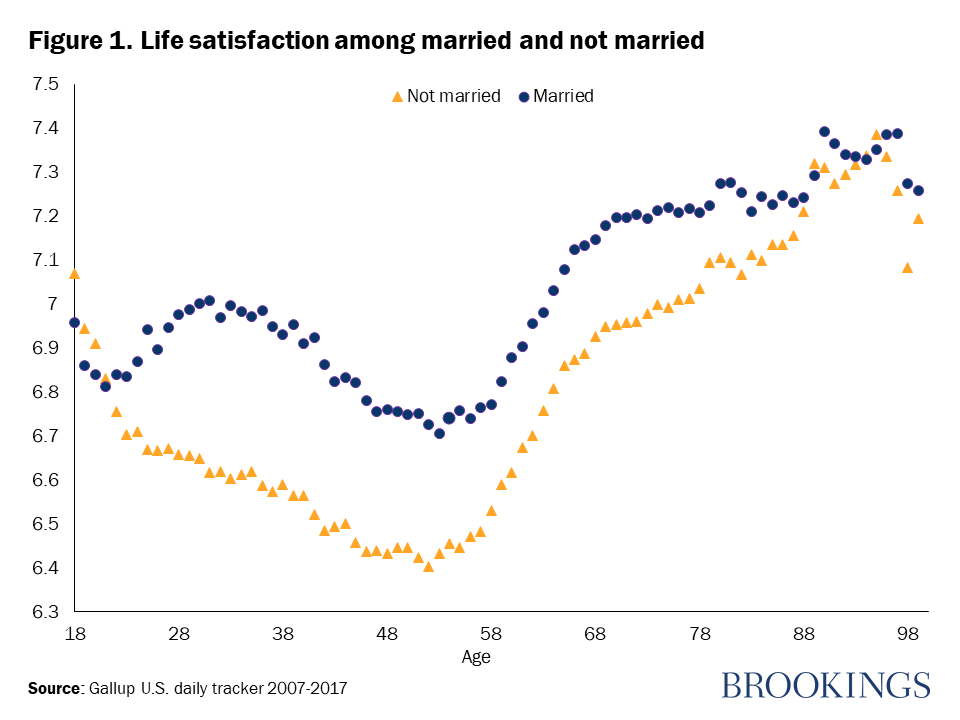
To the contrary - In many countries, average happiness is higher when you are older, despite physical challenges. The lowest happiness is typically in the 30s and 40s.
If you want to approach it from a happiness utilitarian perspective, a year at 60 or 70 is usually worth more than a year at the lifetime average happiness.
These kind of talks always came up in philosophy class and I always made the same point - there isn't saving a life, we are all dying/will die, singularity permitting. Dying just means dying sooner, lifetime QoL should be the only metric for us mortals.
It's just the calculus suffers from the same existential problem as abortion morality - how do you weight a lived life vs non-existence?
reminds me of the ted talk where the speaker said that helmet laws might be costing lives. The idea was that more people would be saved by the opportunity to exercise than were saved by the helmets.
Right: unlike dying, if someone sits in traffic more, they're able to change their situation and seek alternatives. It's not like increasing traffic in the short term is something reasonable to extrapolate to all drivers for the rest of their lives. More likely, traffic increases lead to either (or both) of infrastructure changes or lifestyle changes.
Also the conversation assumes people are actually sitting in traffic for ages
Are the welsj streets so clogged? I recall an article stating that the average increase in journey length was a few minutes.
How would it cost extra lifetimes to people sitting in traffic? If there's sufficient traffic to slow traffic meaningfully from 30mph, a 20mph limit isn't going to make a difference?
When I worked on a product with 10s of millions of users we could say things like "Yay! this 0.2 second improvement in page load will save 5 persons lives this month".
I always assumed it was about slowing cars from 35 to 25mph as hardly anybody sticks to the speed limit.
Llywodraeth Cymru (Welsh Government) claims that a public health study suggests its new 20mph limits will see, annually, a 40 per cent reduction in collisions, between six and ten lives saved, and anything from 1,200 to 2,000 people avoiding injury as a result.
Scale that up across the country and you are looking at way more than "4 or 5 lives".
Note that 4 or 5 fewer death probably also translates to 8-10 fewer paraplegics (statistic made up using that fact that the country where I am from has a 2x ratio between death and paraplegics).
But even that does not take into account secondary effects to reducing the speed limit like fewer people traveling, less air population, people having more time to meditate, etc...
All in all, it's very hard to estimate the impact of such policy.
Are you 2x as likely to become a paraplegic after a motor vehicle accident at 30mph as you are to die? That doesn't sound right.
> fewer people traveling
I don't think anyone says to themselves "it's a 20mph zone on the route so I'm not going, if it was 30 I would go." Lower speed limit != fewer travelers.
> less air population
Assuming you meant pollution, the same amount of cars going slower would cause more pollution in a given area, not less.
> people having more time to meditate
I'm sorry what? Most people don't meditate, and how is sitting in the car longer going to give you more time to meditate?
An LLM is simply a model which given a sequence, predicts the rest of the sequence.
You can accurately describe any AGI or reasoning problem as an open domain sequence modeling problem. It is not an unreasonable hypothesis that brains evolved to solve a similar sequence modeling problem.
> It is not an unreasonable hypothesis that brains evolved to solve a similar sequence modeling problem.
The real world is random, requires making decisions on incomplete information in situations that have never happened before. The real world is not a sequence of tokens.
Consciousness requires instincts in order to prioritize the endless streams of information. One thing people dont want to accept about any AI is that humans always have to tell it WHAT to think about. Our base reptilian brains are the core driver behind all behavior. AI cannot learn that
How do our base reptilian brains reason? We don't know the specifics, but unless it's magic, then it's determined by some kind of logic. I doubt that logic is so unique that it can't eventually be reproduced in computers.
Reptiles didn't use language tokens, that's for sure. We don't have reptilian brains anyway, it's just that part of our brain architecture evolved from a common ancestor. The stuff that might function somewhat similar to an LLM is most likely in the neocortex. But that's for neuroscientists to figure out, not computer scientists. Whatever the case is, it had to have evolved. LLMs are intelligently designed by us, so we should be a little cautious in making that analogy.
"Consciousness requires instincts in order to prioritize the endless streams of information. "
What if "instinct" is also just (pretrained) model weight?
The human brain is very complex and far from understood and definitely does NOT work like a LLM. But it likely shares some core concepts. Neuronal networks were inspired by brain synapses after all.
> What if "instinct" is also just (pretrained) model weight?
Sure - then it will take the same amount of energy to train as our reptilian and higher brains took. That means trillions of real life experiences over millions of years.
Not at all, it took life hundreds of millions of years to develop brains that could work with language, and took us tens of thousands of years to develop languages and writing and universal literacy. Now computers can print it, visually read it, speech-to-text transcribe it, write/create/generate it coherently, text-to-speech output it, translate between languages, rewrite in different styles, explain other writings, and that only took - well, roughly one human lifetime since computers became a thing.
Information is a loaded word. Sure, you can say that based on our physical theories, you can think of the world that way, but information is what's meaningful to us amongst all the noise of the world. Meaningful for goals like survival and reproduction from our ancestors. Nervous systems evolved to help animals decide what's important to focus on. It's not a premade data set, the brain makes it meaningful in context of it's environment.
It depends on the goal, epicycles don't tell you about the nature of heavenly bodies - but they do let you keep an accurate calendar for a reasonable definition of accurate. I'm not sure whether I need deep understanding of intelligence to gain economic benefit from AI.
My first answer was a bit hasty, let me try again;
We are clearly a product of our past experience (in LLMs this is called our datasets). If you go back to the beginning of our experiences, there is little identity, consciousness, or ability to reason. These things are learned indirectly, (in LLMs this is called an emergent property). We don't learn indiscriminately, evolved instinct, social pressure and culture guide and bias our data consumption (in LLMs this is called our weights).
I can't think of any other way our minds could work, on some level they must function like a LLM, Language perhaps supplemented with general Data, but the principle being the same. Every new idea has been an abstraction or supposition of someones current dataset, which is why technological and general societal advancement has not been linear but closer to exponential.
Genes encode a ton of behaviors, you can't just ignore that. Tabula rasa doesn't exist among humans.
> If you go back to the beginning of our experiences, there is little identity, consciousness, or ability to reason.
That is because babies brains aren't properly developed. There is nothing preventing a fully conscious being from being born, you see that among animals etc. A newborn foal is a fully functional animal for example. Genes encode the ability to move around, identify objects, follow other beings, collision avoidance etc.
>Genes encode a ton of behaviors, you can't just ignore that.
I'm not ignoring that, I'm just saying that in LLMs we call these things weights. And i don't want to downplay the importance of weights, its probably a significant difference between us and other hominids.
But even if you considered some behaviors to be more akin to the server or interface or preprocess in LLMs it still wouldn't detract from the fact that the vast majority of the things that make us autonomous logical sentient beings come about through a process that is very similar to the core workings of LLMs. I'm also not saying that all animal brains function like LLMs, though that's an interesting thought to consider.
Look at a year old baby, there is no logic, no reasoning, no real consciousness, just basic algorithms and data input ports. It takes ten years of data sets before these emergent properties start to develop, and another ten years before anything of value can be output.
I strongly disagree. Kids, even infants, show a remarkable degree of sophistication in relation to an LLM.
I admit that humans don’t progress much behaviorally, outside of intellect, past our teen years; we’re very instinct driven.
But still, I think even very young children have a spark that’s something far beyond rote token generation.
I think it’s typical human hubris (and clever marketing) to believe that we can invent AGI in less than 100 years when it took nature millions of years to develop.
Until we understand consciousness, we won’t be able to replicate it and we’re a very long way from that leap.
Humans are not very smart, individually, and over a single lifetime. We become smart as a species in tens of millennia of gathering experience and sharing it through language.
What LLMs learn is exactly the diff between primitive humans and us. It's such a huge jump a human alone can't make it. If we were smarter we should have figured out the germ theory of disease sooner, as we were dying from infections.
So don't praise the learning abilities of little children, without language and social support they would not develop very much. We develop not just by our DNA and direct experiences but also by assimilating past experiences through language. It's a huge cache of crystallized intelligence from the past, without which we would not rule this planet.
That's also why I agree LLMs are stalling because we can't quickly scale a few more orders of magnitude the organic text inputs. So there must the a different way to learn, and that is by putting AI in contact with environments and letting it do its own actions and learn from its mistakes just like us.
I believe humans are "just" contextual language and action models. We apply language to understand, reason and direct our actions. We are GPTs with better feedback from outside, and optimized for surviving in this environment. That explains why we need so few samples to learn, the hard work has been done by many previous generations, brains are fit for their own culture.
So the path forward will imply creating synthetic data, and then somehow evaluating the good from the bad. This will be task specific. For coding, we can execute tests. For math, we can use theorem provers to validate. But for chemistry we need simulations or labs. For physics, we need the particle accelerator to get feedback. But for games - we can just use the score - that's super easy, and already led to super-human level players like AlphaZero.
Each topic has its own slowness and cost. It will be a slow grind ahead. And it can't be any other way, AI and AGI are not magic. They must use the scientific method to make progress just like us.
Humans do more than just enhance predictive capabilities. It is also a very strong assumption that we are optimised for survival in many or all aspects (even unclear what that means). Some things could be totally incidental and not optimised. I find appeals to evolutionary optimisation very tricky and often fraught.
Have you ever met a baby? They're nothing like an LLM. For starters, they learn without using language. By one year old they've taught themselves to move around the physical world. They've started to learn cause and effect. They've learned where "they" end and "the rest of the world" begins. All an LLM has "learnt" is that some words are more likely to follow others.
You know i assumed that was true until right now. But I can't think of a single example of reason and intelligence existing without any form of language. Even insects have rudimentary language, and in fact reasoning and intelligence seem to scale with the complexity of language, both by species and within species.
Do slime mold have a language? Slime mold can learn and adapt to environments, so it is intelligent and can do rudimentary reasoning, but I doubt it communicates that information to other slime molds.
It is a very different kind of life form though so many things that applies to other complex being doesn't apply to them. Being a large single cell means that they learn by changing its proteins and other internals, very hard for us humans to reason about and understand since it is so alien compared to just having nerve cells with physical connections.
Not sure i would say a slime mold has reason and intelligence .. Or if i would then so does a river. Also i think that how it changes its proteins could be considered a language, without stretching the definition of language any more than we have already stretched the definition of reason and intelligence.
Why is a slime mold a river but a human isn't? Slime mold can predict temperature changes in its environment and react before it happens, that isn't something a river could do.
So your statement just seems to be your bias thinking that a slime mold couldn't possible do any reasoning. Cells are much smarter than most thinks.
Edit: Anyway, apparently slime molds can communicate what they learn by sharing those proteins. So they do have a language, it is like a primitive version of how human bodies cells communicate. So your point still stands, reasoning seems to go hand in hand with communication. If you can reason then it is worth it to share those conclusions with your friends and family.
They also taught slime molds to cross a bridge for food, and it learned to do it. Then they got the slime mold to tell other slime molds and now those also knew how to cross the bridge. It is pretty cool that slime molds can be that smart.
> The value of maintaining current discrimination is high enough to motivate laws protecting racists from exposing themselves publicly.
A law that punishes racist speech doesn't protect racist people from exposing themselves. It protects their victims from dealing with that form of hate speech. You're basically arguing that making "hate speech" illegal does more harm than good, but you haven't offered proof or any logical argument why that is. I argue silencing hate speech (or attempting as much) does more good than harm because it limits the impact of such hate speech.
> Or; The value in maintain hatred within society is higher than the value of progressive discourse.
Same as the above.
> My point is that there is a few ways to interpret speech controls
Perhaps, but the ones you've provided don't really stand to scrutiny.
All of human progress has happened through open discussion; i thought this was obvious. We gain immunity to bad ideas by hearing them within public areas where people can argue for and against them honestly. This leads to people gaining/learning good ideas because they more often defeat bad ideas. Leading to a more progressive society. Ban bad ideas in public and people become vulnerable to them in private.
>The value of saying what you want is not held higher than the value of not being discriminated against.
This is not a cogent argument; The vast majority of discrimination is not verbal, in fact the verbal bit isn't generally discrimination at all but a signal that discrimination may be happening.. suppress the signal and you can generally keep the discrimination.
> All of human progress has happened through open discussion; i thought this was obvious. We gain immunity to bad ideas by hearing them within public areas where people can argue for and against them honestly. This leads to people gaining/learning good ideas because they more often defeat bad ideas. Leading to a more progressive society. Ban bad ideas in public and people become vulnerable to them in private.
Brazilian Law doesn't preclude you from having actual intellectual discussions about any topic. There are limits to hate speech, harassment, bullying, etc. There is no real benefit from having bigots spew hatred openly in society. In fact, giving them the opportunity to promote intolerance tends to breed more intolerance. This has been the case with nazis, QAnon, extreme right more generally in the US, Bolsominions in Brazil... We cannot be tolerant of intolerance. Curtailing speech is a "necessary harm" to prevent a bigger harm from occurring, which is the curtailment of life.
> This is not a cogent argument; The vast majority of discrimination is not verbal, in fact the verbal bit isn't generally discrimination at all but a signal that discrimination may be happening.. suppress the signal and you can generally keep the discrimination.
I appreciate the discussion but unfortunately that's not logical. Specifically, I said:
1. All forms of discrimination are harmful and should be minimized or eliminated.
2. Verbal discrimination is a form of discrimination.
3. Therefore, verbal discrimination should be minimized or eliminated.
You're saying
1. The majority of discrimination is non-verbal.
2. Verbal discrimination often signals non-verbal discrimination.
3. If a form of discrimination is less prevalent or is a signal of another form, it is less important to address.
4. Therefore, it's acceptable to allow verbal discrimination.
But that's a fallacy. Specifically "false dichotomy", in that it implies that addressing one issue (verbal discrimination) precludes or is less important than addressing another (non-verbal discrimination). In reality, both can and should be addressed concurrently.
All forms of discrimination, whether prevalent or indicative, contribute to the overall harm caused by discrimination.
Therefore, even if verbal discrimination is less prevalent or a signal of non-verbal discrimination, it should still be minimized or eliminated alongside other forms of discrimination.
You are specifically arguing that we must allow verbal discrimination because we will be able to combat non-verbal discrimination better. I think the burden of proof is on you to prove that this is the case.
Empirically, Brazil is much less racist than the U.S. for a variety of reasons. If freedom of speech was so important to prevent non-verbal discrimination, it would stand to reason that one such example of a "infinitely free speaking" and "tolerant" society would exist. I can't think of any.
Not to mention the fact that "non-verbal discrimination" is specifically harder to legislate against (or even harder to prove in a courtroom), which explains why it is not as clearly outlawed in the Brazilian constitution.
> The risk of being debanked by two independent banks _at the same time_ seems lower than crypto.
I use 3 separate banks for this reason. But honestly, the 'reason' for dropping me might be a 3rd party risk assessment that flags something and services all three banks... Or some sort of story or hysteria that could trigger three similar systems.
Using a decent crypto currency with good practice, the biggest threat is me messing something up. And i can put systems in place to minimize this. The only issue is that most things i spend moneys on don't accept crypto and so still need banking services to use crypto. I hope this changes.