In the 90s I used to make money off shareware, and every time I release a new version hackers would release "cracks" for the license key. Eventually I figured out that these cracks are coming from Russia.
In the next version of my program, I added a check for system language, and if I detect Russian then I bypass the license key checks, and the program is free to use. This stopped hackers from releasing cracks.
I suffered from shyness and what's called introversion when I was young. I also got combative with people I worked with. In my early 20s I met a guy (at a seminar) who was outgoing, friendly, easy to be around. Somehow we hit it off. He got me to attend Toastmasters (to get over my fear of speaking to strangers, and speaking to groups) and gave me some advice that some people pay thousands of dollars in therapy for: smile, look people in the eye, listen. Talk to (at least) one stranger every day -- initiate a conversation rather than standing in the corner.
At first that all felt forced and artificial but before long it was second nature. That free advice helped me in my professional life more than any tech skill. People decide if they like you or not within seconds of meeting you, based on a variety of cues. If they don't like you then you will struggle to get a job or gig.
Programmers often complain that the extroverts get ahead even if their tech skills aren't great. That's human nature, so rather than complain and fight it you can try to change yourself. You don't have to be fake. I see people on HN and other forums all the time writing about "hacking" their lifespan, their diet/metabolism, their ergonomics, their productivity. You can "hack" your personality too. Stop calling yourself an introvert for a start, that's not something a person "is," it's a label you can change.
2. Shielding their team from crap (as someone mentioned already)
3. Don't pitch one team member vs another - this is toxic. Instead nurture their strength. Our competitors are outside the team, not inside
4. Cheer lead/Sponsor for the team outside. Genuinely back your team.
5. Always expect your team members are smarter than you - give them that trust. Thank them for things they teach you.
6. Managing is more like parenting college kids (not toddlers/middle schoolers). You want them to survive worst and replace you if needed. So you too can grow. But avoid micro managing.
7. Learn to have tough conversations - This could be for their/team's improvement.
Rust was the first language in which I used tagged unions. While I can't say that I use Rust at the moment (not mature enough and too low-level for my current needs), I found pattern matching and tagged unions so beneficial and practical that now I refuse to use any language that doesn't have them. Currently I'm writing a bunch of code in F#.
I don't know what the language of the future will be but I can't imagine it not having an ML heritage.
The lesson here is that the power lies with those who who have relationships with consumers. That distribution channel is quite possibly the single most valuable asset one can possess today. Kylie Jenner is ridiculously rich not because she has amazing products (I mean I don't know much about cosmetics but I can't believe they're 10x better than the next thing out there), but rather because she has direct access to a large audience and understood what that audience would be willing to buy.
This is really just a form of vertical integration/cutting out the middleman. Why sell ad space to companies who will use it to sell goods to consumers when you can instead just sell goods directly to those consumers?
The means of production used to be the most important thing - now it's the means of distribution.
So much of everything is about connections and reputation. Tech in particular holds up a guise that people are chosen and ascend because they are “good”, meaning, they are good at what they do. That’s part of it, but it’s an insufficient part, and you can do pretty well in a career being solidly average at what you do.
The real currency in my experience is one thing - relationships. Do I think this person likes, respects, and would vouch for me? Everything else aside, that’s what people optimize for when they choose who to promote, respond to reference requests, and generally in who they engage with at work.
Oftentimes It seems like it may not even be a conscious behavior, they just know that’s who they have a gut feeling about.
I definitely wish this wasn’t the way of the world, as someone who isn’t a natural when it comes to building relationships in a professional setting. But I also don’t let it get me down. It’s an element of human nature that’s hidden many layers deep in the workplace.
When I finally faced this fact and started devoting some of the time I previously spent on hard skills, I realized it was far and away the more impactful way to allocate my resources.
If you found the article interesting, i highly recommend this book: "Other Minds: The Octopus, the Sea, and the Deep Origins of Consciousness". It is a fascinating description of how cephalopods are the closest thing to intelligence that is built vastly different from us. The author also explores philosophical questions (à la Thomas Nagel) What does it feel like to be an octopus? Does it have multiple selves? The book doesn't have all the answers and sort of fizzles out at the end, but definitely one of my better reads this year.
This single fact is one of the most important aspects of online dating.
Many years ago, a woman responded to my message with a reply that included the phrase "at least you don't sound desperate."
I had no idea what that meant, so when we met I asked her and she showed me the many messages she received from other men. It was appalling to say the least. The messages were so awful and pathetic it was hard for me to understand how low their self-esteem had to be. Message after message made it clear that these guys felt they were out of options and were desperately messaging anyone in the hopes of a lucky positive reply. What woman they thought would find this attractive, I have no idea!
Suddenly the success I was having in online dating became clear. Just being pleasant and positive was putting me head and shoulders above what I would be reluctant to call competition.
tl/dr:
Guys, just be nice, polite, friendly and have a positive spin to your dating messages/emails etc. That alone puts you in the top 1%.
A relative of mine worked with a guy who was seduced from retirement by a company desperate for his particular skill set. One of those guys who does something I don't even have the context to understand.
Skill set is key. What you don't want to be is the old guy with the same skill set as people who are expecting to make half what you expect to make.
Do "the majority of the population" have to run their preferences by you first before they get to exercise their choice?
Is there some approved whitelist of candidates, compiled in Western capitals, that needs to be circulated amongst Turks, so that they can exercise their "democratic rights", as long as its only from that sheet of paper?
An amazing definition of "democracy" you have running in your head.
(I know I replied to you elsewhere, but this gem deserved its own response)
Silly Turks, voting for their own choice of leader, without first taking your opinion on board and going along with that.
Someone needs to educate them about what true "Western sponsored" democracy means, I guess.
Oh wait, thats what that attempted coup was for, right? Oops ...
In my opinion, a lot of this rhetoric is being repeated. But the points raised by the original memo require a bit of perhaps subtle mathematics to understand.
This is an attempt at curating a list of relevant math and rationality articles, so that we can at least speak the same language when talking about this.
Start here: I personally view it as the base model of all beliefs that we can hold. It talks about some kinds of things that we can know and how much we should have confidence in what we know.
> that these arguments about innate biological traits are complicated by trans, non-binary, and intersex folks.
2% (outliers) of the population does not invalidate the trends of the other 98% This is just wrong.
> I disagree that it’s possible to write what he did about general populations, then walk it back to say “but of course it doesn’t apply at an individual level.”
Gorillas typically have black fur. So no gorilla can have white fur? Wat?
> there have been some really fabulous responses, including many laying out a lot of research that counters what was in the memo
I'm interested in this research. I have not seen it, nor has it been made available. The following book, with 2 female authors who seem genuinely interested and informed in related topics:
https://www.amazon.com/Why-Arent-More-Women-Science/dp/15914...
Let's at least present the field studies/research, which can throw existing clinical views into doubt. eg Delusions of Gender: The Real Science Behind Sex Differences by Cordelia Fine is at least a rigorous critique of possible flaws.
It's a little saddening, to have this dialog represent the views of an average engineer.
For people who are interested in a story (technically anecdata, I know, but I can't resist to chip in), here's mine.
I have taught a coding bootcamp 2 times now. The selection/recruitment of students -- not done by me -- was fairly loose in some cases. The only thing the bootcamp selection was strict on was that people completed their undergraduate degree (which is financially easier to do in Europe).
__Succesful Students__
What I noticed is that there are people who will be successful. These people somehow have a strong background in logical thinking. It can be by doing predicate logic in philosophy courses, being data oriented from your biology studies or even being hardcore at knitting [1].
Another thing I've noticed is that they learn quick and won't ask a lot of questions. They will use a search engine and will only come to you with difficult questions. They know how they learn quite well -- at the very least.
The final thing I've noticed is their determination. Some people come to a coding bootcamp with the expectation of "fix me, I need a job in this industry." The most successful students don't take anything for granted and know that they need to learn everything they can get their hands on.
__Unsuccessful Students__
What I noticed is with students who aren't successful is that they don't think logical -- their attention/focus does not allow it unfortunately. They may or may not ask a lot of questions. And they will completely fail the bootcamp if they don't ask fellow students for help. Also interesting is that they did not learn the terms or basics well enough.
In one of my groups I've noticed that one of my best students was coaching one of the least successful students. It was intensive, and the explanations and questions were sharp. Yet, by my surprise, it didn't do much. At the end of the bootcamp the student was still one of the least successful students. It makes me believe that not everyone can do a coding bootcamp, since the right mindset is required to start one. Teachers can only help you when you're open enough to receive the knowledge. I don't know to what extent that idea is true, but I want to find out.
__Unsuccessful Students Becoming Successful Students__
I have seen not so successful students become quite successful. They had an insane amount of grit and understood how they needed to learn the material. Compared to their other unsuccessful counter parts (in the beginning at least), these students are more structured and disciplined.
__When To Take A Bootcamp__
Even for not-so successful students it can be a great tool, provided they self-teach 1 to 2 months after that. However, unfortunately, it is not for everyone. If you don't think in a logical fashion, learn fast then at the very least you need to make that up in determination -- or in time after the bootcamp. I feel a bootcamp is as tough as nails if a student only learned bullet points from presentation slides during their academic years. Programming is more akin to learning a music instrument (i.e. it takes practice), and not everyone has experience learning that way.
We have an open floor plan, and it works like this:
* Desk area is for getting work done. Everyone agrees on this.
* We have "phone rooms" for small discussions. But we limit those usually to 1:1s or discussing office politics.
* Try to limit all discussions at the desk area to 5 people or less.
* If someone sighs loudly as they put on their headphones when you're having a discussion right behind them, then that is their signal to you to keep talking loudly, as their noise-canceling headphones will eliminate any trace of your conversation.
* You can usually carry a conversation at your desk at any volume, because other engineers will let you know if you're being too loud. Engineers tend to be extroverted and won't hesitate to let you know if you're bothering them.
* When someone first sits at their desk, it's polite to immediately engage them in a 30-minute conversation about their weekend or what they did last night. It eases their transition into work.
* A person working without headphones on, signifies that it's ok to tap them on the shoulder to ask them a question.
* A person working WITH headphones on, signifies that it's ok to tap them on the shoulder to ask them a question.
* If someone usually works off in quiet parts of the building, one should always remind them "you're never at your desk" with an accusatory tone.
I agree. It's important to direct wants of the consumer into frequent use. The real value in marketing is creating cultures where people must consume to participate.
Consumer needs are path dependent, so it's important to not allow avenues for countercultures or ways to avoid traps.
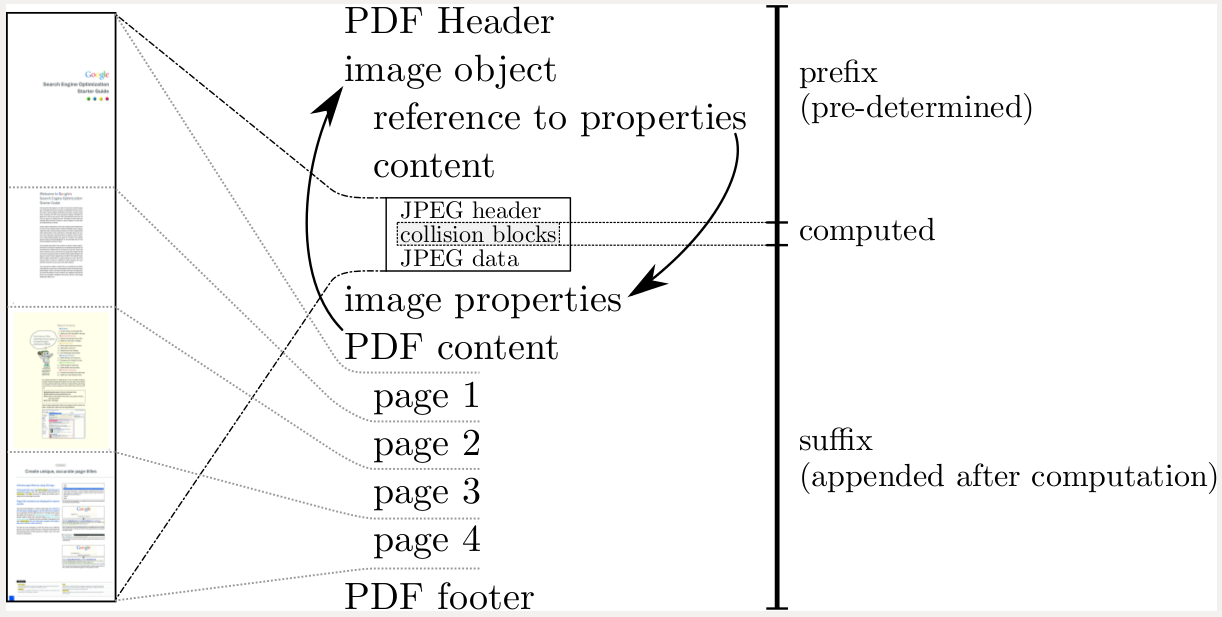
The visual description of the colliding files, at http://shattered.io/static/pdf_format.png, is not very helpful in understanding how they produced the PDFs, so I took apart the PDFs and worked it out.
Basically, each PDF contains a single large (421,385-byte) JPG image, followed by a few PDF commands to display the JPG. The collision lives entirely in the JPG data - the PDF format is merely incidental here. Extracting out the two images shows two JPG files with different contents (but different SHA-1 hashes since the necessary prefix is missing). Each PDF consists of a common prefix (which contains the PDF header, JPG stream descriptor and some JPG headers), and a common suffix (containing image data and PDF display commands).
The header of each JPG contains a comment field, aligned such that the 16-bit length value of the field lies in the collision zone. Thus, when the collision is generated, one of the PDFs will have a longer comment field than the other. After that, they concatenate two complete JPG image streams with different image content - File 1 sees the first image stream and File 2 sees the second image stream. This is achieved by using misalignment of the comment fields to cause the first image stream to appear as a comment in File 2 (more specifically, as a sequence of comments, in order to avoid overflowing the 16-bit comment length field). Since JPGs terminate at the end-of-file (FFD9) marker, the second image stream isn't even examined in File 1 (whereas that marker is just inside a comment in File 2).
tl;dr: the two "PDFs" are just wrappers around JPGs, which each contain two independent image streams, switched by way of a variable-length comment field.